The year is 2026. Nearly eight years after the release of its first chapter, Tatsuki Fujimoto’s Chainsaw Man has come to a close with one of the most popularly polarizing endings in recent memory.
Yes, it’s true: a Shonen manga ended.
Now, with this chaotic story just fresh enough in memory, I’ve written an exhaustive analysis and review of everything Chainsaw Man has to offer. So sit down, get a cup of coffee, and get ready for a deep dive into Tatsuki Fujimoto’s most ambitious work to date.
Prelude: Show Me Your Dreams
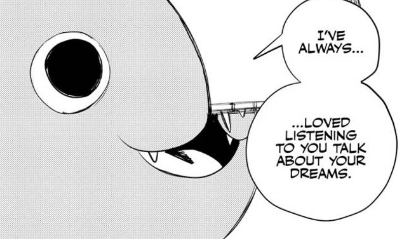
Perhaps one of the biggest praises I can give to Chainsaw Man as a whole is the sheer cohesion of its underlying narrative arc. Despite all the chaos in its presentation, all the extreme ups and downs of emotion, and the disorienting experience that is any first read, the core of Chainsaw Man is a very well grounded, mature, slow-burn story, simply unfiltered at first thought and then reflected through a density of parallels and developments. This all begins with one of the most visceral first chapters Weekly Shonen Jump has to offer.
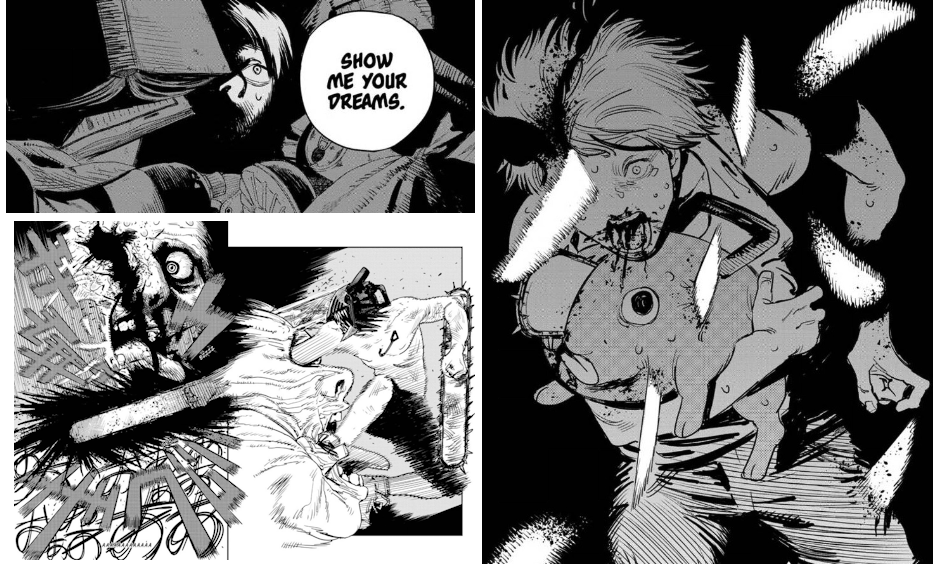
Autism be damned, that Fujimoto can work a pen.
Being presented with a hopelessly dreaming child burdened with the debt of his father, and most audiences, if only unconsciously, will find it very easy to relate to Denji’s state of life. As Ashita no Joe was for the Japan of the sixties, it’s very safe to say right off the bat that Chainsaw Man is a very intense reflection on the social realities of a heavily disenfranchised, hopeless, and alienated youth. With where the manga ultimately goes, in its extremely loud anti-nationalism, close lens on disassociation under authority, and the tragi-comic nature of its final villain, I find that this is clear at once. Exploiting umbilical imagery, a mob turning into literal zombies, a consistent motif of relations as mere exchange, and the weight of choices given, Fujimoto succeeds at setting up almost the entirety of Chainsaw Man’s heart in a single chapter and creating the perfect inflection point for a very unique direction to come.
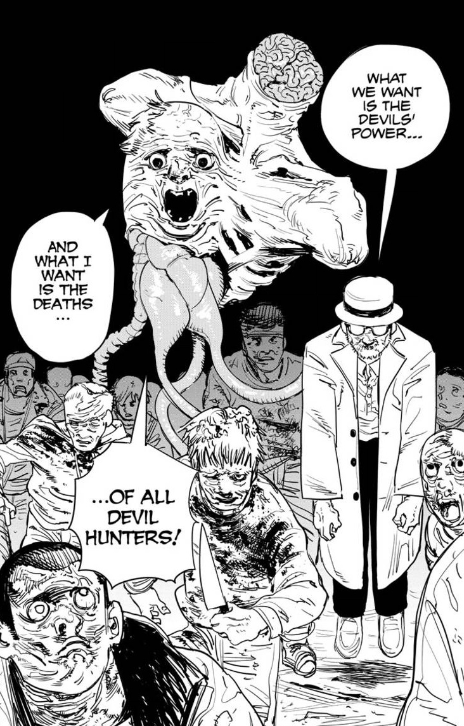
“What WE want” says the devil, speaking through the enslaved collective. Almost like…
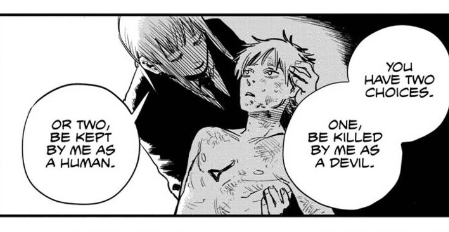
…hello, it’s the state calling. We’ve awarded you the choice between two options we chose in advance.
THE ANALYSIS – PART ONE
The Weird Early Stuff
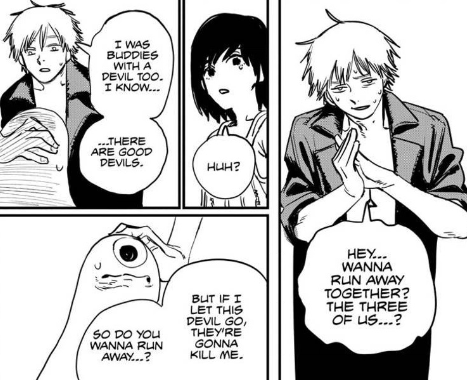
It’s a surprise parallel that will help us later.
Ignoring some horrible decisions from Studio Mappa’s S1 team, we find that Fujimoto continues his incredible narrative efficiency by giving us back-to-back character-defining moments for Denji: first, a demonstration of his extraordinarily kind, moral, and empathetic nature, which will come back around for the grand finale of Part One; second, a very interesting piece of dialogue with Aki, which will be taken out and shot for the entire duration of Part Two.
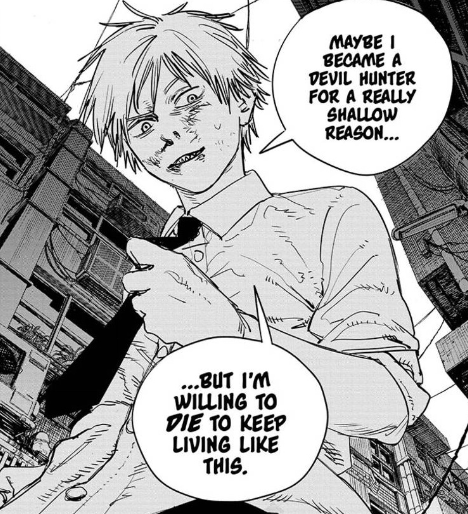
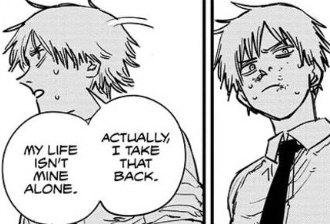
The panels continuing the iconic shot of Denji aren’t brought up very often, if much at all, but they’re what elevates Denji from the dog we like to put him down as to the wounded child at the heart of a very vulnerable, anti-mythic manga. It’s extraordinarily on-the-nose and a tell of Fujimoto’s sheer mastery of the craft that we get the big, badass, iconic protagonist-esque statement and panel that implies he’s a sleazeball followed by small, simple, forgettable panels that show his humanity, in strict opposition to archetypal or, should I say, heroic writing.
This conscious choice and emphasis can fairly be named the foundational thesis of the entirety of Fujimoto’s works, so I want to emphasize it as much as possible and ensure you don’t let it slip from your mind for a single second of this analysis and review. This isn’t mythic. Grandiose statements and beliefs are delusions built to defend one’s ego. No character is allowed to be too cool – everyone is strictly human, with human motivations, and a product of others. Our problems aren’t the result of incomprehensible Heavenly disasters or cosmic forces we can’t influence. No one is an apotheosis. We must not run away from our own responsibility. If you were to read Fire Punch and Chainsaw Man back-to-back, it’s fair to say you’d understand the inside of Fujimoto’s brain about as well as he does, because he does not hold his perspective back in the slightest. Everything I’ve just said is as essential as to understanding Chainsaw Man as is being able to read the literal text on the pages.
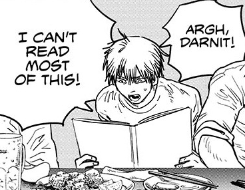
Denji and Power: The Lost Kid and the Careless Beast
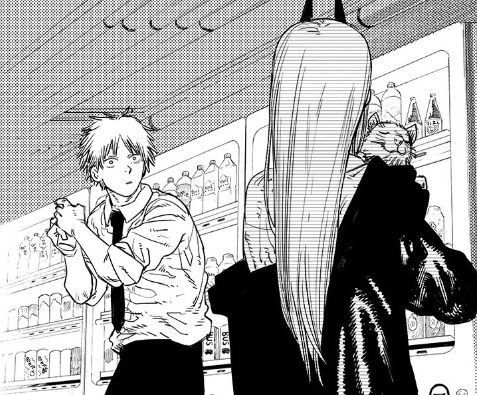
Having hammered in Denji’s dog motif and love for Pochita, Fujimoto, on just the fifth chapter, gets to work on presenting the first complete parallel through which he builds his story. This is Denji and Power: dogs and cats, a kid who never felt warmth and a wild girl whose existence is the mastered comprehension of blood.
For this first proper arc, Fujimoto gives us a very interesting idea, building off the cold exchanges of devils and yakuza presented in the first chapter.
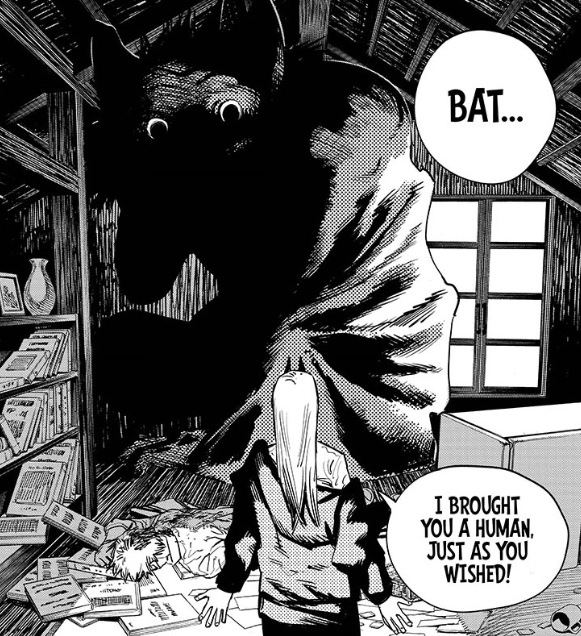
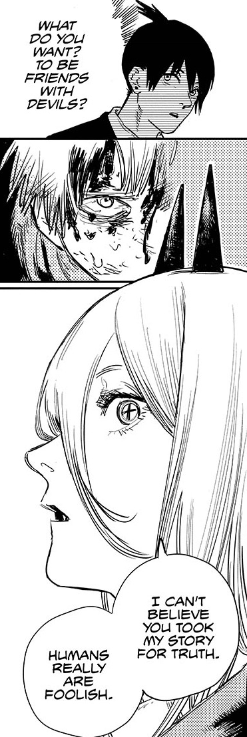
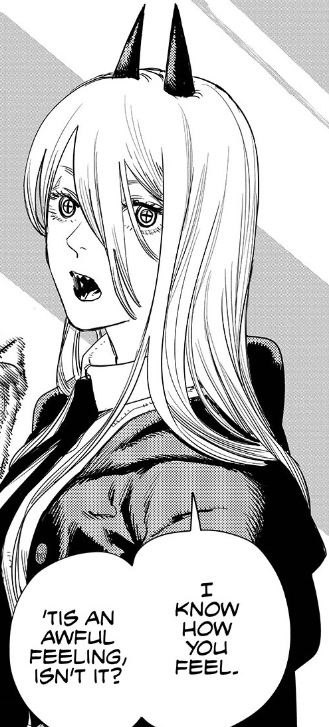
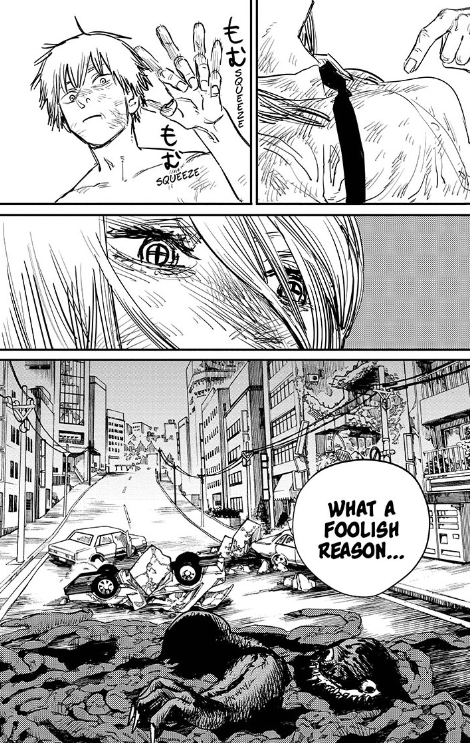
This idea is the deception and use of people in much the same way, but… for flesh-and-blood reasons, for masqueraded, but innocent humanity – once again at the behest of the cruelest, in this case, the Bat Devil.
This distinction of humanity is foundational, and the quick integration of Aki as a rationalist who rejects this selfishness of devils (essentially: children, animals, ‘pure ones’) affirms his role in the myths of the system and his entire character arc perfectly. Using a direct indication via Meowy and even giving her special eyes like Makima’s, setting up a further parallel to come, and you’ve got worlds of emotional information conveyed in four chapters.
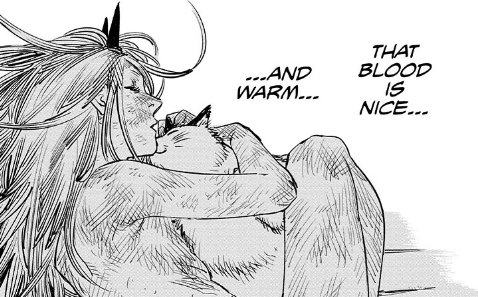
This is great. It’s nothing crazy in any higher scale, but it’s done so awfully well for the first semi-proper arc of the manga.
And now, the real story begins.
Devil Hunters at Work: Fighting Eternity
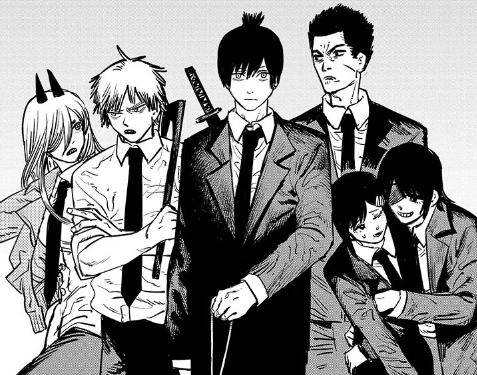
The Eternity Devil arc stands with Gun and Control as the greatest arcs of Chainsaw Man Part One.
My fingers did not slip on the keys. This arc is an unbarred existential confrontation and utterly perfect in its underlying ‘script.’ It could not possibly be better, and it defines Denji’s entire character, the fundamental nature of devils, and sets the base for the metafictional and escapist angles that ultimately bring Chainsaw Man up to Good Ass Shonen levels, in addition to providing us with the first true taste of the final statement the whole manga summed up to tell at the very end.
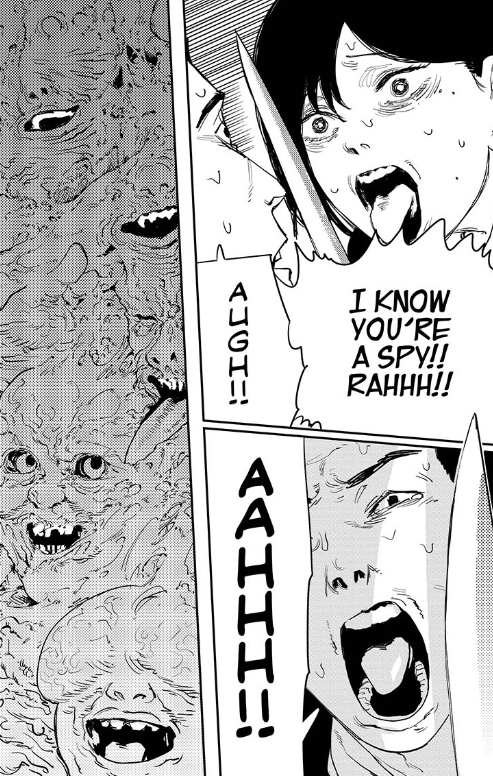
Starting a little smaller with a, nonetheless, incredibly important piece of context: devils feed on fear. It’s a trivial enough statement to be taken for empty worldbuilding, but it’s the defining framework of Part One as a whole. As the weight of eternity closes in on the day-to-day of disempowered human beings, the fear they produce empowers the very images, concepts, idols which take their lives. This is a bad thing, and Himeno provides the best-worst answer possible.
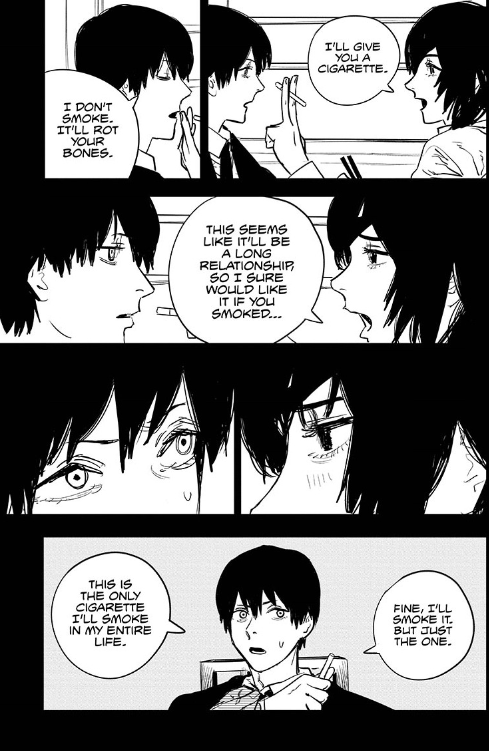
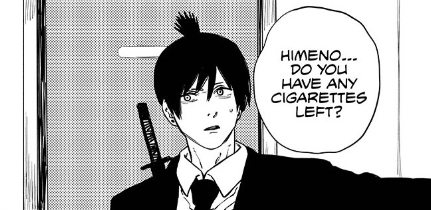
The little habits that stick us together are worth more than the highest principles in the world, and even someone as far up his own ass as early Aki can’t wholly resist what his body tells him.
This embrace of reality, and subsequent connection to everyone else suffering under the weight of eternity, is precisely how ordinary people win against overbearing systems. Even if it’s taking cigarettes provided by massive corporations. Anything is better than perfection.
But what makes this arc a masterpiece is the scene that compresses Denji’s entire downfall (quite literal) into a single scene. Kick back and enjoy the view.
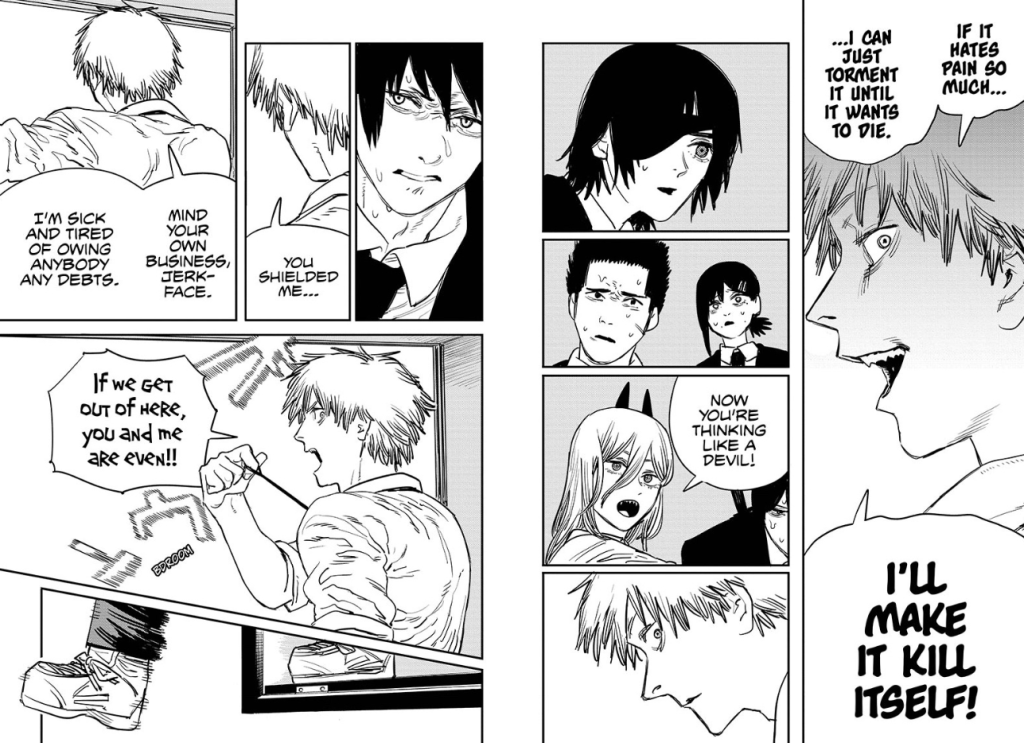
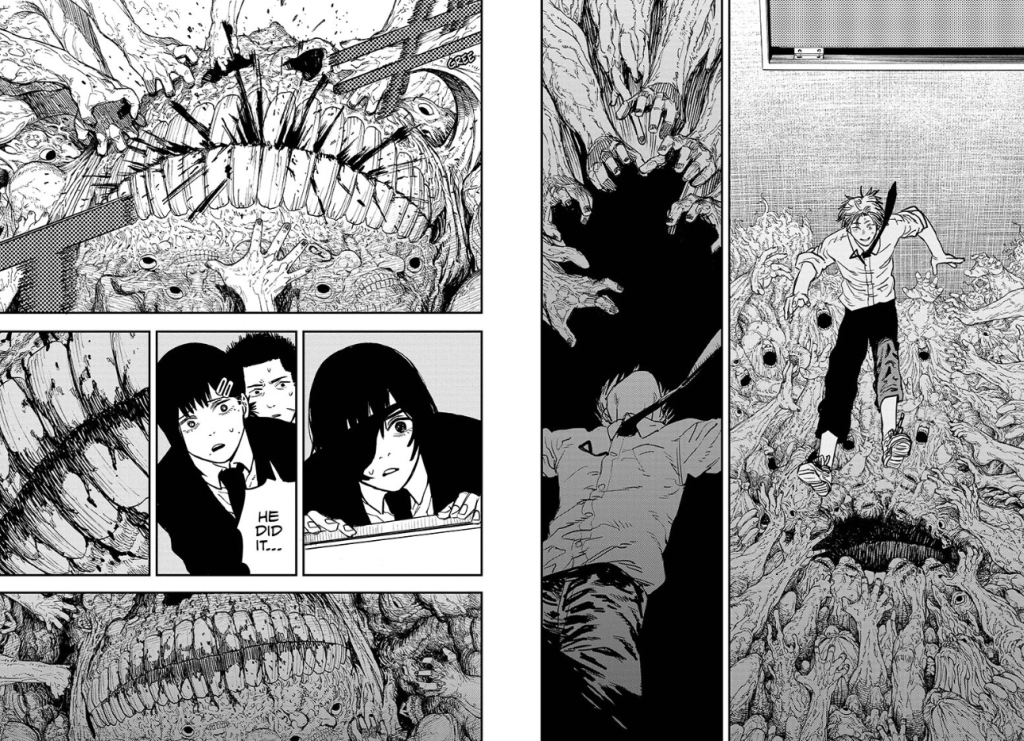
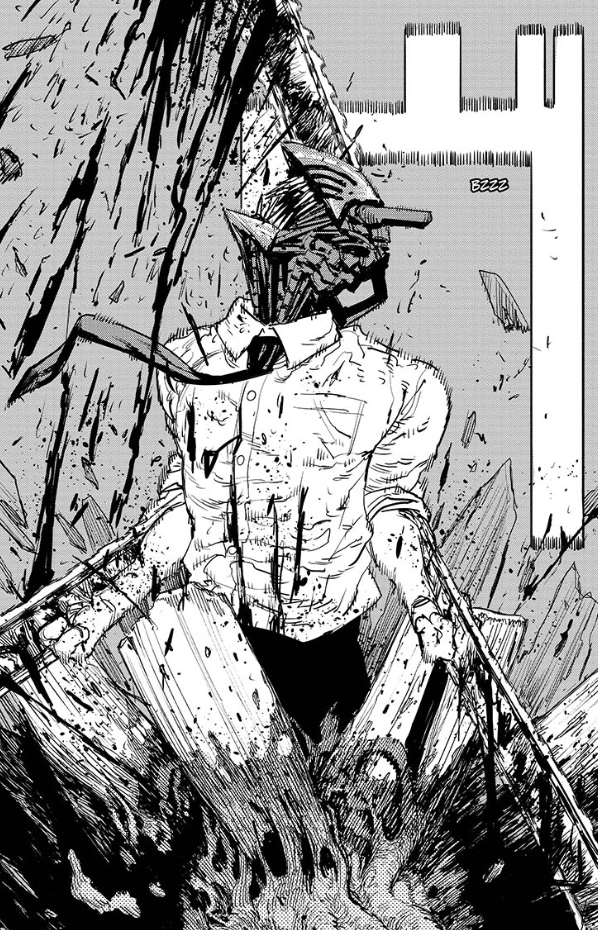
Coping by matching the thinking of ‘devils’ the image rather than devils the flesh or, forbid, the people around him, Denji disregards all that Easy Revenge! crap to literally jump into the maw of the Eternity Devil and burst out as a gleeful Chainsaw Man – and it is fucking glorious.
No wonder he gets addicted to this – and, hey, he was pushed into this by Kobeni’s attack, anyhow, so what choice did he have? Why not just jump into the abyss, when connection is clearly impossible?
And then it gets worse.
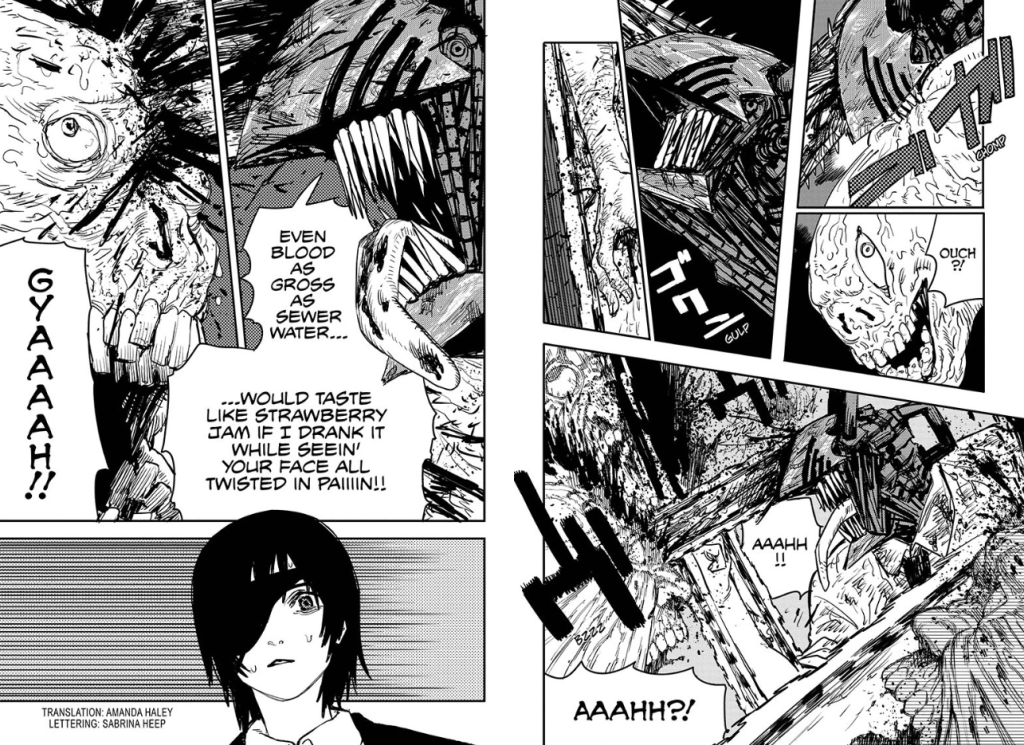
Where Power, as the Blood Devil, has a developed relationship with warmth, Denji, a stunted child who lacks basic human developmental experience, quite naturally becomes addicted to literal consumption of blood and guts to an extent Power could never reach. At least it’s just a Devil he’s eating, and he isn’t downing human guts in desperate psychosis after society at large abandoned him.
Anyways, it gets worse.
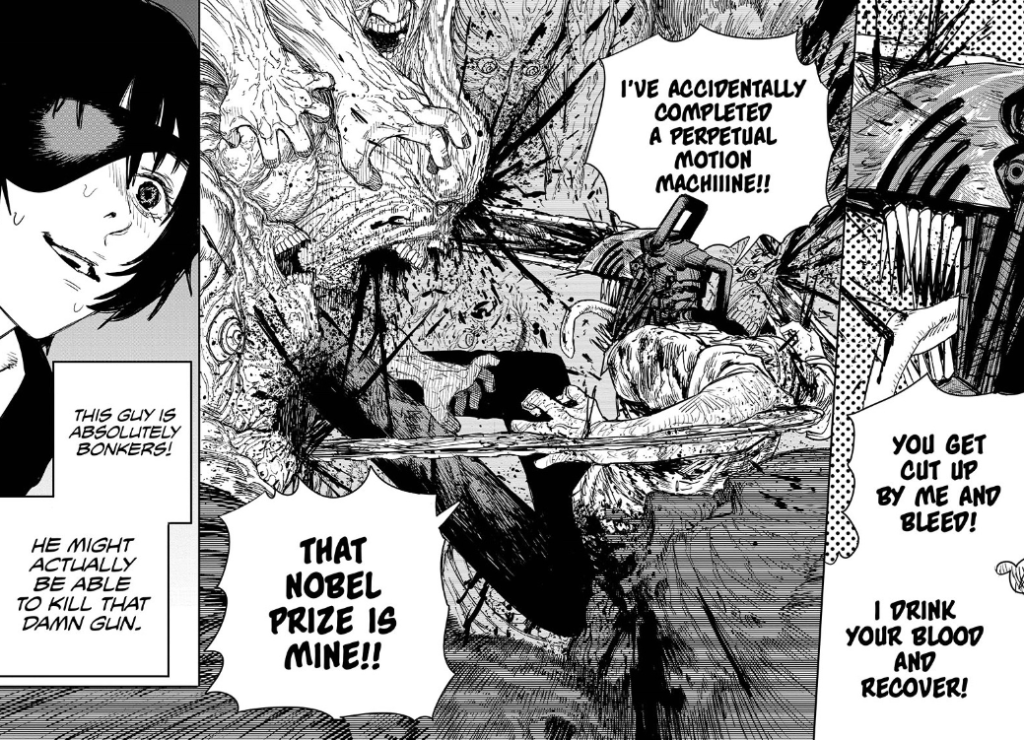
Denji finally finds a true deeper pleasure in the wake of his empty childhood, and it’s a perpetual motion machine of cutting and consuming. The fact that he jokes about the Nobel Prize just a couple chapters after Power did it first further emphasizes the contrast.
And, if you would look over to that panel on the left? It gets worse.
At this exact moment, throwing himself into madness, feasting on blood to compensate his lack of warmth, and becoming addicted to justifying the endless cycle of Eternity, Denji becomes a hero for the first time.
When the world is so rough, and you’d choose destroying your own body to cope, how wrong is it to give in to the temptation to idolize and admire a hero who can win out against the big man? Someone crazy enough, someone stupid enough, someone fucking suicidal enough: a hero, a character, a sacrifice, and not a human being to empathize with.
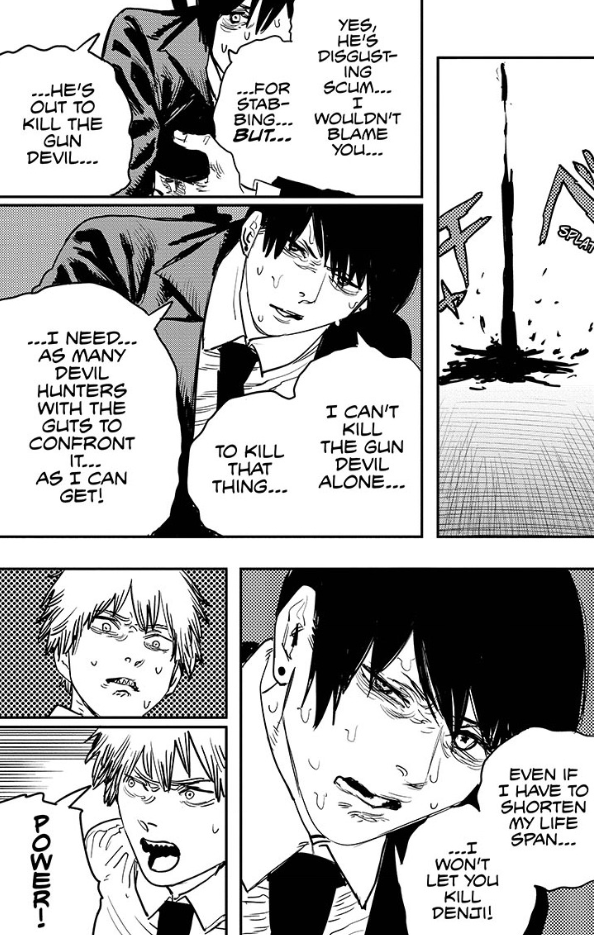
An idol to sacrifice yourself to, to achieve a state-sanctioned fantasy. Not a human being to live together with.
(Little note: Aki sure loves sacrificing his lifespan and giving in to the future, doesn’t he?)
But, as with Denji and Power, behind all these little evils is something that’s not quite irreversibly bad – and, as we’ll see more and more, it’s very much the process of maturation that helps bring about true living side-by-side.
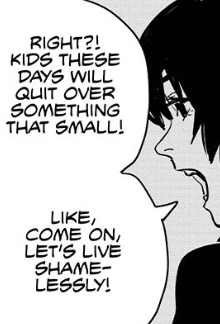
Mafia, Past, Power, or: Everyone is Ten Years Old
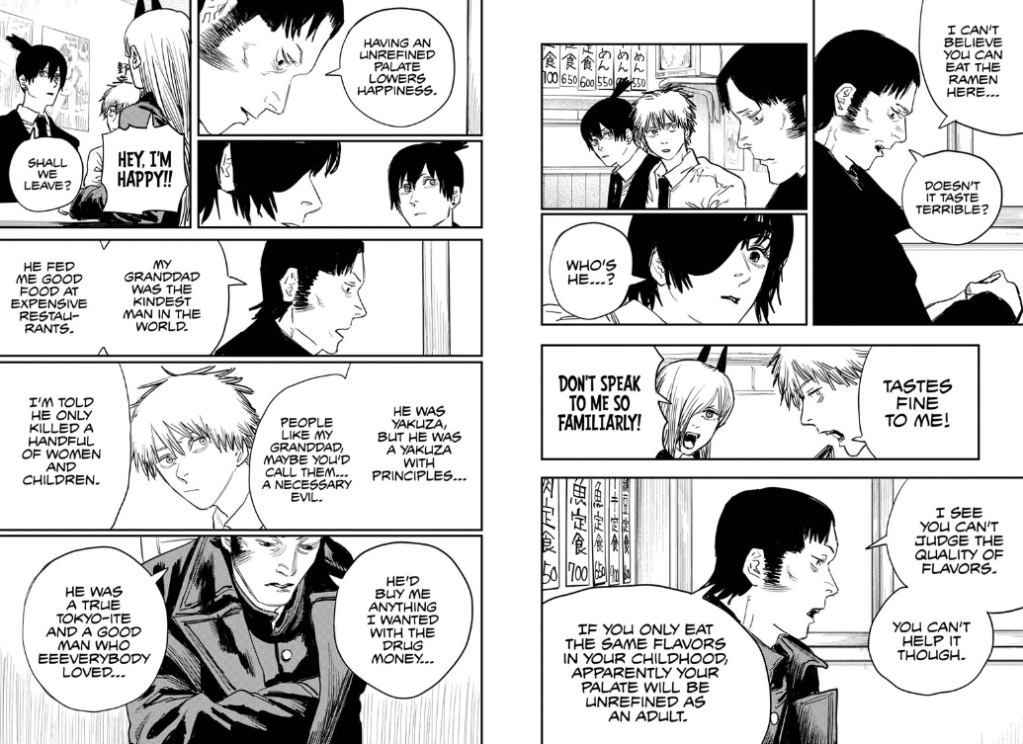
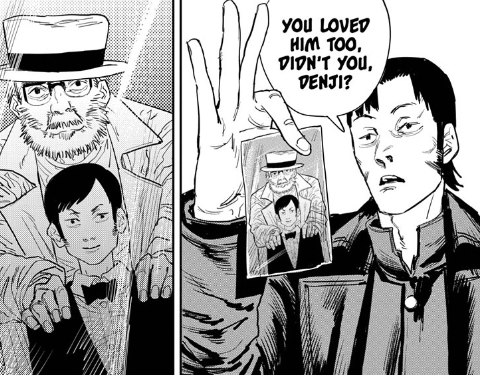
Stunted children and victims of poorly placed births; amid them all, there are a handful of very exceptional people: those who are just straight up fucking stupid.
Katana Man, as I will not be assed to remember his name, is one of the funniest villains I’ve ever had the pleasure of witnessing. His complete lack of intelligence or comprehension is a perfect punchline for the opening act of Chainsaw Man and a clean fit for an early arc villain. Beyond the painfully realistic absurdism of a spoiled manchild who thinks his mafia father’s death was an objective tragedy, there isn’t much to say. This is great stuff, but it’s very self-explanatory, and a very, very enjoyable semi-closure for this plot thread. Easy Revenge! is a beautiful thesis for Himeno’s character, the comment on a yen payment to the gun devil is great foreshadowing, and I love the tragedy of Makima calling herself a necessary evil. There is one scene from this arc that truly sticks out, and this is a point where I must dip further into subjective evaluation of this is really, really cool scene construction.
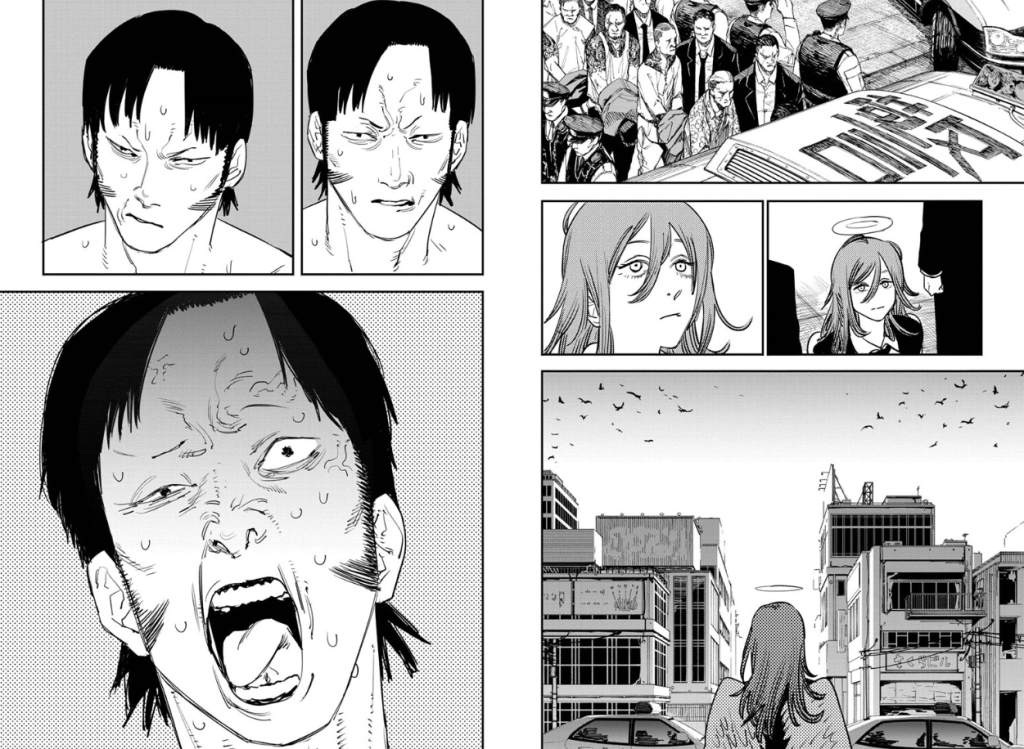
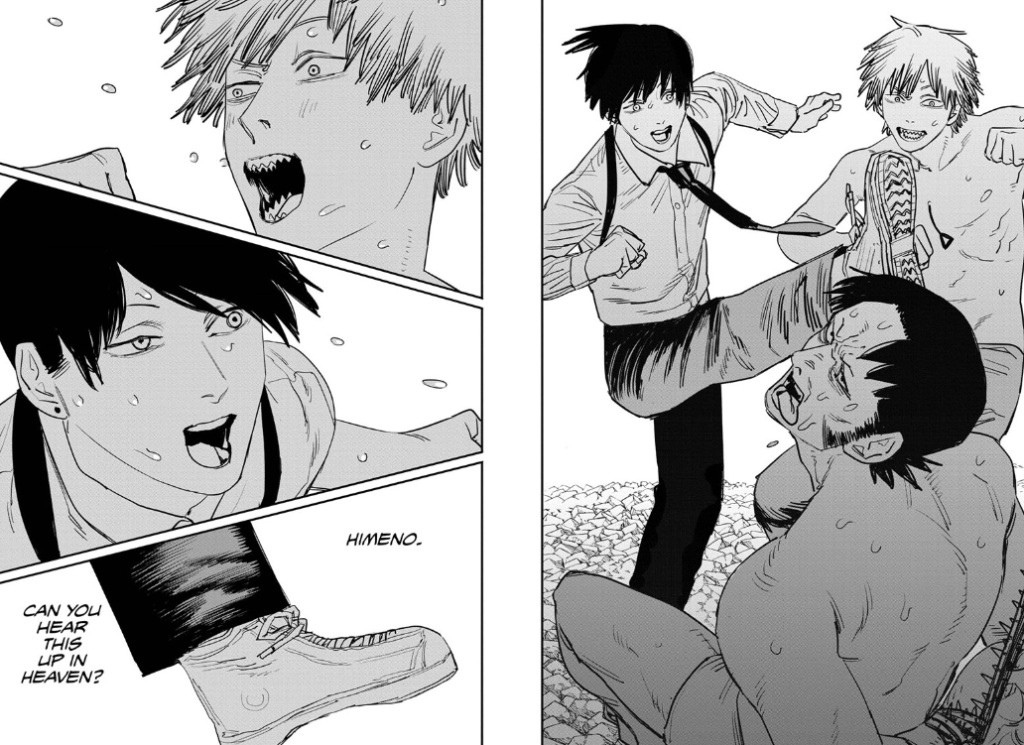
Having the Angel Devil, with whom Aki’s comprehension of his own human nature unfolds itself, gaze upon Aki and Denji’s requiem to Heaven is perfection of craft. There are many, many instances in which Fujimoto leads consecutive scenes into each other to develop much larger, story-defining theses, and this is one of his finest.
Our words to Heaven are most often but childish play, our justice is gratification of our own ego, we often find this in exploitation of state power dynamics, and man, it’s fun as Hell to make Heaven this way.
But beside the Katana Klusterfuck, there is one particular scene of vital importance.
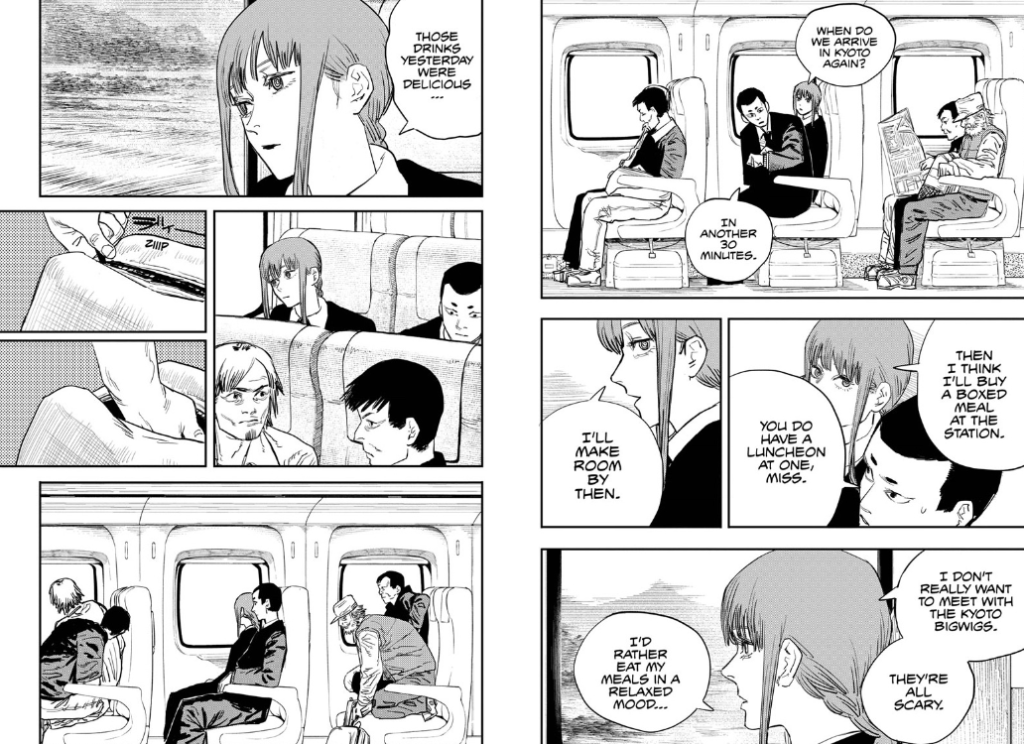
Let’s analyze this next chapter with this in mind.
Interlude: This Chapter is So Fucking Good Oh My God
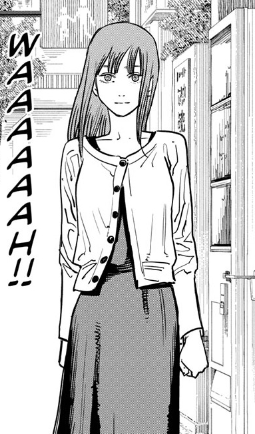
For chapter 39, I will briefly exit Super Analysis Mode entirely to scream about how great it is, and what interlude more perfect than this one?
Jesus Christ, I love this chapter.
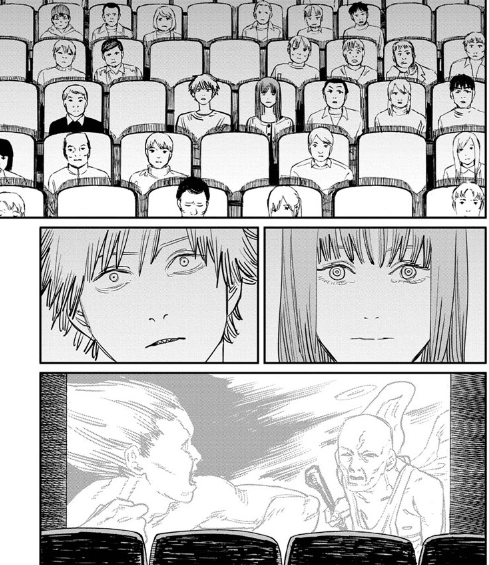
What if we watched foreshadowing of our final fight complete with the visual of a (equally emotionally distant) crowd beside us? That’d be so badass.
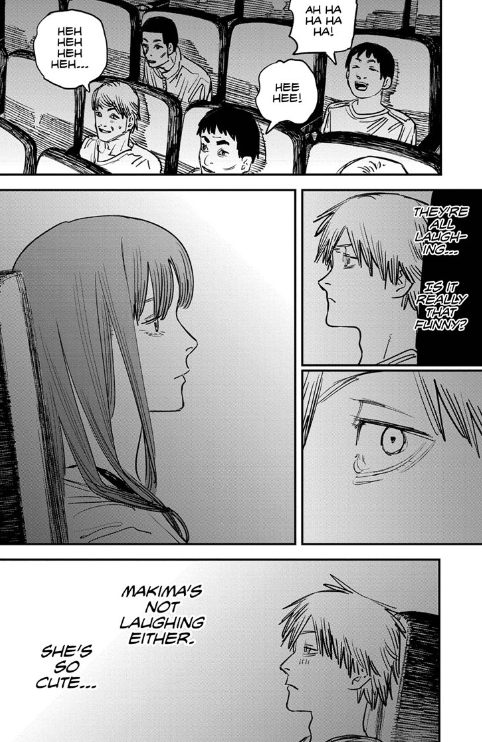
In this chapter, Fujimoto executes the finest characterization Part One has to offer and reaches into the depths of my soul. The contrast of Denji’s deep and engaged inner monologue with Makima’s blank face (no one with a functional soul makes the faces Makima makes in this chapter) is perfection. His attentiveness to her, the audience around them, and himself whilst Makima seems to have all the world set a stage before her, no thoughts permitted before the switch in her head says This is good, cry. The brutal visibility of the disgusting nature of this relationship: the clear fact that this is a grown woman and a sixteen year old boy, that she’s dragging him into her own world in a way that tragically alludes to her adult need to share her inner soul, the way Denji seems to reflect her own inner child and her horrid disengagement from it – the fact, again, that Denji is an actual child and all of this inner war of hers is made into a law that he has to suffer: what better metaphor for the entire world would you find than this?
I cannot accept the idea that this chapter is purely acting from Makima, even if it’s the design. Makima is not without emotion. The entire thesis of her character is that under the endless perfection and virtue is an attention-hungry little kid and a massive sub bottom trying everything she can to impress her universe’s Godzilla so she can get headpats from him. This chapter is agonizing.
And then Fujimoto starts killing the audience in real time.
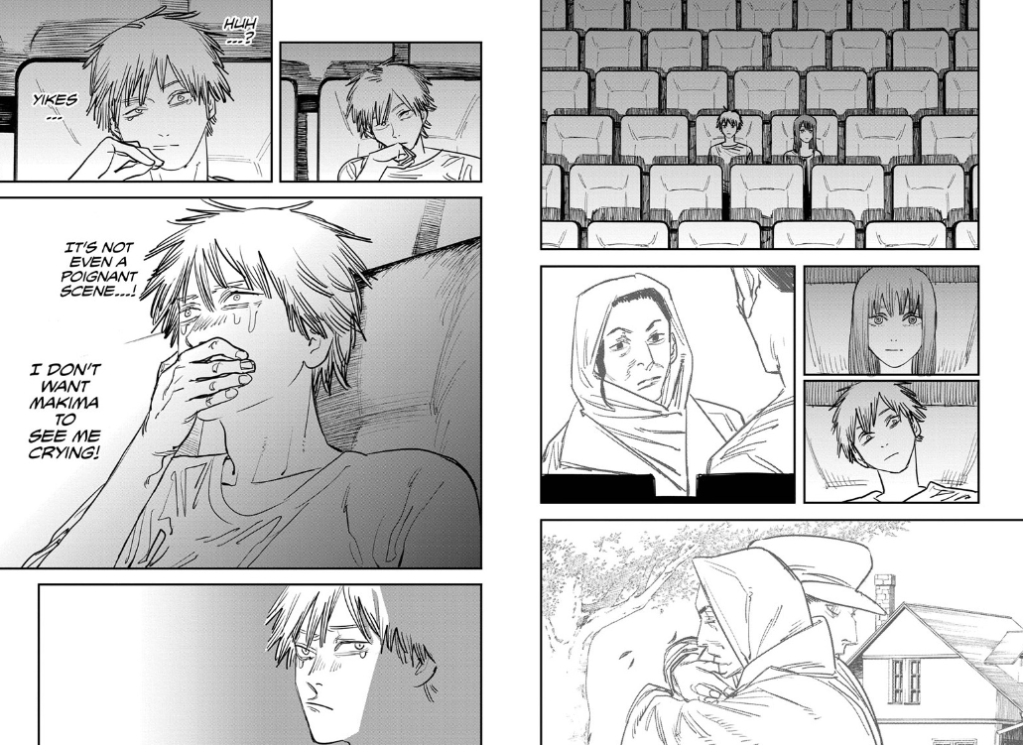
The lack of an audience in the one scene where Makima can cry really makes you wonder how much the world and her constant performance strangles her.
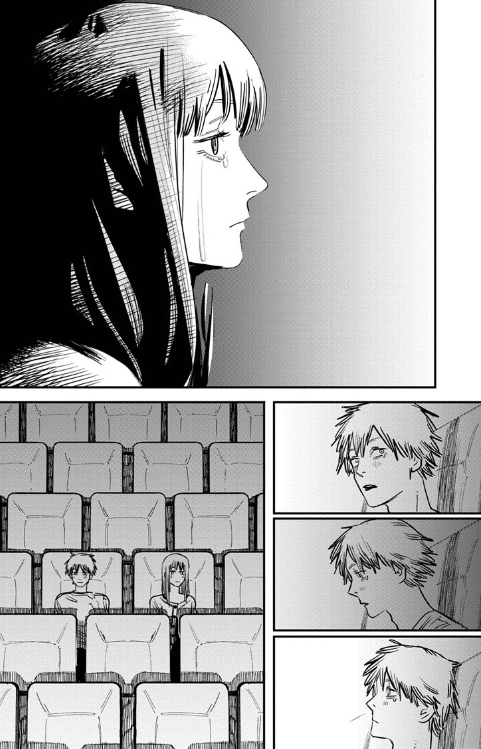
I dedicate this to Denji from this moment on.
While even Makima’s faintest tear reeks of control (and its brief break, her breath of fresh air from all those scary adults), Denji is so painfully a kid beholden to it all during the whole course of this chapter. The mama concept of Makima, building off how purposefully Fujimoto excluding mention of Denji’s mother beyond her dying of a heart disease, is so visible, alongside the abusive romance nature in the same. Denji’s giving it his all to figure out what he even should feel because he hasn’t formed a coherent identity yet. And we see, again and again, how much of a controlling, experienced adult Makima is over this naive child.
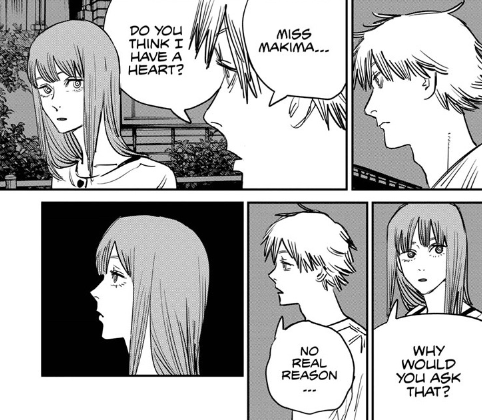
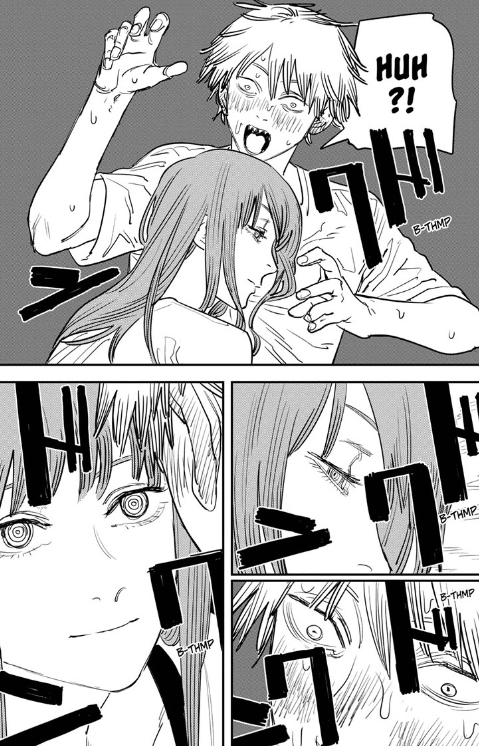
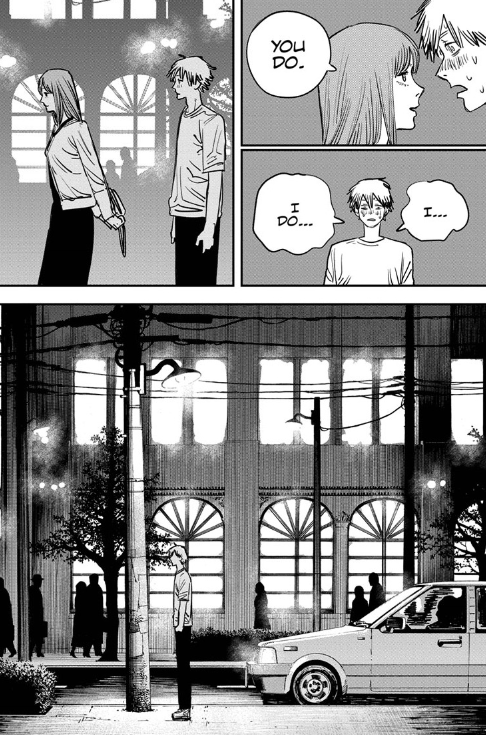
God Bless Japan: Human Experience and the Weight of Empire
No one is an apotheosis. When I used this funny phrase earlier in the essay, I meant, simply, that Fujimoto, despite writing a manga where concepts literally get embodied, refuses to write his characters purely as the embodiments of concepts, or as pure concepts themselves. This is not mythic writing. Everyone is the sum of a particular baby and a particular set of circumstances and experiences. And in the Reze Arc, we begin to see how the machine churns.
Fittingly enough after the movie date, Denji’s lack of identity is thrust against a histrionic actor – who, precisely like Power, is acting out the reality beneath the lie. And with this arc, this concept is concretized into a statement.
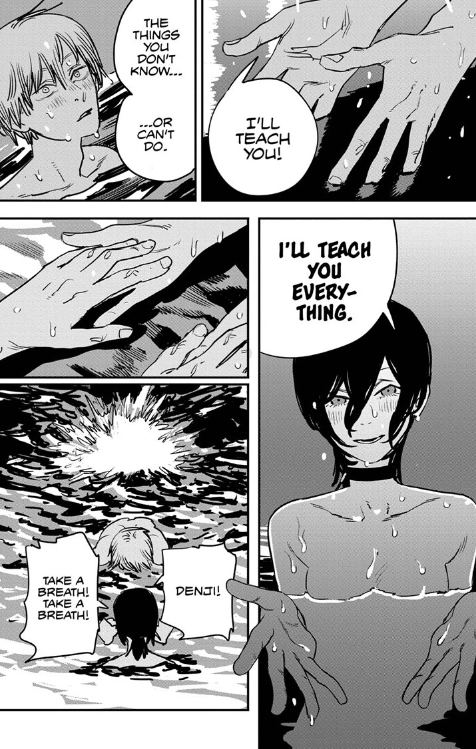
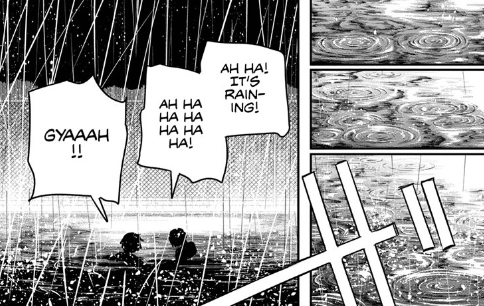
Acting, deception, and habitual escapism are all means to live out the realities the system doesn’t give room to breathe. With particular reference to the excellence of this arc’s film adaptation: this scene encapsulates the purity of real, inner feeling buried away behind a million obligations of power. What lost children like these were never able to wholly experience, and, as the International Assassins Arc up next will emphasize, healthy ones (that aren’t as stupid as Katana) live blindly, without shadows.
And before the moment where Reze attempts to fulfill her mission, we get a very interesting exchange.
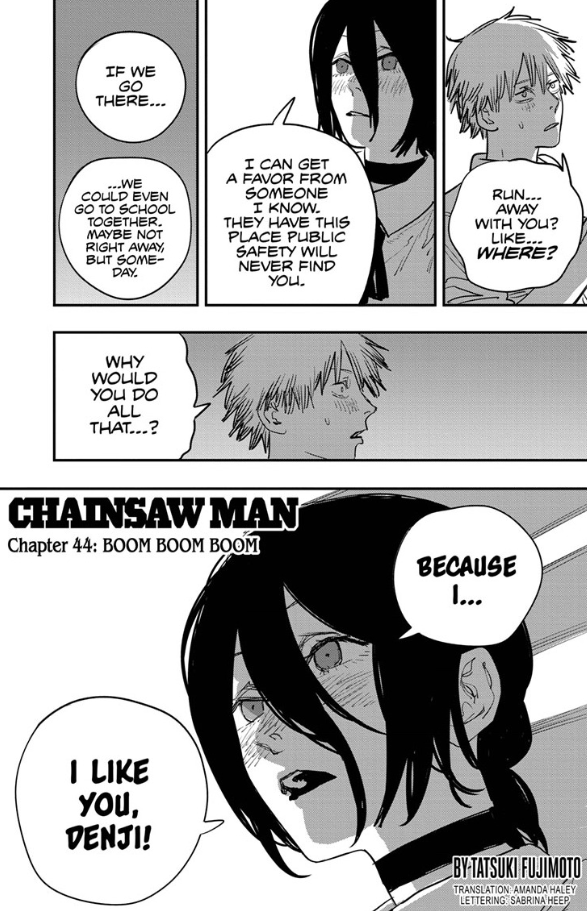
The shadows casting the flag of Imperial Japan off her head… her mama would be proud.
Behind the performance of Reze weaving a movie plot to isolate this naive child and kill him properly is, once again, a reality: Reze’s only response to her usage by the state is endlessly running away, with the ultimate desire to truly run past it all into a beautiful life with someone she can connect with.
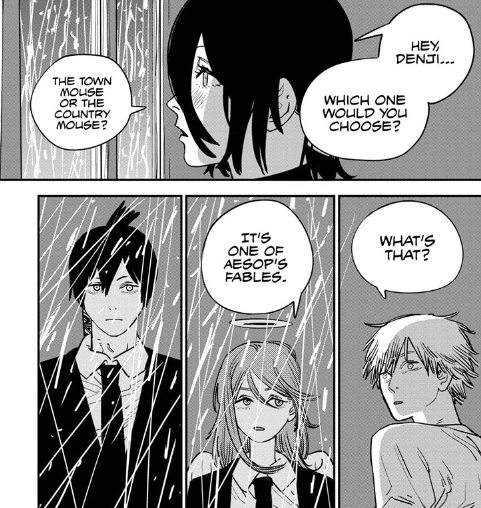
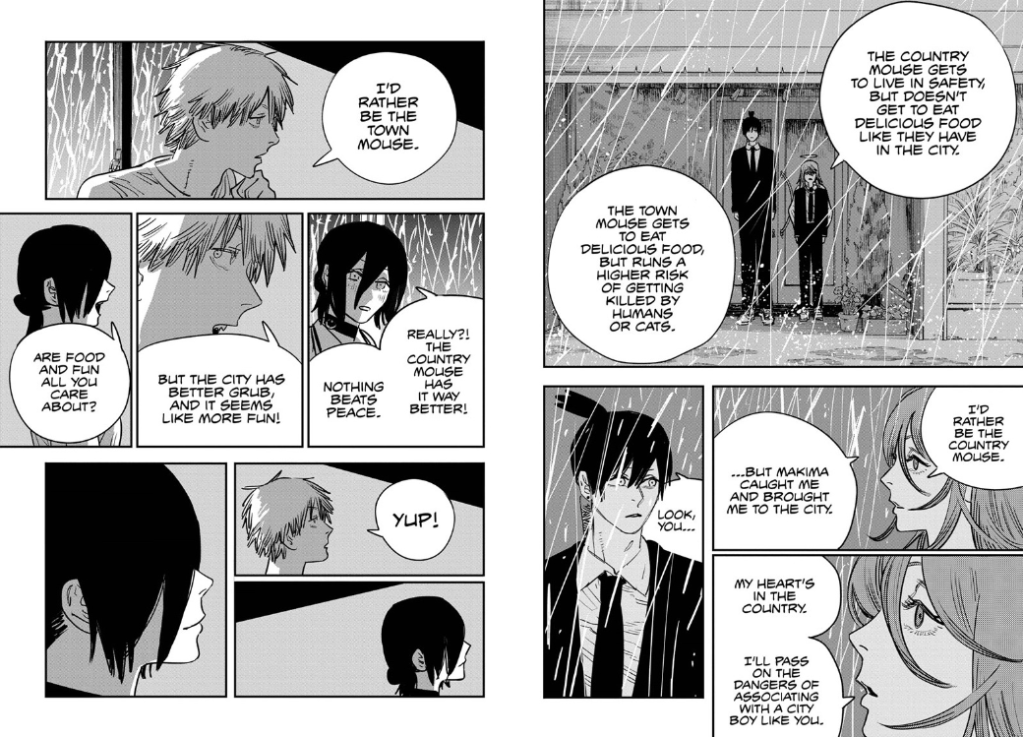
This is extraordinarily good stuff leading up to the brutal truth: that every such pair of choices is propped up by the state, which retains the ability to make real choices.
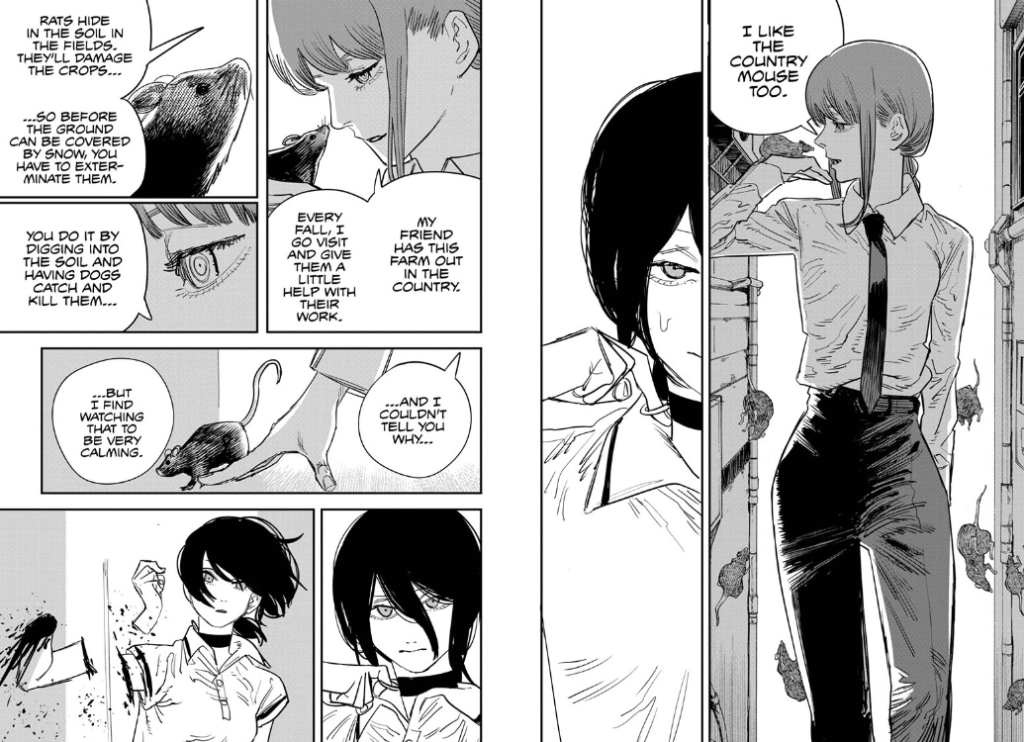
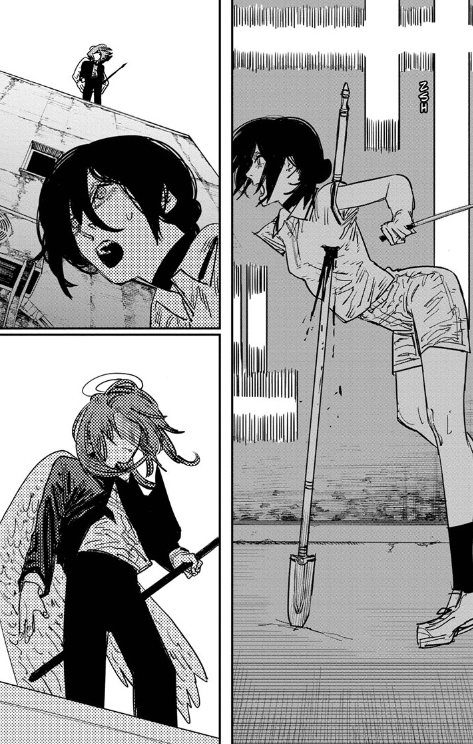
Kiddish, quixotic adults like Reze who vie for leaving the world behind and speak in mythic, fable terms are perfect tools to be manufactured into the state’s mythos, the same used to produce both human weapons and effective workers – to either whip out or appropriate all which is true from birth.
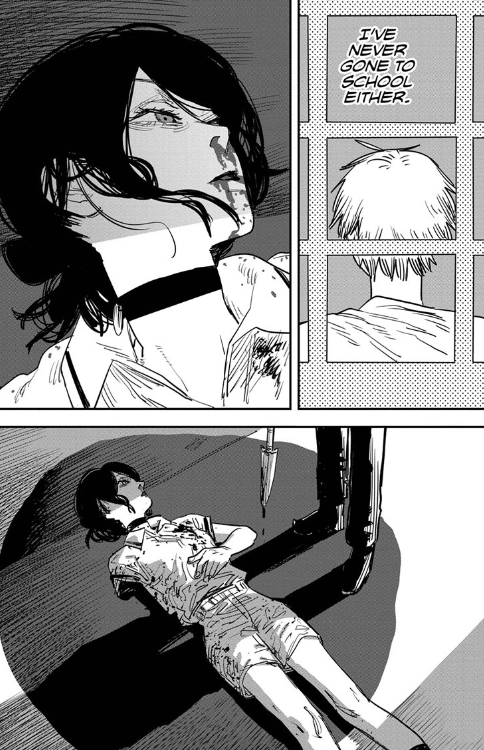
Die, die for empire, die for Japan.
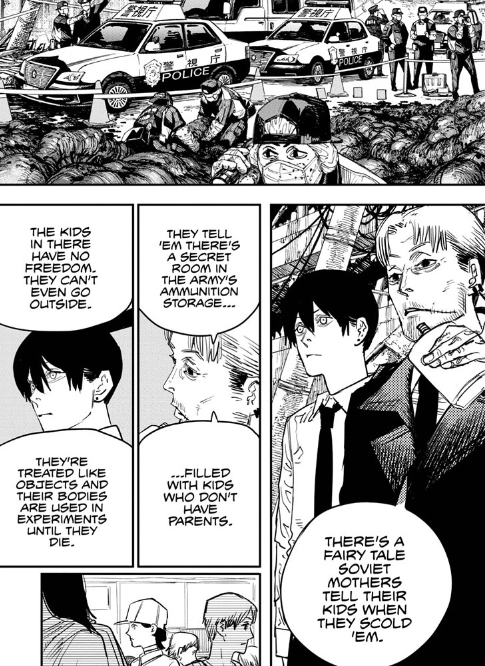
Die, die for empire, die for the Soviets.
Most monsters are not born. They are cultivated by a culture which needs weapons, a culture which sacrifices life to devils, a culture which must keep the war machine running.
And, indeed, we get a perfect piece of imagery confirming Makima’s role as the one who produces mythos and symbolism to begin with: the Angel Devil is literally her servant, and it’s none other than him, who introduced the myth to Aki (of all the people to fall for the Angel Devil that sucks out your embodied life), to execute her in a poetic book-end for the story of her life.
And there is no one more deeply pleased with the whole performance than the woman who watches every mouse die.
Merry Christmas: Esotericism and Reality, Shadow and Light
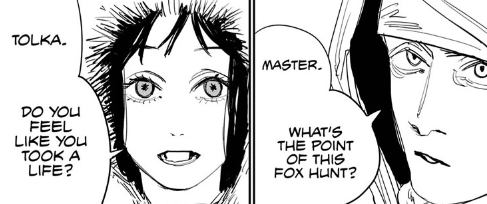
“I’ll tell you the secret to making a sophisticated doll.”
With the International Assassins Arc, Chainsaw Man fully begins. Though our Chainsaw Man is still a half-formed Chainsaw Devil, the spectacle is now gathering international attention. Global power games have begun to creep up, and, oh God, it’s America.
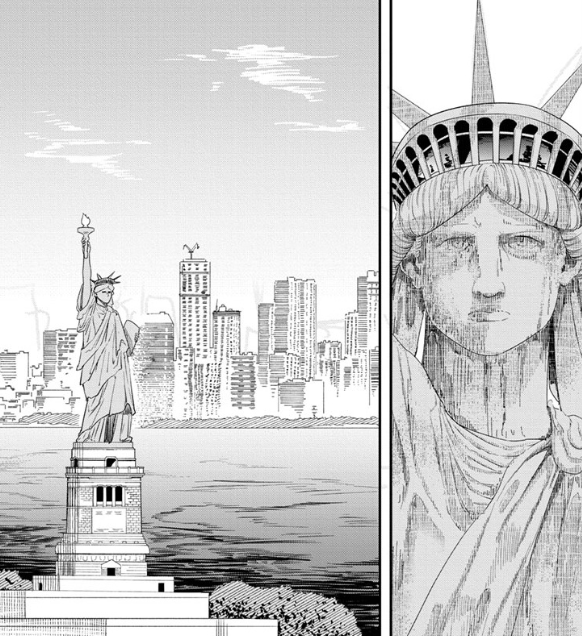
Of all the arcs in Part One of Chainsaw Man, International Assassins is the only one wholly written in the manner of a Part Two arc, even introducing a certain… someone.
Anyone else hear that ominous fruit moaning? No? Just me?
Being entirely honest, I don’t care about this arc. Kishibe’s dynamic as the ever-numbing and logical reality follower, how Quanxi foils everyone, Doll’s esotericism – it’s all good fun, but its strengths are just in moving the narrative along in a very boring, basic manner. With that said: let’s try to continue analyzing.
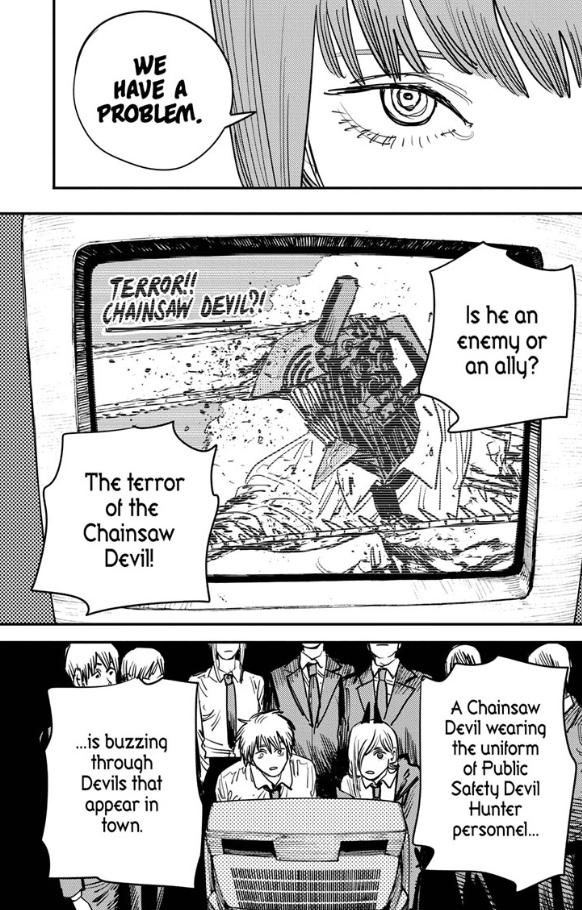
The desensitization is the point.
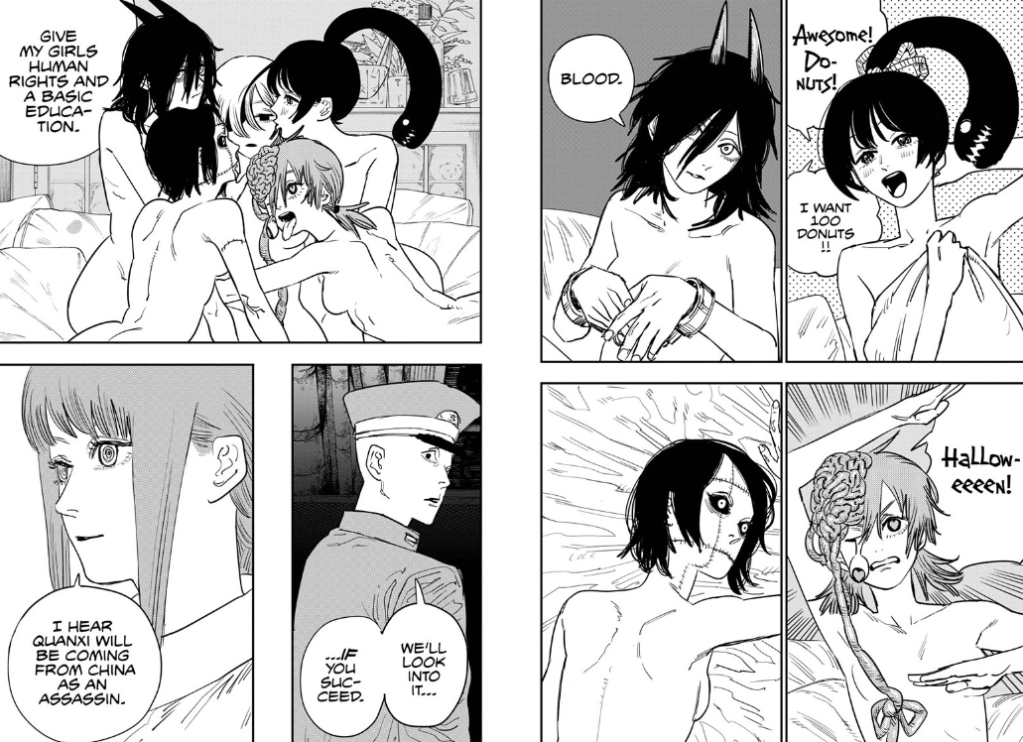
In a manga loaded with such damages and a handful of authority figures for them, Quanxi stands out for her serious, matured desire to provide for those screwed over by God. She’s a clear parallel to Makima’s dogs as well as a more subtle foil to Santa, with both being paired with four children in the arc. Themes of realism and escapism begin to get very loud, though unusually unrefined, as Kishibe, the man who dulls himself endlessly in the name of what truly works against a much bigger, inhuman enemy, comes to a very memorable dialogue with Quanxi.
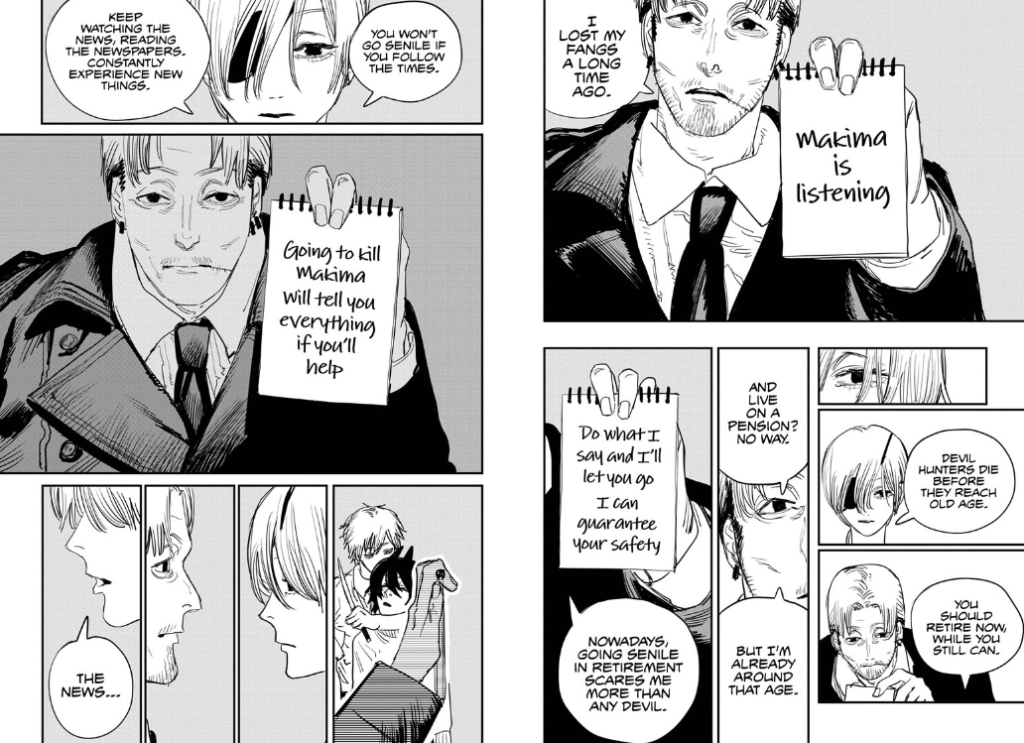
Cutting to the chase, we have a villain who is simultaneously one of the most and least interesting in Fujimoto’s catalogue. The one and only Santa Claus, AKA, Doll Devil.
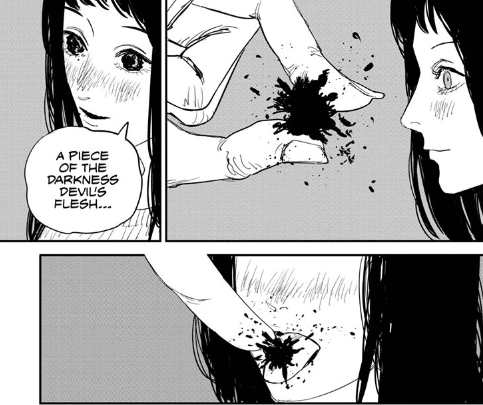
Here we have a very special kind of delusion, where one believes that esotericism and the chase of an endless remove will place one over the all-encompassing control of the state, which weaponizes conventional religion to its whims.
The house, of course, always wins: and it wins precisely through turning the youth against all enemies.
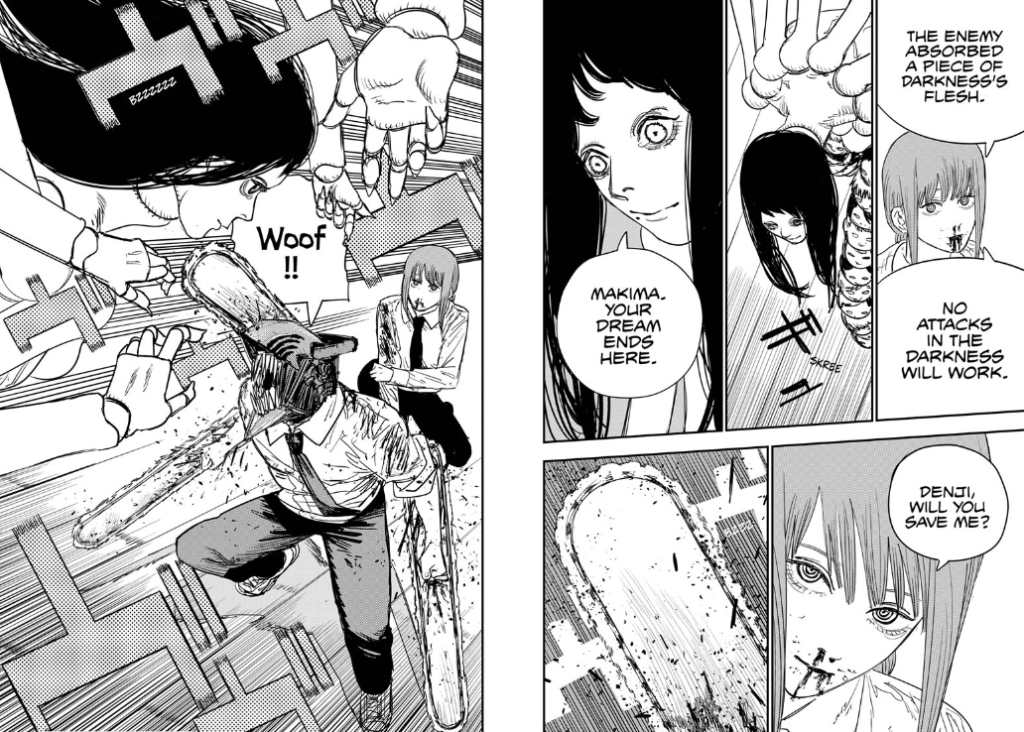
And it is precisely here that Makima’s victory truly begins to set in: this act of submission releases Denji’s decay for the next 170 chapters.
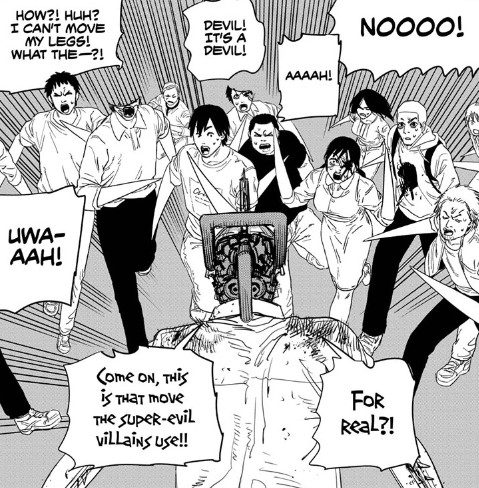
He’s beginning to speak in Marvelese.
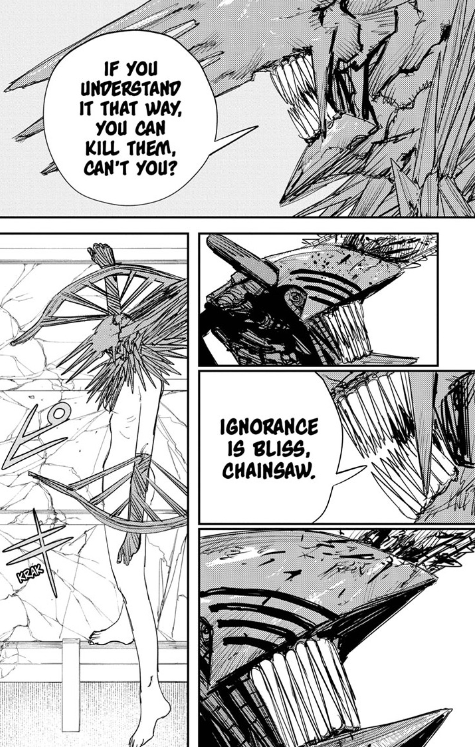
Makima and Santa’s strap-measuring contest of who can groom naive men better works to break Denji open and gently poach him like an egg, as the experienced Quanxi further elucidates her willful, conscious detachment for the sake of sanity… and Denji, who cannot let go of what’s right in front of him, who’ll be given a spectacle of two “choices” and, neither choosing one nor rejecting the game, just chooses both… Well, of course he chooses to become Deadpool. What did you expect? A mature response?
Denji is a sixteen year-old boy without a mother.
And if the visual of Denji’s chainsaws splitting his wrists wasn’t enough, we get to watch him self-immolate in the name of defeating Makima’s enemy.
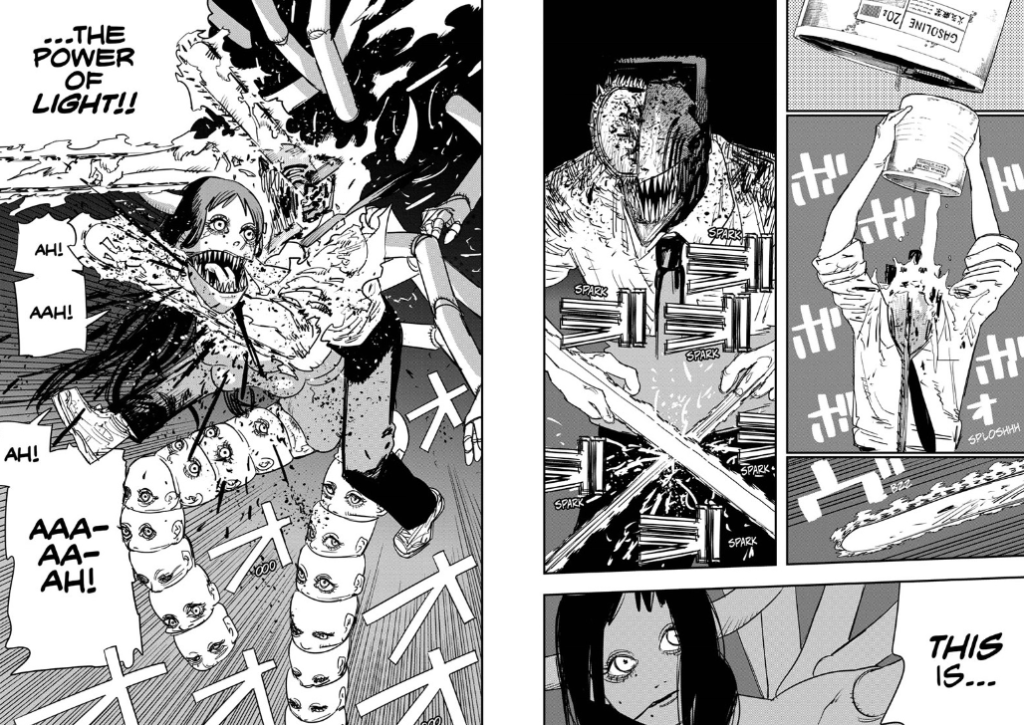
“Become Fire Punch!”
It’s hard not to notice a motif of mentally stunted man-children burning themselves and otherwise grasping onto maternal and physical needs in a horribly exaggerated way in Fujimoto’s two major works. Beyond it all, it is just enjoyable as a sort-of fanservice – a sentiment I’m sure a certain lovable and kind flame-throwing man would agree with.
The great punchline of Santa is that for all her esoteric understanding, she’s made herself completely blind to the realities which healthily developing youth live without shadow, in pure light, giving not an external word but Halloween to reflect all the knowledge of the real, solid universe coursing through their actual lives.
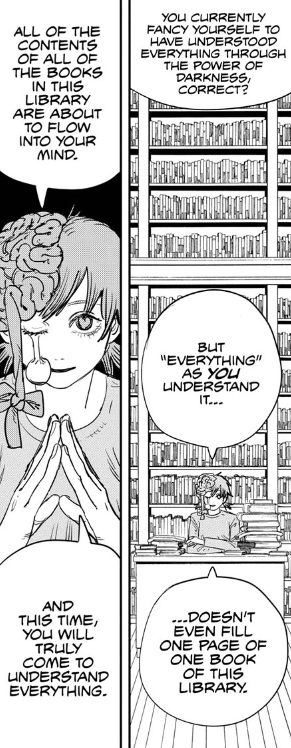
And, of course, it’s a beautiful, beautiful joke on Halloween defeating Christmas – because why not?
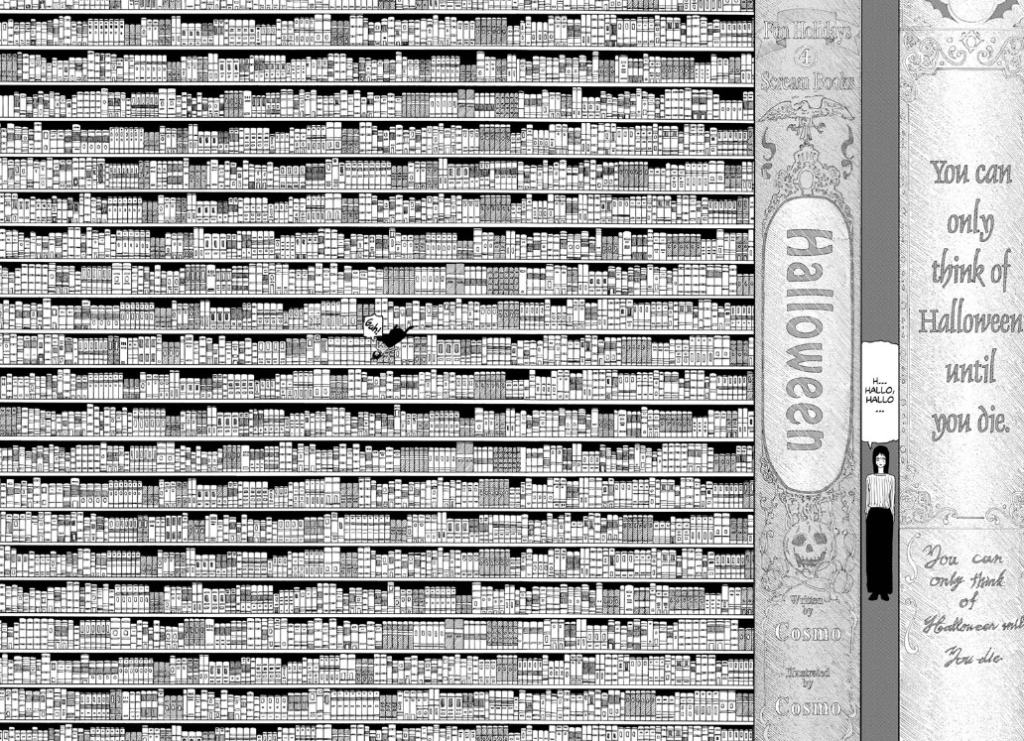
And how tragic is it? The rebellion of Doll, the game itself trying to run against the ones who play it. The imagery of youth’s spark and human life going up against ever-corroding, self-fracturing social norms in crisis. Halloween and Christmas.
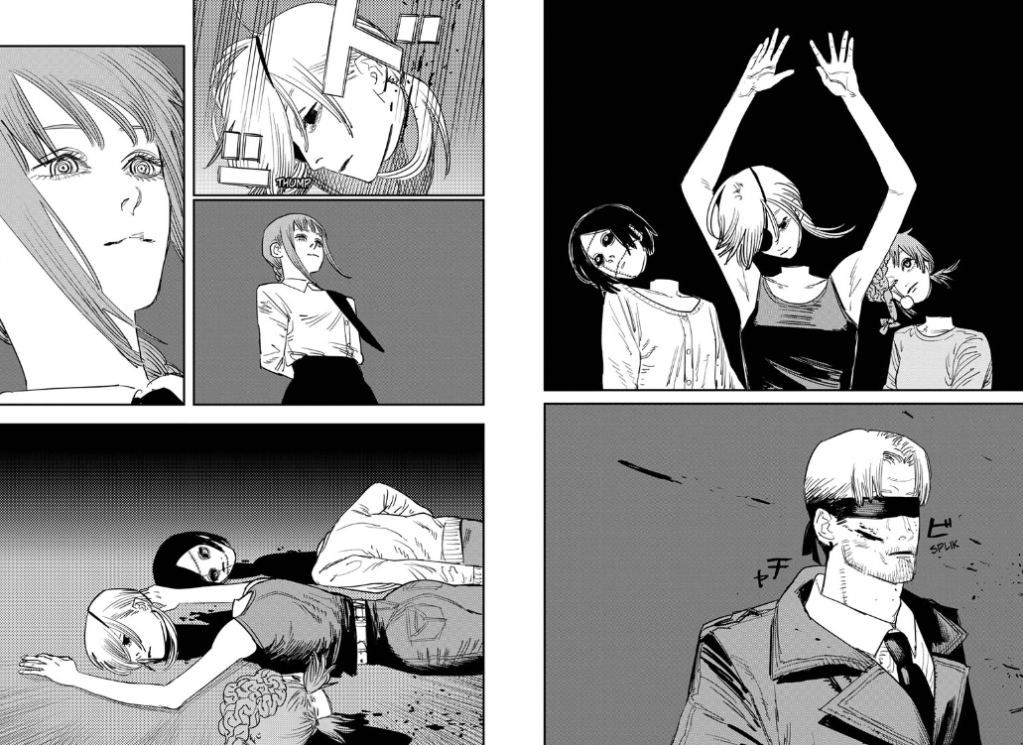
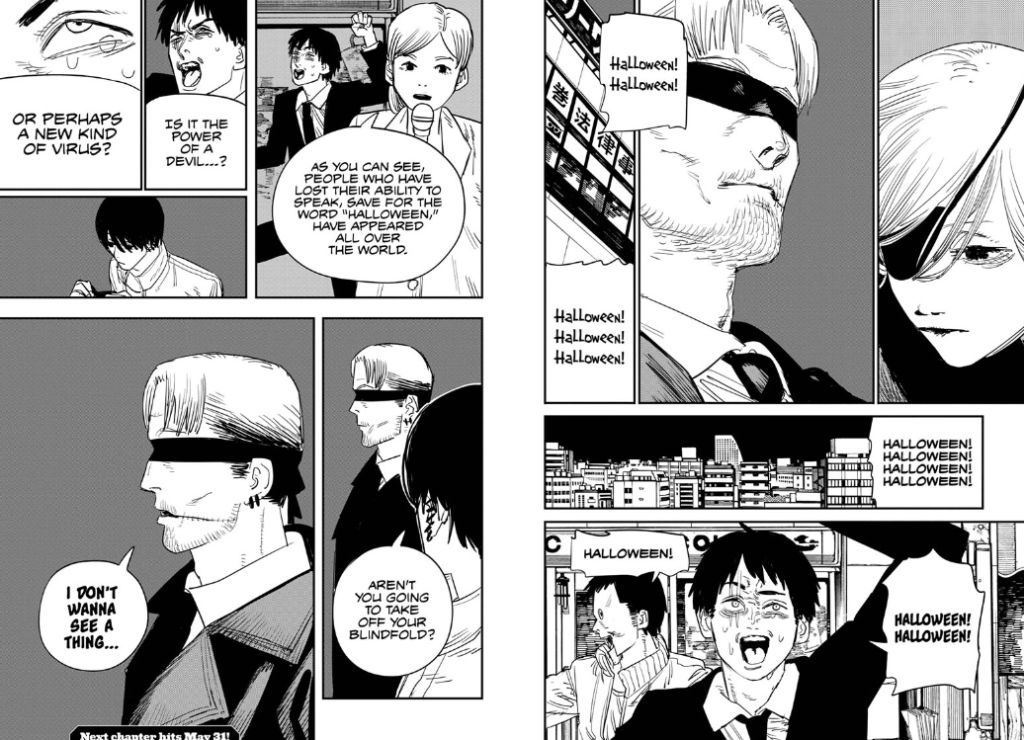
All for the eyes and ears of the one who sees and hears all, through all her own flesh-and-blood dolls, real tools to use. Throughout Heaven and Earth, Makima alone is the Honored One.
And then it gets worse. Much, much worse.
The Gun Devil Arc
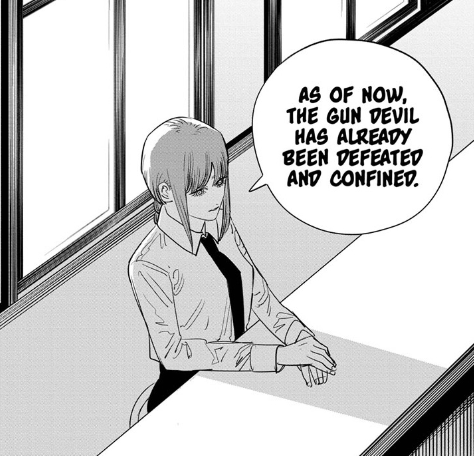
An analysis of the Gun Devil Arc is an analysis of Aki Hayakawa. Let’s take a damn good look at his life.
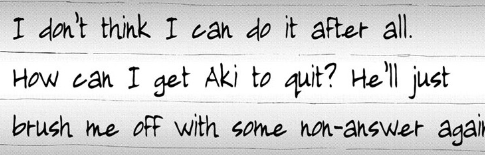
Precisely because Himeno’s escapism is built on understanding, she conflicts with Aki’s delusional fixation on an impossible revenge against the Gun Devil.
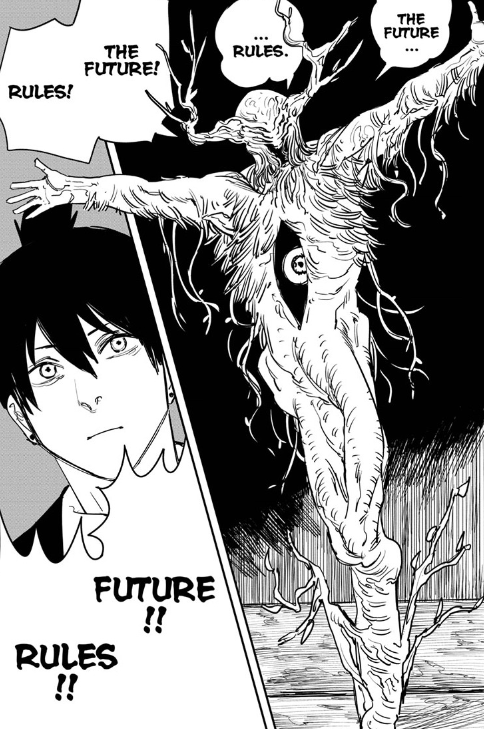
Aki submits himself to the physical crystalization of his fate/future in the name of mythical revenge.
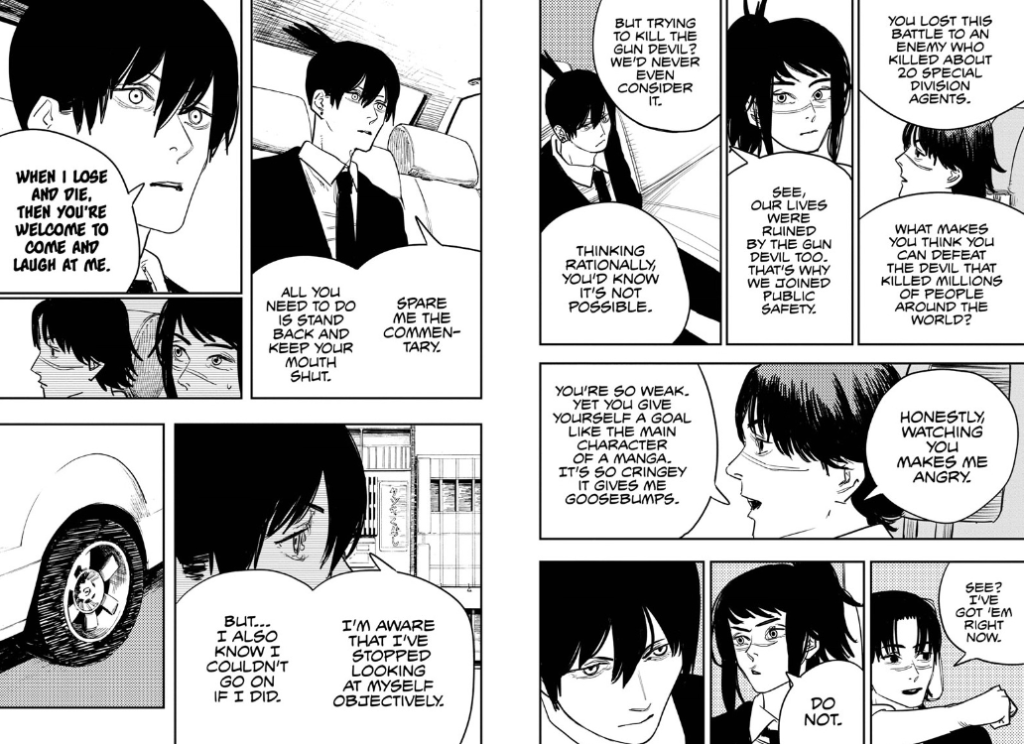
He acknowledges this particular form of escapism; an arrogant one which, unlike cigarettes, cuts him off from others as an antisocial douchebag, the inexperienced teenage fool most people have to spend some time as.
And in the end…
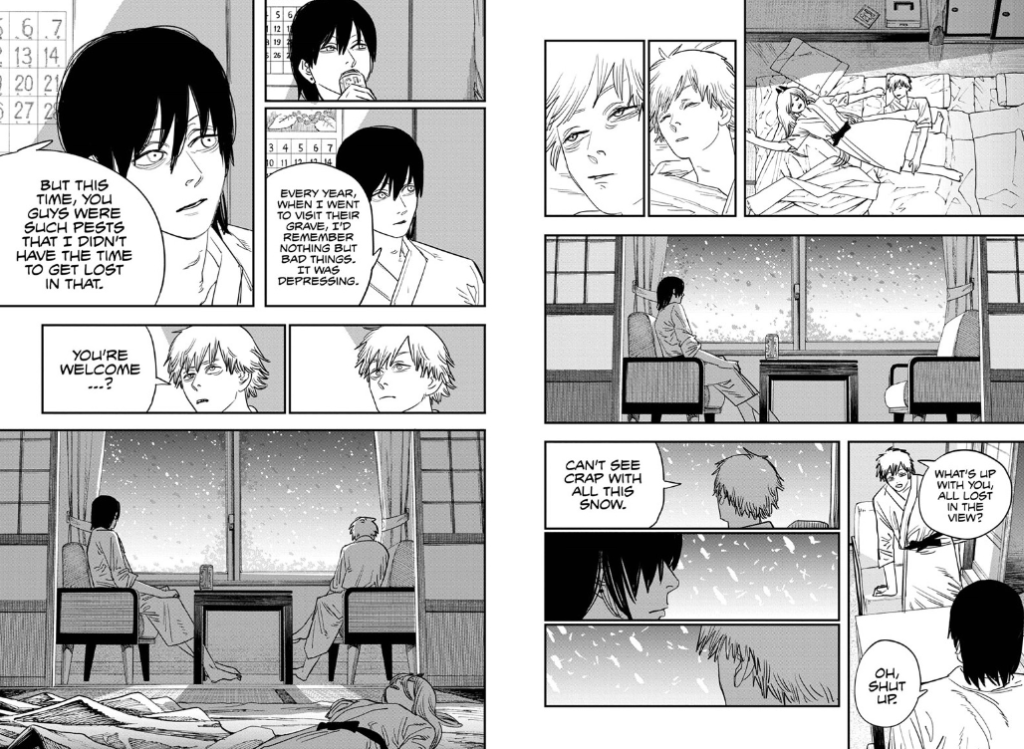
…the children, the brats, the devils, the animals; the ones outside the system of rights, without reason, of base instinct, serving personal desire…
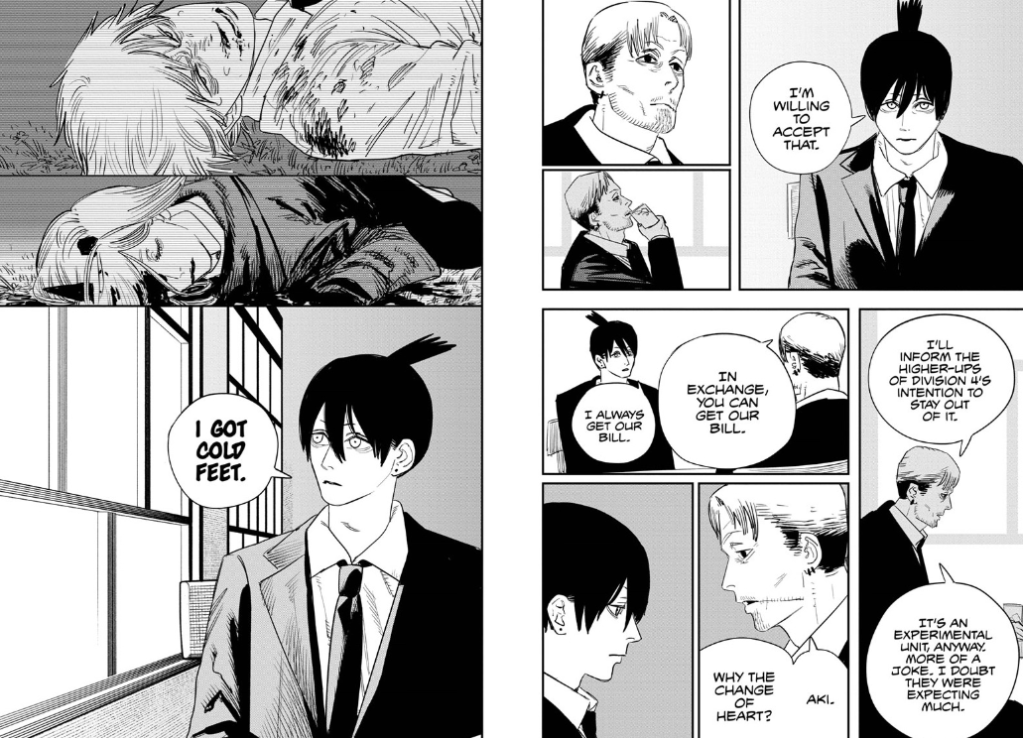
…were the ones who brought Aki back into reality.
They taught him to abstain from ideals, fantasies, heroic complexes, and self-sacrifice to instead value life. His life, and that of others, because this whole system of fantastical idealism is self-sacrifice in the name of the state’s devils. It’s willful suicide and rejection of the world – and this is an idea I want you to keep in mind for Big M herself in the next section.
…but despite all this, it was simply too late. The state had already put its eyes directly on Aki as an individual, and then went on to reveal that the entire mythos of the Gun Devil…
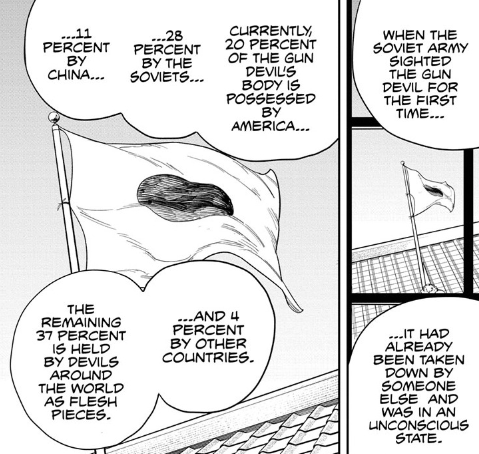
…was manufactured atop the reality of international power games.
Revenge, heroism, avenging one’s family and home – games and myths propped up in the service of the globe.
And for it, nothing is sacred.
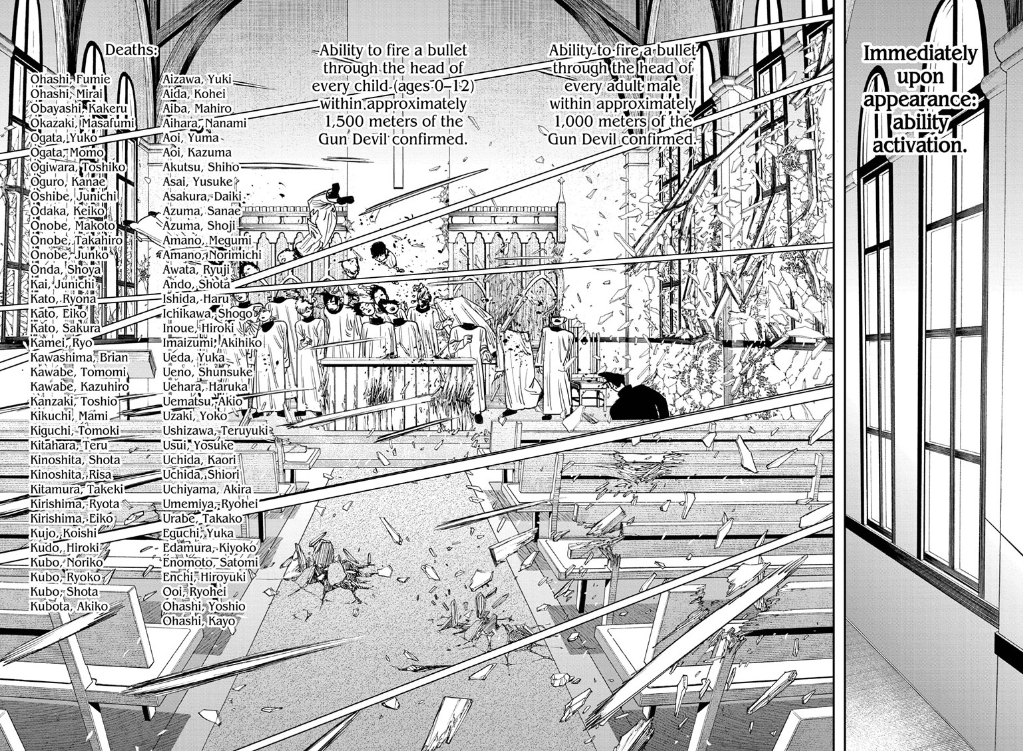
And for its Devils, the best fuel will be used, whatever it is.
And the homes we build together, from all our habits and empathetic growing pains, are the same ones we’re then made to destroy in a mere moment.
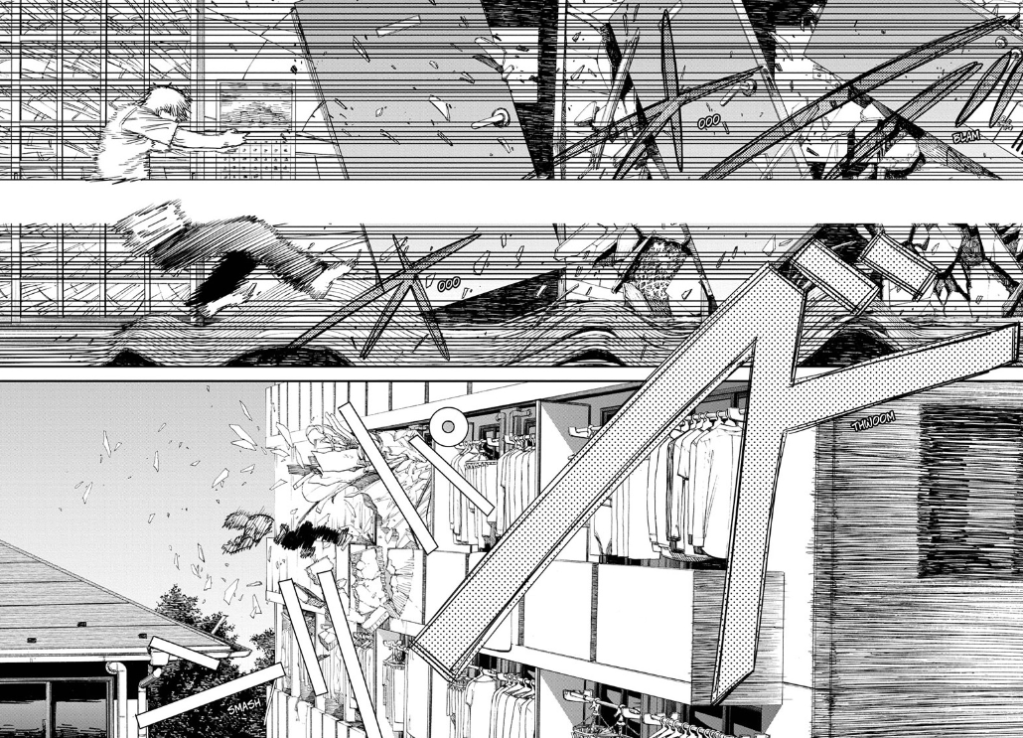
And Aki’s character arc ends with possibly the finest masterstroke of Fujimoto’s career.
Aki was a self-deluded ‘adult’ dealing with the spoiled children of Denji and Power, whose Devil natures he couldn’t comprehend.
And in the end, he becomes a child living the reality of inexperienced devils.
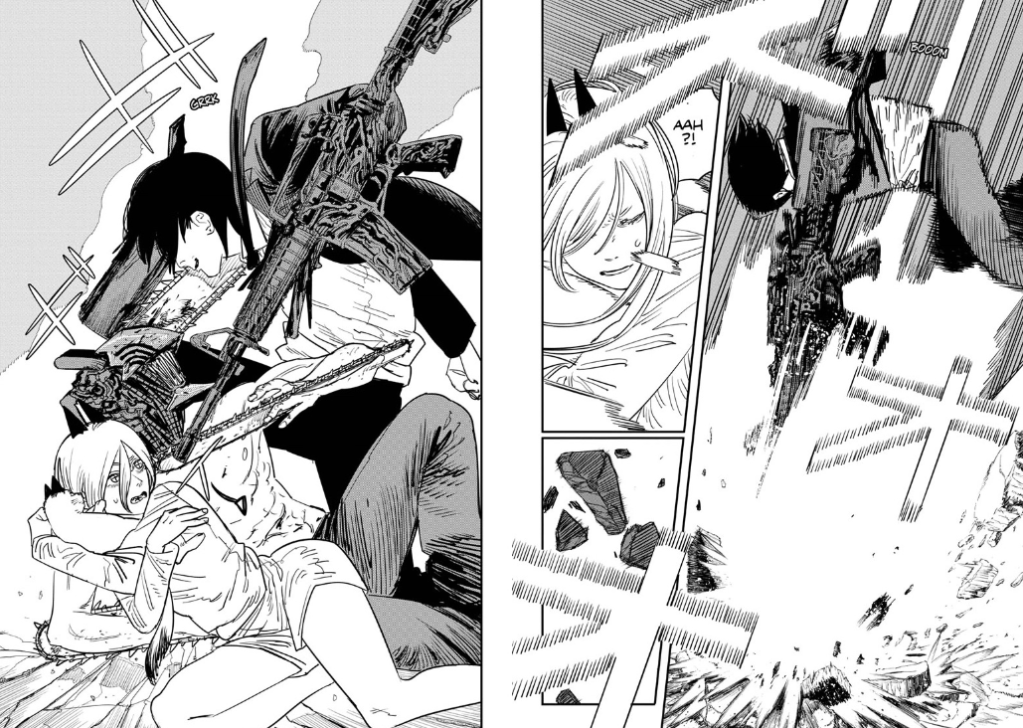
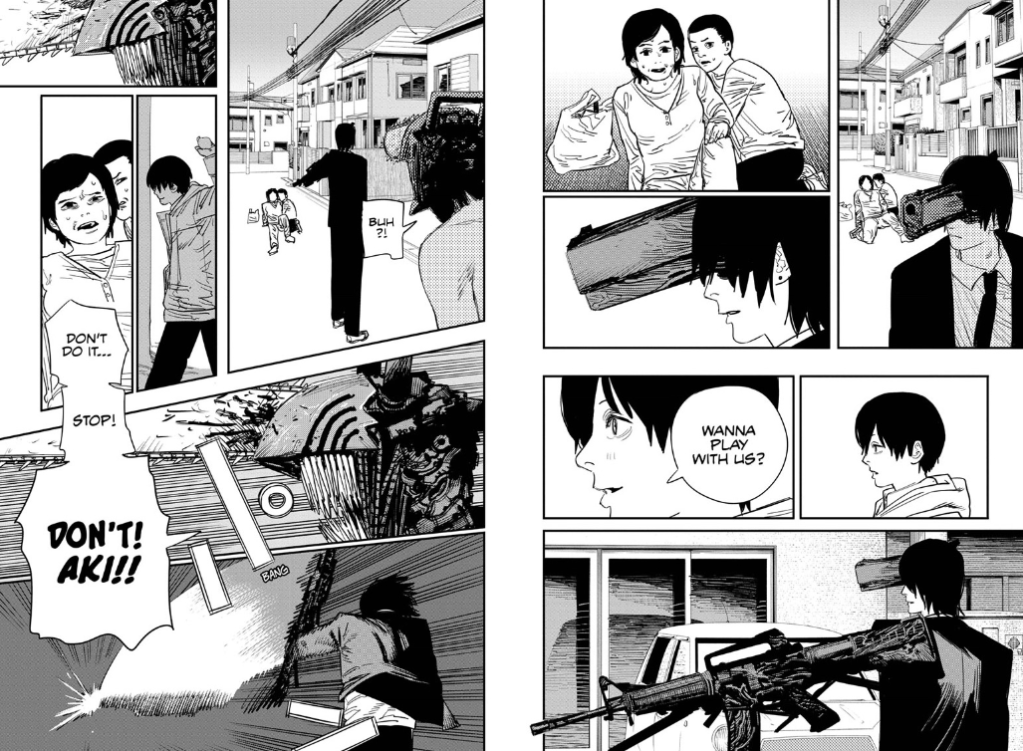
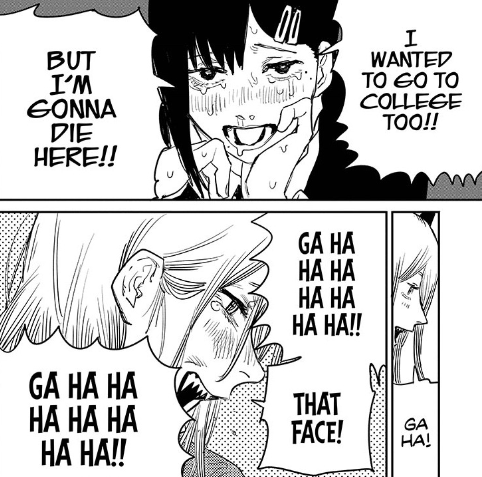
How could so many men be made to mass murder without deception and desensitization by the state to begin with? How many are made into this every single day by international interests? Millions.
And then, of course, it gets worse.
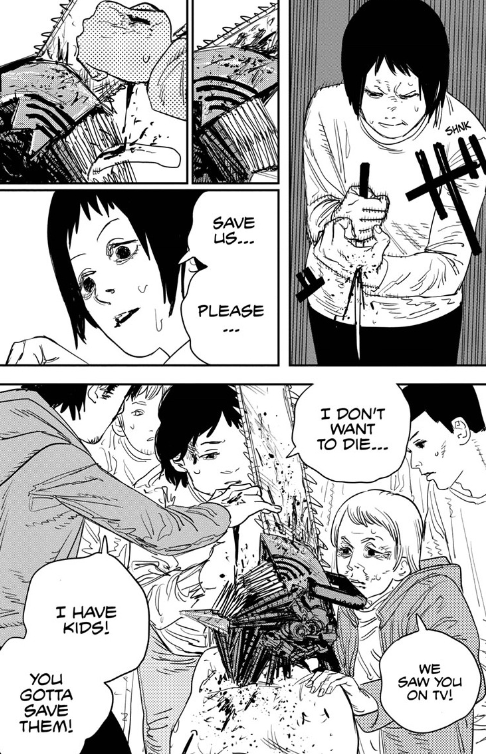
Denji is made into a definitive televised spectacle through the act of murdering his best friend, complete with people willingly sacrificing blood to him – all by Makima’s design for the sake of the performance of conquering him.
The majority of these scenarios don’t just happen by fate or random bad luck. If they can happen, and they can be exploited, they will be perfected and mass-produced, regardless of the human cost.
And so: a completely fractured reality, a crisis of human experience.
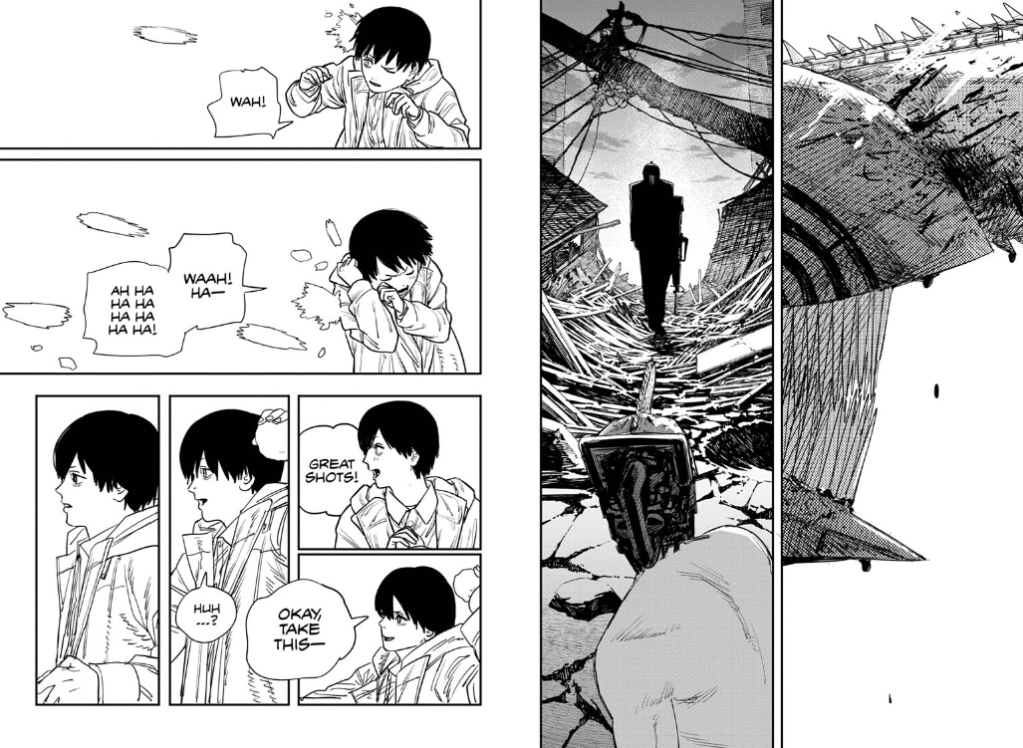
Denji, who sees his best friend reduced to a weapon human; Aki, who sees a psuedo-Heaven of corrupt childhood; everyone around them, who beg for the hero to murder his best friend.
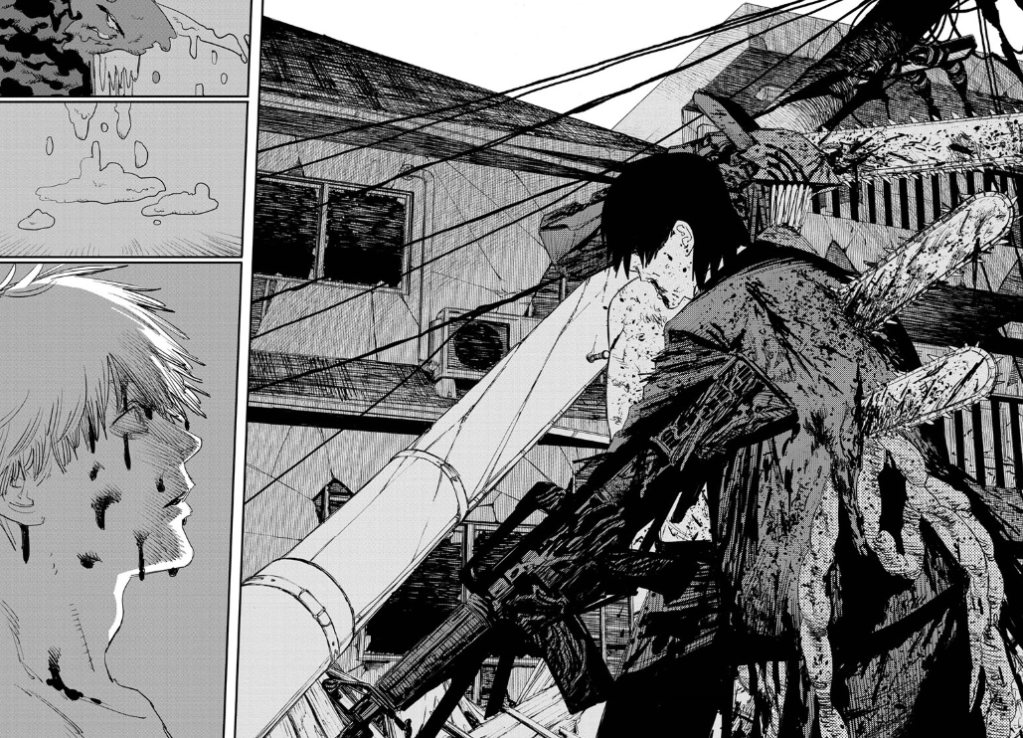
The worst possible future for the chainsaw boy.
The Society of the Spectacle: Fandom, Idolatry, and the Self-Making of the Demiurge
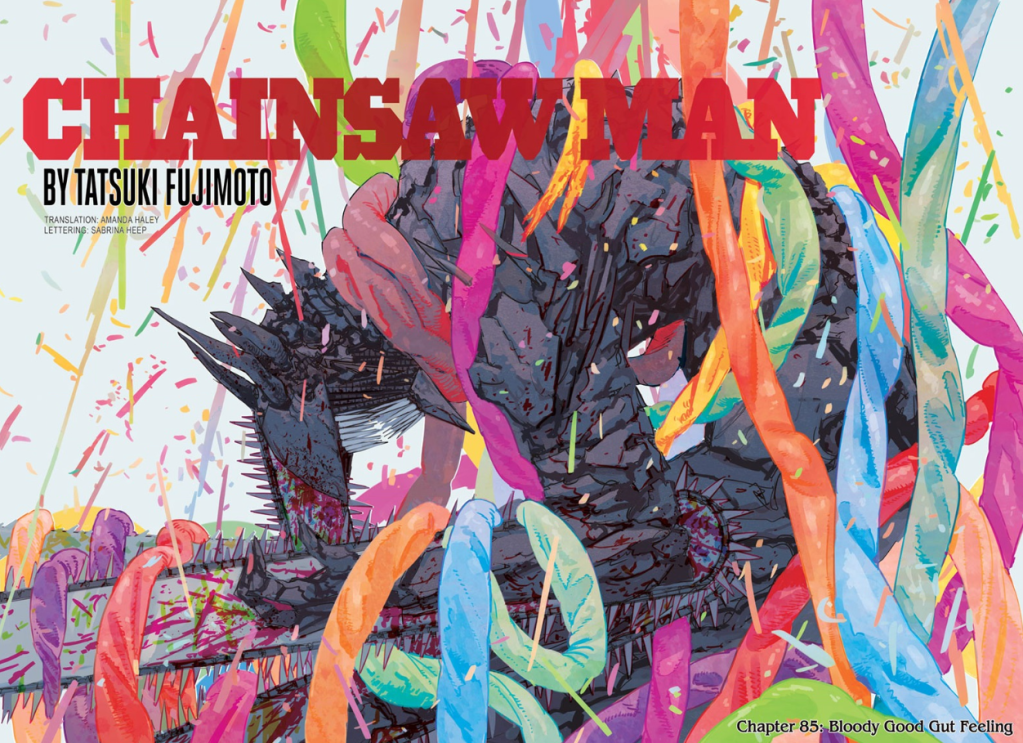
The final arc of Chainsaw Man’s first part, the Control Devil arc, is among the most existential, intellectual, and metafictional arcs in contemporary Shonen and, in any case:
Wow.
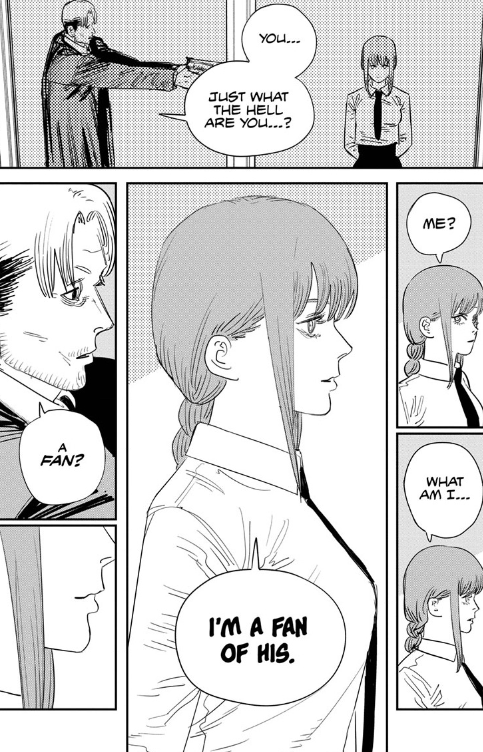
Before we really delve into the meat of this arc, it’d be good to quickly check over the horribly devastating lead-up.
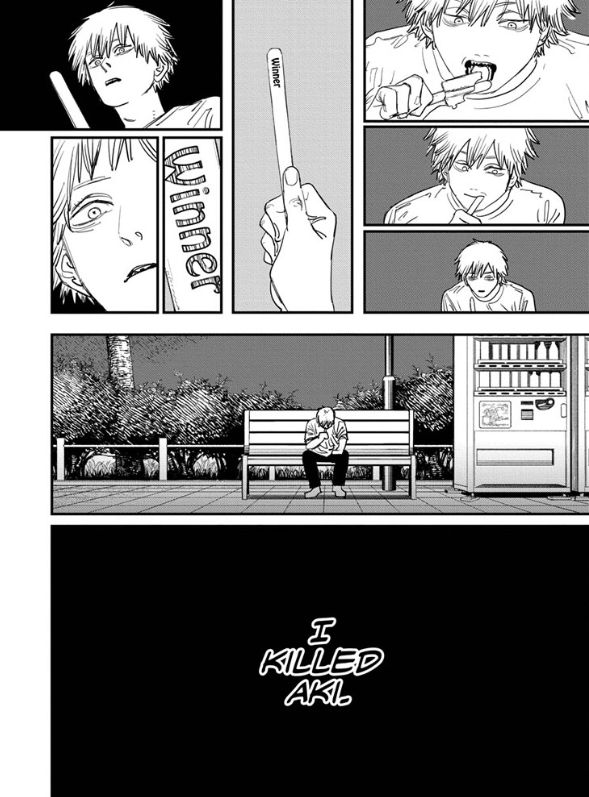
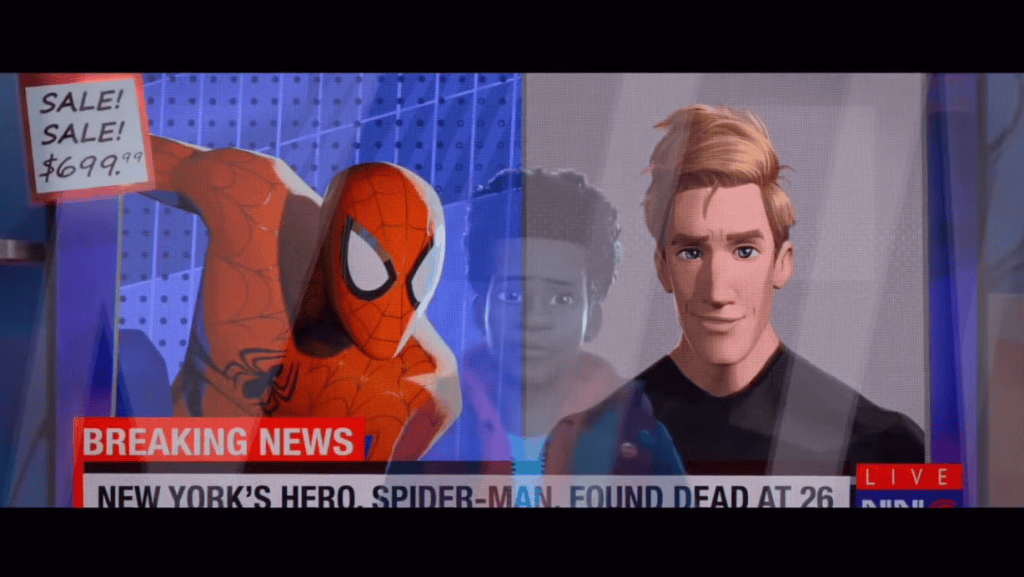
Trust me on this comparison.
After a constant effort for self-evaluation, Denji’s brain has gone to mush from murdering the self-gone Aki. And here, we enter the one, the only…
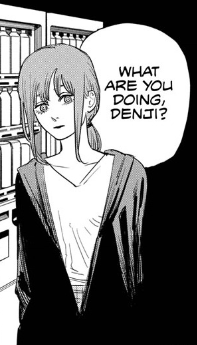
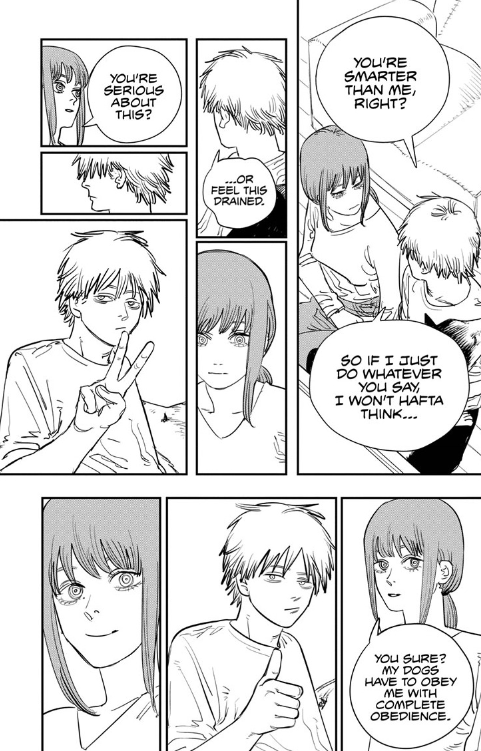
“Watch the hands.”
In this one page, we are presented with one of the most absurd and significant images in all of Chainsaw Man: the explanation of the victory sign symbol.
2=1.
Victory is the manufactured glory of the state for human weapons to fulfill. Two choices are one choice, and that choice is the approval of the state: complete obedience. To accept the game at all is to be played.
There has never been a choice, because you were never in-touch with your own flesh-and-blood humanity.
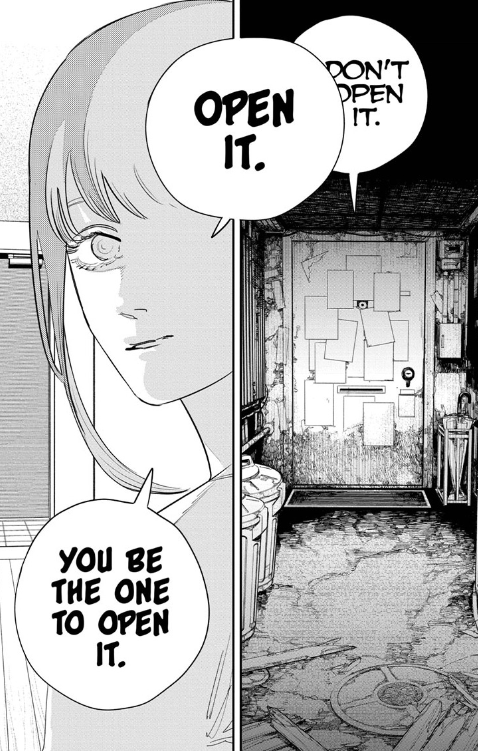
It goes as far as to overwrite our most bodily level instincts and make us lose contact with our fundamental humanity, however much the thing worked to keep itself alive and functioning. The desensitization is the point.
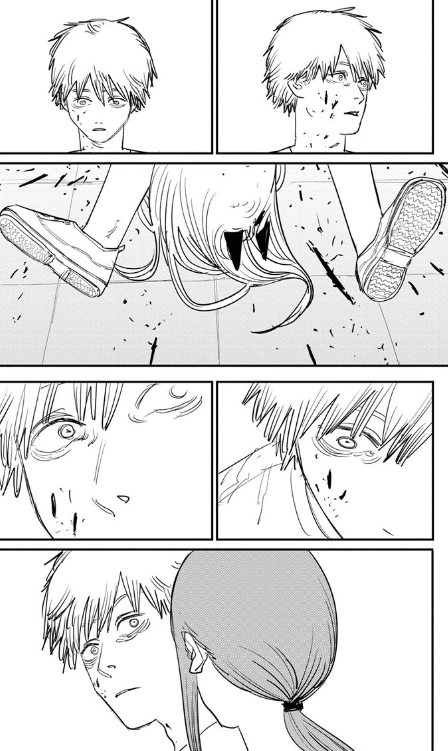
And with that, we find ourselves in such a state disassociating before authority, Milgram Experiment style.
And then it gets worse.
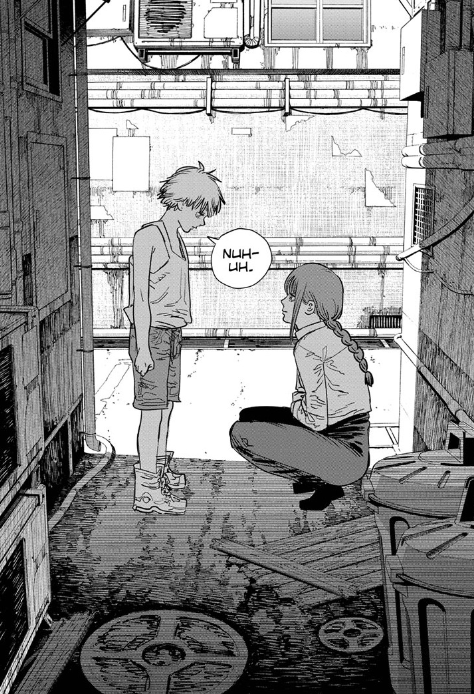
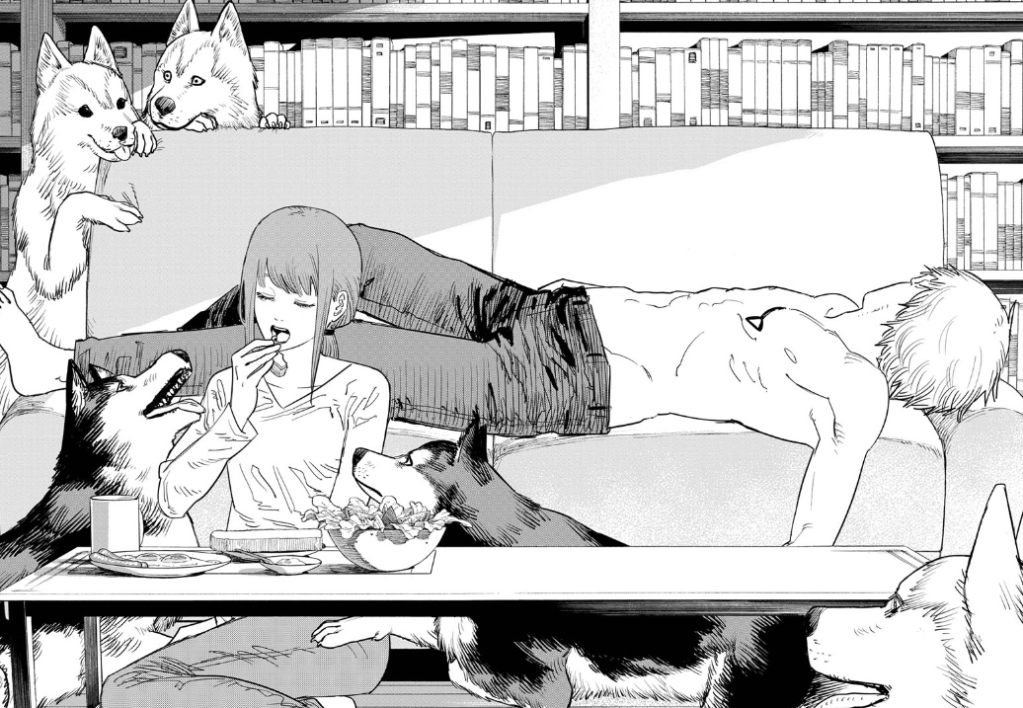
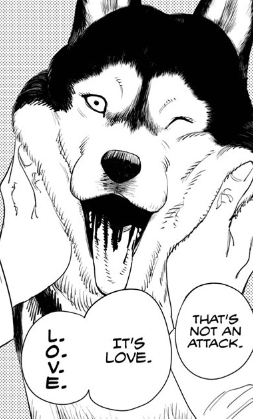
Beyond the very visible rape allegory of this visual, the usage of motifs pertaining to day-by-day habits is here transformed into cruel indifference and internal dejection from a girl so fundamentally off she truly, essentially needs all these dogs to keep herself just functioning at the level where she can continue to project, control, withhold, and deny.
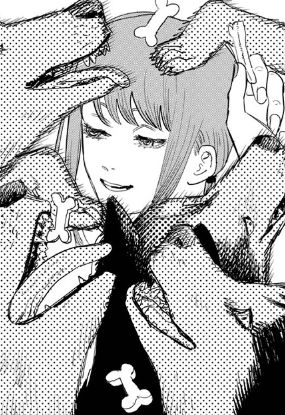
Arguably the best panel Fujimoto has ever drawn.
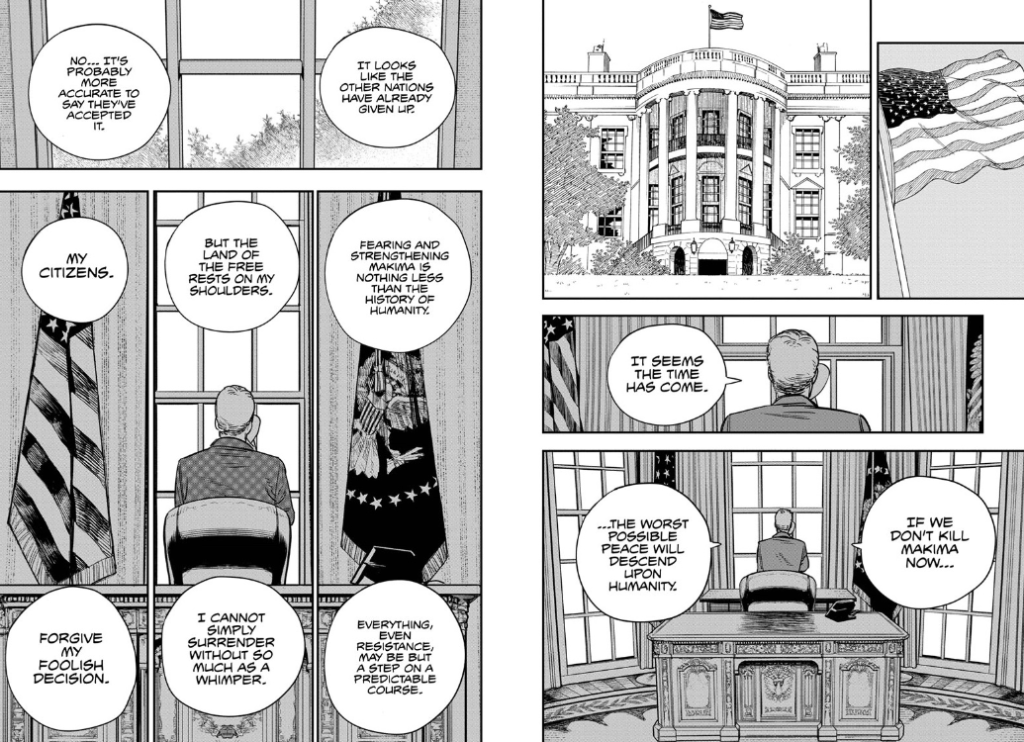
There are smart people in power, conscious of this first-worlding state of being, how utterly horrifying this manic emptiness of controlled peace is – who work to keep their own humanity…
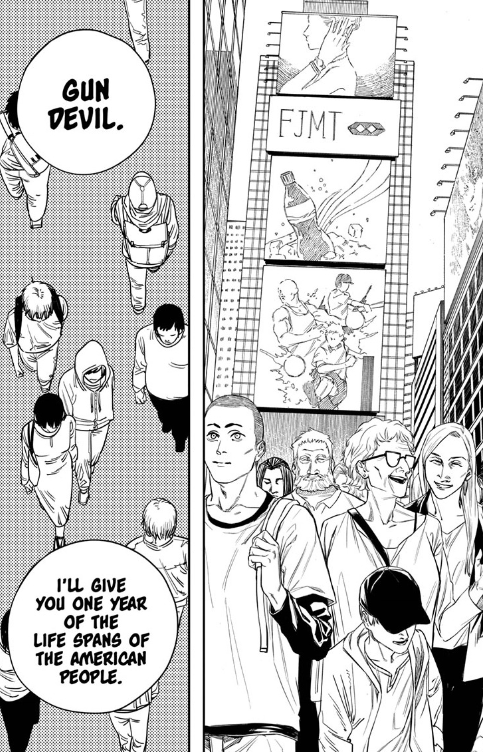
…and we already saw how citizens like Aki are always the means for whatever they truly want, whether they’re in-touch with said humanity or not. Power does its things regardless of all the wishy-washy life wisdom.
She also larps as the demiurge, much as Bill Clinton up there elevates her the same – because what else do you do when you have this much power and free time, when you’re this distant from the day-to-day?
You lose contact with reality and self-mythologize as devils. You feed the fear, relish in the control, lose yourself to your own images – and the most foolish of men feed these images more with their own fear, rather than disregarding this whole illusory game at the root and living together as conscious humans.
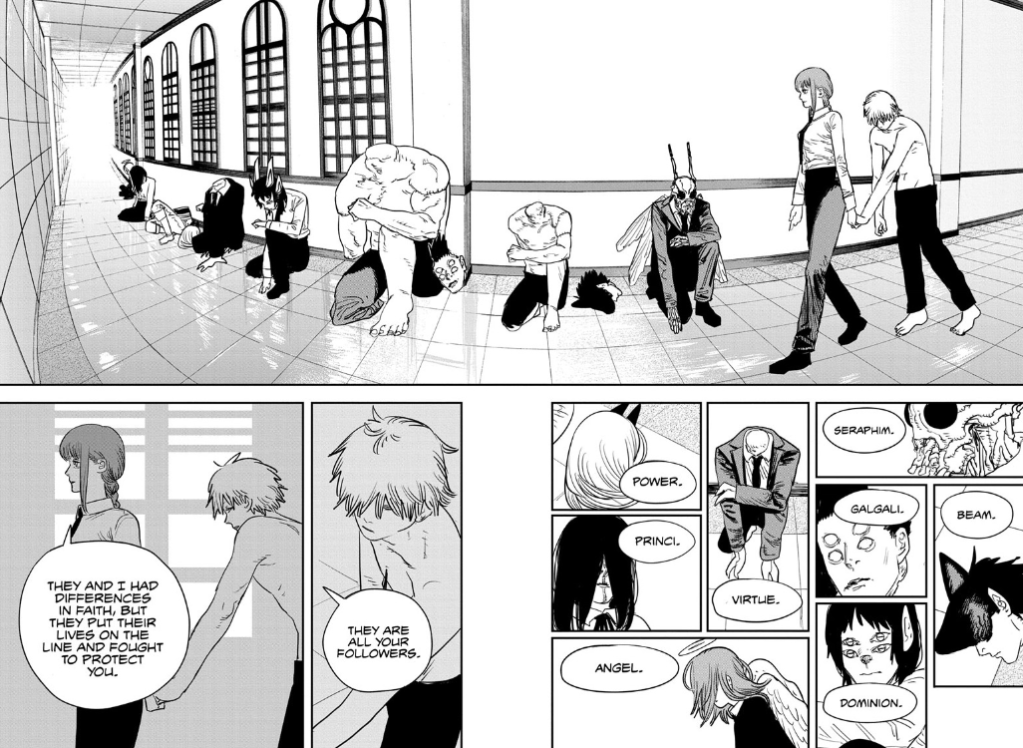
Finally, we get the ever-awaited title drop, with Denji’s gut coming out as an umbilical cord that hangs him, because you can never have enough symbolism.
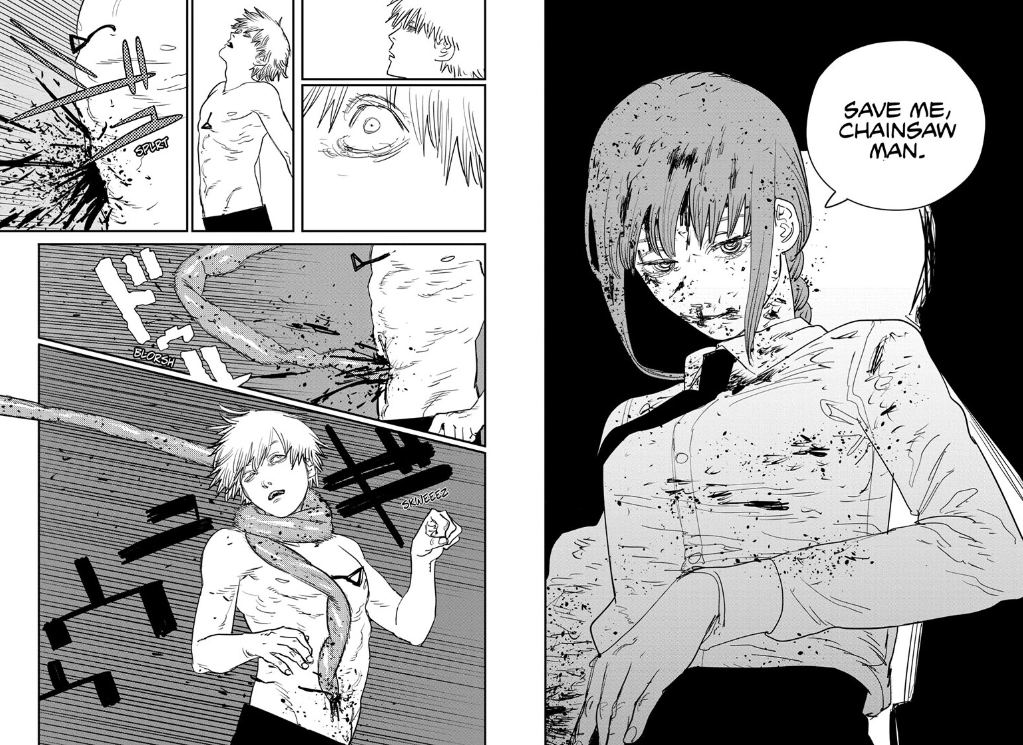
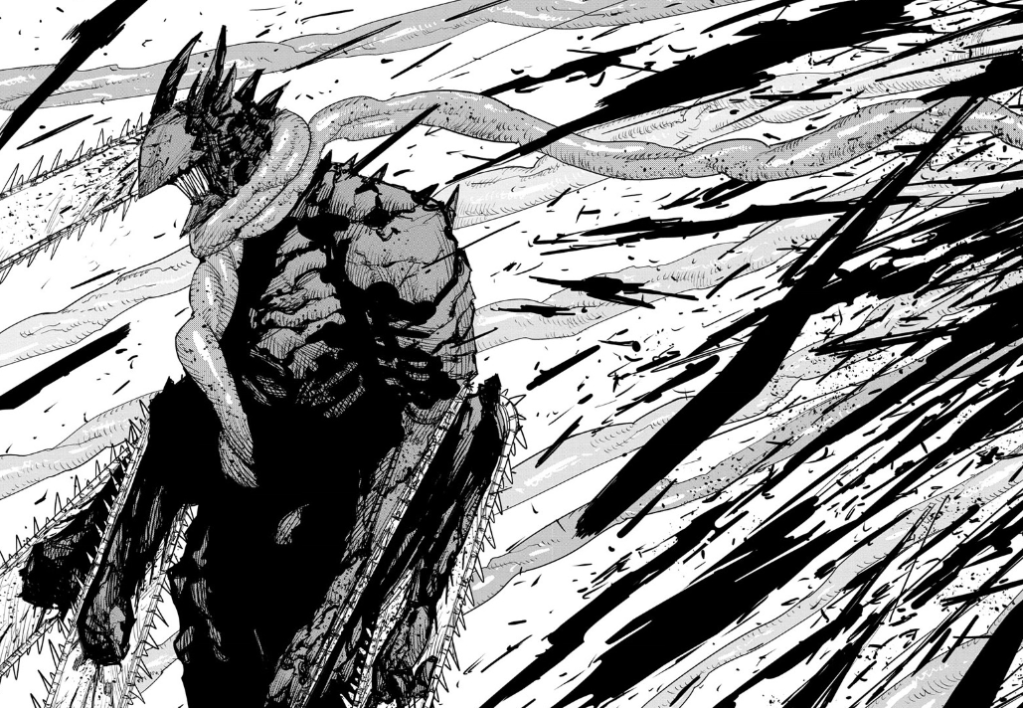
And blood and guts rain down as confetti announcing the introduction of the hero.
And from here on out, it gets really, really ugly.
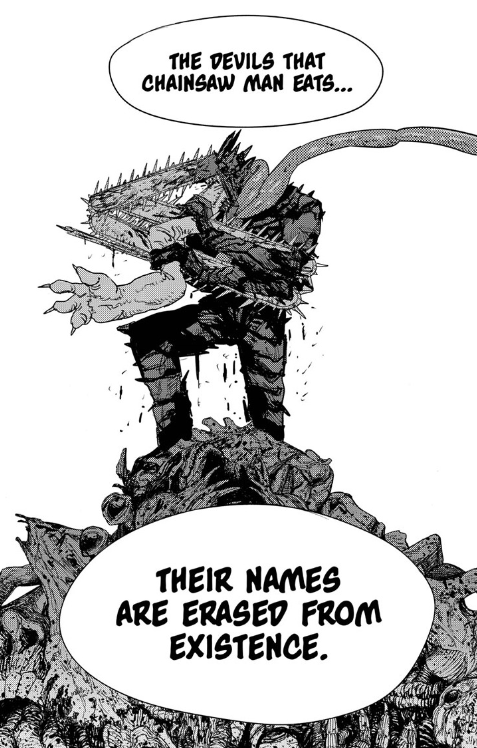
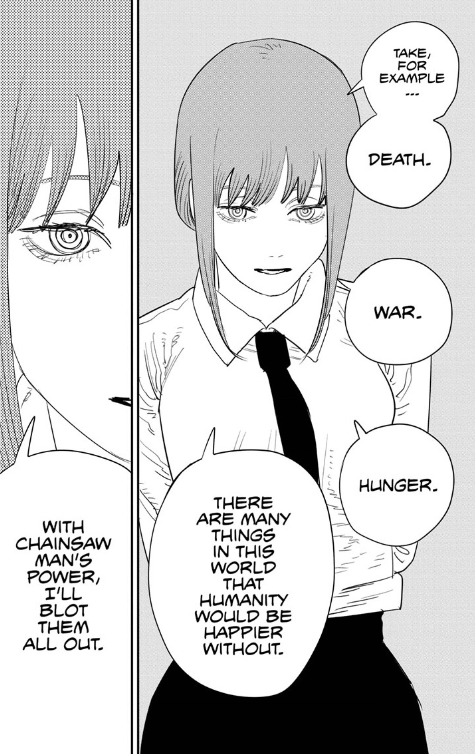
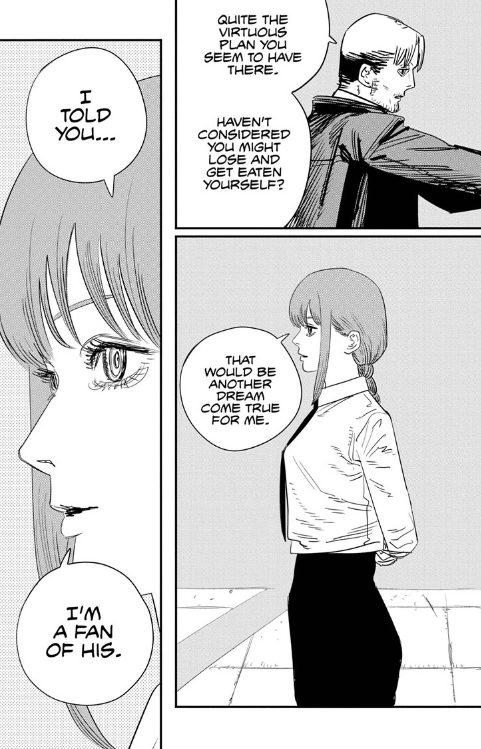
The world is half-ruled by a suicidal fangirl whose two goals which contradict each other because she truly doesn’t want either actuated (please take note of this, I’m subtly emphasizing the theme) are, respectively:
- Lobotomize platonic reality and literally shrink existence.
- Be conquered by her fantasy and get consumed by it, ceasing to exist in reality.
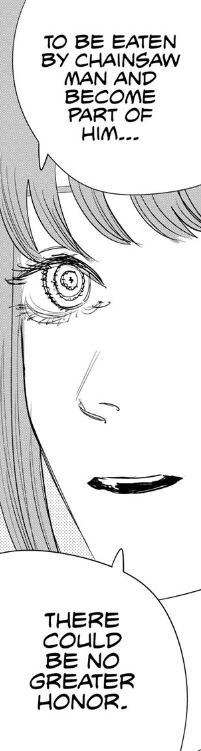
First, I want to emphasize that this state of erasure of reality is essential to Makima’s entire mode of being as pictured above, a certain state of dementia and forgettance, of the old burdening the young, of power’s retreat, of trauma settling in with foggy numbness for the hearts of youth. The stage for Part Two, and a complete description of, again, the fundamental feelings of burden, of loss, of alienation Fujimoto clocked in himself and many of the youth of Japan, of the world today.
Second, I want to emphasize the maternal theming of Makima, the fact that Fujimoto based her on abusive parents, and the abusive spouse and rapist theming. The fact that Denji fundamentally inherits this train of mental illness and gets destroyed by it for all of Part Two is harrowing and completely reinforces both of these allegories.
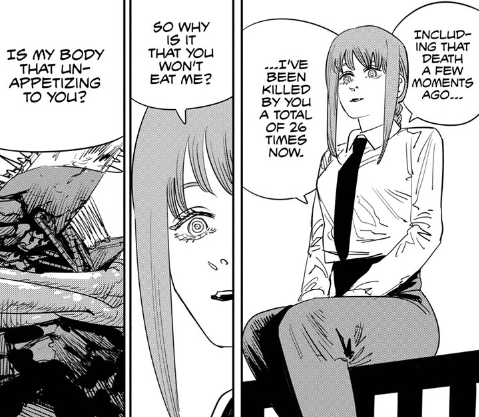
Weaponize pure control through a human body, and what you’ve created is an infinite longing for parental, romantic, platonic, sexual affection in the most childish woman possible. Every experience withheld is development not attained. Makima is not something as nonsensical as the “Demiurge,” “Satan,” or the fucking Antichrist because all of these are images of the system worshipping and fearing itself – running away from all reality, retreating from life, building up its own fetishes, committing ontological suicide and mapping this over all the world as much as the world will let them by ‘choice.’ Makima is a child seeking external approval by any means necessary. Everything of devils, idols, images are self-echoes and corrupt ‘introspections’ which those with more and more power inevitably must bear in the manner of a Lynch film.
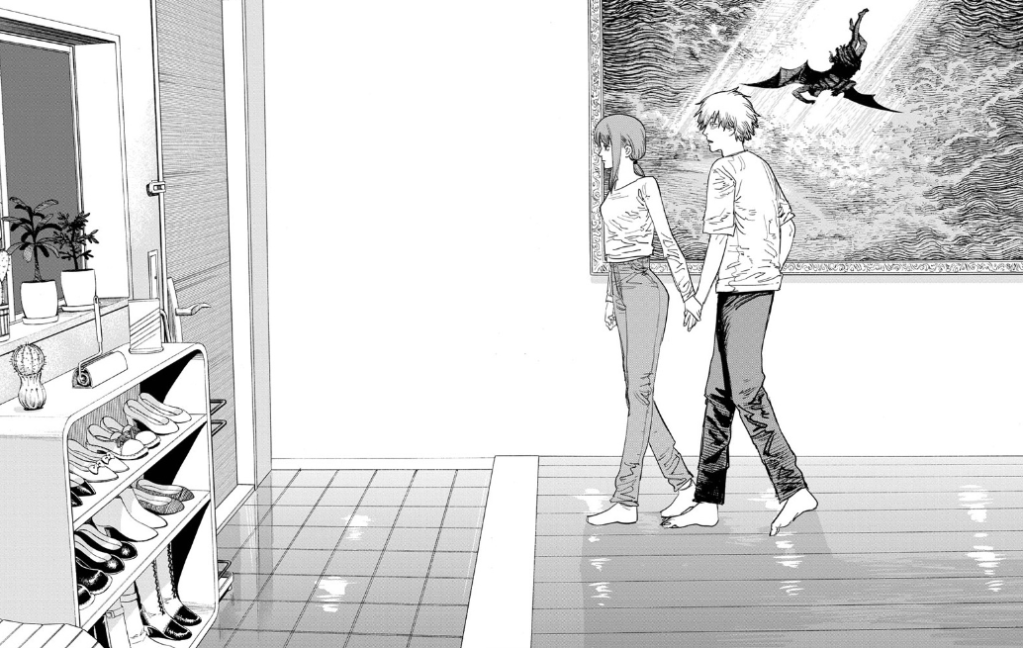
This bitch literally framed a picture of Lucifer’s fall in her living room in front of her door. A complete chuunibyou, and she’s literally a devil to begin with.
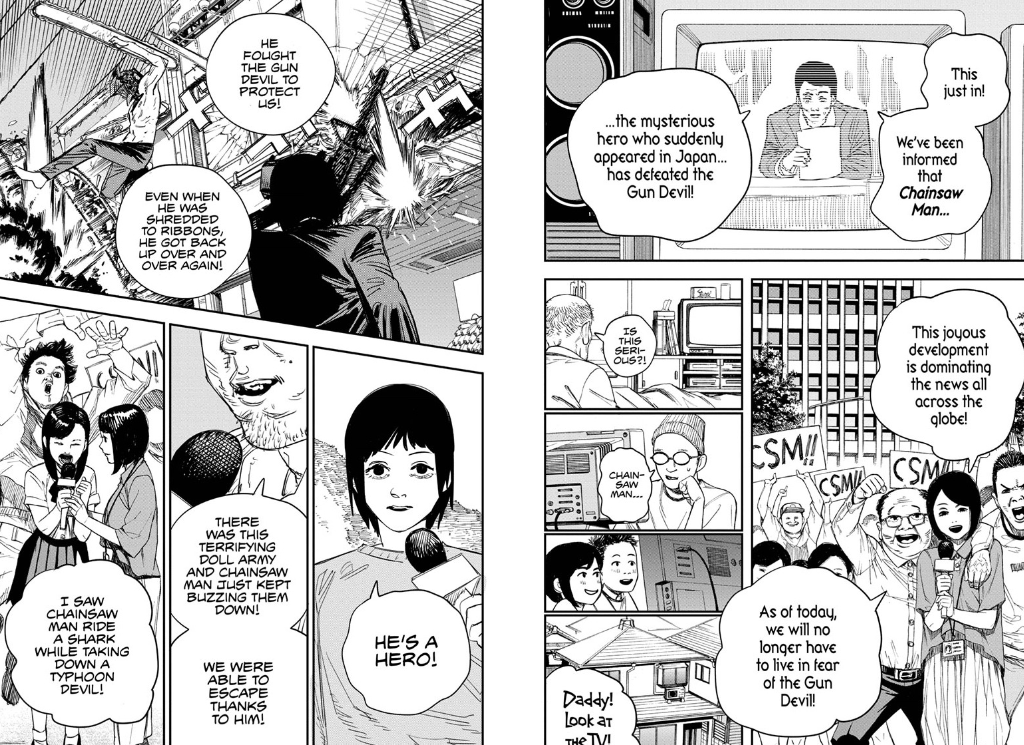
Everything Makima does is a performance of a drive for affection, and this performance reflects the entire spectacle of Chainsaw Man, the hero. This idolatry, this worship of the idea and dismissal of the reality, this extraction of human potential to perpetuate the system’s fantasies. This is the precise diagnosis Part One as a whole, and half, gives before its resolvent thesis soon-to-come.
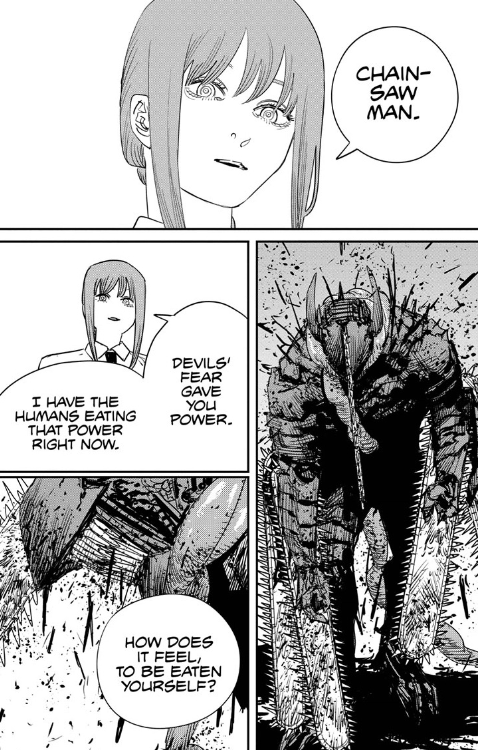
To be admired is to be reduced to an idea. To be followed is to be turned into an idol. The ideal of freedom, liberation, and the hero is based in denying that hero’s physical individuation. Makima’s no-choice performance for affection requires her to defang the real, threatening, flesh-and-blood Pochita and reduce him to Chainsaw Man. The perfect idea becomes bigger the smaller and more controlled the actual is made.
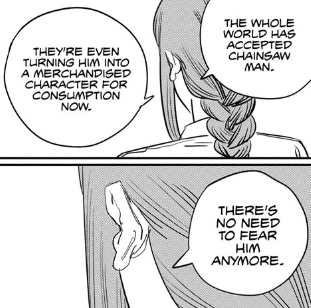
The state is conquering its own devils. How could we not secularize? Common people don’t own the Angels. They don’t get to write the myths. They don’t determine the theses of history. Not as long as the state will allow it.
And then Makima shoots Christ’s Millennial Kingdom through the Holy Trinity to make Pochita sacrifice himself to save the meek who will inherit the Earth because Fujimoto wants to use this myth-woman as an excuse to indulge and create a third category of symbolism as big as language and mathematics.
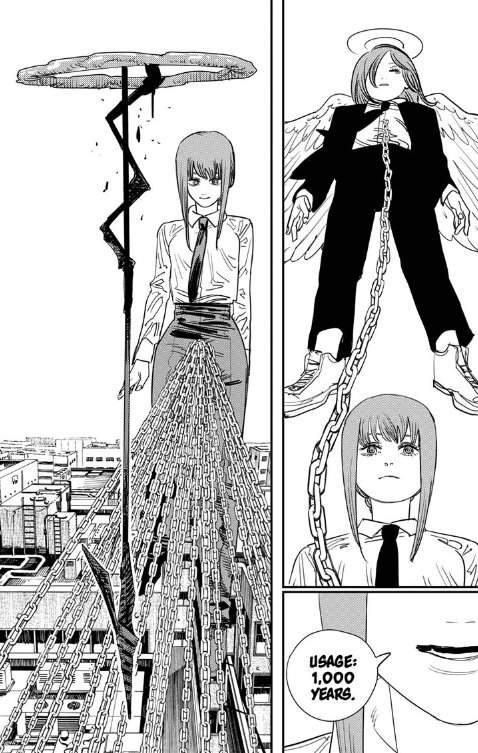
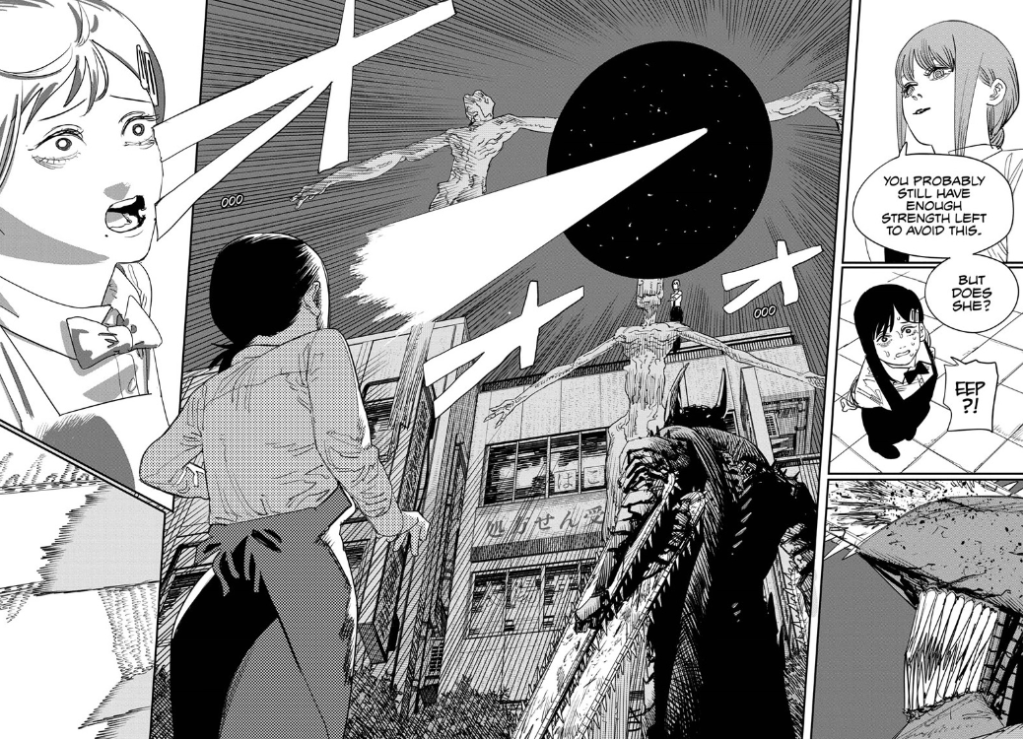
The Catholic Church is pretty bad.
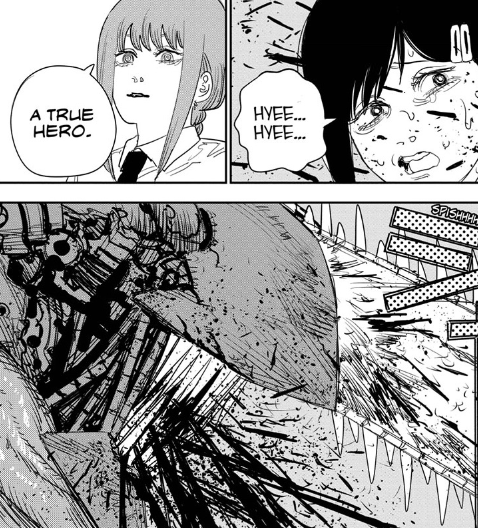
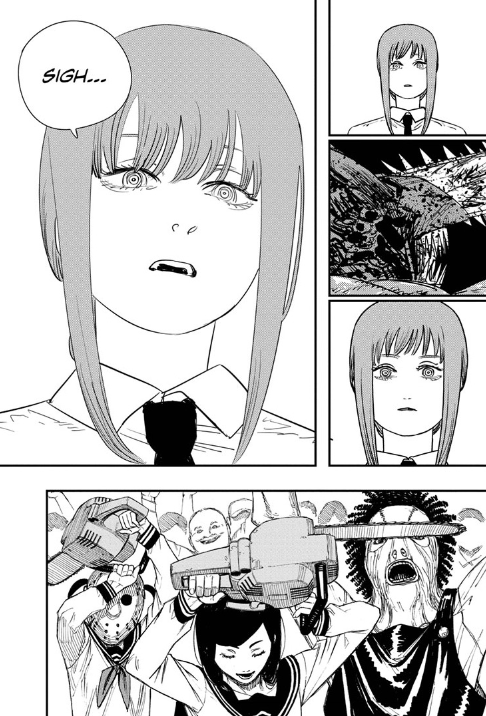
But against this infinite spectacle of mythology and painting oneself the ultimate Demiurge… reality begins to seep through in our modernity. Rather, our day-to-day lives are finally being accepted by the state as permissible myth. But now, for just a moment…
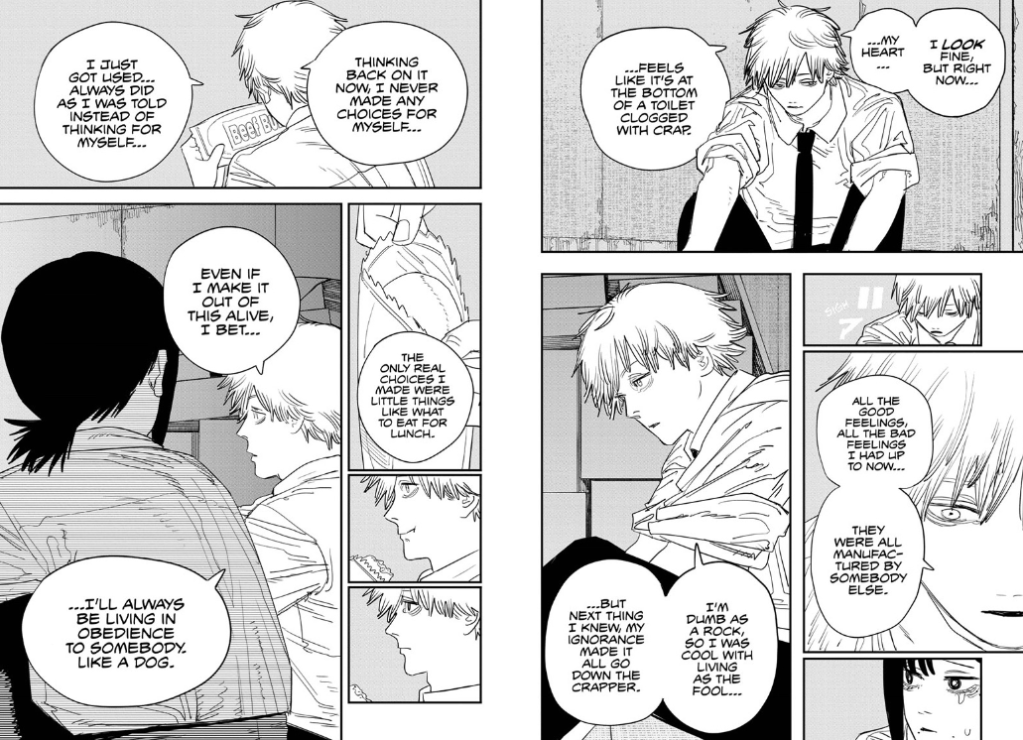
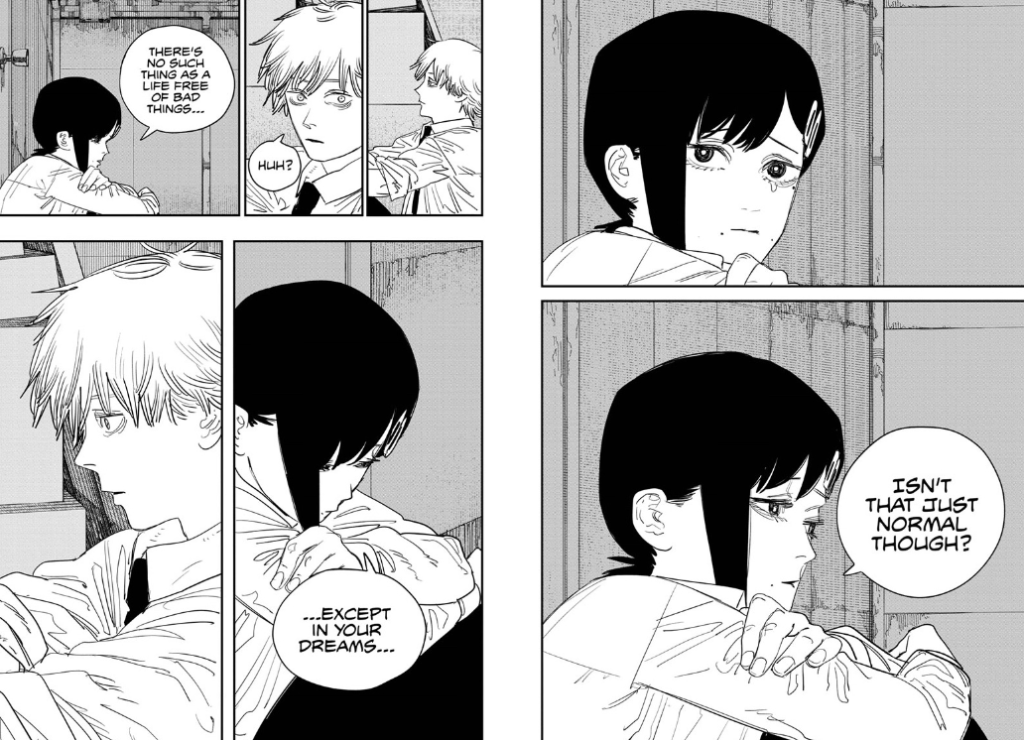
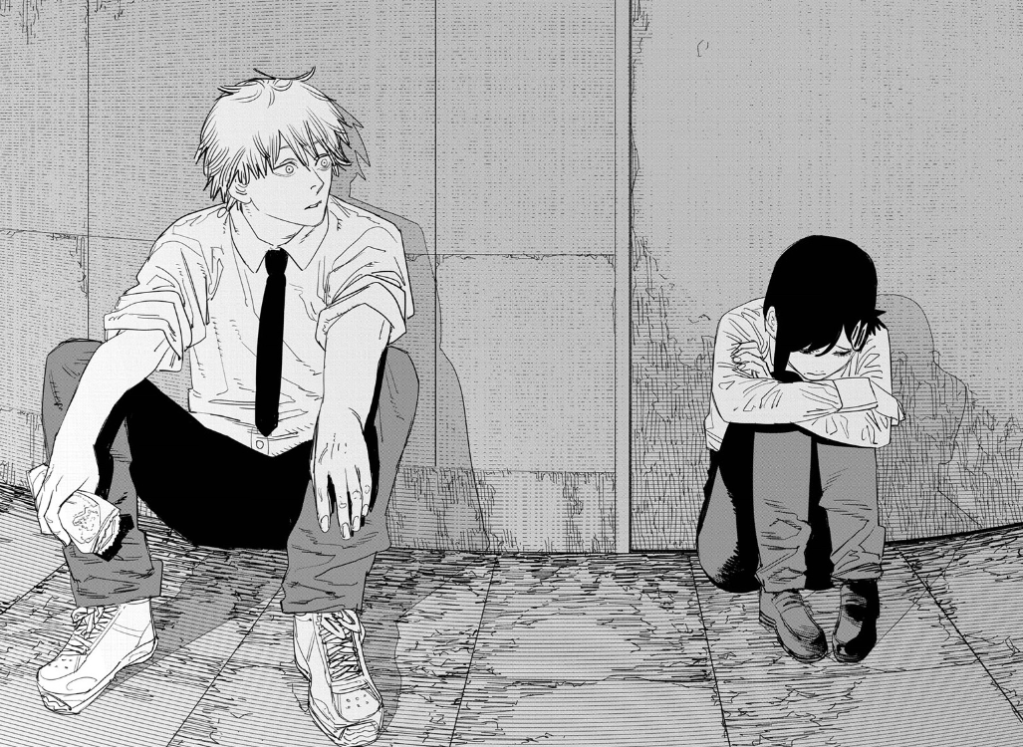
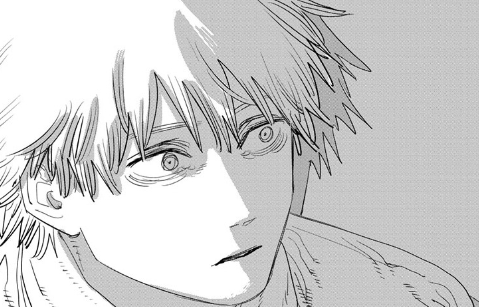
Denji, and we, get to see and feel the reality.
The thesis of Chainsaw Man Part One is to free oneself of the idolatrous spectacle of the state’s devils to live as a human. To live in reality, without images, to suffer in passion with other human beings on equal terms. Makima is the utter antithesis to this. She can never access it, and it is all she can long for in the same. For her, it is a mere form of entertainment to be studied and perfected, not understood or lived in.
But after this great moment, the man whose whole being was entirely destroyed by Makima before he could have formed a stable identity… begins to latch on.
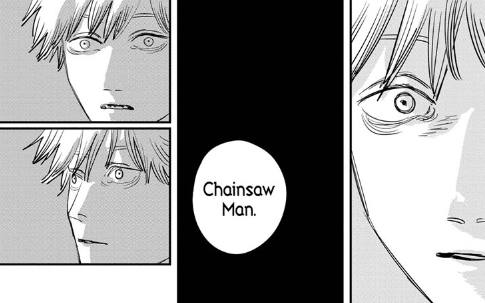
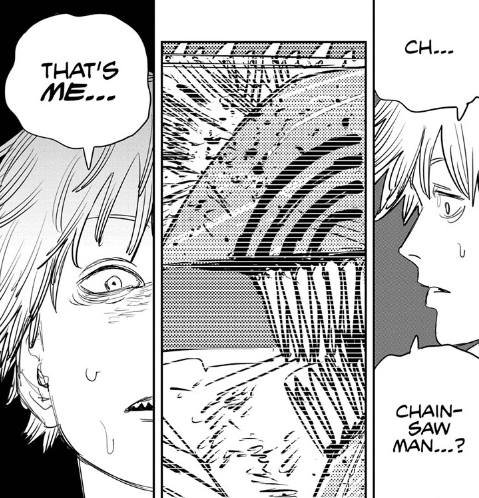
When the state promises young adults choices and fantasies, or the simple allure of functioning life as an adult, or even love, of something more true – and once it utterly destroys them, extracts the utility of these human weapons, and works to get from us its own desperately needed savior… what can most of us do, but latch on to some more of its mythologies, and find an identity and purpose through that?
Right here, in this moment, Denji became Chainsawberg Chainsaw Man.
Not Pochita. Not Denji. Chainsaw Man.
What we see here is the root of fascism, what we can call the dying cry of the soul. Makima has irreversibly won.
But for one final moment, the boy must speak his humanity – and, as he once did, risk it all for the heart of a young, hurt girl before him. But this time, with all the experiences he accumulated in Part One, he can make a choice.
And that choice is to leave the next one to Pochita himself. Because who, in the whole cast of worshippers of Chainsaw Man here and to come, in the fandom itself – how many cared of what Pochita wanted as an individual?
Show me your dreams.
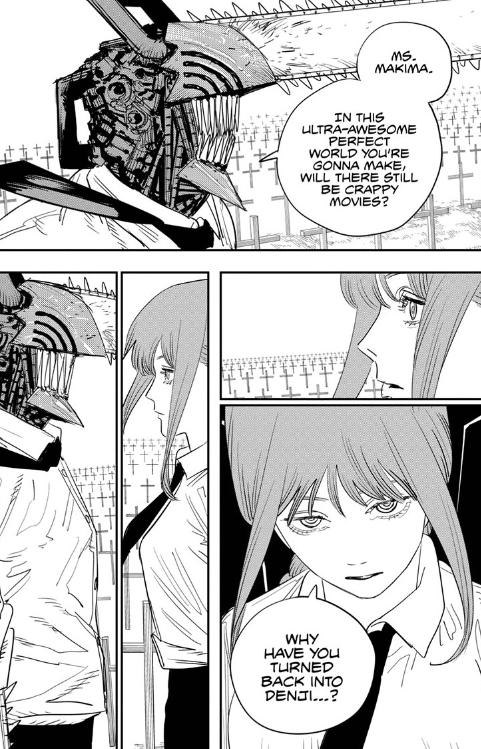
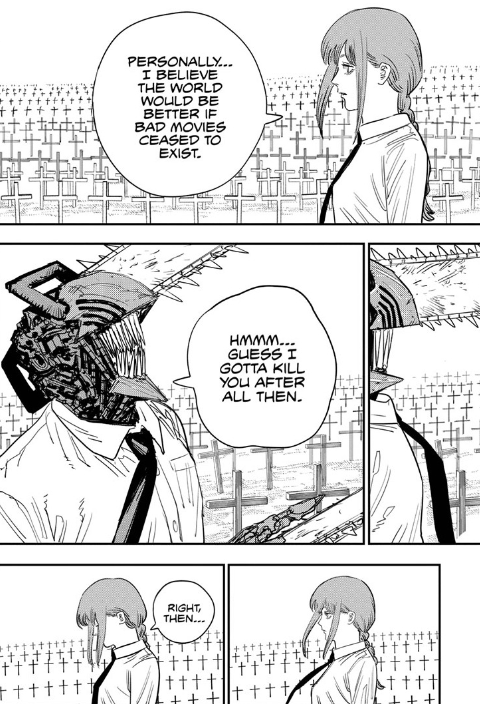
For the one who loves dreams, the fact of the state not permitting the day-to-day reality of all the people in the world who produce them, of not accepting any of it into the common mythology, of doing away with bad movies entirely for some dead image to worship… is tantamount to suicide.
And that’s all she ever did.
There are few pieces of dialogue in any manga which articulate the themes of a whole work so succinctly as this. And with it, a legendary fight comes and ends.
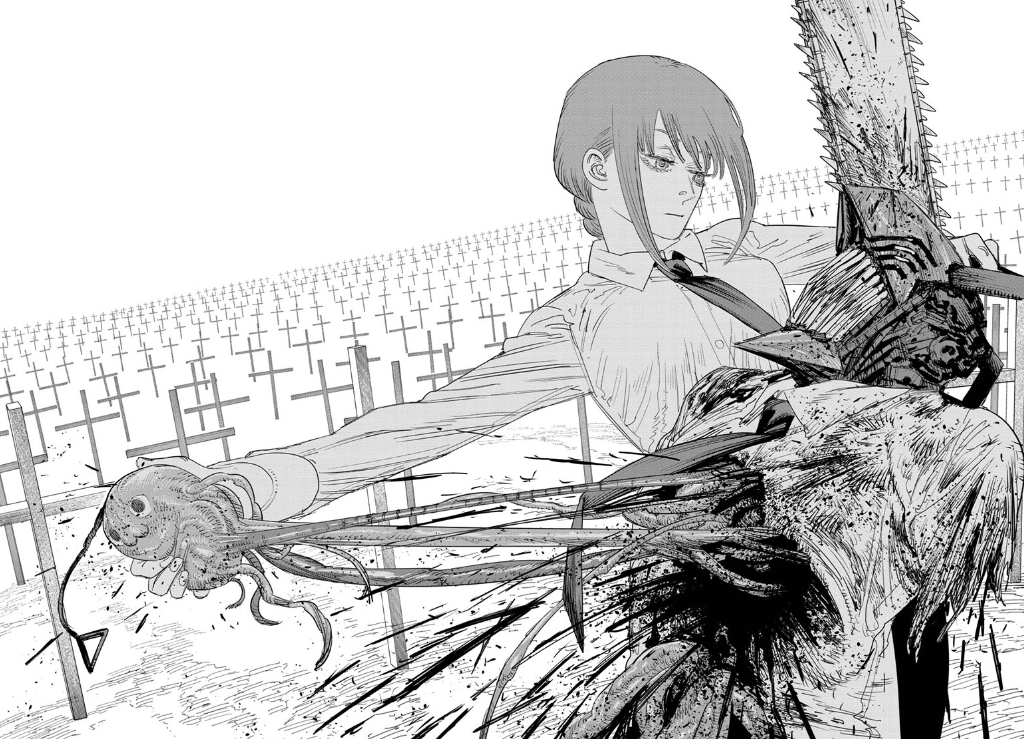
And Makima’s core bares itself as pathetically as possible.
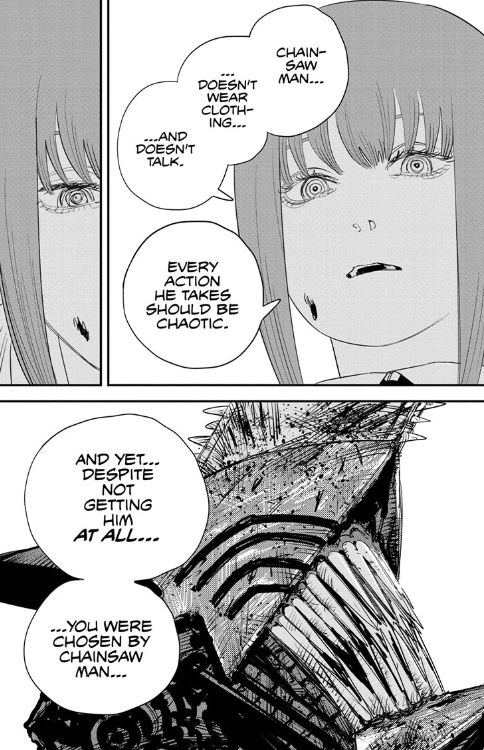
And we get the funniest, most absurd instance of a fictional character quoting another from their work in literal history.
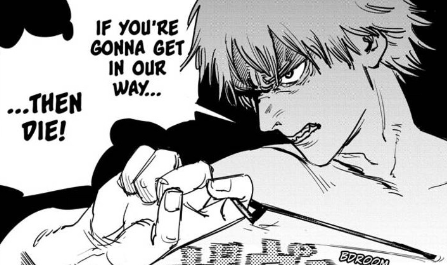
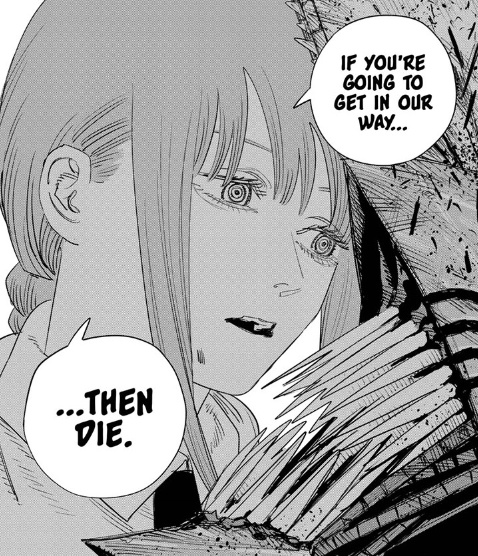
And with this absurdity unifying state appropriation and manic depressive fangirlism, she effectively kills Pochita. If there were no Denji, Pochita would be done here. There would be only the idea of Chainsaw Man.
And then reality triumphs over the ideal, over the God complex, over the fanatic at last – and also saves Pochita in doing so.
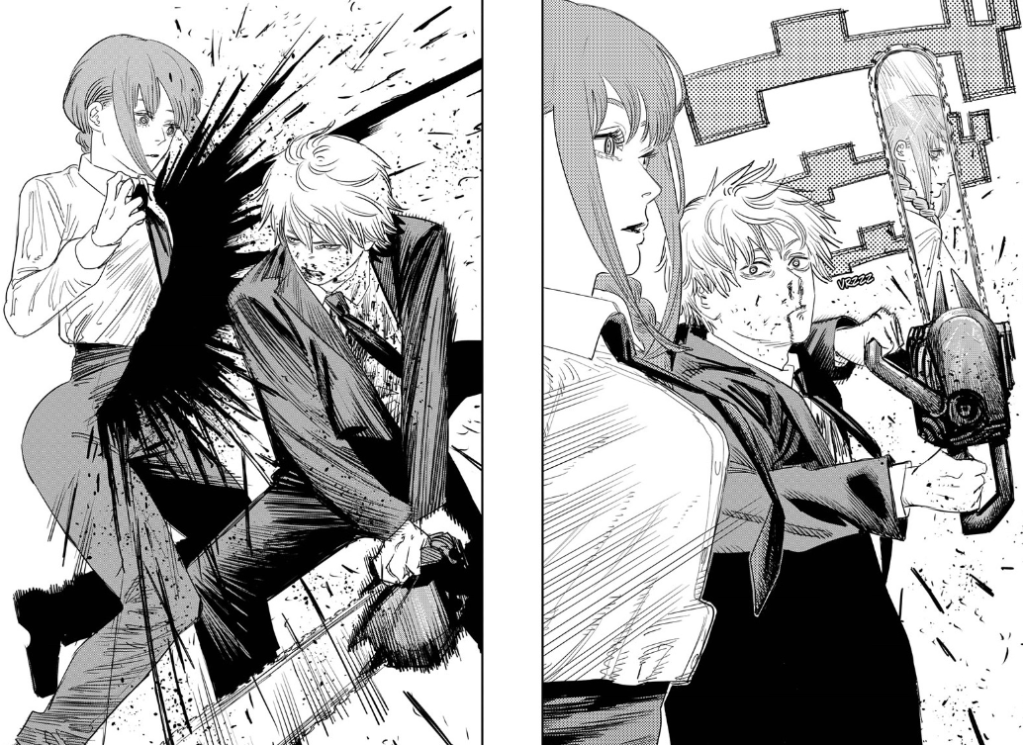
A broken sixteen year-old boy, wielding a real chainsaw enhanced by one of all the people in his life Makima killed off to break his individuality, asserts his existence in tragic desperation and ends the one who nearly made herself God with one fell swing.
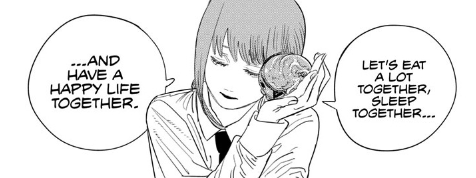
And how horrifyingly tragically evil was she, to sacrifice all the homes of the world for her own never to come as long as humans walk the Earth? Once again: I must give Fujimoto borderline exaltation for articulating the entire mode-of-being of suburbanite-imperialism as perfectly and utterly as this. What a villain.
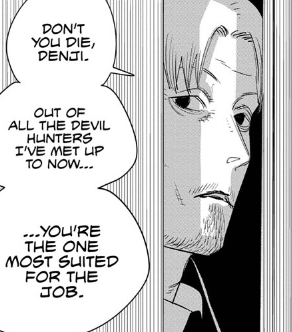
And with this final push… Denji is gone.
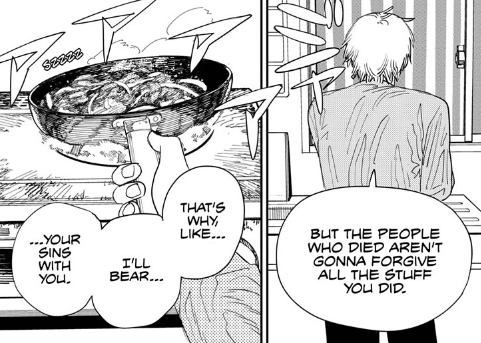
He bears her sins and consumes her flesh. It could not be worse.
And then it gets worse.
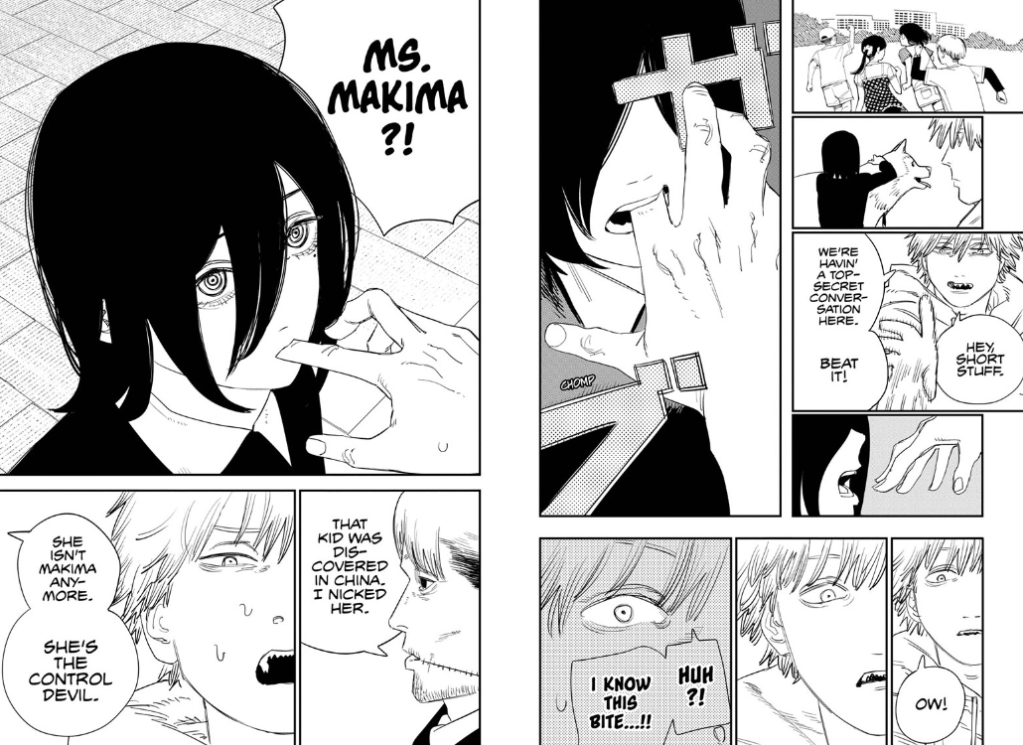
The duality of Denji/Makima and how they bind to Pochita/Chainsaw Man is the core of Part One, and of the entirety of the dream Denji showed Pochita. Makima is the spine which binds the book, the entrance of Denji/Fujimoto’s fantasy, the muse who adorns this grounded narrative in a luscious excess of symbolism, an intellectual manifestation of Fujimoto’s own masochism taken to divine principle. For fuck’s sake, their powers are chains and chainsaws.
The brilliance of Pochita is that he accesses true spirit. Where Makima symbolizes and perfects to absurdity in her own dejection, Pochita pursues others’ dreams. Pochita is the script-runner, and Makima is the worst possible reader. The two of them are the glory and the misunderstanding of abstraction, fictionalization, and mythologization. They are inseparable – as Fujimoto will confirm in due time. Pochita cannot defeat Makima, and Makima cannot do away with Pochita. Without Makima, Pochita would likely never have come to Earth; and without Pochita, Makima would have no reason to exist. They are legitimately bound to each other. The mama who binds others to her womb, and the chainsaw hero who assists in birth, but keeps himself choked in his own, by the fact of his own existence, as given by the visual of his umbilical-scarf. This contradiction of Pochita’s being is something that will come back around much later.
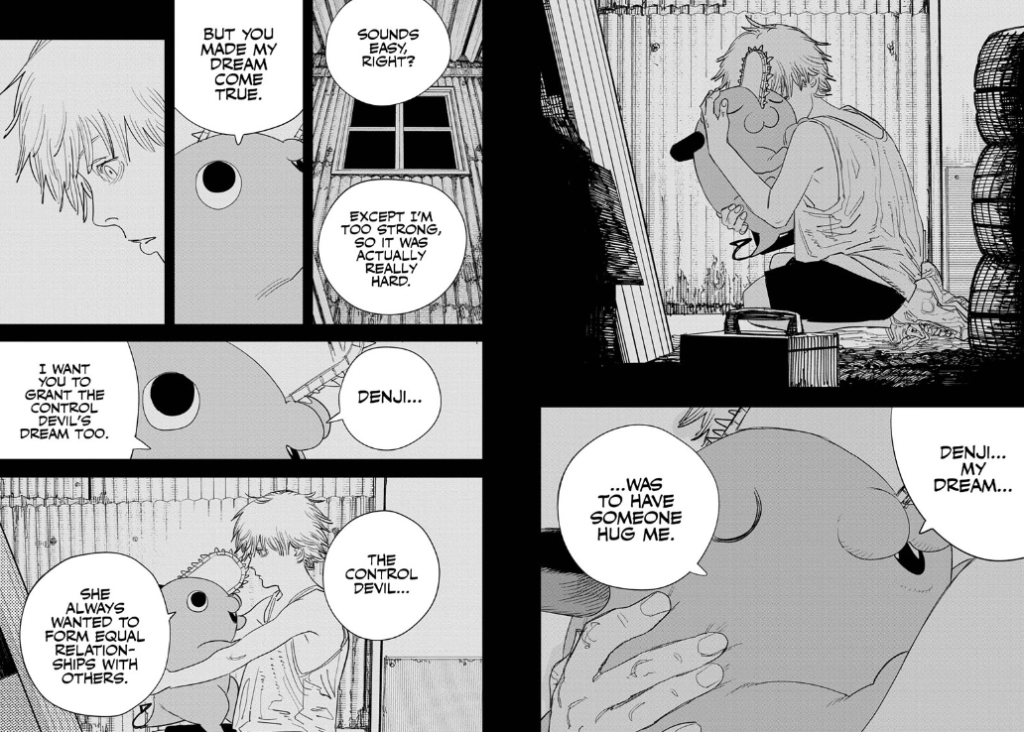
But still, this arc is heavily set up here. Pochita’s being contradicts himself. The vivacity that gives him such a strong desire to love gives him too much strength to make it happen. And, naturally, this meant Pochita wants to see others live out their dreams. As a grandparent, mind and body beginning to give, looks with worldly wisdom to their grandchildren – Pochita, the ultimate devil that all devil fears, looks to the dreams of all devils and men in exchange for his own dream, the one that absolutely cannot be fulfilled. And past that canceled-out sacrifice, the metaphor for adulthood and deep love that pins the entirety of Chainsaw Man’s first part – in that love of all living things, he achieves a higher purpose still, for which he can live forever, in never-aging love and infinite spirit.
Yes, Pochita is, to some extent, clearly based on Jesus Fucking Christ.
But even if Denji would tear it all down for the sake of a person as grounded as Kobeni, he must show Pochita his dream to the very end, we must see the end of Fujimoto’s dream; and this dream turns into a post-traumatic nightmare as she binds herself to Denji for eternity, as the SA allegory escalates with Nayuta, who provides the solution and the responsibility of living with it all…
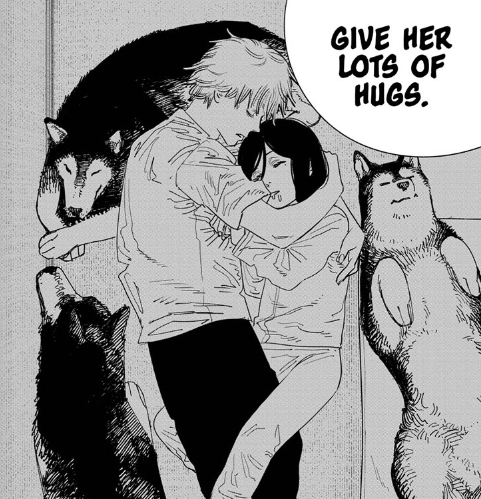
…but Nayuta is strictly her own. Makima herself, not the Control Devil, truly lives within Denji for eternity. It is not with Nayuta, with Himeno or Aki or Power, with any new people Denji can meet – not with Pochita, not for any further dreams of his own, not for any life lived with others, any semblance of reality and the reaching for life away from Eternity – with none of these does Denji now go on.
Denji has ‘taken Makima’s sins.’ He has taken to Chainsaw Man, not to Pochita; he has taken to validation through the public spectacle, not to individuated human affection. He has taken Makima’s way of being. From now on, his life is with Makima, the world is with Makima.
Or rather…
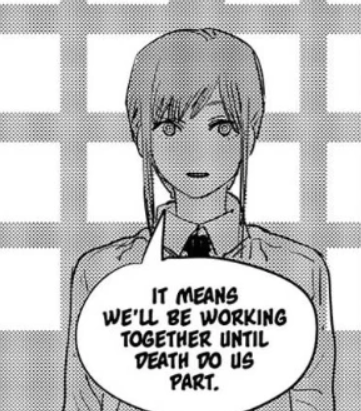
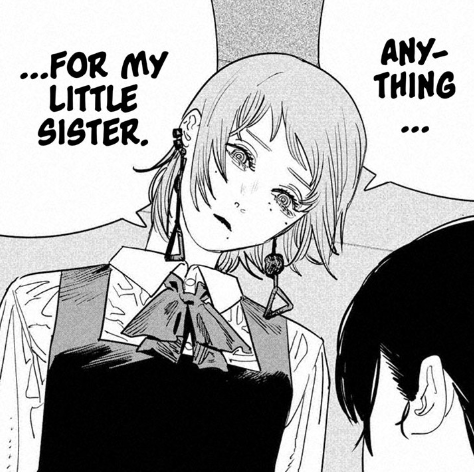
END OF PART ONE ANALYSIS
THE ANALYSIS – PART TWO
Foreword
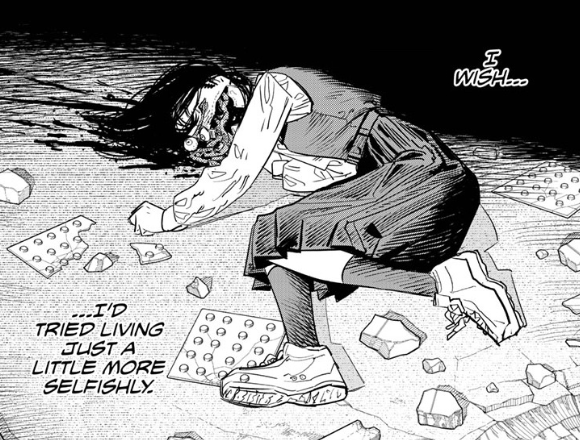
When I began this analysis-review with some statements about Chainsaw Man as a whole, I praised Fujimoto’s ability to write a slow-burn, character-driven narrative through and beyond a series of chaotic, hype-fest arcs. Part Two seems, on a casual read, to break this in exchange for a vaguely postmodern collapse of narratives, with characters as islands of isolated narrative that only drift further and further apart.
Part Two very effectively levels-up the game from Part One in taking its slow-burn-over-chaos approach and amplifying it considerably while also delivering the theses of its characters immediately in almost every case. In Part One, most characters have mystery-based arcs, being introduced in-media-res and then gradually having their backbones revealed over the course of the slow-burn. Aki is a stiff, principled man, whose underlying fuel is revealed when the Gun Devil is introduced. Himeno’s character is drip-fed to readers from the beginning of the Eternity Devil Arc to its end. Makima needs no introduction, and a massive element of Denji’s life is withheld from us until she reveals it to complete our picture of his character. The only major characters in Part One to spell themselves out immediately are Power and Kishibe.
Part Two’s character arcs are more accurately described as instantaneous deliveries of the very theses of the cast, which are then tested against the narrative, rather than being the foci of it – the way Aki, Santa, Makima had the narrative swirling around them at different points. No one in Part Two is in control of it, and, with the exception of its two main villains, all of them are completely spelled out as soon as possible.
After enough regurgitation of Part One’s common praises in the first half of the analysis, the time has come to evaluate the truly difficult second half of Chainsaw Man, so bombarded with both slander and praise from fan and hater alike. Without further ado: Chainsaw Man Part Two.
BEGINNING, AGAIN: Also Dope on the Mic
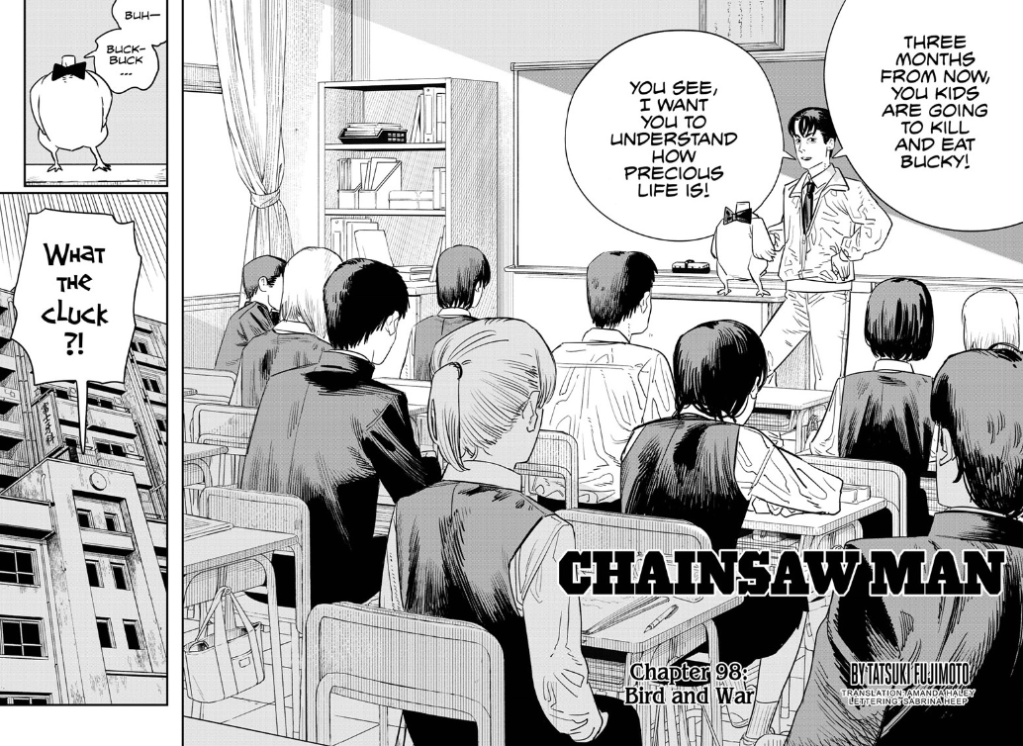
The first block of analysis for Part Two will be dedicated entirely to its first chapter, because this is, with the possible exception of the second-to-last chapter we’ll see near the end, the absolute densest narrative piece Fujimoto wrote in his entire life until now.
This is the introduction of the one-and-only…
Asa Mitaka.
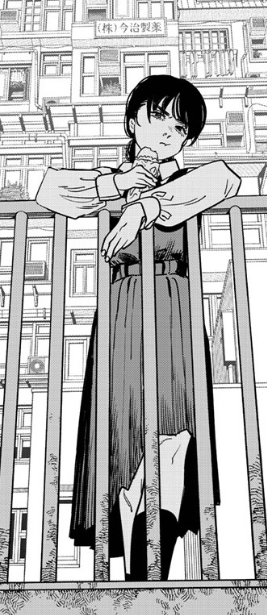
Asa Mitaka. Oh, Asa Mitaka. Oh, my sweet, sweet Autism Mimiga.
Trying to analyze this character is less of an interpretation of meaning and more of an insertion of a strange and exotic amoeba under a microscope. This chapter is some of the strongest characterization of Fujimoto’s career. What he sacrifices in direct meaning, he makes up for in apparently ripping a real-life human soul out of its body and shoving it into a comic homunculus.
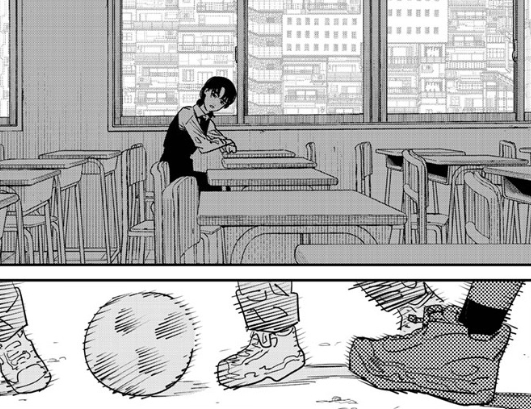
And it’s a horrifying comic homunculus.
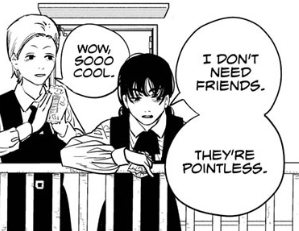
While I could continue to gush about just how well this horrible entity is characterized, that would very much be entering entirely into review territory, so I’ll start getting to the point.
Fujimoto completely defines Asa’s entire character, character arc, and mode-of-being in the span of a single chapter, and the crux of this is one of the most interesting ideas he’s ever come up with (or conveyed; I can’t strictly tell if Fujimoto knew the precise extent of what he was selling): Ontological Hypocrisy.
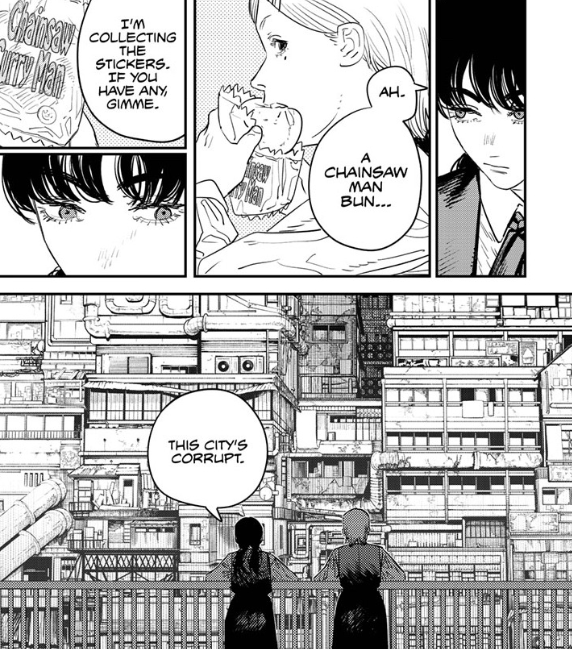
This might be a pretentious way to refer to her being a teenager, that horrible thing, but Fujimoto creates a phenomenal and very immediately striking character set-piece in the span of five relatively understated panels (by Fujimoto’s standards of subtlety). Asa’s rejection of others is pure bullshit. As our Lord and Savior Yoru will speak well upon, Asa is rejecting her own life – and, in a sense, legitimizing societal decay. Asa Mitaka does not have critical thinking skills. She rejects social and societal corruption whilst openly engaging in its spectacle and nothing else. She keeps her shallow interpretation of self so close to heart, out of pathetic envy, that she’s lost all contact not only with external objectivity, but with actual self-awareness. Asa is the product of the world to an extreme extent, far beyond her more surface-level ‘materialistic’ peers. Her rejection is based in her materialism, dialectically reaffirmed with her consciousness-rejection. She is the child of a corrupt society, and her subconscious is that, or becomes that, which reinforces it most of all. The world is practically built for her; and her, for it.
Because she rejects it.
Asa being presented as a sort of anti-Denji while also being equated with him is the most deliberate move of Fujimoto’s career, because she’s an even greater, normalcy-level embodiment and the product of the horrible circumstances he desperately tries to fight, but can’t. In the same way that Denji embodies contemporary alienation and enburdenment in Japanese youth, Asa embodies an even greater, worse trend amid us youth today: consumerist dejection, antisocial rationalization, and abandonment of both responsibility and reality altogether. A society blatantly fueled by rejection, convenience, and disconnection will make its best, most-fit potential members into fires of rejection, convenience, and disconnection. Asa is a fucking clusterfuck of traumatic introjection, absolute ignorance, and sheer autism that sees and falls under ‘actuality‘ whilst rejecting proper social standards, which the, well, not-blatantly-autistic classmates around her keep up not because they’re dishonest, but because they understand, more fully than her, that this is what should be.
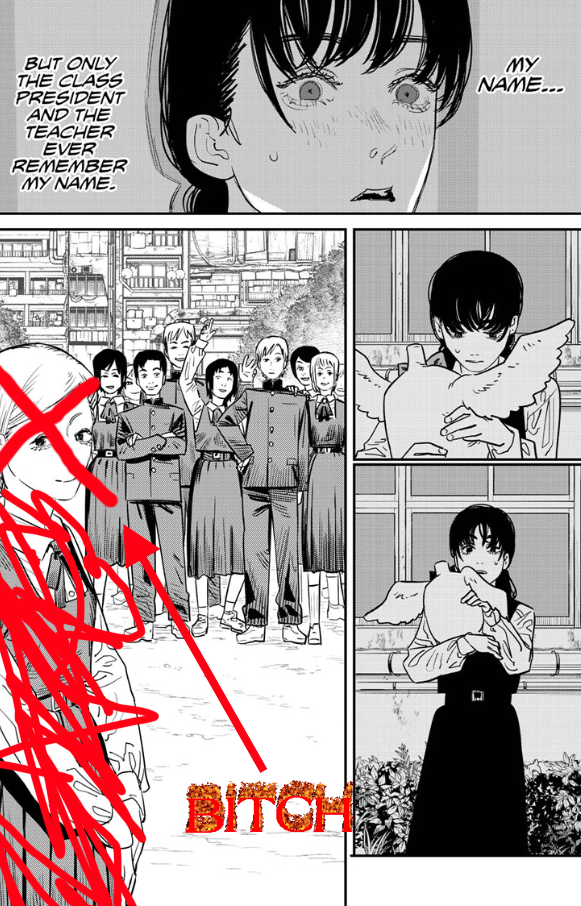
There really isn’t any way to analyze this character without bringing up her autism. Asa Mitaka is as explicitly autistic as you can make a fictional character without having them look to the screen and wave to the audience, saying, “Hi, I’m autistic!” Another of Fujimoto’s great strengths as an author is how he portrays mental illness. He does not glorify it. He acknowledges that, in so many cases, it actually does end up defining who you are. This doesn’t mean it can’t be mostly broken out of, at least for some, or that it’s universal.
But, again: Fujimoto can be a brutal realist.
Denji is a fairly realistic representation of extreme trauma, especially sexual, as well as arguably ADHD. Asa is a horribly realistic representation of being an autistic teenage girl in a misogynist, consumerist society. It is what it is, and Fujimoto checks it without restraint, equally expressing both rage-filled tragedy and absolute comedy, especially in these first two arcs of Part Two.
But with this set-up of Asa’s insane societally-backed unconscious, we’re given quite the pay-off.
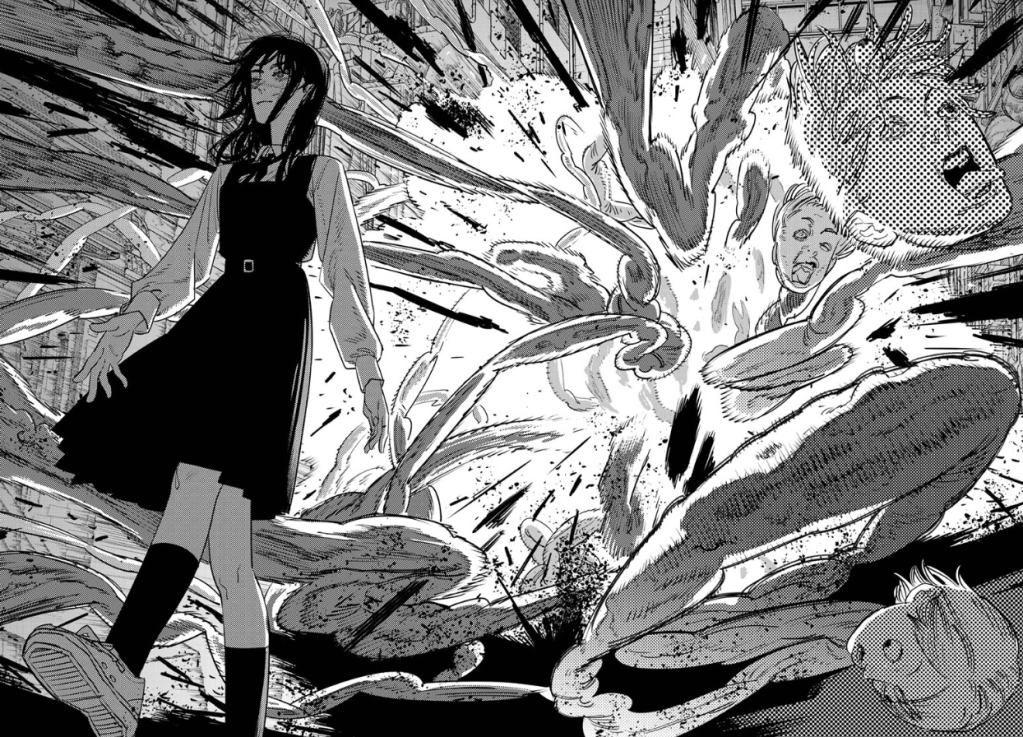
We’re the greatest devil in the history of this country
Yoru presents herself as Asa’s shadow, quite literally taking Yoru (Night) as her name parallel to Asa (Day). The explosive, repressed, visceral energy (and how much could I sing praise of Fujimoto’s presentation of viscera as a symbol both of violent consumption and of spectacle, unified through the imagery of confetti intestines upon the incarnate Chainsaw Man) of Asa bursts out in the fantastical relief of Yoru. In other words, Yoru is the test for the completed character of Asa. We understand her entire character: but with that hypocritical subconscious actuated, can she process it, exceed it, integrate it, and become better before the end of this story?
Asa wanted to be loved by others.
Asa wished to live a little more selfishly.
This dynamic might ring quite the bell with our first protagonist in a much more substantial way, which recontextualizes and adds new layers to Denji’s character in the same. But to really dive into that dynamic (Denji and Pochita), this new dynamic, and the ultimate pay-off of Chainsaw Man as a two-sided whole, we should move onto the second meaning of the name Yoru.
Let’s repeat the foundations of it all.
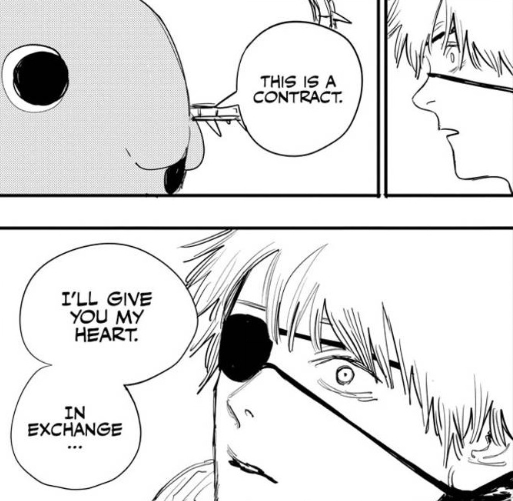
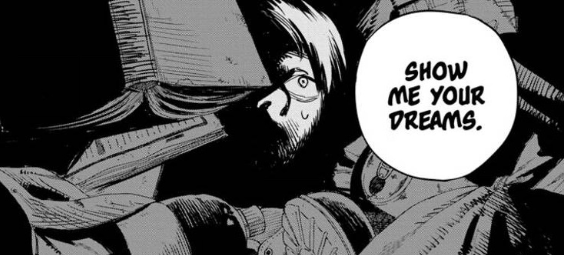
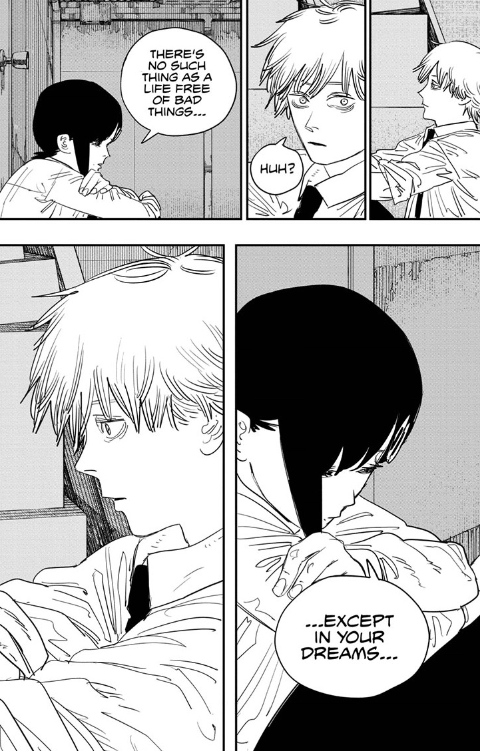
We live with our repressed urges, unattainable desires, and lost chances during the day, and dream during the night. I’m astounded I haven’t seen this pointed out before. Asa and Yoru. Yoru is the ultimate representation of all the escapist, violent, fantastical, free-spirited dreams of Chainsaw Man. She is the dream Denji (Fujimoto) showed us in its purest, most destabilized form, refusing to go out in day. She is the dream turned into a nightmare.
Internalize this interpretation if you haven’t already developed or found it, because, like many good things in Tatsuki Fujimoto’s works, it will be taken back out and shot in due time.
While we could dedicate good time here to Bucky setting up Fujimoto’s use of consumption-as-dehumanization (because this is a massive, massive theme for Part Two), I’ll just allude to the idea for now because I don’t want to destroy my credibility with a dedicated Bucky section.
Denji-kun, Love is Justice
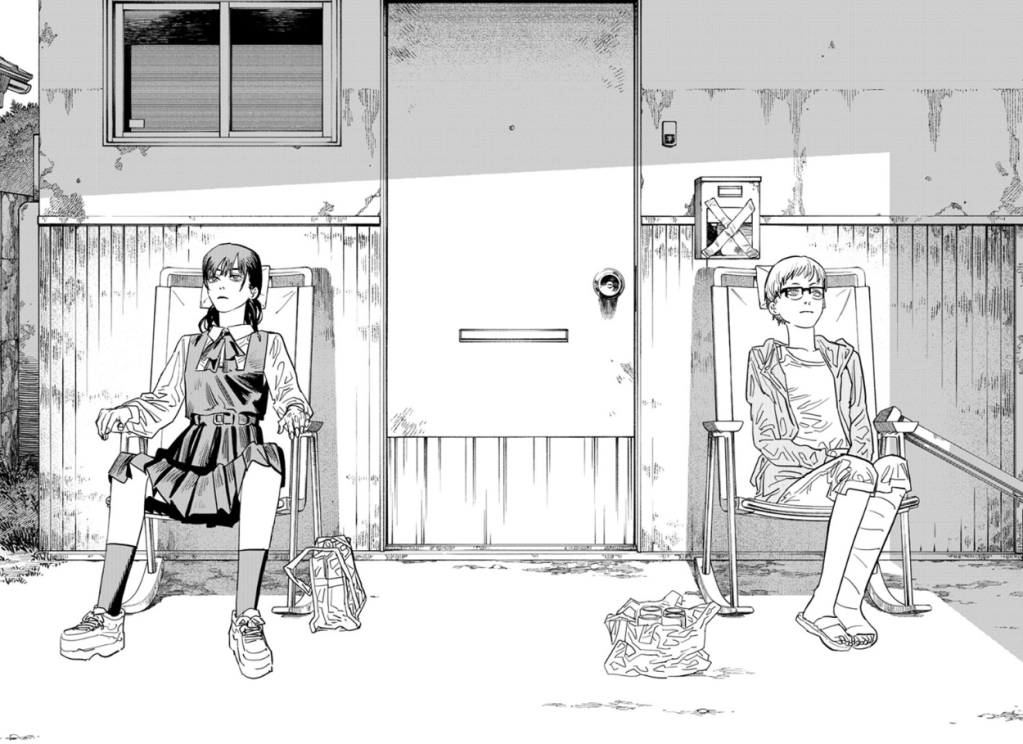
The first arc of Chainsaw Man’s second part serves as a microcosm of the tragedy which will define the whole and, in one of Fujimoto’s most effective narrative strokes, bases it against its humane, grounded, and responsible alternative.
Asa Mitaka longs for genuine human connection, connecting to a great wave of deep melancholy amid today’s alienated youth. To set the conflict and give weight to Asa’s fears, Fujimoto comes in swinging with a nightmare.
Introducing: Yuko
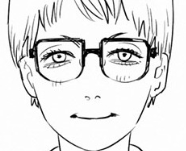
This is me. Literally me. No other character can come close to relating to me like this. There is no way you can convince me this is not me. This character could not possibly be anymore me. It’s me, and nobody can convince me otherwise.
Yuko is more difficult to evaluate than one might initially expect because of the whole ‘Fire Devil contract pushes her into psychosis’ thing and the very, very clear foreshadowing for it before the reveal combined with her, well, also being like that.
And while this is ultimately not too much more than a plot detail, Justice Devil is Fujimoto’s most expertly plotted, structured, and crafted arc, period, so it would be doing a disservice not to check up on it.
Let’s be clear: Asa’s first meeting with Yuko was the only time she saw her before the Fire Devil took to her.
Fujimoto immediately establishes two things about Yuko:
- She’s a big-time Chainsaw Man fan
- She’s deeply principled and loving by nature
She’s a silly enough goober that I see no reason to doubt her initial presentation, which stands night-and-day against, say, how Reze “presented” herself to Denji. While “I’ve been super into Chainsaw Man lately!” would be the obvious foreshadow of the decade, the sequence here not being genuine would legitimately detract from the themeing of Chainsaw Man as a whole and, as such, the possibility will be discarded by necessity.
Moreover, Fujimoto used an incredibly clear metaphor for the point of no return: seeing each other off and crossing a visual boundary.
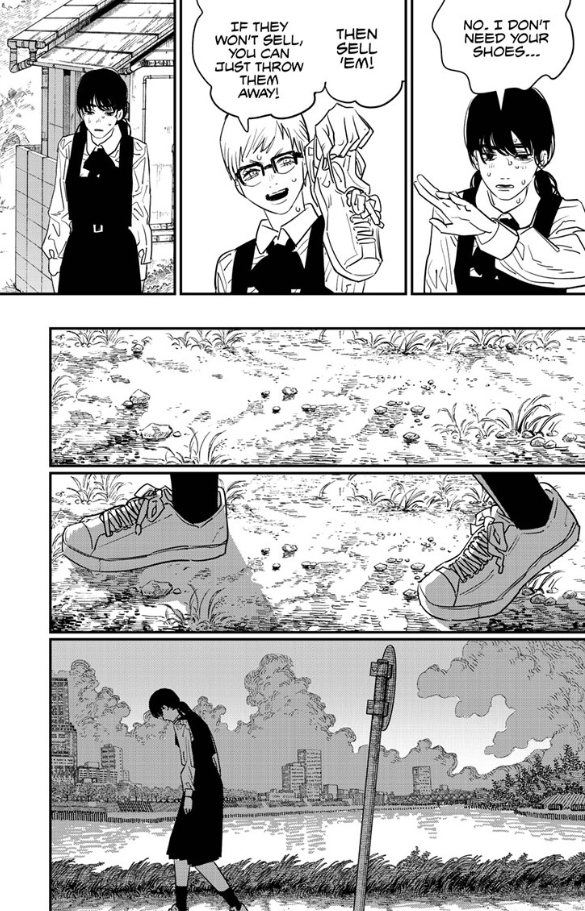
With Part Two taking place in 1999 Japan, the sign Asa passed should be either a no entry or no overtaking sign based on its circular shape. I’m confident it’s the latter for a number of reasons; here, because it works both as a tragic allusion to Asa leaving Yuko behind and a funny joke about the next page, where she refuses Yoru’s advance.
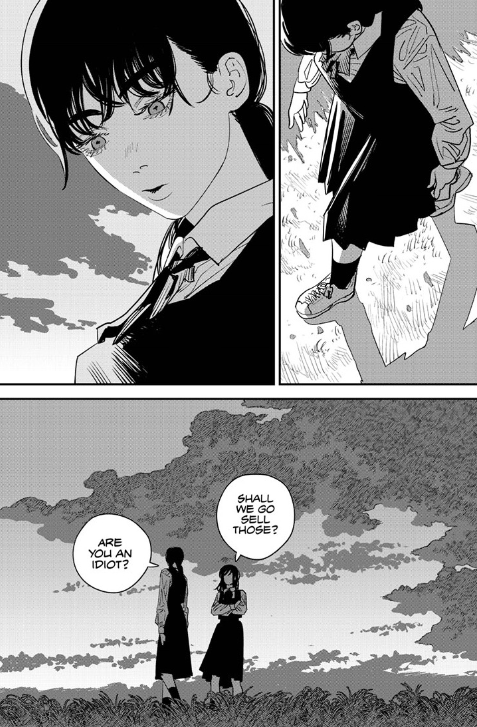
The latter element also fits Asa’s established character as a hypocritical rule-enforcer, but that’s schizophrenia territory. What’s vital is the boundary between the original Yuko and the Yuko who’s more actively losing it. This moment works perfectly.
Combined with the explicit timeframe given by Yuko, and the evidence becomes iron-tight. The only yesterday from what we saw would be the day before everything else, when they first met. It would be ineffective plotting if there was an extra, unseen day anywhere between their first meeting and chapter 105.
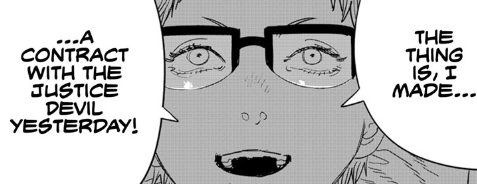
Returning now to the day in question.
With her original introduction, Yuko is already established as a Chainsaw Man fan, beginning the extremely heavy-handed commentary that Part Two will be expressing constantly, as well as setting the foundations for the much more meaningful conclusion Fujimoto will build off of it.
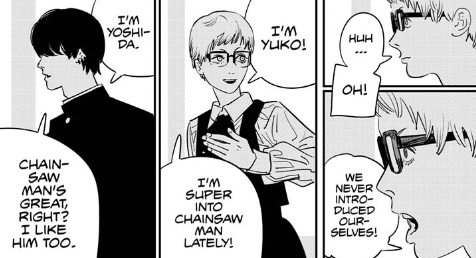
“Haunt the narrative?” Weak. Makima haunts Fujimoto irl.
What’s so striking about Yuko (initially) is that, compared to everyone we’ll come to see, her love for Chainsaw Man doesn’t seem to be paired with envy or escapism. Against Asa, especially, this point is massive.
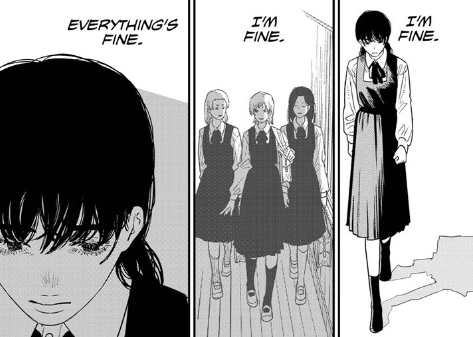
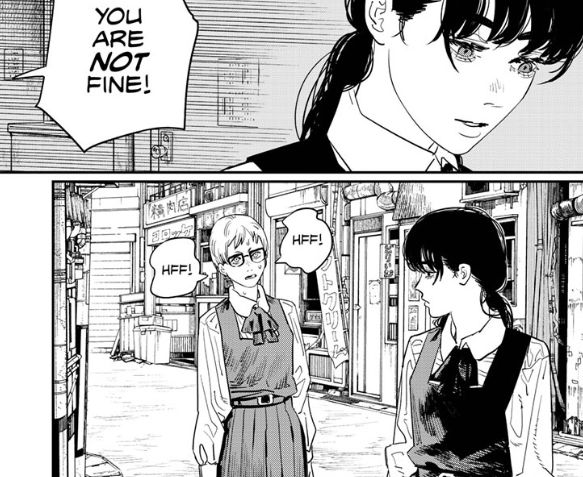
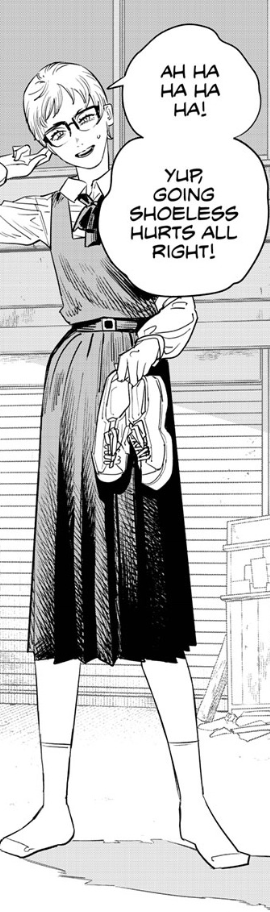
Yuko breaking Asa out of her delusions, built on everyone else’s revenge fantasies, is so simple, but all the more effective for it, especially with the understated body horror element of Yoru’s possession. Combined with the extraordinarily human running shoeless scene as the pay-off, and this sequence as a whole sings the soul Fujimoto tries to convey through almost all of his works. It’s extraordinarily human.
I believe this is the last we see of the fully lucid Yuko.
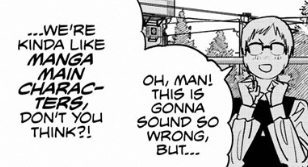
She’s enough of a gleeful child that it works either way, but her next appearance plays up the relevant ideas of her character in a much more tragic way – though I’ll remain humble enough to recognize that Fujimoto does not want characters bending to ideas, which could well invalidate all of this. Consider this a framing device if nothing else, because it does feel risky to make any kind of symbolic evaluation of Fujimoto’s work at its most anti-symbolic and humanistic.
With that said: Yuko’s friendliness is bound up in a very intense sentimentality that a devil would find awfully easy to latch on to, to the point that a smooth transition to her later state makes sense.
But what I really want to tackle are Yuko’s transformation in parallel to Denji’s; yes, I’m going ahead with this on Yuko rather than Asa, though I’ll emphasize both. Let’s reframe Chainsaw Man’s very first chapter and what it says about devil contracts and ‘dreams,’ because all of that comes entirely to the forefront in Part Two.
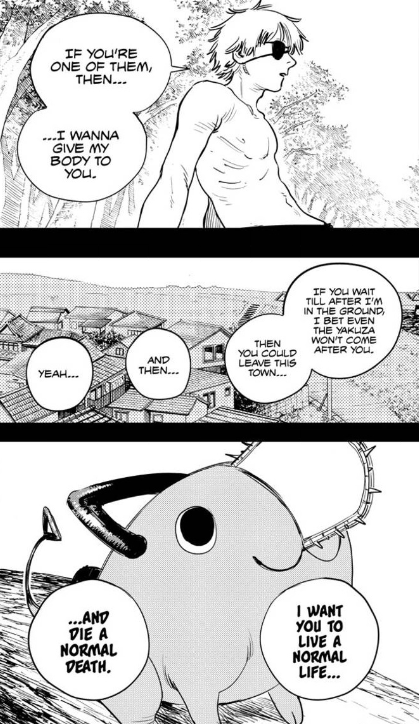
The point-of-interest for Denji and Pochita’s contract is that it was led on, without Denji’s knowledge, by the human rather than the devil. This makes all the difference in the world.
And the heavier side is the fact that Denji was not aware of the fact that he was making a contract, in addition to being wholly lucid (of heavy contrast with Asa, who was not only at her most vulnerable, but was literal having her brain(-guts??) spilled on the ground when she made that final, revelatory rather than intentional wish.)
Denji wasn’t making a contract. He expressed his unfiltered desire, and Pochita resonated with it.
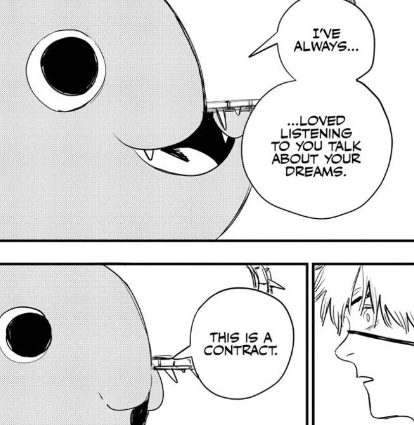
A human’s lucid intention and a devil’s real passion.
There’s a very clear ambiguity introduced by this arc, which implies that Pochita, Yoru, and Fire’s mere presences (if not their intentions) had, in fact, corrupted some part of Denji, Asa, and Yuko’s personalities in ways that would only be seen in Part Two’s avalanche Hellscape.
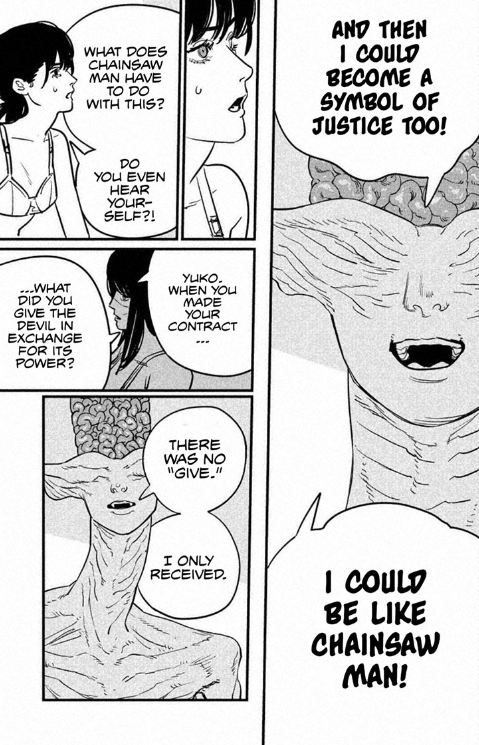
But there’s an infinitely more interesting idea that I resonate with.
Not a single devil ever meddled directly in a human mind, barring the ones who do it by the nature of their concepts (Zombie, Control) or who explicitly phrase it that way in their contracts.
When we hear Yuko state that she only received, it’s played as a comedic absurdity.
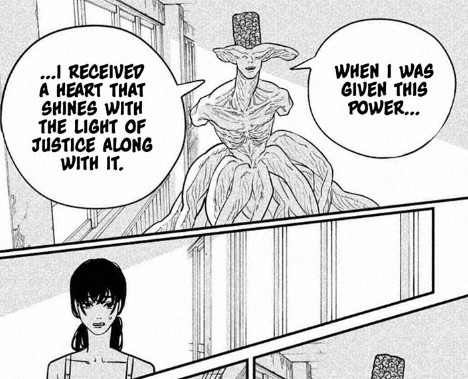
Despite the fact that the ability to see true intentions, which fits this description, was already established.
And if we skip ahead to the Fire Devil’s appearance near the end of Chainsaw Man, this interpretation appears to be objectively correct.
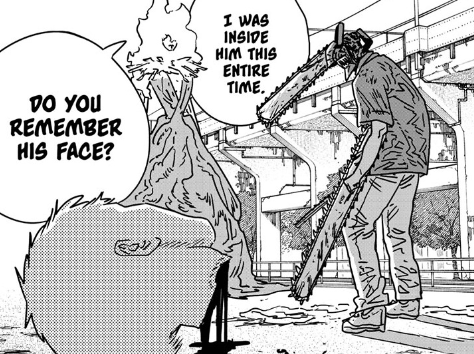
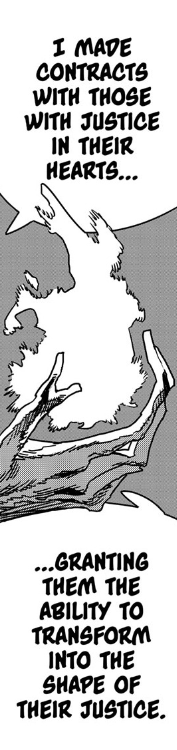
The light of justice is simply the presence of the Fire Devil’s will, literally the light of justice. She never interfered. She merely gave the power (and the responsibility) to transform oneself into the shape of their justice.
A human’s lucid intention and a devil’s real passion. A dream turned into a nightmare.
Yuko’s mental corruption isn’t because she was literally brainwashed. It’s because she could not bear the bombardment of everyone else’s thoughts combined with the ability to transform herself into her own inner image of justice – exactly as Denji’s relationship with Pochita collapsed into I wanna be Chainsaw Man, amplified by the constant bombardment of everyone else’s thoughts about Chainsaw Man.
Asa and Yoru’s relationship makes for such an interesting contrast to both devils, because Yoru also can’t brainwash Asa with the contract she made. All she can do is project, aurafarm, and threaten, making her role as the antithesis to every theme of connection in Chainsaw Man that much more significant.
Yuko truly, from the bottom of her heart, wanted to be a hero like Chainsaw Man. She just couldn’t bear the weight of actually being able to do it. She could not bear the light of justice, only worship it as an idol over human life.
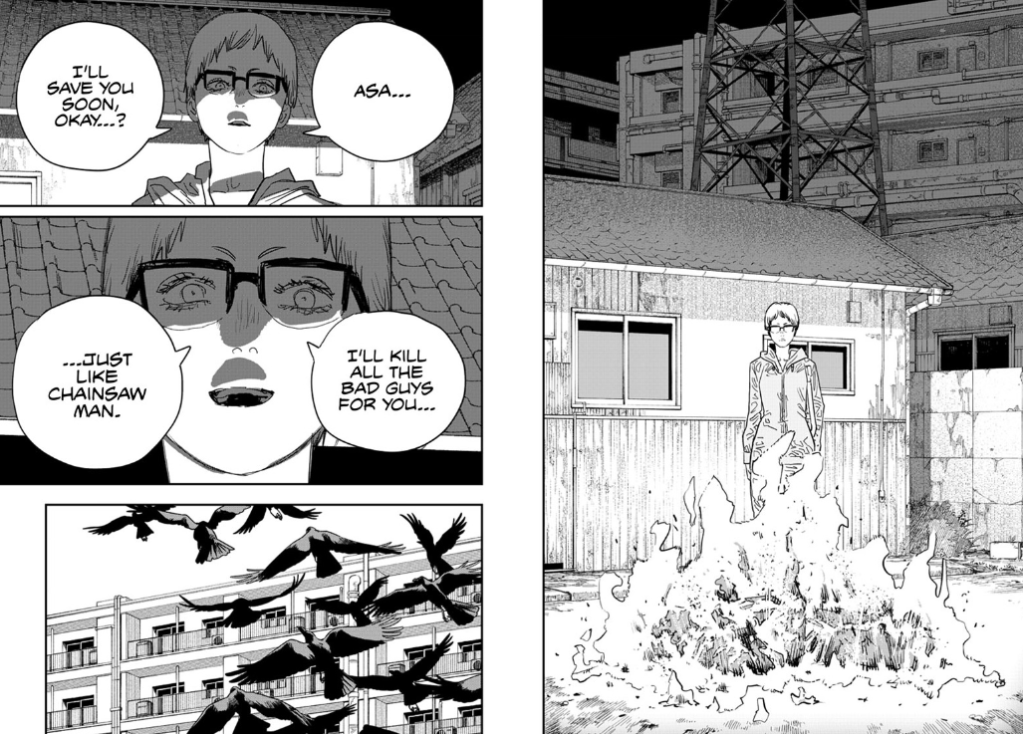
The girl who never understood people or had any friends, her inevitably deformed fantasies, and the disastrous results of the powers-that-be giving her the tools to realize them, without any of the necessary life experience. That’s how fascism starts up, baby.
As a quick digression: Fujimoto’s excellent characterization hits with the funniest off-screen gag in history of Lil D throwing an entire hoodie over a normal schoolgirl outfit out of some clear, stupid idea that it’d make her more subtle or mysterious before throwing it off in an off-screen minute to aurafarm with hands in her pockets. What a socially oblivious dickhead.
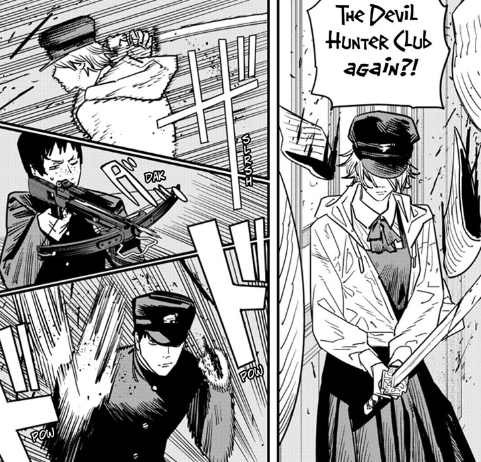
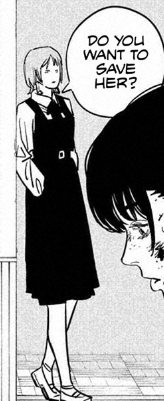
The conclusion of Yuko’s character marks one of the highest points in all of Chainsaw Man.
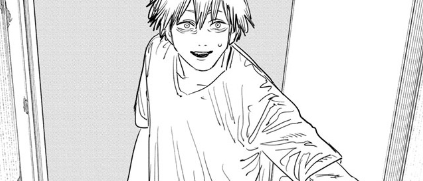
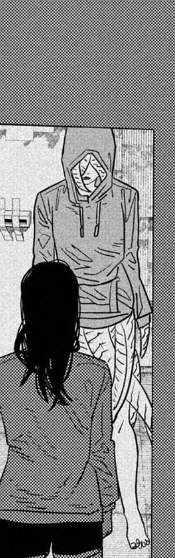
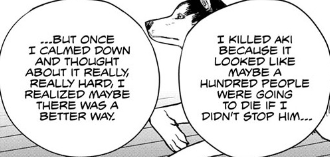
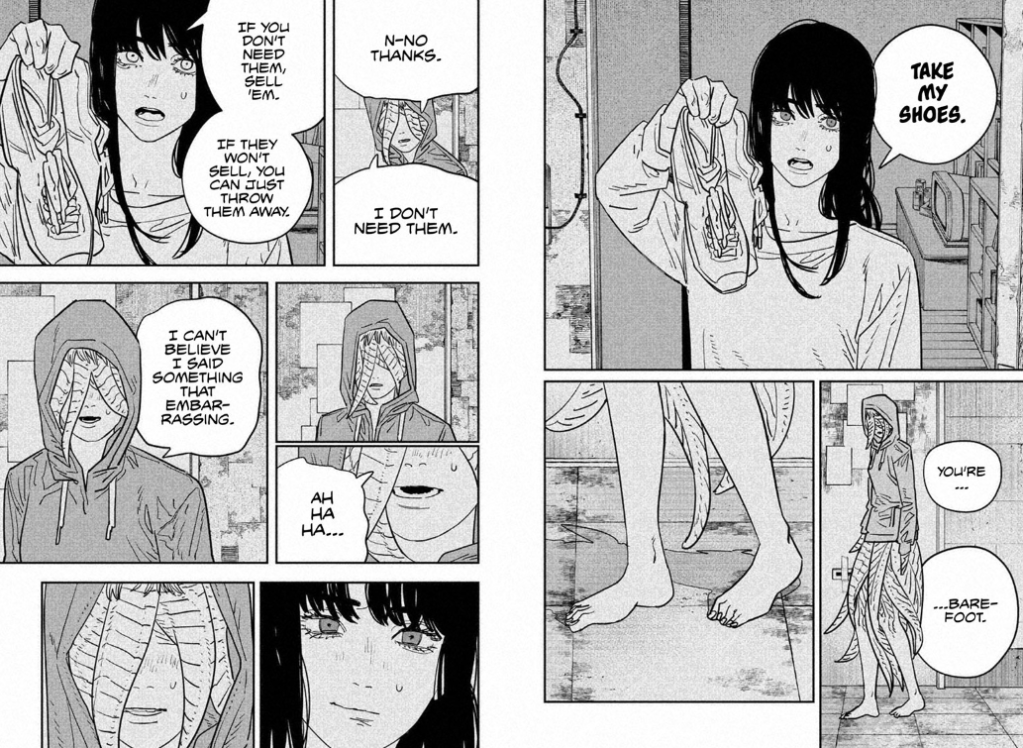
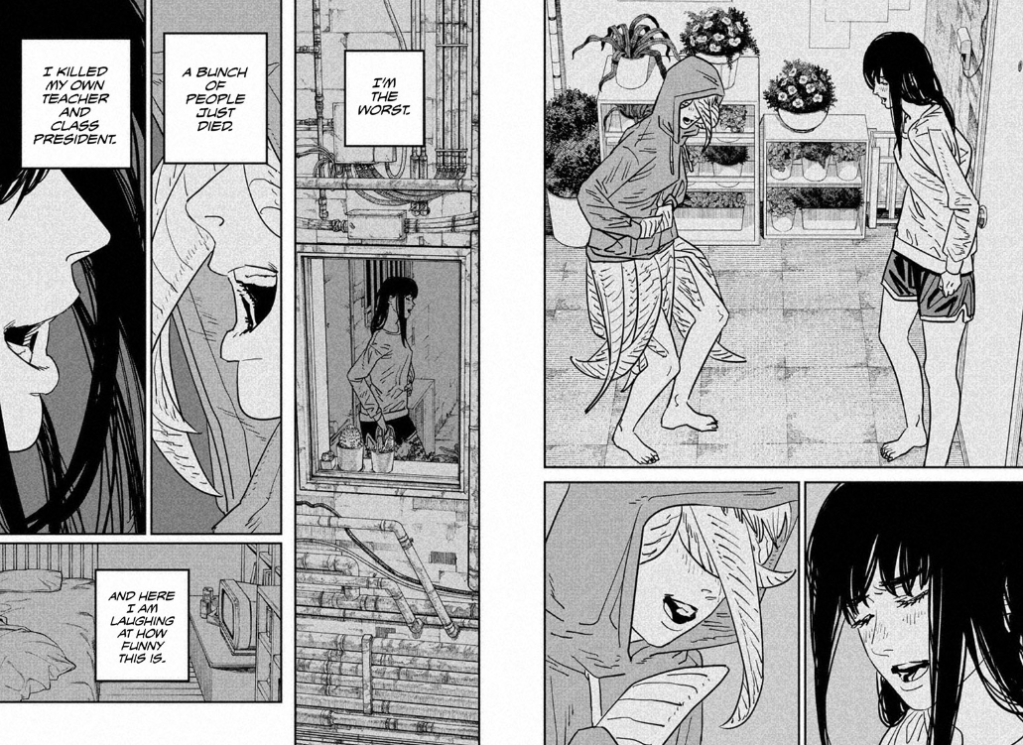
If Aki’s childish brain wasn’t a death-shock of trauma created by international power games, maybe a lifelong friend could have brought him into happiness, as a good caretaker does with a dementia patient.
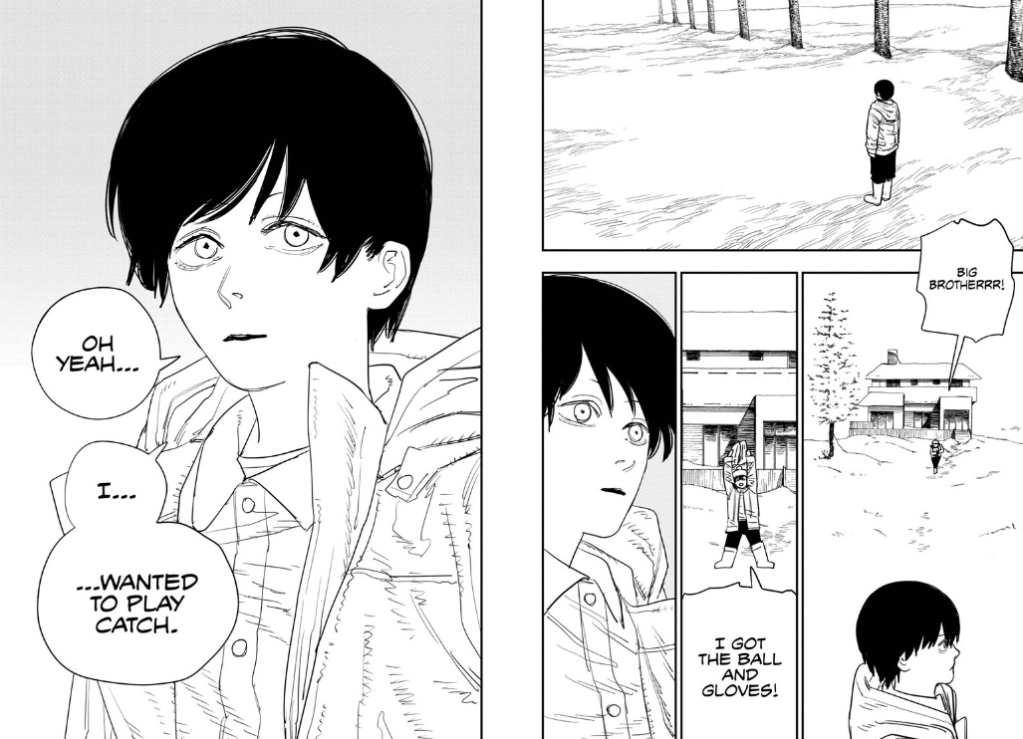
If ego games, materialism, approval-seeking, and longing for glory were stripped down, so that the social settings children grew up in were of organic relationships with one another, maybe we wouldn’t have so many emotionally-stunted psychopaths playing real-life Doom the moment they get the tools.
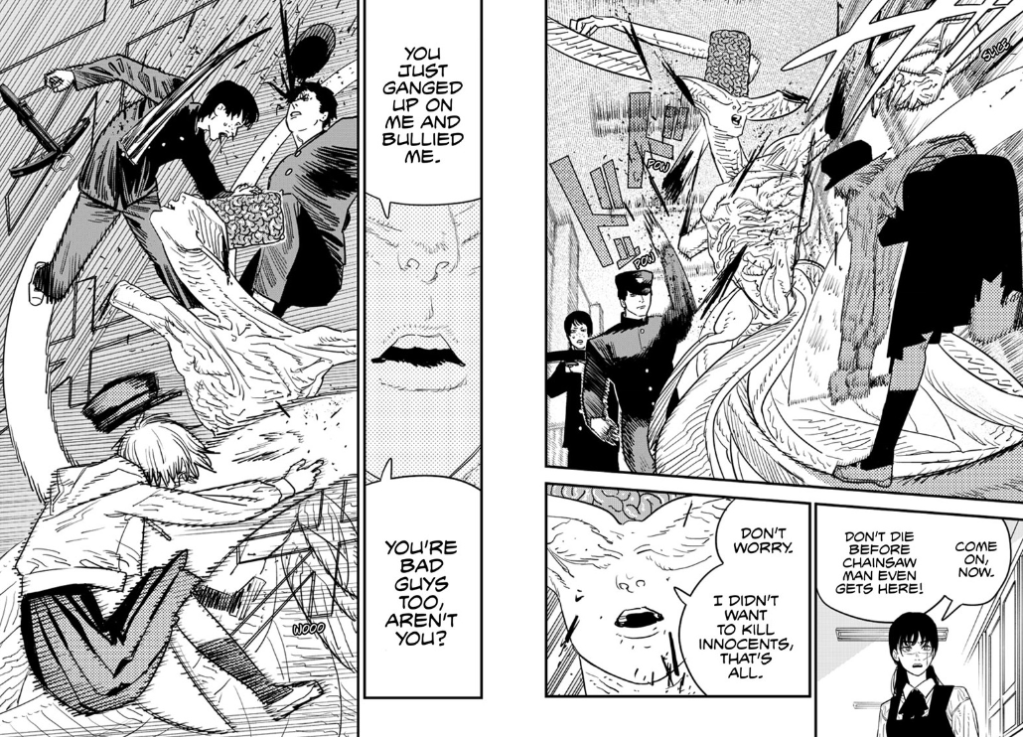
Maybe Heaven can come to Earth. And maybe, instead of waiting for it to magically arrive one day, we should try a little more empathy for the lowest of us.
Maybe, if maintaining the right images weren’t the concern, the majority of us could succeed in showing lasting peace to the downtrodden.
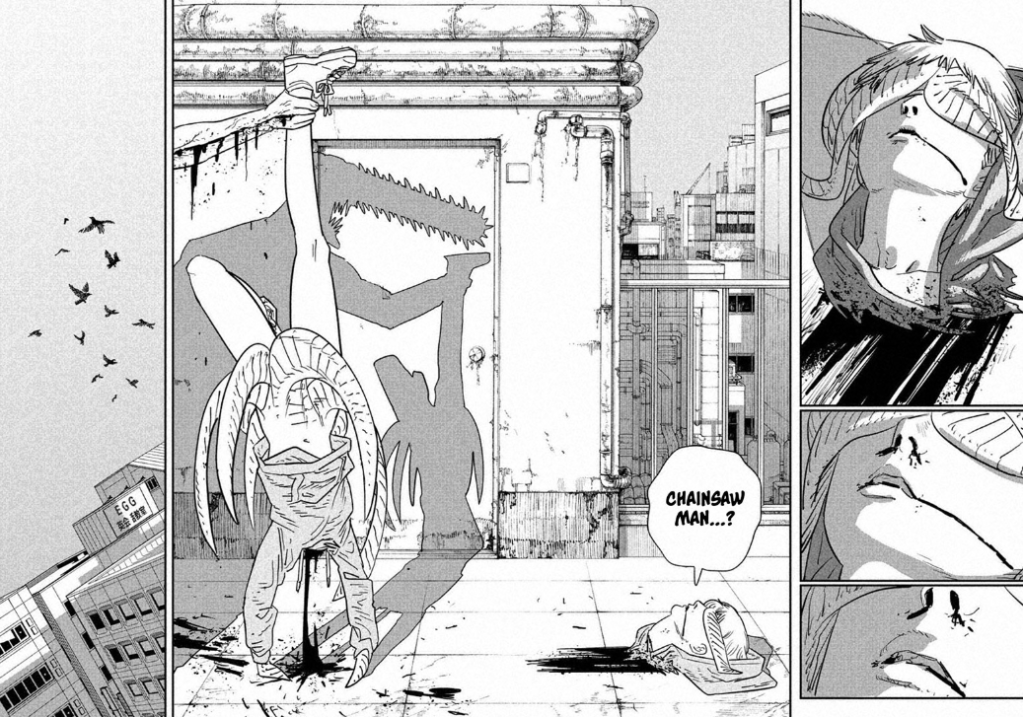
Aki wasn’t magically gone away. Aki’s inner child was too broken to come out in this world.
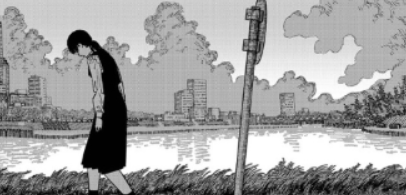
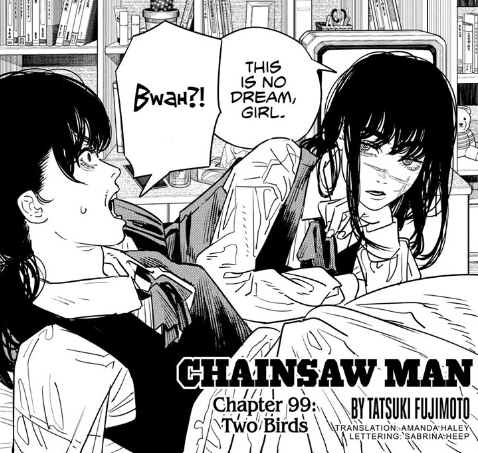
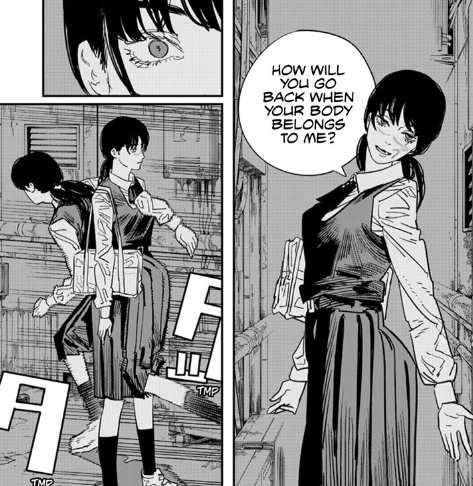
No overtaking.
Good luck being alone in the world again, Asa Mitaka. Don’t let it linger too long. There’s a very big-hearted gooner ready to welcome you.
Before I go further with the analysis, I’d like to move into speculation off of a distinct fact of Chainsaw Man: Heaven is never shown. Neither Heaven nor angels, only the ideas and devil corresponding to the latter. There’s only humans and devils, devils in the cycle of being promoted back-and-forth while feeding on fear, or being redeemed. Earth and Hell. In the context of Chainsaw Man’s humanist, anti-spectacle, anti-glory themes, I want to open the idea that devils’ reputation-based nature is a direct representation of the same fame-to-compensate that Fujimoto works with and against in all of Chainsaw Man, especially Part Two – Chainsaw Man literally being the subject of his contract opening him up to greater fame. In this case, the mode of love I considered above would be the best endgame for this universe: Hell slowly coming to Earth as humans come to peace with their devils and redeem them with humility, reaching out without limit to every living thing around us rather than consuming and seeking fame, thus making the products of our concepts come peacefully at last.
But dropping that idea and moving into the glory of devils: let’s talk Yoru.
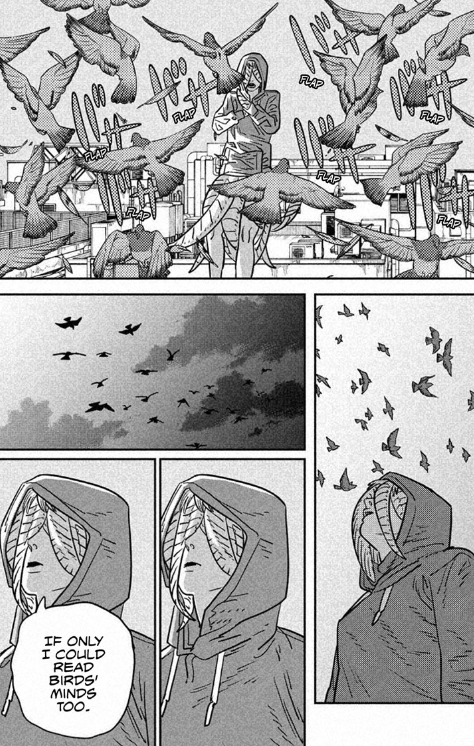
We have to analyze the groundwork of this freaky ass body horror fascist abomination and burden before we go any further.
There’s, again, the very easy and obvious read of Yoru as Asa’s unconscious personified, but it’s already time to go at least a little bit deeper with it.
Yoru is a complete burden upon Asa’s shoulders, the burden of a being lusting for the fulfillment of her own ego in a world of other human beings and the beauty of transcending that ego to connect with them.
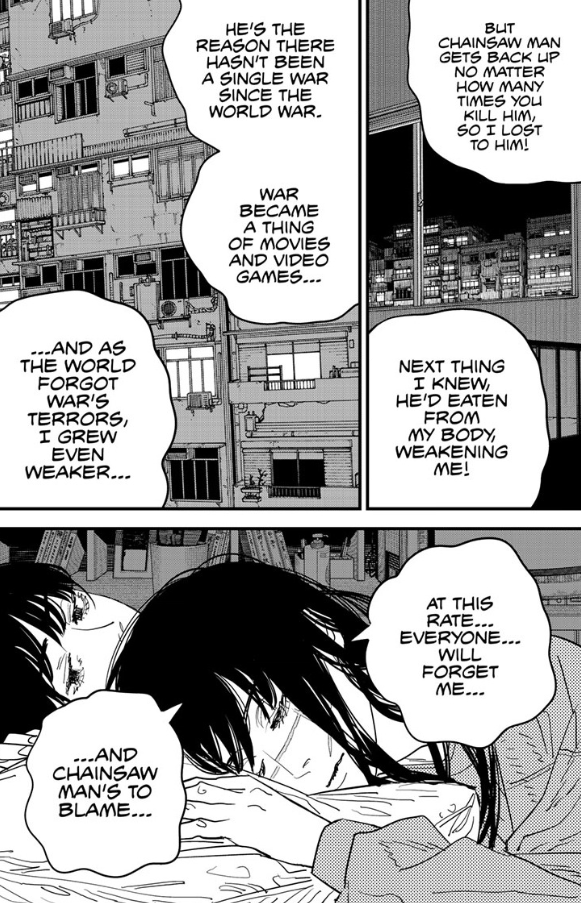
There’s a lot to be commented on the seemingly clear escapism theme Fujimoto set up at this moment, but, as far as I can tell, it just isn’t the ultimate direction Fujimoto wanted to go with. Fujimoto doesn’t really seem like the kind of guy to mind us living with video games. What he minds is Yoru just… being like that.
Every time Asa intends to reach out, she becomes afraid of rejection.
And with Yoru…
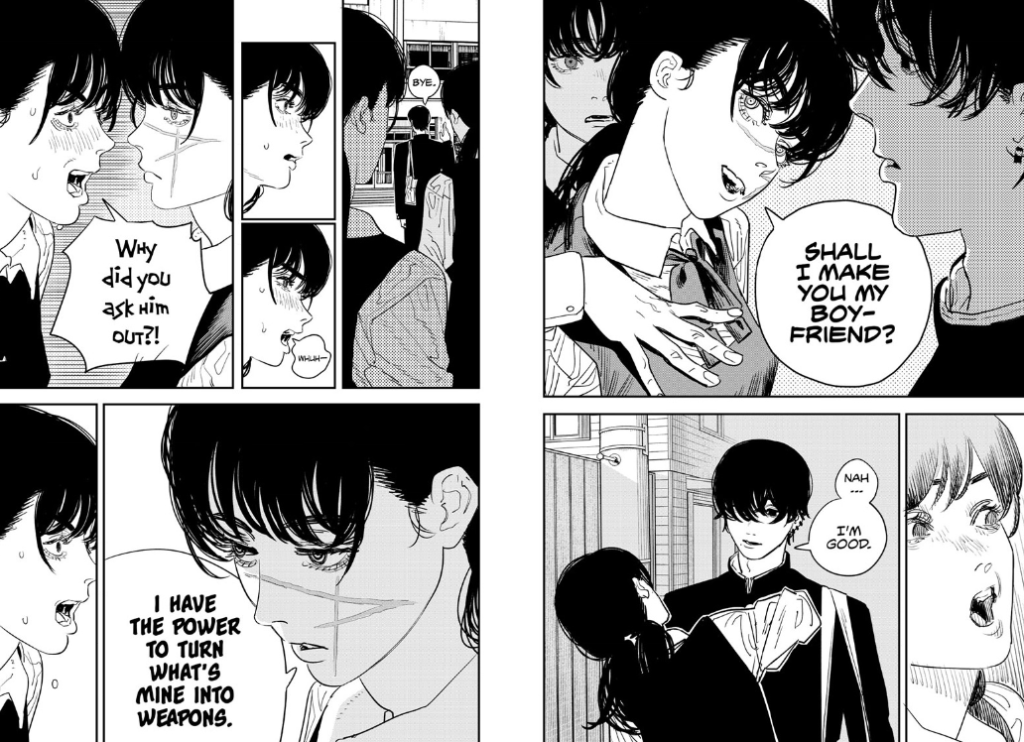
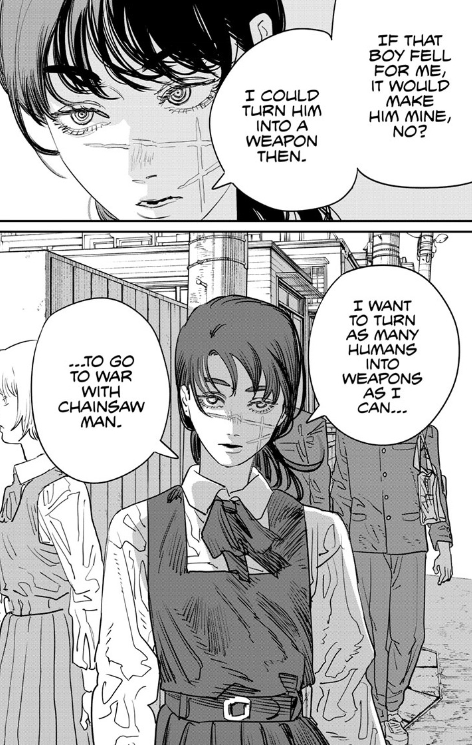
…bonds are weaponized.
Asa cannot connect to people because the back of her head literally dehumanizes and objectifies them.
Asa will objectify people in her head out of her own vulnerability, and they will become the weapons with which War, which uses her body as a vessel, will use to attain her own glory – against the interests of every single one of us.
What a profound fucking metaphor.
We literally see the same mindset of dehumanization on loud display in this arc with Yuko, another emotionally vulnerable and stunted bully victim who longs for glory, to escape into an amazing heroism, to actually be approved of by others and society while dehumanizing them in the same. It’s such a devastatingly real examination of the consequences of inner vulnerability, with no disrespect to the vulnerable for being that way. When so much victim-blaming arises not only from projection, but from the projection mutually arising from this understanding – when there’s so much of a reaction back against this in the name of decency – Fujimoto’s ability to portray the reality without insulting the victims is a monument of emotional maturity.
It’s not that Asa’s hurting people. It’s not that evil ghosts and spirits and bad eye and narcissist manipulators and all of that other bullshit arises from the downtrodden, so we’d better exorcise or institutionalize them. The fact is that the glory of war is built on taking these vulnerabilities in every single one of us and using them to its own advantage with its propaganda and force.
Yoru is the Goddamn Devil.
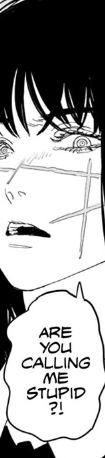
Everything we already saw in Part One, of the production of weapon humans in the shadows of states, of young boys groomed both ideologically and literally by control, which objectifies its own flesh and appeals to the basest parts of human nature – all of this is synthesized in its purest form by the one-and-only War Devil, by Yoru. She takes it all and also shows it in the far more subtle, down-to-Earth nightmare we all bear every day.
It’s an interesting point of comparison that Yoru, the personification of fascist hysteria, has lost her image and is objectifying all the world, where Makima, the personification of neoliberalism, has in security her self-gratifying image as both the light and the dark of the world. Makima transforms each and every ego in the world into an extension of the great, self-denying/self-worshipping societal ego, quite aligned with the Freudian Superego; Yoru appeals to, conquers, and ultimately negates all ego to wholly objectify the other, quite aligned with the Freudian Id. Makima is the Superego destroying the world for its unreachable Id ideal (Chainsaw Man); Yoru is the Id destroying the world for its unreachable Superego ideal (the act of defeating Chainsaw Man). Control that fetishizes the animal reality it has wholly subjugated and anarchy that worships the image of its own apotheosis negated by the same animalistic nature. Fascism, where neoliberalism goes when its citizens’ Egos can no longer pretend to even-level play. A perfect model of societal decay.
And how is Denji reintroduced in Part Two? Without the Chainsaw Man transformation?
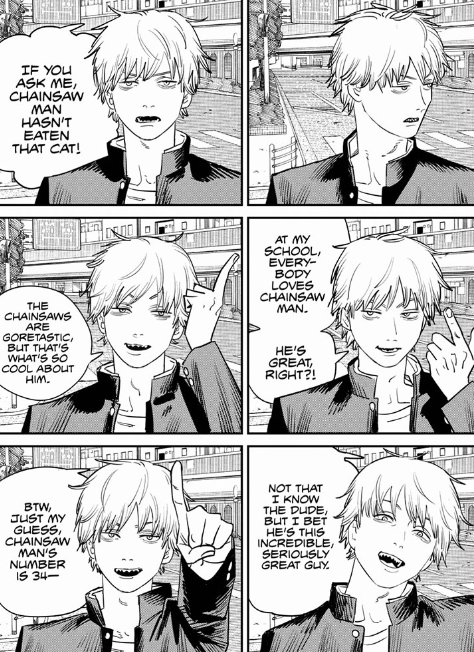
It’s as in-your-face as most of Chainsaw Man, but it’s just as perfect as most of Chainsaw Man. Denji shows himself out of the Chainsaw Man form by gassing up Chainsaw Man as a bid for bitches. What a fucking teenager. And, in so many ways, what a perfect mirror to Yoru.
Although it wasn’t too clear in the week-to-week, Denji’s weakening relationship with Pochita was already being established at the outset. In the same way Yoru wants the act of defeating Chainsaw Man to fulfill her glory, Denji wants the recognition of being Chainsaw Man to fulfill his fundamental lack of warmth. As Yoru instrumentalizes people and will never be satisfied, Denji instrumentalizes Pochita and will never be satisfied with the presence of Chainsaw Man. In compensating for his lack of warmth through hypersexuality, Denji is as doomed to a cycle of dissatisfaction as Yoru is. He’s using Pochita as instrumentally as a pimp uses his whores. After all, he’s gone far enough into it to no longer understand Pochita as someone he lives for.
Let’s bring it back around.
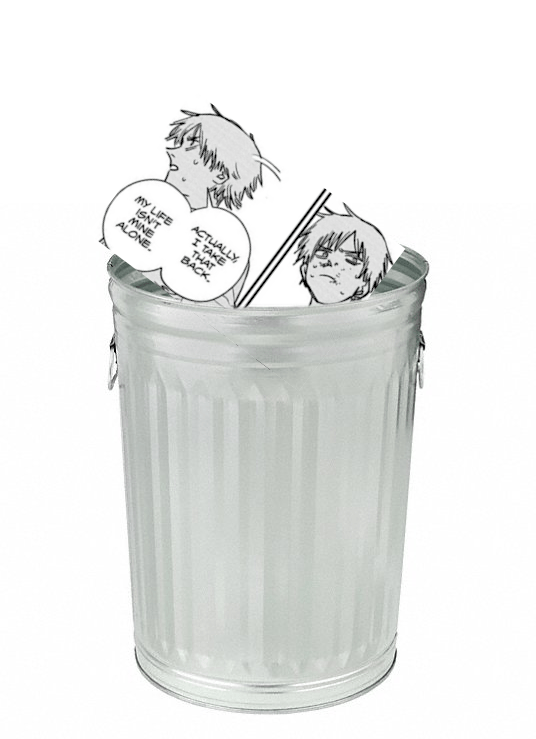
I will not be analyzing Yoshida here because the meat of his character is provided in Denji’s mouth future arcs, and there’s nothing I could say now that wouldn’t end up redundant.
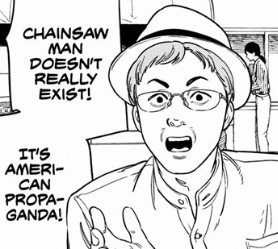
Bro had a vision
Do Neurodivergent Skinwalkers Dream of Eclectic Love?
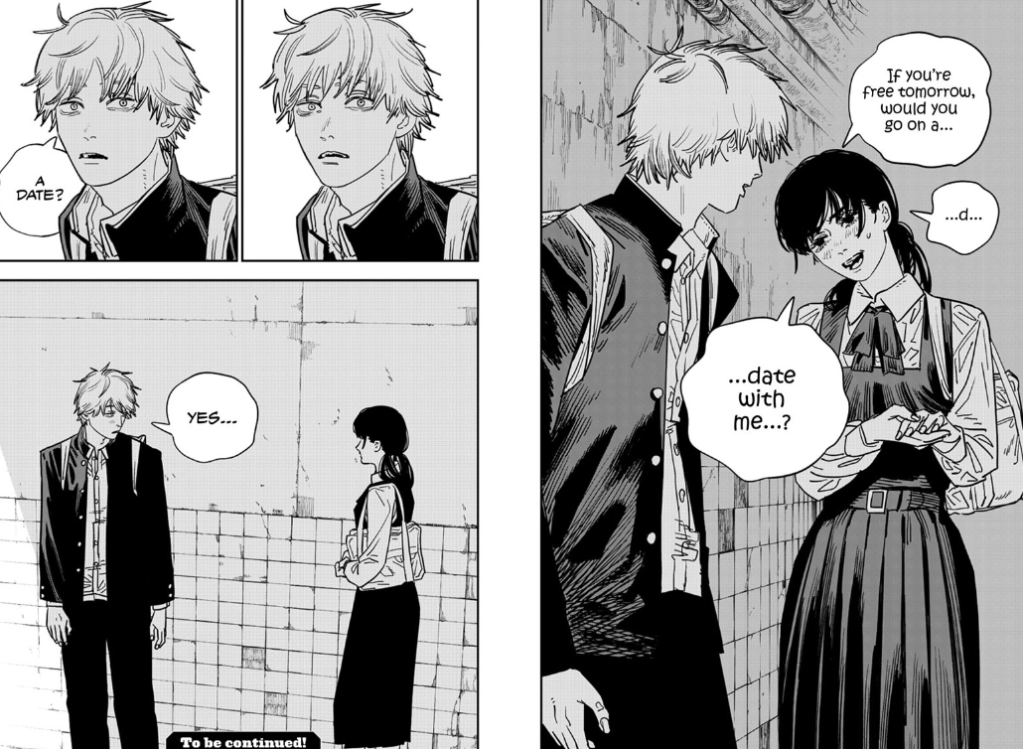
Fujimoto introduced the main characters and primary motifs of Part Two in its first arc, setting the base for their many tests to come. So, what does he do for its second arc? How does he continue with Asa, who now can work towards a new healthy relationship with Denji in the wake of Yuko’s passing?
He has the time of his life exploring the complete dysfunctionality of their initial attempts at relating to one another.
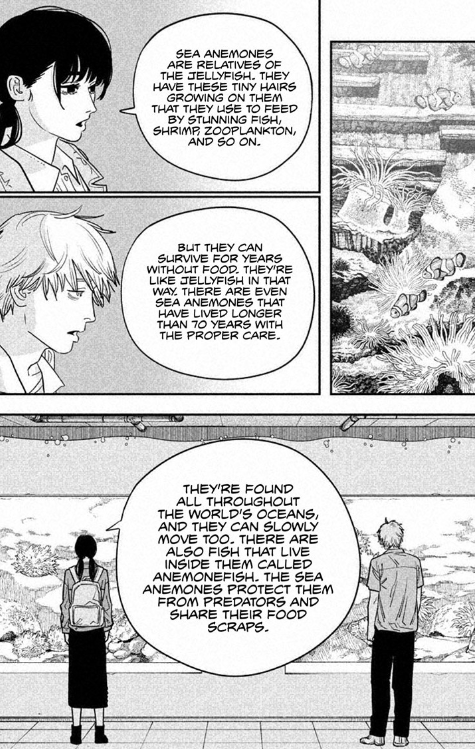
Chainsaw Man is a very funny manga. Sequences like vam-va-gah and the end of Kobeni’s car are almost unforgettable for how perfectly, palatably absurd they are. But the Aquarium Date Arc is, with the possible exception of a certain character motivation in Fire Punch, the funniest thing Fujimoto ever wrote.
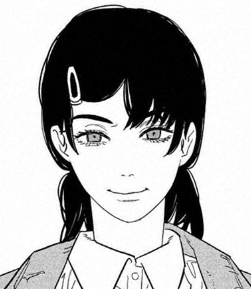
There isn’t much I can say for the first part of this arc, so I’ll dedicate a section to this face.
This face. Look at it. Take a good, long fucking look at it. This face completely sells “Autistic teenage girl possessed by the apotheosis of war attempts to get close to the real Chainsaw Man who she thinks is a random dude in order to fucking kill him so she can use him against the fake Chainsaw Man who she thinks is the real one and she’s gaslighting herself for the triple-double-fake-date-with-cheese to think both that it’s real and that it’s fake, neither of which is true, and somewhere along this path she was supposed to be trying to eject what presents itself as the manifestation of her own unconscious.” It sells the entire thought process of what’s going through her fucking head during this incomprehensible postmodern nightmare. It makes the face of Jack Nicholson look like that of a PR manager with botox. It’s the greatest expression ever conceived of by a human being. It’s fucking haunted.
Asa Mitaka must be killed before it’s too late.
Anyways, back to the substance of the arc.
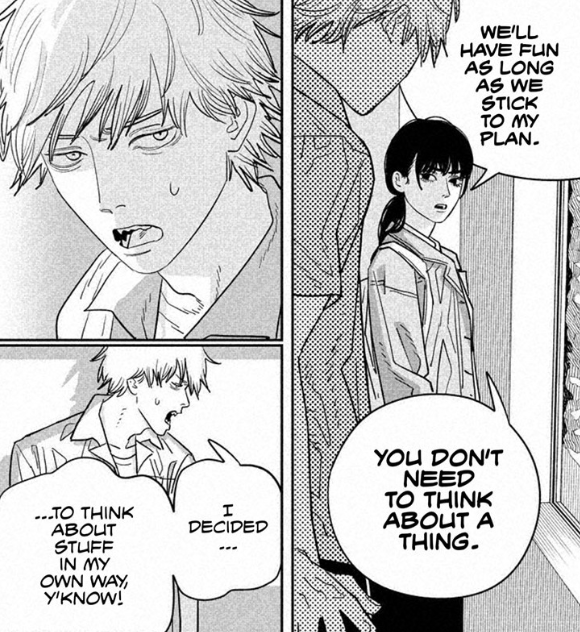
On one hand, Asa can only manage relationships (read: build up and sustain a feeling of security against the difficulties of relationships) by arranging things in advance and sticking to her plan (exactly as Yoru objectifies relations to empower her (and eventually Asa’s) image.) On the other, Denji is trying to reaffirm the last bits of his own volition and identity whenever his high-school-educated brain sees a chance. What we get as a result is two reflections of modern youth standing beside each other and talking to themselves. Neither of these two is talking to the other at the start of the arc. The meat of the arc’s progression is them (mostly Denji) slowly breaking through this, and it is pretty emotionally rewarding – by working as a foil to everything Yoru represents against this for Asa (and everything the mere idea of Chainsaw Man represents for Denji at this stage.)
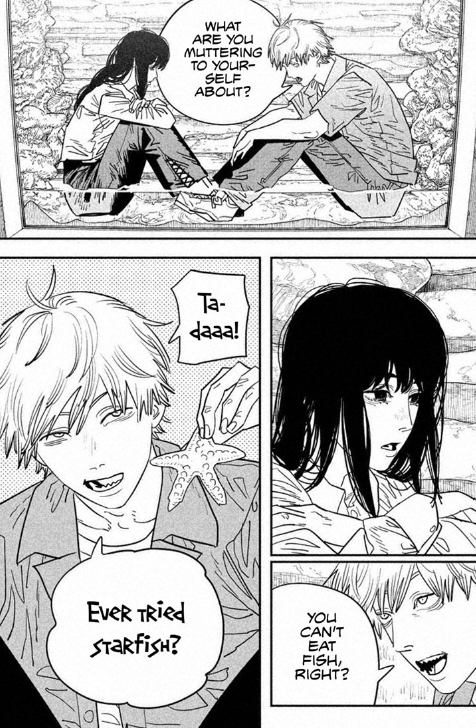
Against these inner forces keeping them stuck on negative feedback loops, Denji and Asa, through a moment of legitimate effort from Denji, do break free and become closer to one another. It’s an incredibly simple, grounded conflict for a manga that has shit like the Control Devil Arc, and it’s very good for what it is.
And that’s it for the Aquarium Date.
But this is one of those arcs that doesn’t end in its primary setting.
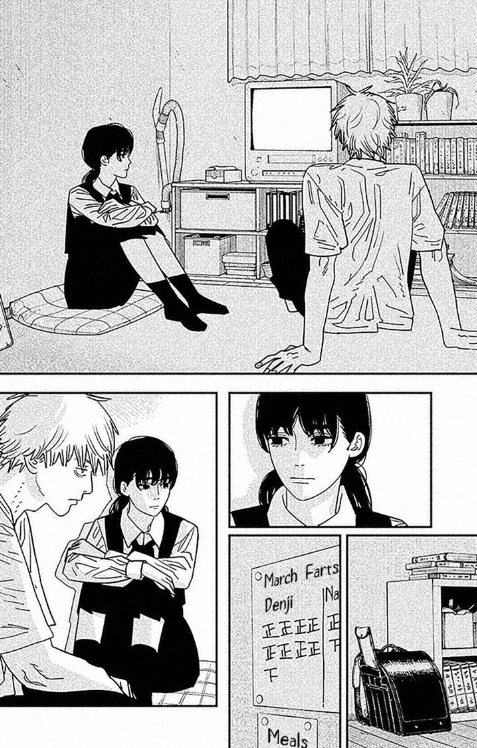
The second part of this arc elevates its simplicity much further, and this is very much the last time the manga will ever be this clean. And it comes down to the long-awaited interjection of our girl, Yoru.
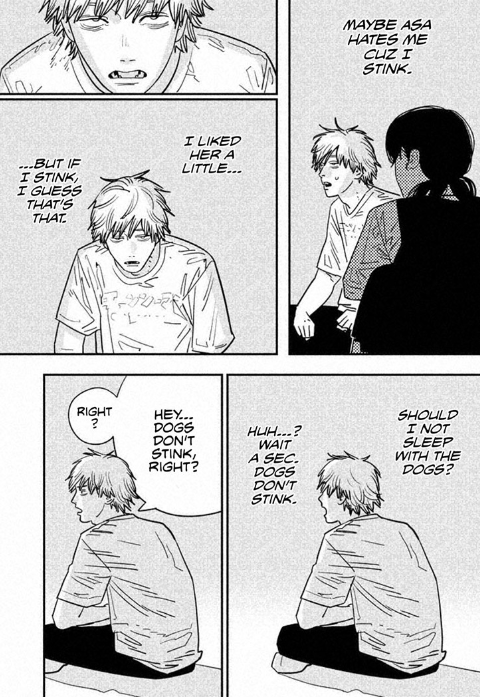
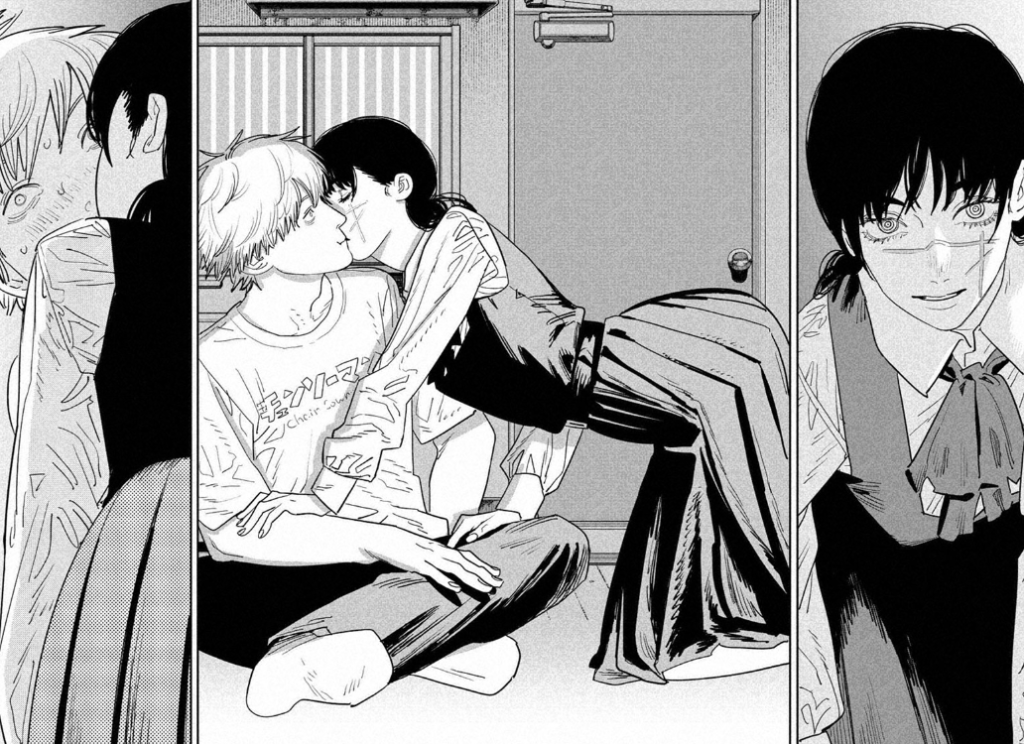
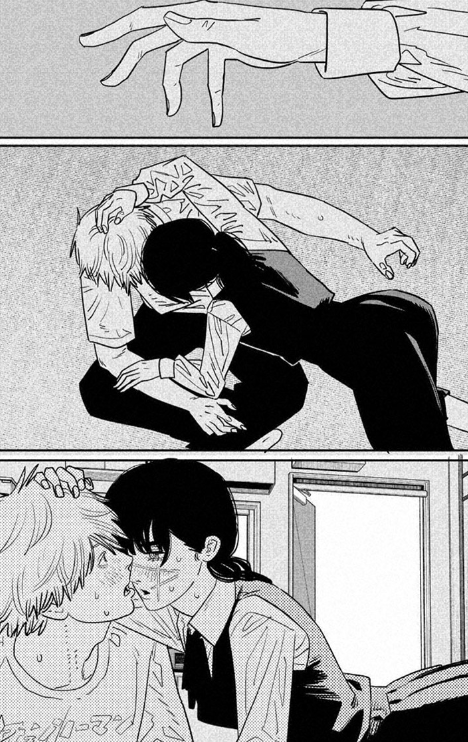
The theme of instrumentalization of bonds is manifest in its clearest ever form in this exact moment. After Denji and Asa had seemingly broken past their own heads and gotten to connect more deeply to one another, we’re alerted to the reality of Yoru (pay attention to this! This will happen in worse and worse ways for the entire part) as she takes her chance: the rapiest scene in the entire manga. Or rather the second.
The third.
This will happen in worse and worse ways for the entire part.
The absurdity in relationships that Chainsaw Man portrays is fully contextualized in a harrowing, hopeless way by the active presence of Yoru, and this is the first moment of pay-off for it. There is no gap, as with Reze and the Soviet and Japanese forces which pressured her, or Denji with Public Safety. Yoru is a dark force residing within Asa herself. She is the laughter before the death of innocents. She is the imperialist inside our heads that objectifies our bodies and makes us try to hurt others to ‘reclaim’ it. She is the night, the setting sun of Japan, the final convulsions of empire in a world which isn’t glorifying it enough anymore.
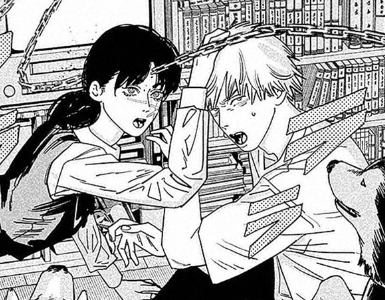
I find the dynamic of Asa wishing to regain control of her body by inevitably empowering Yoru to be such an interesting and horrifying ‘shadow’ dynamic. With Yuko having given Asa a psuedo-freedom in that absurdist escapism, and Denji, much more healthily and freely, offering day-to-day peace against eternity, Yoru attempting to take Asa hostage from within herself drives home the same themes we saw with Aki exceptionally well.
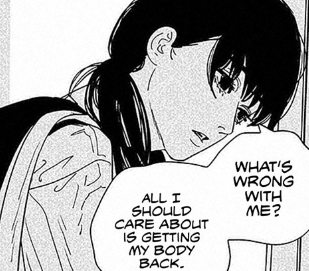
To “regain control of her body,” Asa sacrifices all of her bonds with others. To empower some visceral satisfaction, she fights against her own moments of glee with Denji. The more she empowers her shadow (which, in theory, entirely accesses pure physical reality), the less she has in her reality. She falls back into herself after how far she got with Yuko. It’s the perfect articulation of the original theme Fujimoto conveyed in Part One, in the clearest possible form.
The final piece of this arc is in the closing conversation between Asa and Yoshida, which fully lays the groundwork of his deeper character after the role he presented in Justice Devil, in direct contrast to Asa’s journey toward connection.
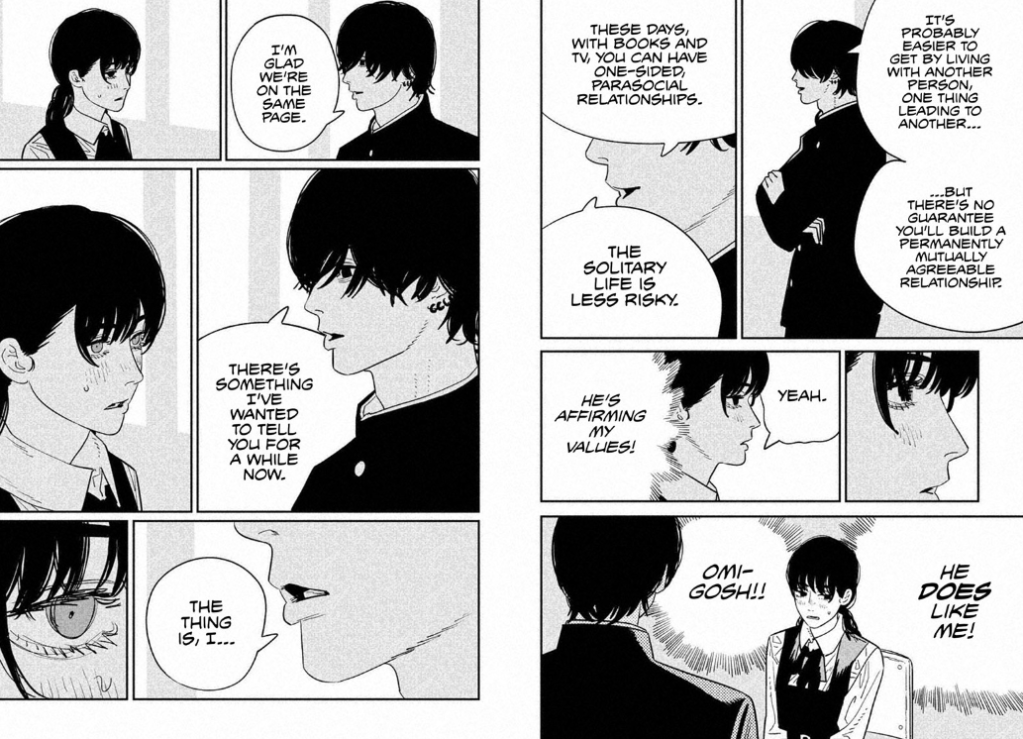
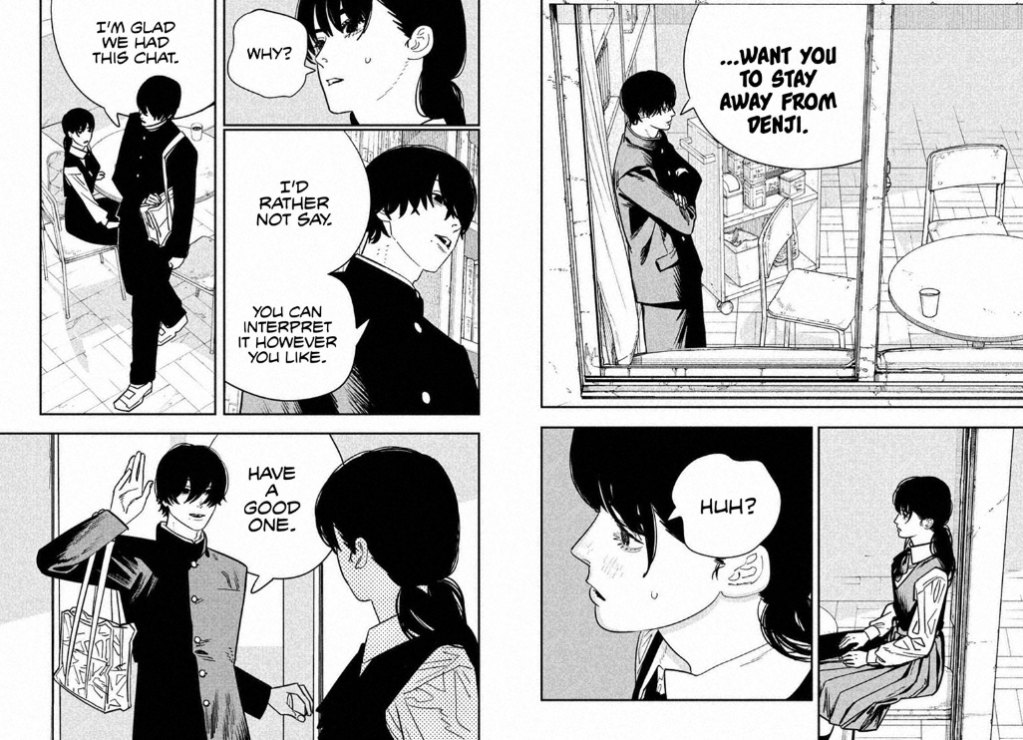
Amid her internal war, and not long after the shock of Yuko’s psychosis, we get Yoshida openly stating that he prefers the convenience of simulated, parasocial relationships.
I have real issues with how on-the-nose and in-your-face of a writer Fujimoto can be at times, but it takes skill to have such explicit theses stated in conversation without it coming across as tastelessly as in, say, The Holy Mountain (a high school essay pretending to be a film.) I’ll say more of my thoughts on this matter in the review section, but this dialogue is acceptable, despite towing the line a little. The way his speech bubble about parasocial relationships covers his eyes and leaves only his mouth is a good use of craft (and I find it very captivating that we saw the same covering-of-eyes when Asa and Yuko were lmaoing, however you’d wish to interpret that); exiting Asa’s imagination by framing him and even his speech bubble behind a window/screen is very good use of craft. Heavy-handed? Yes. Effective? Yes.
The reason that this works despite its lack of artistic subtlety is that the meaning is in-between the islands of narrative, the isolated characters. Exploring human connections and how we justify our egos are the most essential parts of Chainsaw Man, so making the textual aspects of the characters as individuals so in-your-face is, for the most part, a good, pragmatic compromise to make the deeper narrative ring through. The issues have more to do with other instances and the failings of Part Two’s back half resulting from Fujimoto’s working conditions getting to him, and, again, full focus will be given on the review section.
What matters is how well Denji and Asa connect despite all odds; how Yoru works her way out through this to damage their relationship from the inside; how Yoshida, off of that climax, openly rejects it all for convenience handed to him by the state and society at large. And, of course, it’ll all comes back to Chainsaw Man.
Part Two’s first half is the cleanest narrative progression of Fujimoto’s career, with all four of its big arcs rolling down a hill like a snowball – practically being just one mega-arc.
Onwards to its third act.
I’m Falling!
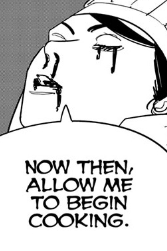
To whet the appetite, it would be a good time to formally introduce the motif of consumption in Chainsaw Man. Here is a record of key times the manga’s cast ate.
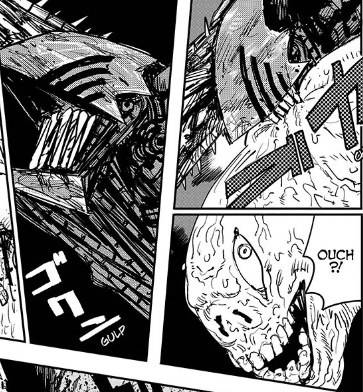
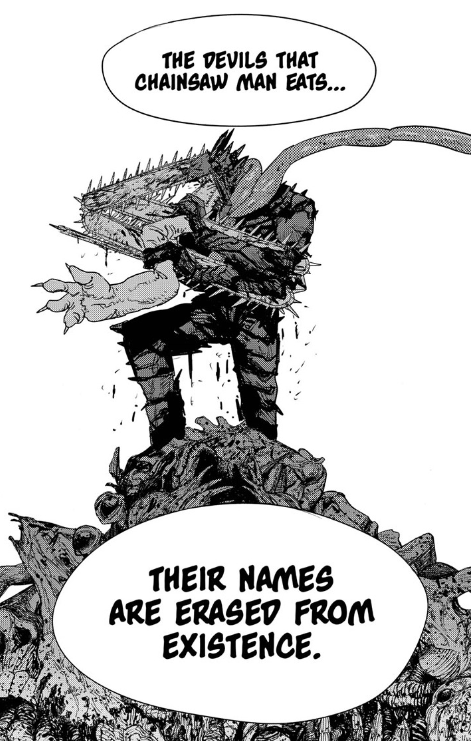
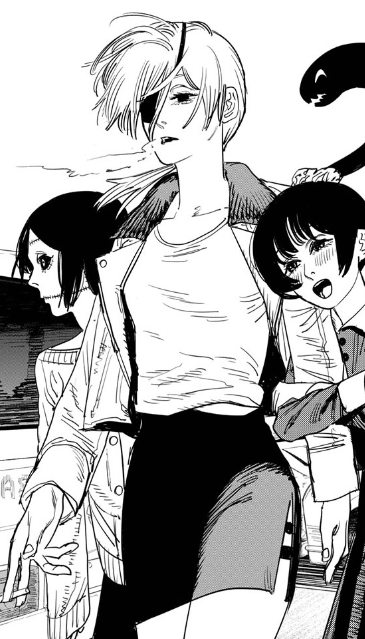
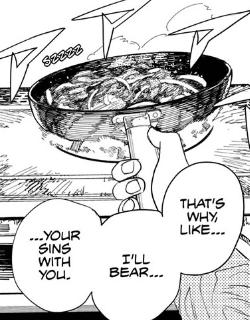
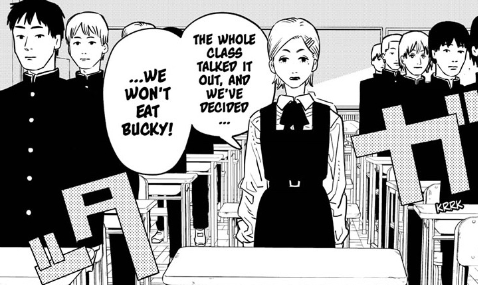
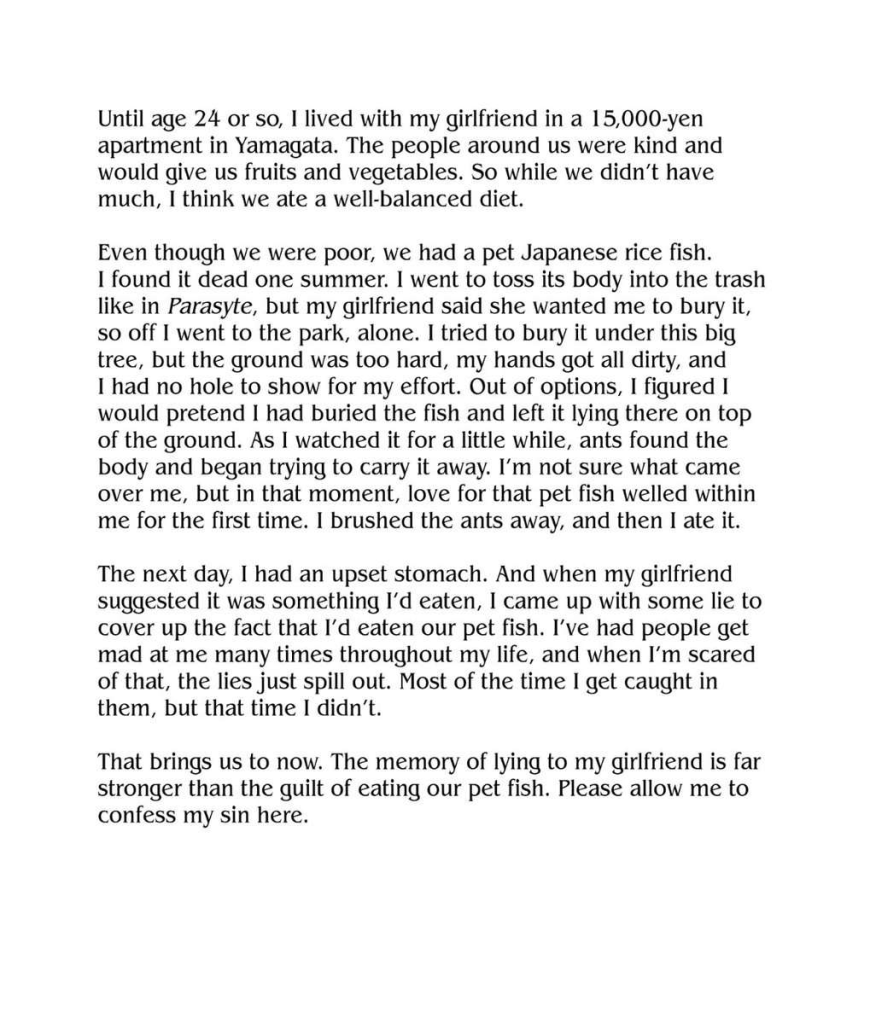
Although this part of the analysis goes beyond an objective read into subjective interpretation territory, the motif in question is so pronounced both thematically for the work and psychologically for Fujimoto, in addition to being explicitly highlighted in the Falling Devil Arc, and given two insane moments of climax in the coming Aging Devil Arc, that it would be improper not to formally highlight it here.
The most irrefutable aspect of this motif is in Chainsaw Man’s titular devil: the names of devils Chainsaw Man eats are erased from existence. Forgotten, by all but the most powerful and intelligent of devils. Forgotten from Chainsaw Man, if not Chainsaw Man. I won’t waste too much time on the logic of it, because I don’t think Fujimoto wasted too much time on it, either. The contradiction is not relevant to the story. What’s of overwhelming interest is the concept of forgetting and doing away with aspects of reality by consuming their representatives; and that Denji himself, inversely, immortalizes Makima’s influence upon him by consuming her.
The Bucky thread is, unfortunately, quite interesting: the subject of Part Two’s opening chapter, showing the difference between blind killing and consuming, which is dehumanizing, and love, which is active, lived, and a positive force. The motif and placement holds regardless of the parodic tone, and it gives a symbolic representation to the two ends Asa can reach in her journey.
Consuming and forgetting brings you back to yourself. Connecting and keeping memories is what brings people to life.
Denji’s consumption of Makima, through which he intends to bear her sins, is of particular interest. Denji equates it with love – literally, he goes out of his way to call it that.
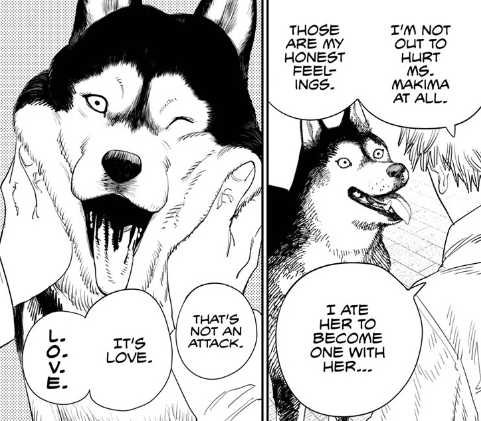
The contradiction with the rest of the portrayal of consumption in Chainsaw Man quite perfectly illustrates the downfall of Denji’s character, but we’ll see that spell out in the next arc.
The motif of consuming-to-forget in Chainsaw Man isn’t inherently meaningful. This isn’t a Toby-Fox-has-musically-fucked-us-again type of beat. Again, Fujimoto does not write in mythic terms, and in Part Two, not even in terms of immediate narrative. What this motif does is serve as a vehicle for character exploration, which then brings about meaning in the interplay between the cast.
It’s time to properly introduce Chainsaw Man’s other main villain.
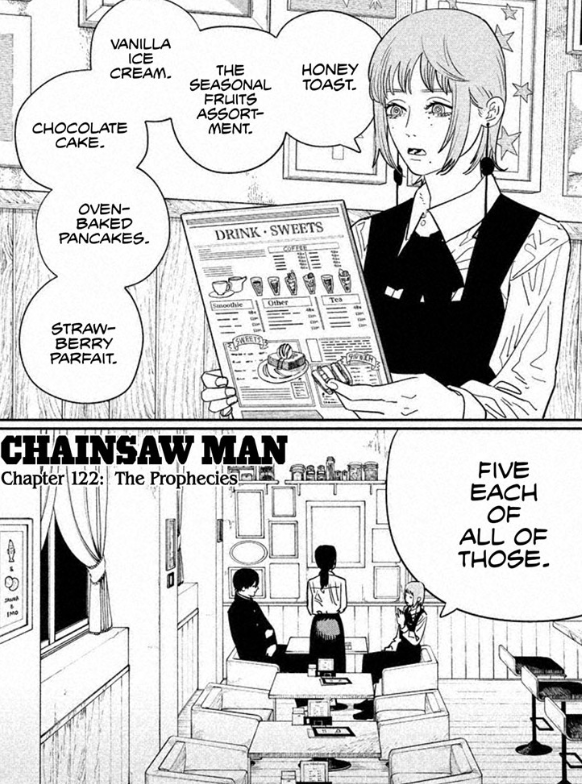
Did you buy Yoru being the sole main villain, rather than just the last one remaining? Because, in my weekly reading, I did.
While I’m still dodging a certain subject for a later point in the analysis, I see no alternative to stating early on that Tiny Wang is, in fact, a main villain of Chainsaw Man on par (in THREAT, not in writing depth) with Makima and Yoru.
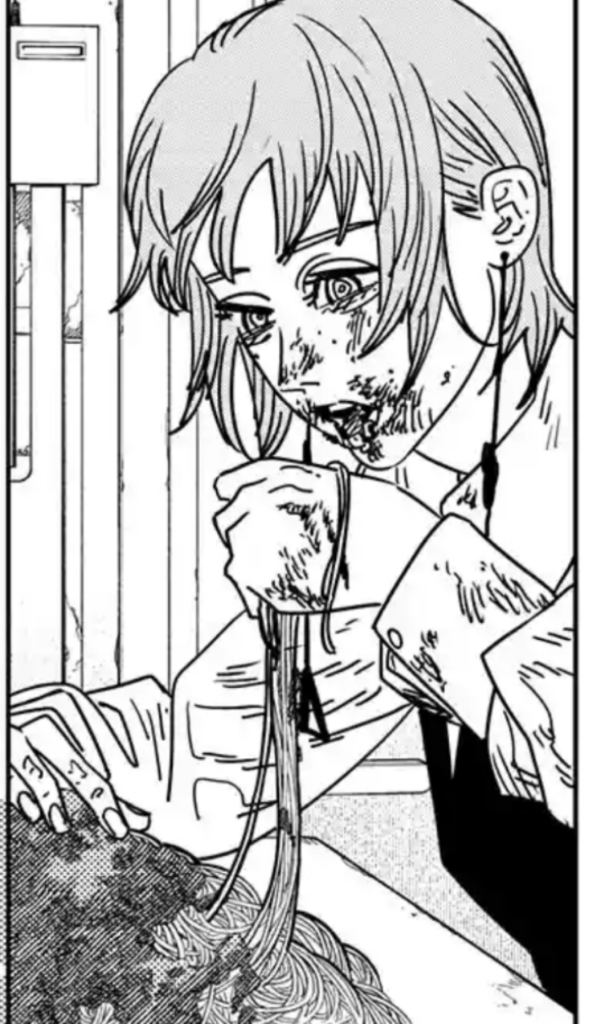
Makima’s Superego and Yoru’s Id are both ultimately playthings before Minute Weewee’s stomach. If you pay close attention to her character from here on, you’ll notice some very, very interesting things: every action she ever takes brings nothing but death, physical or spiritual. And the closer our cast gets to her, the worse the reality of everyone involved, the lesser our characters become before the many tests they fail more and more severely, and the more the narrative itself unravels.
Lil’ D lives to savor. She wants humanity to continue to live so she can continue to savor the experience of them for herself. She has no sense of duty, no higher cause, no inner craving for glory. All she has is the continuance of life for the purpose of consuming life. She’s the exact opposite of what we saw in that first chapter with Bucky. She and everyone who legitimizes her mode of being works for Pochita to consume her. Consuming and being consumed is her purpose. That’s the nightmare of it. She savors the world, and the world forgets itself. She’s ego-death as a negative, in contrast to the general issues Fujimoto raises with egotism and image-focus.
Everyone who works for her is spiritually dead, and brings physical death in their actions.
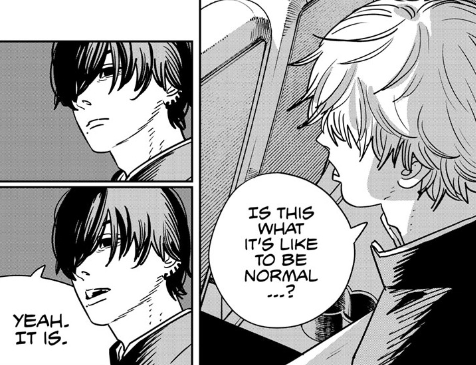
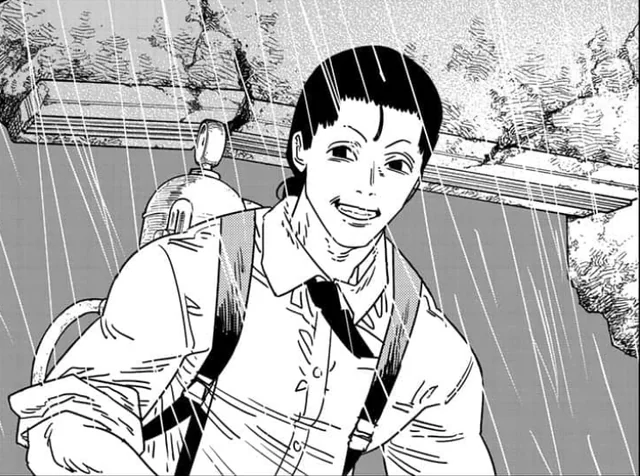
Which, as in the context of the panel above, leads to physical death for the far-gone folks themselves. It’s a long way down her gut.
I’ll state it clearly now: Yoru is Asa’s final villain, and Lil D is Denji’s final villain. Yoru is the physical representation of the parts in Asa that hold her away from humanity, and Lil D is the physical representation of what holds Denji away from humanity. An endless cycle of consumption. Savoring. And convulsing in the hand of one’s public image in order to preserve warmth.
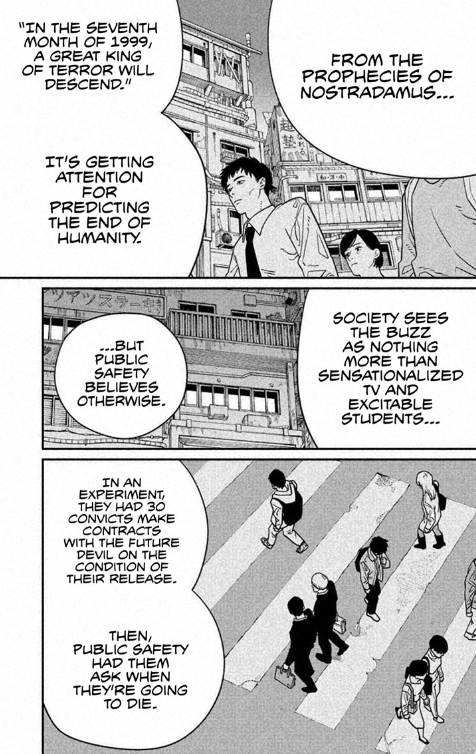
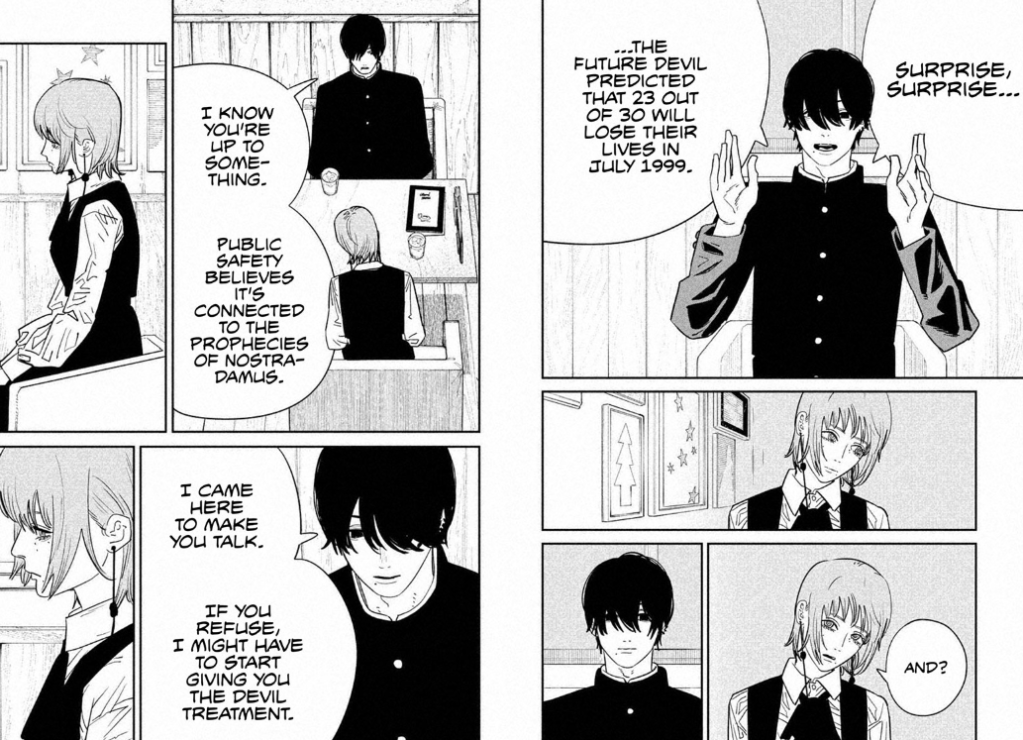
Fujimoto plays with the absurdity of the Y2K craze and world-end cults, both of which are massive, intertwined themes in the Japanese consciousness (think of 20th Century Boys and Subarashiki-hibi, both of which give their own critiques of this era), and it’s very telling that Miniscule Dingaling is both the object and the reactive subject of the final Y2K prophecy. She’s as reactive as anyone in Chainsaw Man‘s second part, in fact, her entire existence is nothing but reaction because all she can ever do is savor human life. Her performance in the narrative is the perfect expression of death. Despite this, I’m not going to call her ontologically evil – which is a huge shame, because this is the one time the phrase would be correct!
Fujimoto plays around a lot with devil and human nature for the rest of Part Two, in a supremely empathic and pragmatic way, and, while Nayuta gets a role to play, and Yoru gets to express profound meaning as the person she happens to be, Lil D’s spot in the narrative is just… suffering. The easy route, then, would be to change the phrasing to an ontological tragedy, because Fujimoto is, once again, a hardline humanist who never turns an eye away or reduces realities to somewhere outside his sphere of personal responsibility.
But the tragedy is the fact that she acts with respect to herself. The reason she manifests as death is because of her fear of her own realization; we bring death into life by fearing death. Lil D fears the implication of her own existence. And what is mindless consumption, but that fear of death made physically manifest in the ultimate negation of life? Bucky and Such.
Now, let’s finally get to the arc itself.
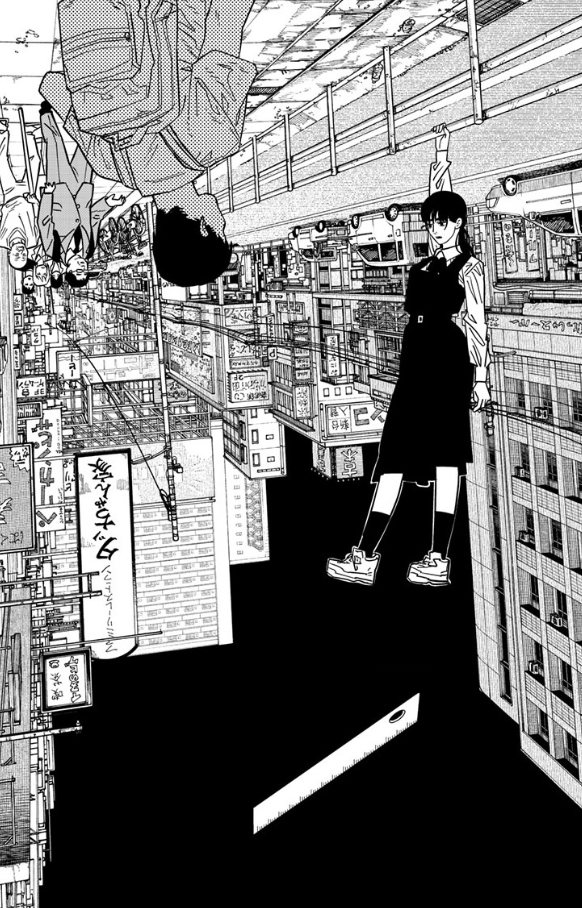
Falling Devil continues Asa’s dilemma between “reclaiming her body from Yoru” and finding actual peace with Denji. Again, the Reze comparison works wonders; as long as Denji doesn’t shit himself and bring them both down, they can build something.
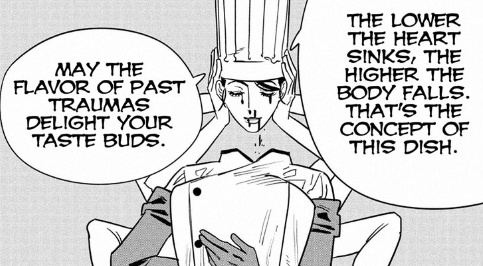
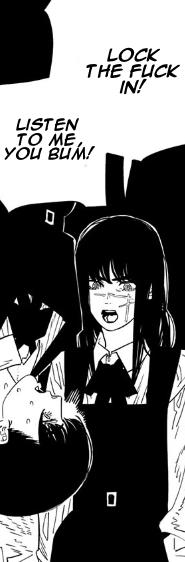
I’ll acknowledge the psuedo-Jungian angle on the unconscious, repressed shadow reality which Falling brings subjects down into, destroying their socially constructed/attained world. The actual point of this is where it goes with Virtual Schlong: she’s the one in command of the meal, the meal that is this collapse of human reason into fear of death. And, again: enough bullshitting and pretending, and we gain access to one another, to build something more. Falling into our own flaws only brings us all under the thumb of Death.
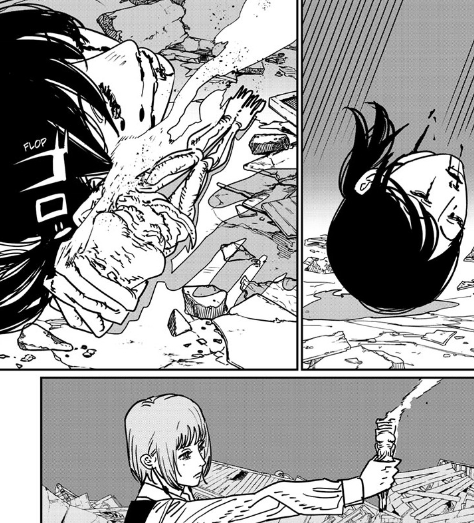
This very much succeeds in foreshadowing her as a primal devil of devils: the truth of devils feed on fear is transformed into a social dimension. Not the raw, crude form we saw with Eternity, or the societal form of Makima, but a horrid ritual sacrifice of humanity to Death.
But for Asa… this arc does nothing. Unlike International Assassins, it has its own big-time merits as an expression of Denji’s character. But Asa’s only role here is to deal with that.
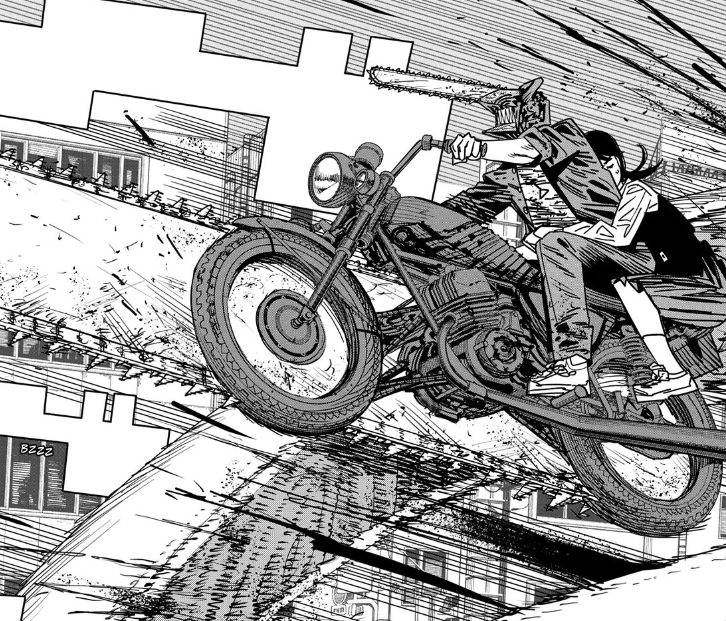
That it does just roll off it. Denji and Asa’s relationship-building and Yoru’s relation to it continue without really progressing in its substance. We just get more.
The semi-final point on plot and foreshadowing here is with Denji.
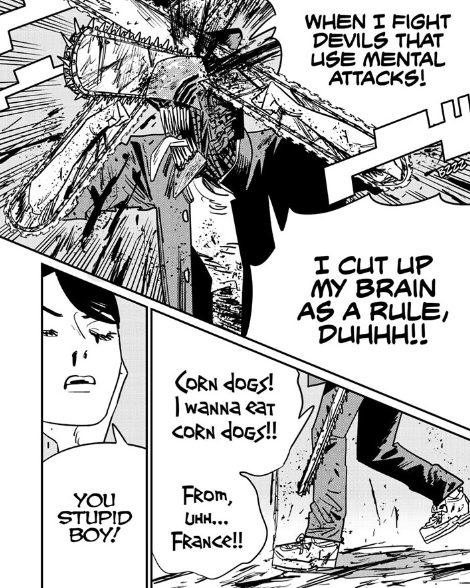
Denji escalates the self-harm visual metaphor by making it textually explicit and cutting up his own brain to stand up against a threat he isn’t built for, while reinforcing consumption-as-blindness. And…
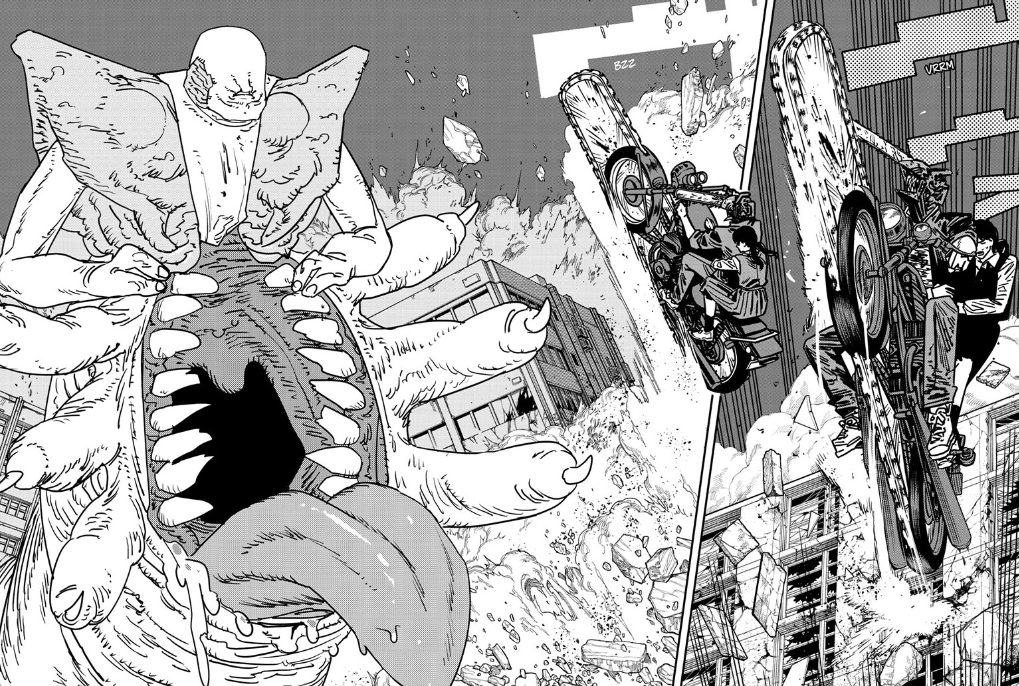
Falling tries to feed Denji and Asa to the actual Justice Devil, which can be read in a few ways, thematically and foreshadowing-wise.
But the big break is Denji wanting to fuck.
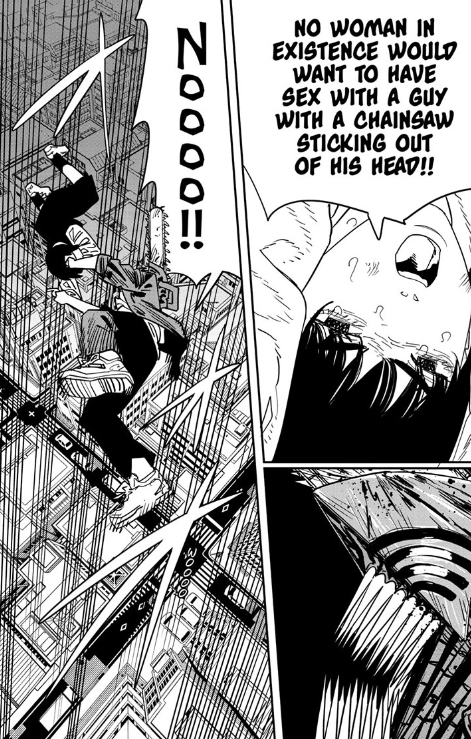
Denji screaming about the fact that he’s living for sex; playing the role of Chainsaw Man in such a crude way makes him unappealing to women, when he’s doing it to get their attention; confronting this fact means seizure by Falling as the repressed truth catches up once again and now both of them, caught back up in their inevitable faults when left alone, get fed to devils, because devils feed on fear, and our falling into ourselves is the best possible kitchen. Lil D runs the whole thing half-because she feeds on human expression, but, at the same time, this quite clearly aligns with a crude taming of humanity out of her own self-fear, the most viscious of all cycles. More on all this later. That’s it for this arc. I don’t care for it.
The Chainsaw Man Church Arc
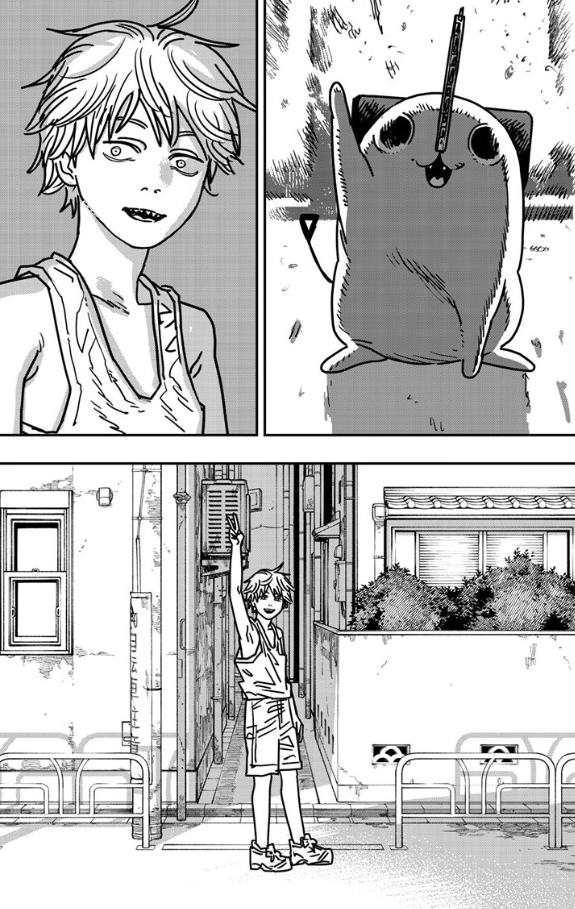
The Chainsaw Man Church Arc is the greatest thing Fujimoto ever wrote, to the point of making up for virtually all of the shortcomings present in not just Falling, or even the last two arcs of Part Two, but even the worst moments of Part One. Hell, it makes up for the weakest parts of Fire Punch, and all of Fujimoto’s one-shots – fuck, it makes up for him eating his pet goldfish.
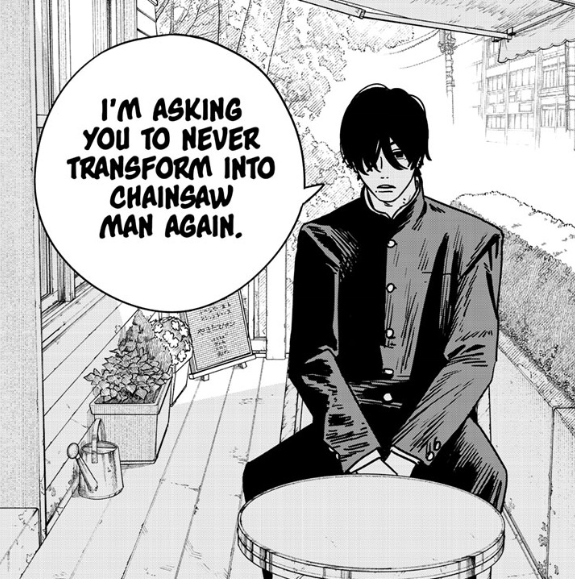
Fujimoto’s greatest skill as a storyteller is his total understanding of human thinking.
Denji’s internal conflict between his deep empathy and the need for compensating the childhood lack that produced that very empathy is a masterclass. Aki’s conscious abandonment of reality in exchange for the will to go on in an absurd life, only finally choosing his senses again when he regains connection against that will, is a masterclass. Power’s relishing in raw childish fun that takes the shape of a more loving little sister-figure amid mutual trauma is a masterclass. Makima’s fucking everything is a masterclass. Asa’s disconnected desire for profound, perfect affection, constantly betraying her own interest to defend her fragile, shivering young ego, is a masterclass. Yoshida’s complete abandonment of human volition is a masterclass.
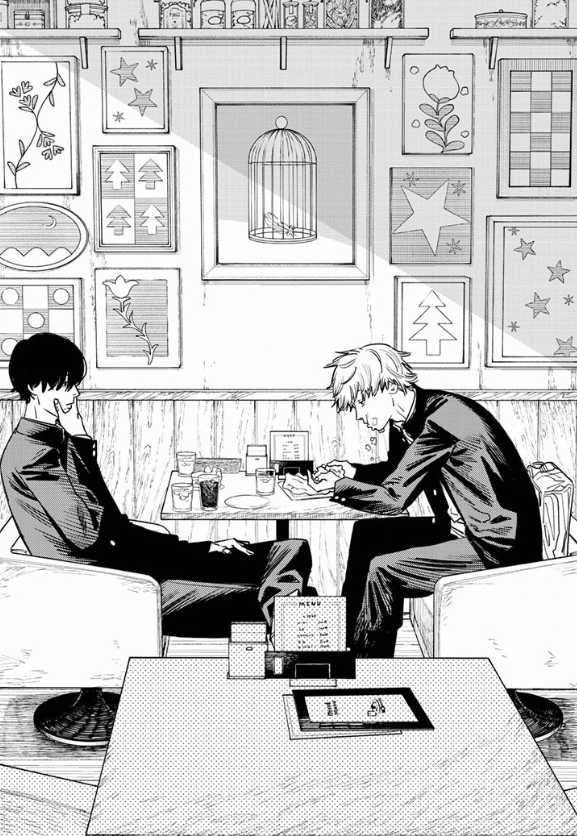
Among all the characters which Part Two gives its focus, Yoshida is without question the one who shined the most consistently for me. Asa has amazing moments and I love her, but the combination of her essence being given immediately and her very slow and repetitive arc hold her back. Yoru at her peak is genuine perfection, and across the part, she sings, but, even beyond her use of personas to appear in-charge or logical when she isn’t, it’s clear that her writing isn’t entirely consistent, or even coherent. Fumiko is unironically one of the best written characters in the manga, but she’s barely around. Yoshida, more than even Denji, has everything going for him from the moment he’s introduced to the moment he confirms his equal preference for giving and taking. From his introduction, he was introduced as a falling knife, but a realist. Then, we discover (a little too loudly, yes) that he quite consciously chooses the parasocial over real human relationships because it’s simply easier that way. And for the entirety of his time in the narrative, he’s being developed. He has no wasted panels. Every moment Yoshida is around builds on him to a degree that’s striking even without deep reading.
The foundations were clear enough, but the inner process of Yoshida really took time to bare itself, behind all his frontings and externalized rationalization of his own misery. And it’s in Chainsaw Man Church that his inner truth becomes blatantly visible.
Yoshida flat-out doesn’t care about his responsibilities as a conscious human being.
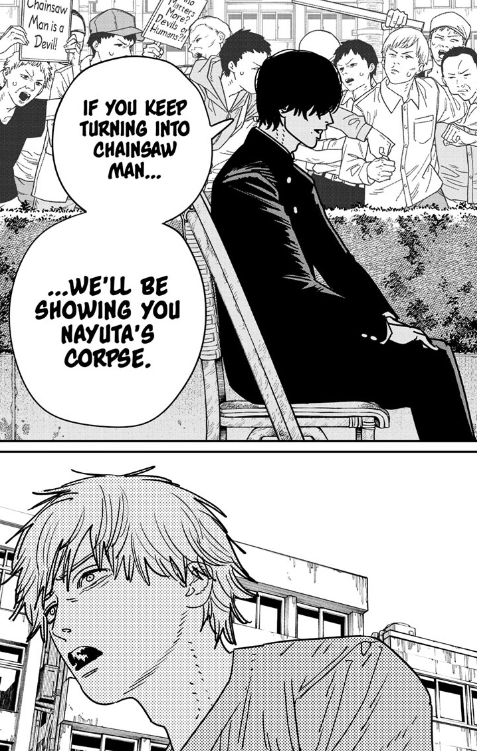
The revelation comes in a solid two blocks, the first of which is Yoshida openly telling Denji that, if he doesn’t stop turning into Chainsaw Man, Public Safety (which Denji has already associated Yoshida with) will be showing him his adopted daughter’s corpse.
He’s shocked and furious when Denji is shocked and furious at this.
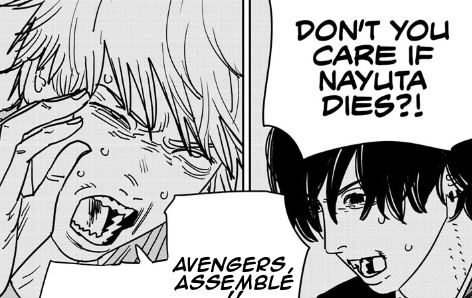
Fujimoto’s mastery of character goes beyond full understanding of interiority into objectivity of portrayal, because not only is every character’s interiority exhaustively clear in almost every scene (pre-Aging, at least), but the collective portrayal to come out of that is of entirely non-archetypal writing, regardless of how bad that makes its cast look.
It makes them look fucking awful.
On one hand, we have Yoshida, threatening a teenager’s adopted daughter to his face and expecting him to bend the knee. On the other, we the teenager in question reject the absurd dilemma offered to him by societal powers not by actually doing something of his own, but by having a brain aneurysm and asking for both, then trying to get the crowd to defend him like he’s in a superhero movie.
It’s so harrowingly realistic, one could kill themselves over it. Everything about this situation is awful.
And it’s here that Fujimoto finally lines everything up.
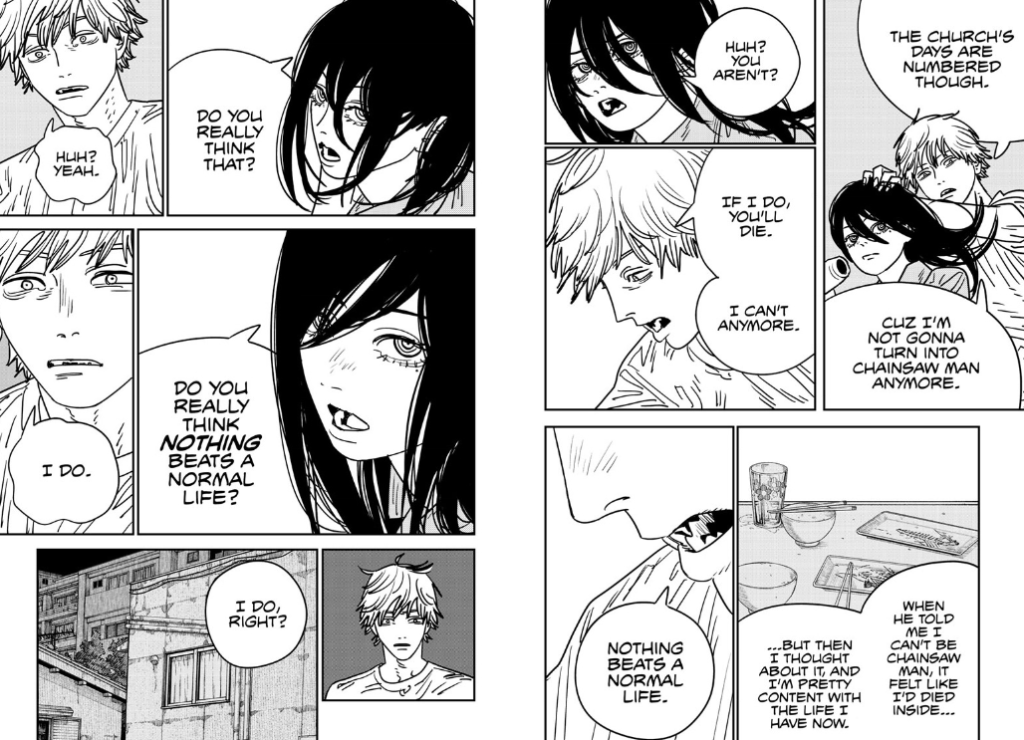
Fujimoto contrasts between Denji trying to gaslight himself to build a better life, as Falling Devil established as a seemingly fair enough venue in a twisted world, and Nayuta forcing him to connect with his inner self. Nayuta is an extraordinarily tragic reminder of the life Denji was once granted against his own will (hooray for SA allegories), which works even more effectively as a critique of our contemporary condition. When your two alternatives are abandonment by society and having society give you other people’s work to consume in ignorance, there really isn’t any way that any of us will ever be healthy, sane, and in-touch without either putting serious work into understanding and self-determination (which is difficult when you’re starving or trying to raise a kid as a single father with no social support network), or give up and embrace escapism that is, once again, simply provided to you. And if you try to escape…
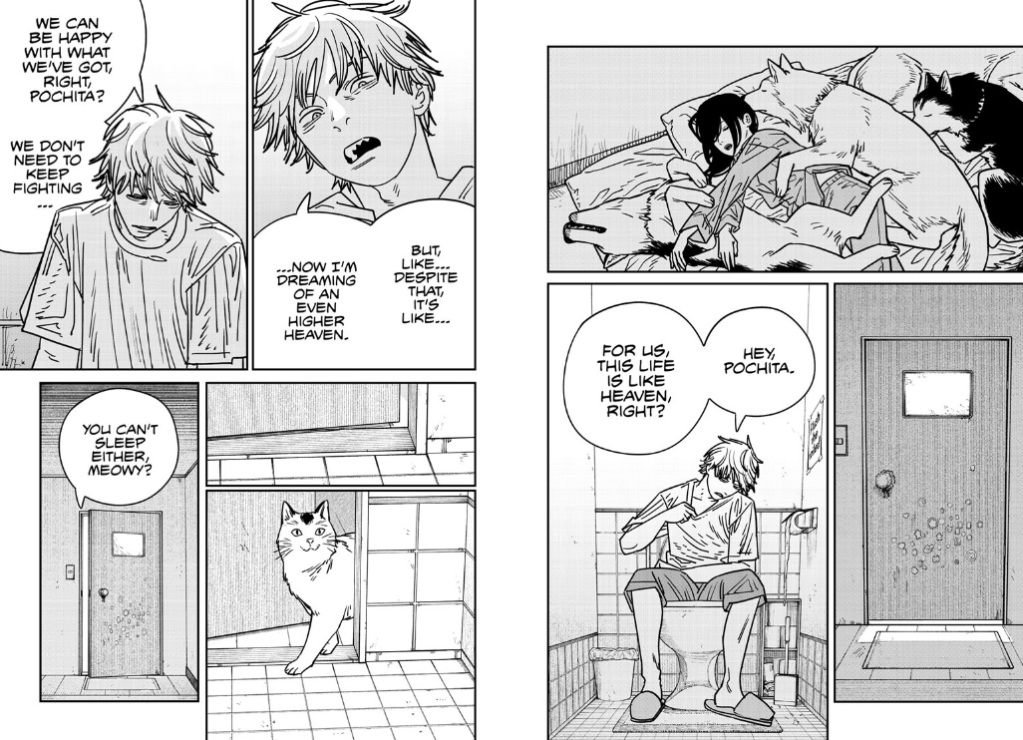
…they pull you back in.
The Chainsaw Man Church Arc is, above all else, the story of Denji finally losing all control of Chainsaw Man (which is to say, the idea, the role, the symbol. Not Pochita literally.) The process spans nearly the whole arc and goes through multiple twists and turns, but it’s of overwhelming interest that, after having one party push him to capitulate out of forceful threats, Denji feels the pressure mount again not because of anything he heard from Pochita – and he tried to talk to Pochita, to no avail, mere moments before disaster. It’s because corporate and state media advertised their Chainsaw Man.
Instead of Denji being in charge of his role, we have him breaking down in the same manner as a crackhead addict watching reality TV while his rape-baby tries to comfort him over his lost ownership of his ‘own’ identity.
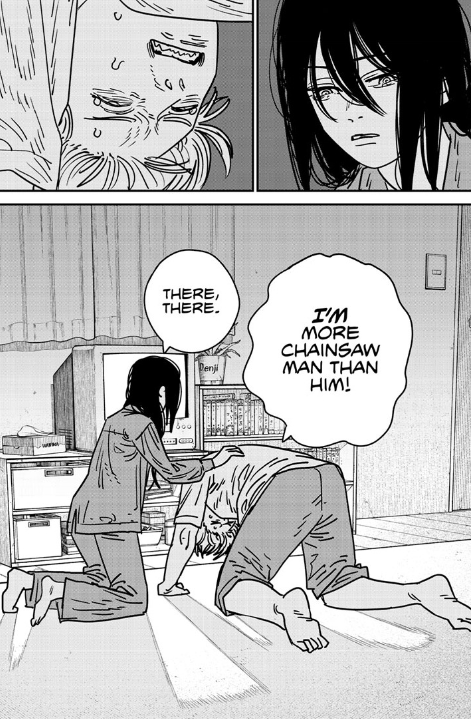
In the same way that the Chainsaw Man Church claims ownership of the Chainsaw Man identity away from Denji, Yoru claims ownership of bodies and capacities, beginning with Asa and using her as a slave to gain control of everyone else. The parallels are deliberate: everything Lil D and Public Safety tries to use to take control of Chainsaw Man and the prophecy only empowers the reality of War, because their methodology is fucking identical. A system which abstracts away people’s basic senses of identity and uses it to its own benefit will turn its citizens into hopeless addicts of approval, its higher-ups into desensitized psychopaths turning their internalized misery into a torture game, and will produce one unavoidable societal destiny: a takeover by fascist ecstasy. Lil D knew this, she knew that she was feeding Yoru, everyone under her thought otherwise for the most part and just went along with it, and everyone got fucked harder and harder the longer things went on.
Of the two sections of society just described, we’ll first half to focus on the desensitized psychopaths, with the absolute greatest chapter in all of Chainsaw Man.
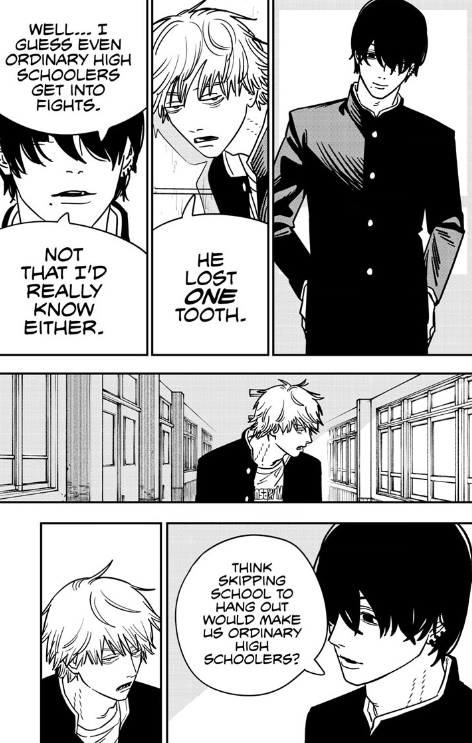
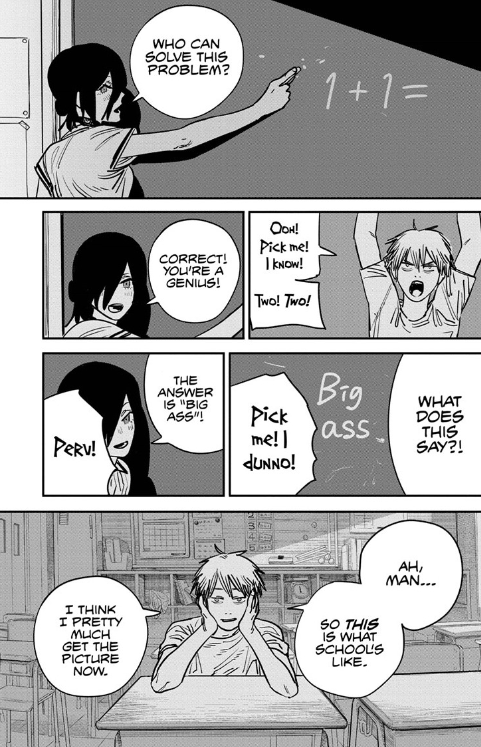
While I try to avoid referencing previous arcs wholesale, the Bomb Devil Arc is so essential to interpreting the Chainsaw Man Church Arc in particular because the former is the ultimate window into Fujimoto’s model for humanity and set-up for the disasters to come while the latter is the highest, greatest manifestation of the manga’s core tragedies in its entire run.
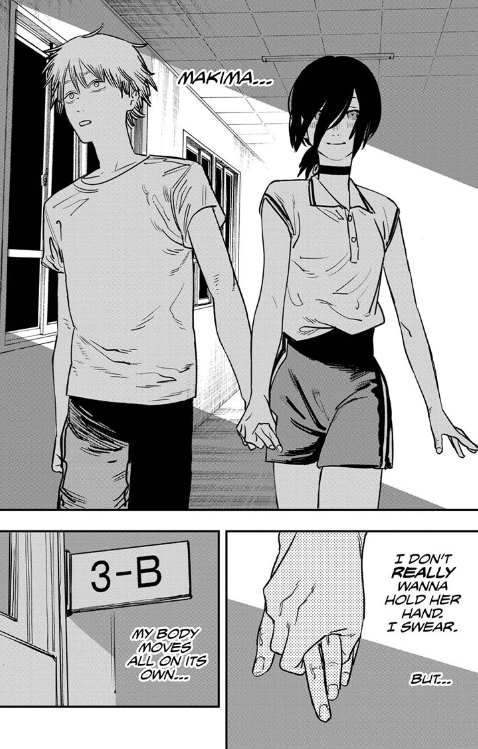
Overriding the body’s instincts. As Makima did to Denji to such an extreme extent in order to control him, so do we see, in the manga’s biggest emotional downpoint, the personal override that is endless rationalization. What makes Yoshida such a striking character is he’s never truly presented as a victim. A tragic result of the general environment – overwhelmingly so! But never once as a victim.
He simply abandoned all hope and rationalized everything away, as we already saw him admit to in his previous dialogue with Asa – however little he could even feel the full implications of his own words. And just as he emphasized his preference for parasocial relationships, Yoshida’s character as a whole is one of constant simulation of that which he abandoned in reality.
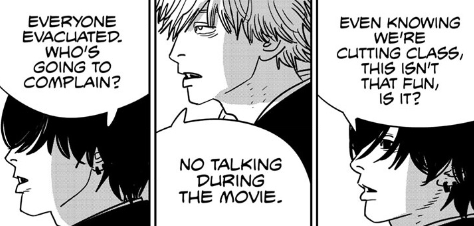
Yoshida doesn’t intend to do anything with his high school life, but he’ll cockily play with the idea of acting as high schoolers do. He’ll roll up into a movie theater just to deliver a lecture, and when Denji, in his worsening inwardness, states his focus on the movie, Yoshida once again covers his eyes and denies himself.
Everyone evacuated. Who’s going to complain?
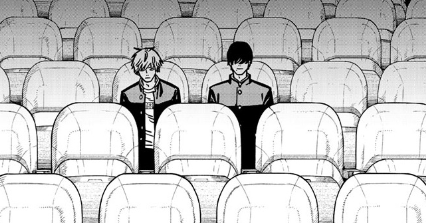
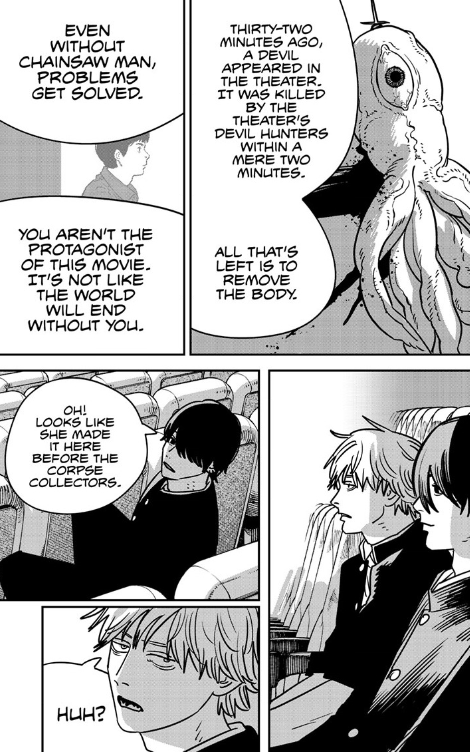
He’ll project grand, fantastical ideas like protagonist and the world’s end onto Denji to deny the inevitable fact that neither of these teenagers (and it’s so easy to forget that Yoshida is a teenager) is remotely alive at this stage of the narrative. Neither of them has a purpose, period. Yoshida gave up his own desires and, in doing so, became not a responsible and reasonable adult, but an appendage of Death, because it’s either reactionary Death or glory-hungry War that runs this system. Denji, himself, fucks up his relationship with Pochita time and time again in the wake of what Makima did to his brain and their contract. He’s almost entirely ceased to view Pochita as someone he’s accountable to. He still tries. The fact that he tries is his source of contrast with Yoshida that makes this the best or second best dialogue in the entire manga, even above Pochita and Makima’s final conversation (though still fighting brutally with Denji and Kobeni’s final dialogue, my beloved.) But he just doesn’t have much of the capacity left amid the reminder of Makima, the difficulty of providing for both himself and her while also attending high school, his accumulated trauma, and the general rot seeping through the world around him. How harrowingly relatable, off the still theoretically hopeful relatability of Denji as he was originally poised, the man who seemingly escaped his father’s debt.
It turns out you set your own debts just by being alive. You’re not going to catch up without putting your foot down and building something of your own.
And for Yoshida, who’s lived by convenience, the alternative is to just miserably spread your ways onto whoever’s next to you with smug frustration.
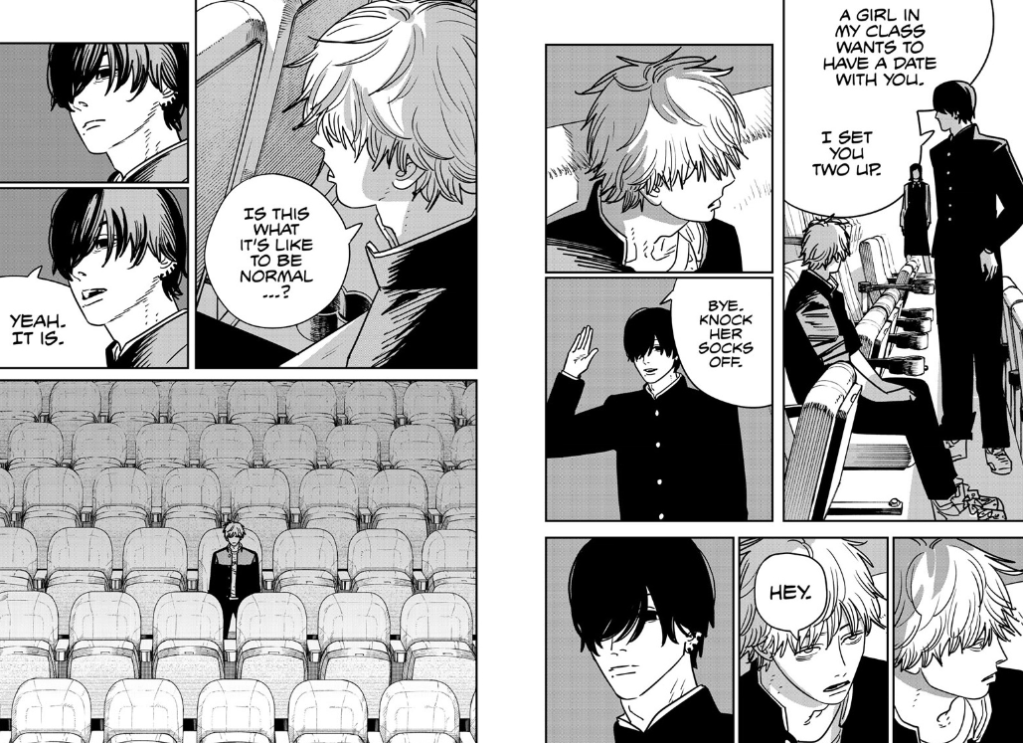
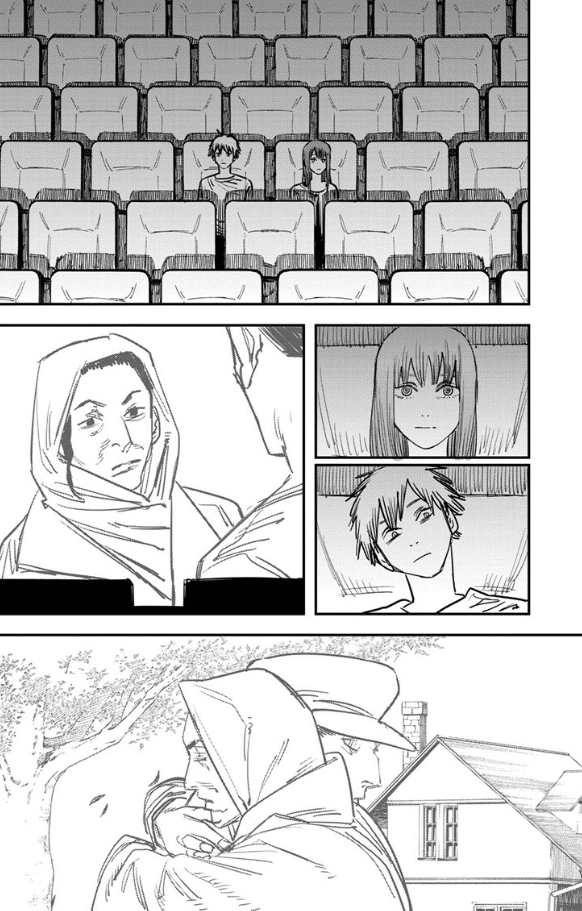
“Yeah. It is.”
I weep for Yoshida. And you’d better do so, too, because he’ll never weep for himself.
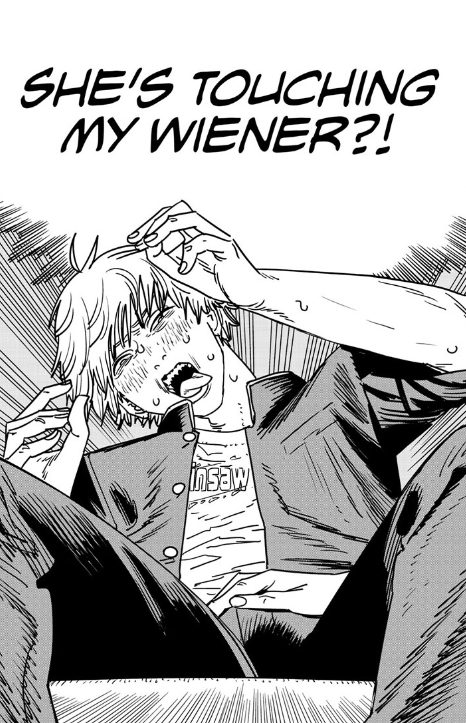
SHE’S TOUCHING HIS WIENER!?
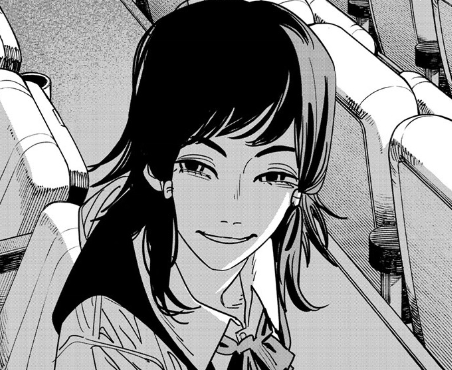
We’ll give full focus to my GOAT, Fumiko Mifune, later on, but for now we’ll acknowledge the heaviest recontextualization of this entire sequence: Yoshida said all that while setting Denji up to die at the hands of the STD Devil’s current user. A SA victim spreading it further and literally turning those she kills into copies of herself. A perfect mirror to Yoshida himself, without any of the pretenses. Just the joy of giving up and letting the world fuck you.
The greatest chapter Tatsuki Fujimoto ever wrote and one of the greatest manga chapters of 2023. I would have said the greatest, but I looked into it and found we also got Sukuna’s big moment in the Culling Game and the entire Kuma flashback that year. I have no idea what the fuck was in the air in 2023. What the Hell?
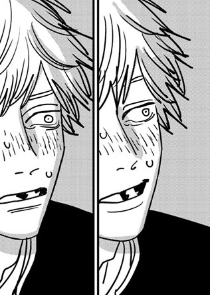
A brief rejoicing at the former state of WSJ aside, this stretch of chapters is just so fucked up in the best way.
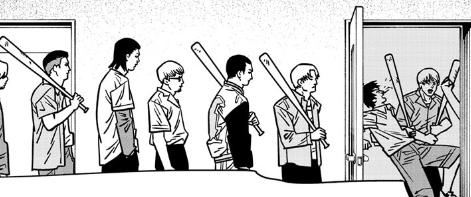
Phallic Metaphors and Such
Denji regresses into his base instinct against the pretense of it, and we get even further emphasis on the painful contrast between his awareness of what’s right and wrong, gleamed largely from his experiences with Aki and Power, and his inability to do anything amid the freak show but watch.
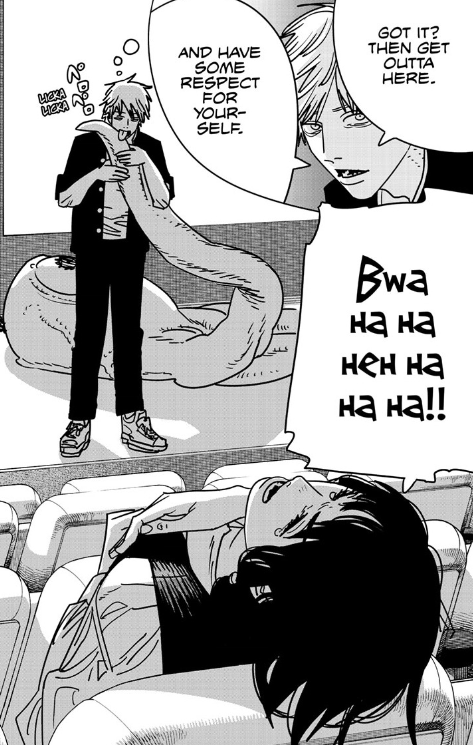
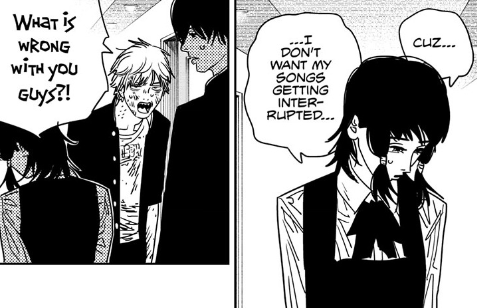
The forces moving around Lil D are winning. Even without Denji’s death to Fumiko actually happening, he falls further and further into the hypersexuality and love-me-please loop and away from all he once had built up with Aki and Power in Part One, and what he’s beginning to build with Asa, as well, begins collapsing further by the same means.
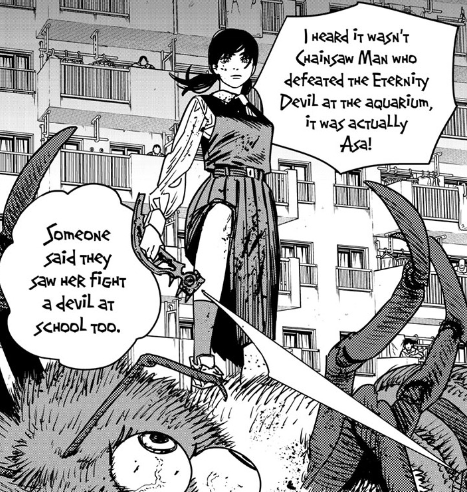
Lil D’s misplaced efforts won’t stop with Denji, or even Asa: she’s here to provide the fuel for even Yoru’s descent into the worst version of herself. We’ll have to go back a few chapters before returning to Asa’s mini-arc.
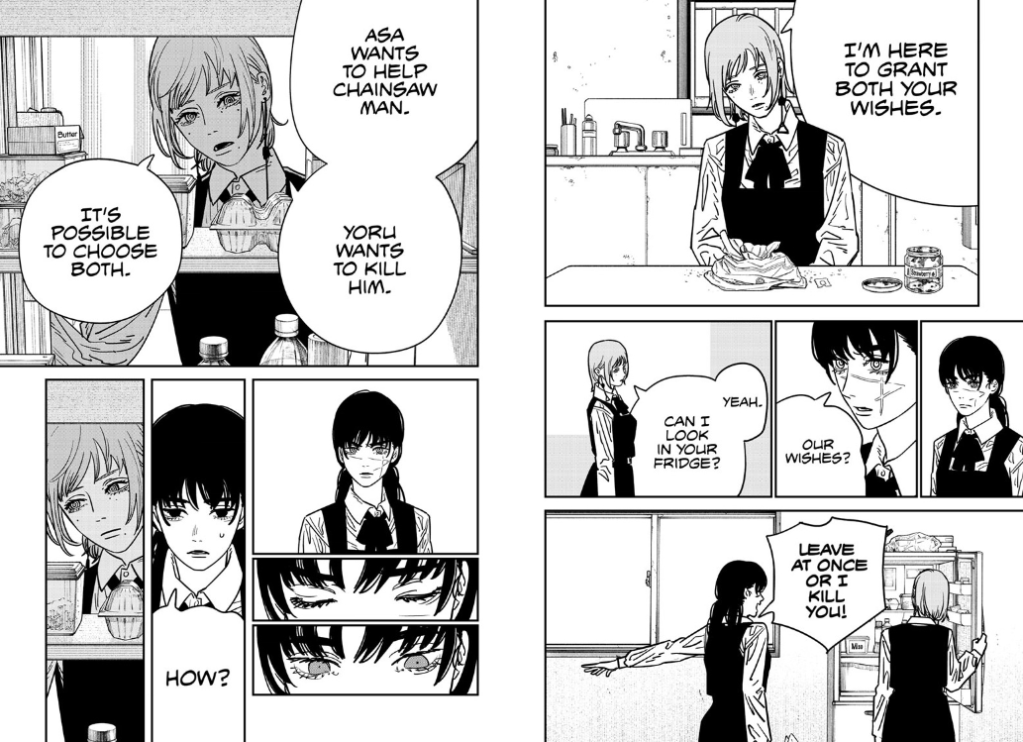
If someone in Chainsaw Man mentions granting two diametrically opposed wishes, it’s time for you to run, especially with the visual metaphor of Death raiding your fridge.
Visual foreshadowing and such (the fridge door’s edge is positioned like a noose on her tilted neck)
And now she sells her idea to Yoru.
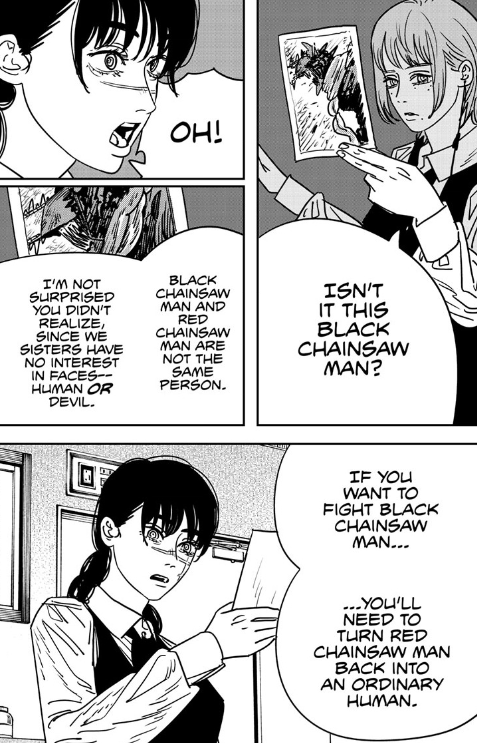
In order to fulfill her desire and defeat the black Chainsaw Man (defeat Pochita), Yoru ‘needs’ to separate him from Denji, the red Chainsaw Man – leave Denji as just Denji.
In the shallowest sense, this solution looks perfect. It doesn’t seem to have that compensatory frustration that Yoshida acts with. It isn’t harming anyone – in fact, it’s separating Denji from his ‘addiction.’ In doing so, we’d also be able to eventually bring this whole Chainsaw Man nightmare to a close by pointing at the real one and killing him! Wait. Wait, a minute.
While Fujimoto firmly established the need to hold trust with one’s body, it’s in this arc that he truly begins to move into a more metaphysical, or at least deeply interpersonal, angle. What is to be done with the contract between a boy and a devil?
If you’ve paid very close attention to the manifestations of Fujimoto’s humanism, you’d correctly guess that the interstice of their meeting should be their mutual responsibility, rather than either the weapon of war or a sacrifice to the glory that baits the boy into giving up his connection for nothing more than societal recognition.
And what do Asa and Yoru want, above all else? Why are either of them doing any of this?
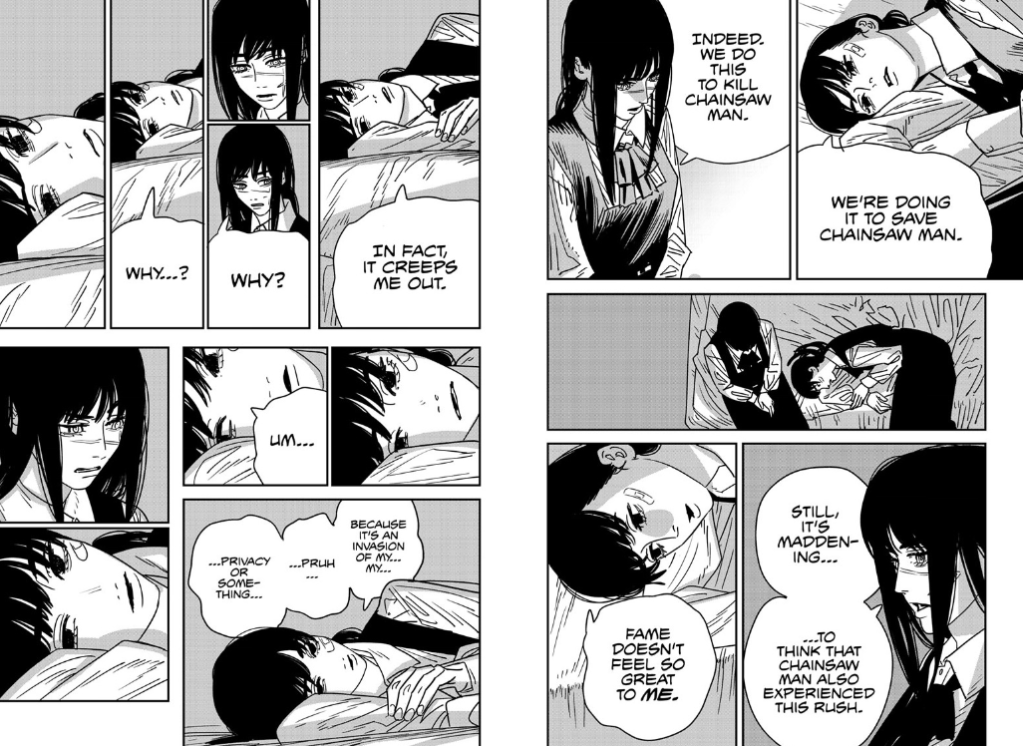
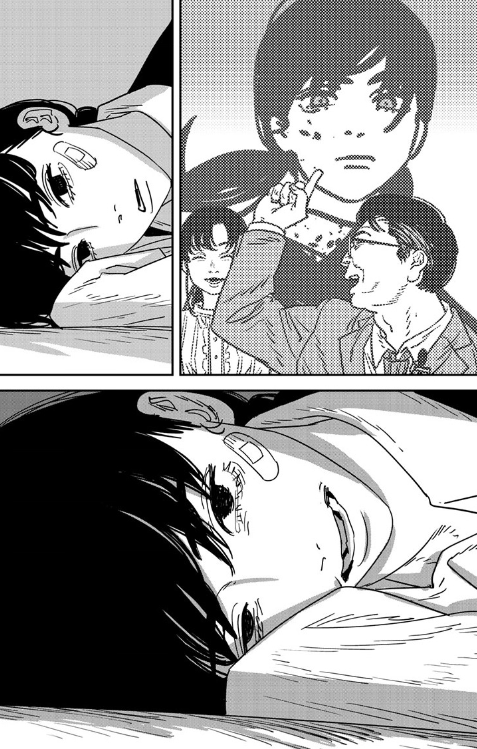
Do not sacrifice your own understanding for the sake of approval, or you will go raving mad.
The reason this extraordinarily complex subject of Denji’s relationship with Chainsaw Man works is because Asa’s own relationship with fame, approval, and Yoru shows what actually happens if you, quote-unqoute, “give away” your ego and desires to the powers that be. You fatten it up into a monstrosity and, in losing comprehension of your own unconscious desires, wind up with this zombie-like smile contorting your face amid the eager collapse of your entire society.
In three pages, we see Asa undo forty chapters of character growth.
The rotted, lazy-eyed smile Asa gives is one of my favorite expressions in Chainsaw Man, which says a lot for a manga with probably my favorite expressions in the medium. The biggest reason it’s so wrong now is because Asa’s aware enough to feel bottled-up shame over it, which, as with Denji’s own impotence, does nothing but mix itself up with the joy to produce something much, much more disgusting than either alone. It’s the same mood we see Yoshida carry himself with – disgust, pity, spite.
At this stage, everyone is letting themselves go.
Amid this insanely dense lattice of existential agony, Fujimoto grabs the reader’s balls tighter still and throws us directly into the belly of the beast: the Chainsaw Man Church.
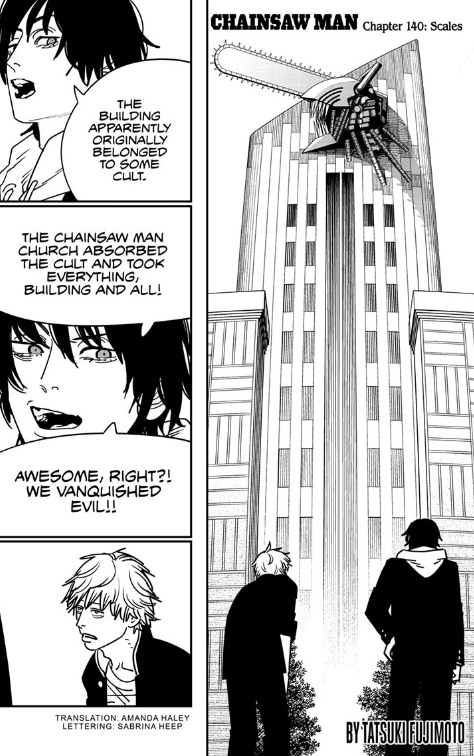
Miri is a straightforward, but very effective and tightly written character. Denji alternates between two things: being unable to enforce right and wrong amid disasters he’s wholly conscious of, and falling in-line more and more with his own base desires. The latter is very much the fuel of the former.
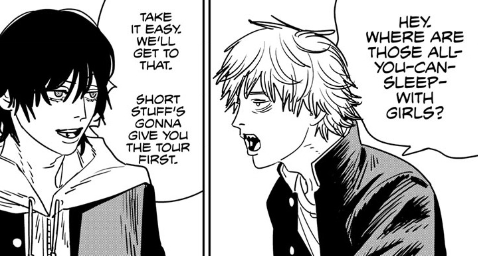
The reason this dynamic works and Miri gets characterized so fast is because of, again, character contrast. Denji can tell what’s bullshit, however much his personal volition functions against it. Miri tries much more consistently to point himself against the tide, but he’s just… a dumbass.
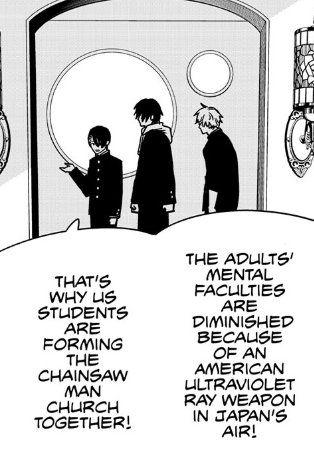
Kobeni’s future was sacrificed for her brother to get this.
The density of mentally ill teenagers increases exponentially here as everything Chainsaw Man critiques comes to its ultimate fruition. Total disassociation under authority, total loss of contact with one’s bodily sense, total servitude to abstraction, the works.
Everyone has their pretenses. Denji has the memory of right while doing a worsening fuck-all about it. Asa’s the biggest hypocrite of 2015. Miri pretends to take command of his life by giving it up to bigger sources so he won’t have to do the mental labor. Lil D spreads her Death-iness under the belief that she’s somehow fighting it. Yoshida puts on airs of reason to defend his scummy character. Everyone bullshits themselves about what they’re doing with their lives.
All except one legendary man.
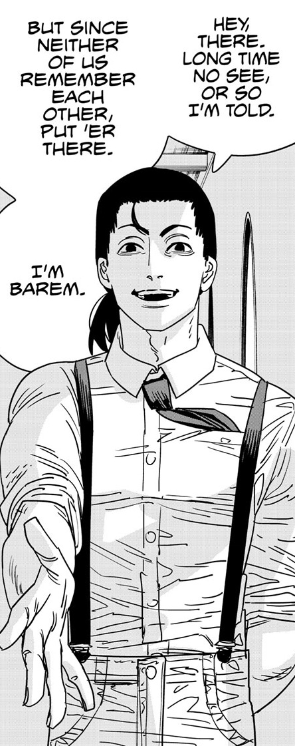
Fujimoto does such a good job at showing the weight of each character’s perspective that you understand them all quite quickly, but Barem is unique in being genuinely insane. This isn’t a shorthand, nor is he a victim (as far as we know.) His head wasn’t screwed on correctly and this whole scenario happens to be screwed just the right way for him to stand proud amid everyone else.
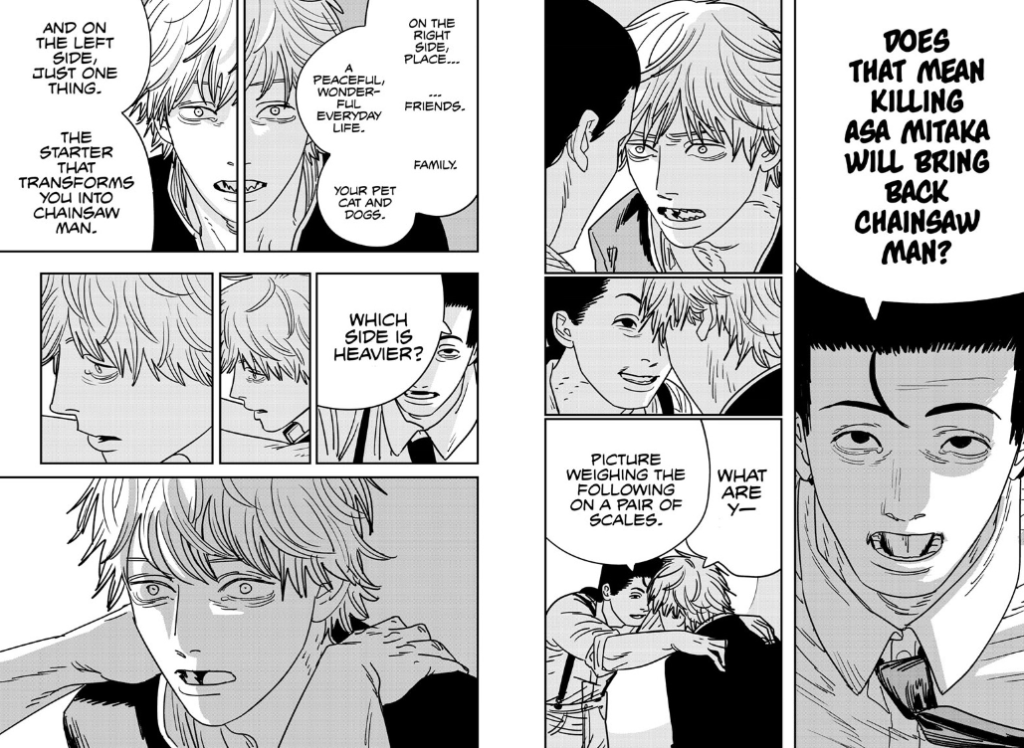
He’s in his senses. He only makes up bullshit to escape external pressures.
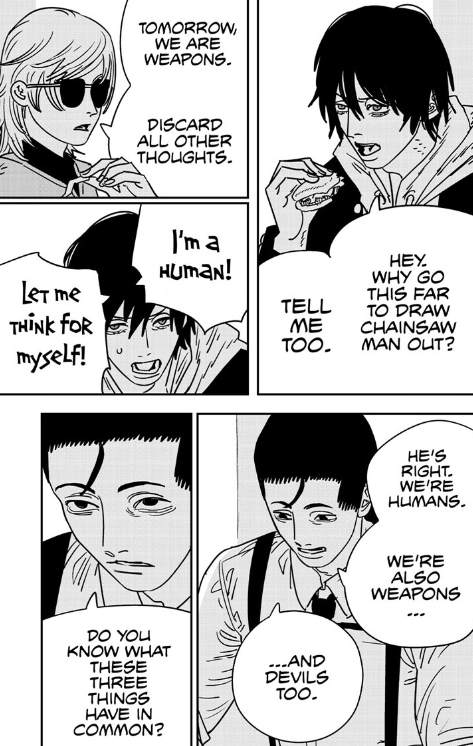
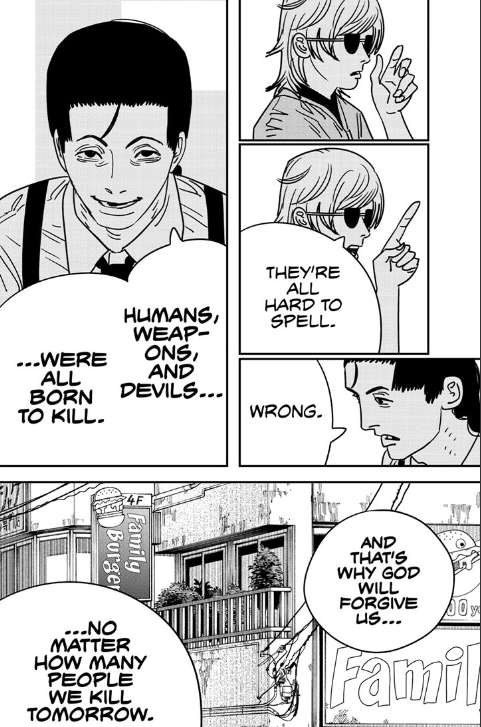
Barem is exactly where he wants to be. Whip, however unpronounced her role, is also where she wants to be. She’s fine being used as a weapon human. She just wants an excuse to live out her Heavenly fantasy of destiny. And this provides the highest contrast for Denji.
Barem presents Denji with two options, becoming Chainsaw Man or living a normal life. But the key is that Denji was never truly given either option. He can either live under the thumb of people and devils like Makima, readily executed at the slightest sign of doing too much, or he can be the Chainsaw Man public safety wants him to be. He can be a weapon human. He can be a dog. He cannot, as Pochita wanted of him, live like humans do. He cannot get too close to Pochita. The state never provides you with real choices. No choice is ever real because everything provided to you is outside your own will. The solution is a genuine, mutual dialogue with people who actually care about you and what you care about. Denji, time and time again, has grasped this intuitively, hence his brain aneurysm before Yoshida, but hasn’t had the slightest conscious grasp upon it. He’ll just freak out over wanting both without affirming himself.
Whatever anyone does, Barem will be happy. He just wants to burn and watch burn.
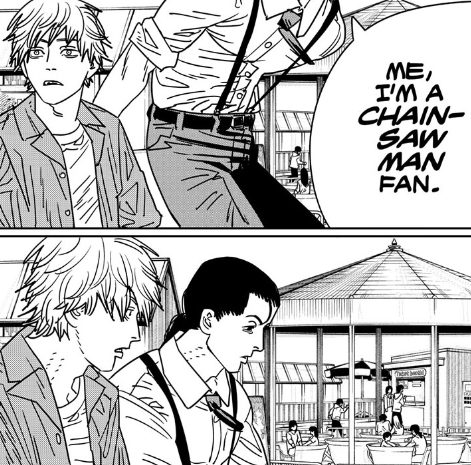
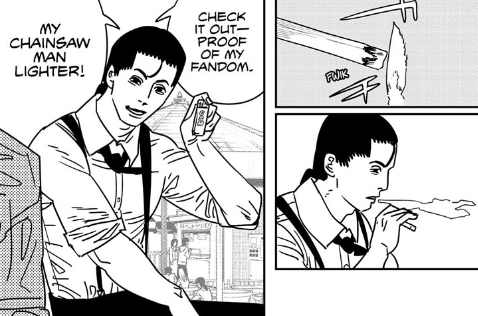
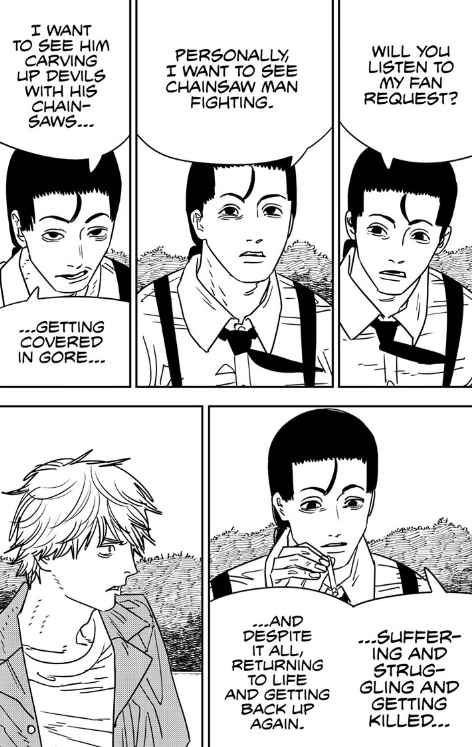
As comically heavy-handed as this section is, I love the character work underlying the meta-messaging. Barem can make perfect sense to himself and also get whatever he wants because the desires running him are extremely base. There is nothing complex to him, nothing deep to him, no responsibilities lay upon his shoulders, and he has nothing to defend. He likes it when there’s blood and then blood again. He loves being a weapon human, more than any other, and that’s why he’s, for lack of a better term, the final boss of the weapon humans in Chainsaw Man. He’s the ultimate living weapon of the state.
But let’s acknowledge Fujimoto’s frustrations, because Chainsaw Man is his work. It will always have been his work. That’s arguably his biggest statement amid literally everything else and I respect him tremendously for it.
It’s a massive damn waste to be a Chainsaw Man fan because you love its appeals to the simplest, easiest-to-access desires you have. It’s a massive abdication of personal responsibility and, with it, insult to Fujimoto’s own labor in writing the work so tightly, with such effort and passion, even under the chop-shop of WSJ.
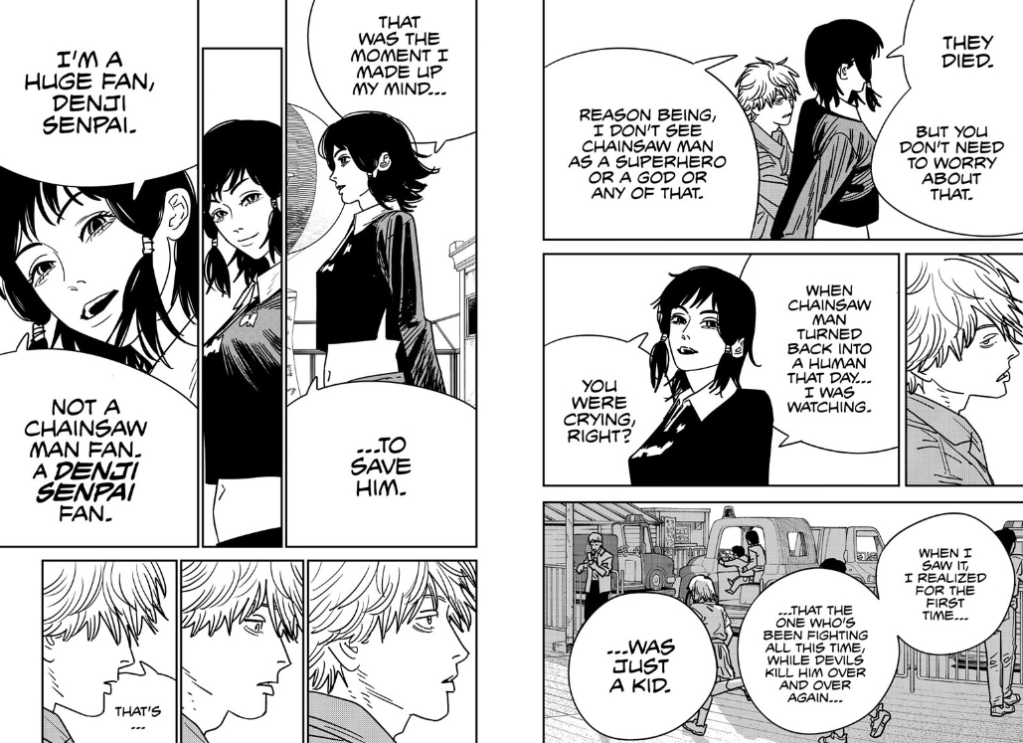
And it’s an, at least ostensibly, real Denji fan who’ll push him to feel himself again – and his bond with Pochita, again. The same internal duty Fujimoto conveyed with Look Back’s Fujino and Kyomoto. As deep into his own rabbit hole and the rabbit holes of the world around him that he’s gone, genuine feedback is necessary for Fujimoto to reaffirm his relationship with that inner promise and move forward. Most of Chainsaw Man is ultimately his journey with this promise, and Part Two’s ultimate direction is all about that duty extrapolated beyond his inner universe into everyone impacted by his ideas. It’s great stuff.
And, of course, it’s at that moment that Barem hits his comically tone-deaf (really, tone-disregarding) opinions on Chainsaw Man.
Among the elements of the next couple chapters, the only one of thematic and narrative significance that won’t be better expounded upon in different sections of this analysis is the introduction of the Chainsaw Man zombies.
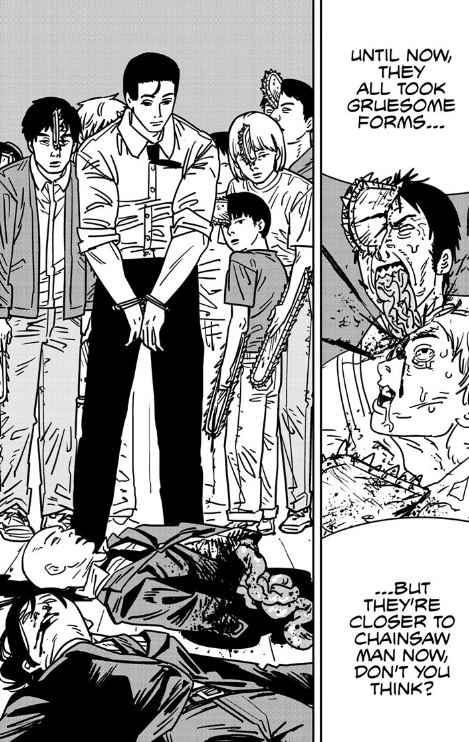
The Fire Devil’s original expression of respect towards humanity caused Yuko to horribly express her own will; the advancement of its contracts on a societal scale by the direction of the centralized Chainsaw Man Church resulted in the complete destruction of personal meaning in exchange for pure, unadulterated zombification into images of Chainsaw Man. There’s no inheritance at all left with this further distortion of her contracts; there is only the insertion of a universal and meaningless symbol where once stood individual spasms of passion.
It will be difficult to progress further without elucidating the narrative role of the Fire Devil, because her weight upon Part Two is monumental and the part flat-out doesn’t work without understanding everything she does for it. Though it’s still early, I’ll quickly state the foundational idea: the Fire Devil is an objective outside force for the Chainsaw Man phenomenon. She doesn’t love Chainsaw Man. She admires the love others have for Chainsaw Man and works to give them the power to realize it. She plays much the same role for this clusterfuck of inheritance and control as Jujutsu Kaisen’s Kento Nanami plays for the concept of a sorcerer and Yuji Itadori’s character arc – external, impartial evaluation. We’ll do a deep dive on it when we get to her, but this is the gist of her narrative-haunting role. A sort-of societal Kyomoto that Fujimoto has to grapple with.
Now let’s get on with it.
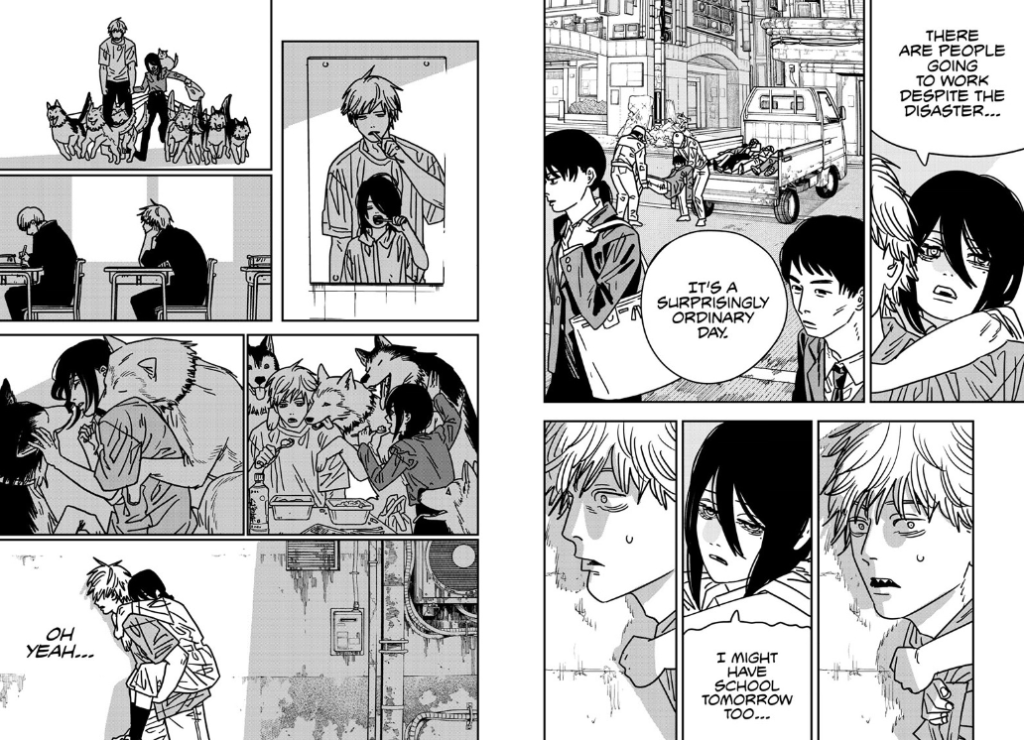
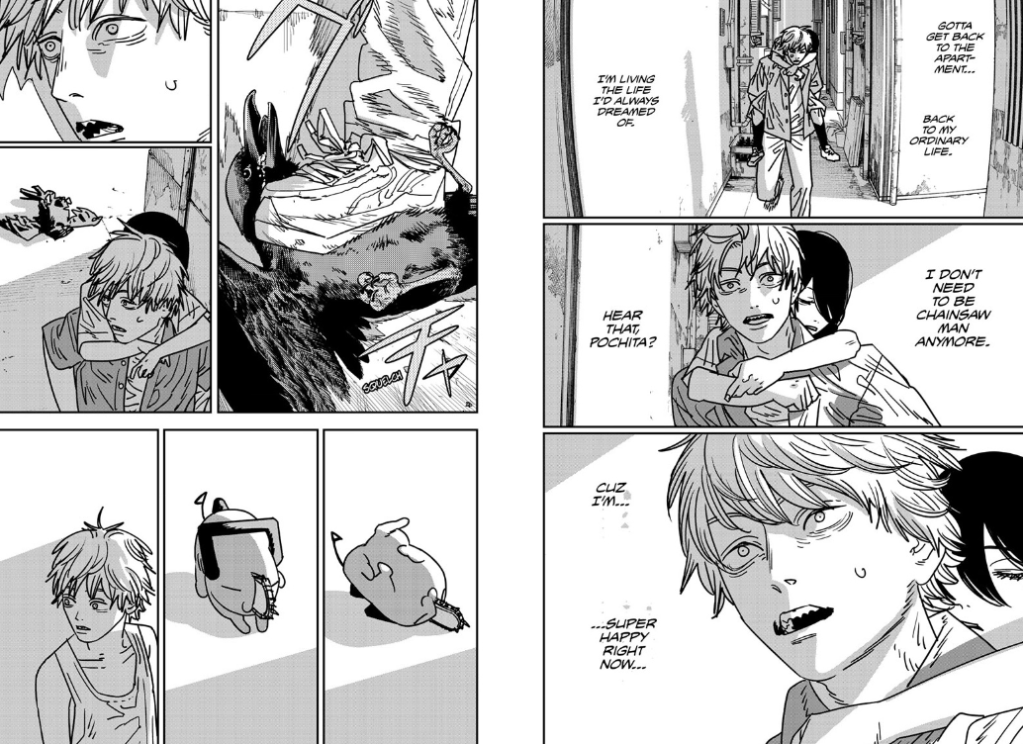
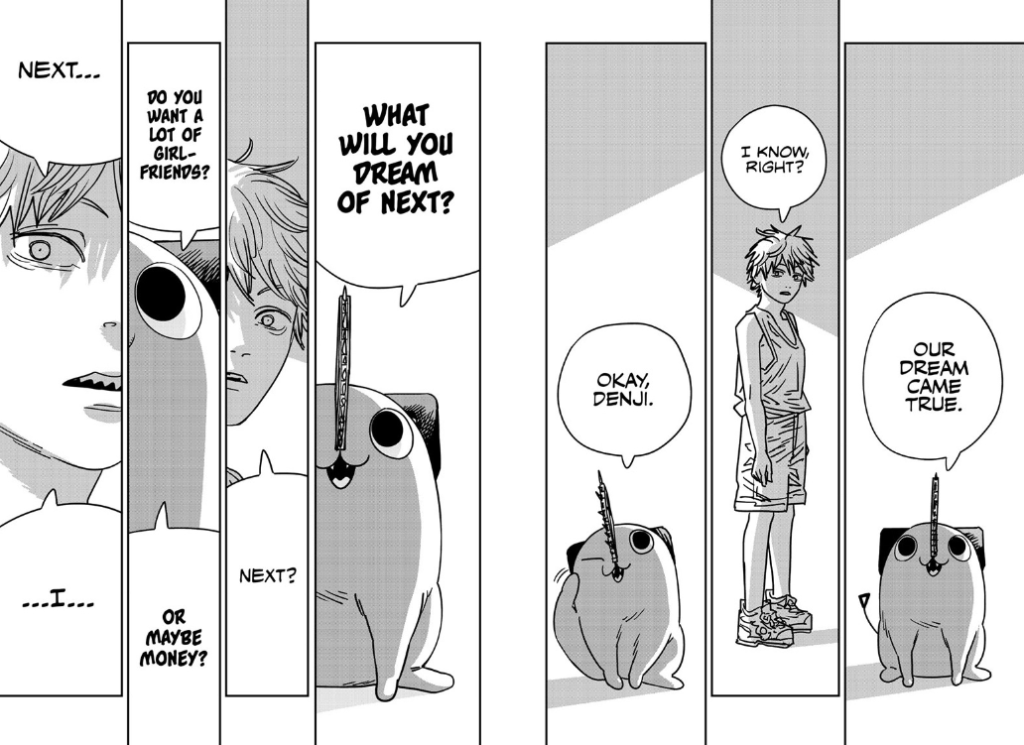
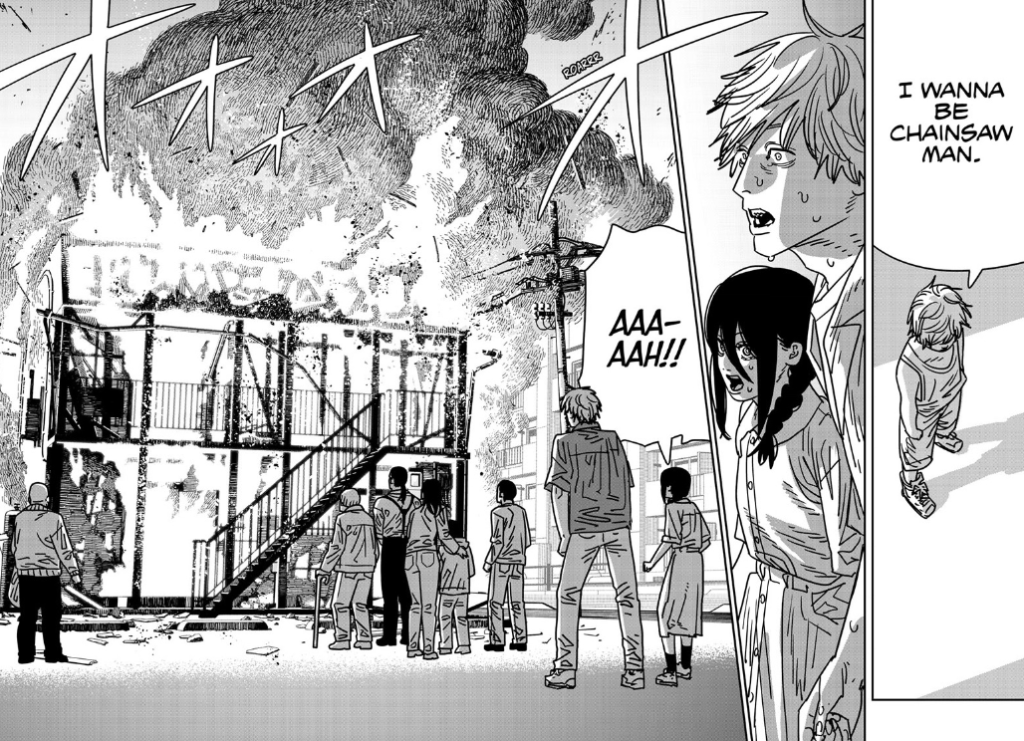
Pochita accepted Denji’s musings and formed them into a contract: show me your dreams.
Fujimoto’s gave his musings to his early works, and in due time, he understood the responsibility they gave to him: express your dreams through me.
Makima broke Pochita’s relation to Denji, so that the Chainsaw Man who wished to see Denji’s dreams got cut off by the Denji who abandoned his dreams and wished to be a dog.
In Fujimoto’s early life, his masochism often left him as fish-eater or soon-to-be NEET, which he grappled with against the deeper responsibilities he realized through his art, something he truly pours his soul into.
Denji began to use Pochita as a mere means to an ends, to amend his need for love.
I don’t know what Fujimoto was working through in all the difficulties of fame and its responsibility.
Denji stopped minding his contract.
Denji stopped showing Pochita his dreams. Denji stopped being Chainsaw Man.
Denji began to want to be Chainsaw Man.
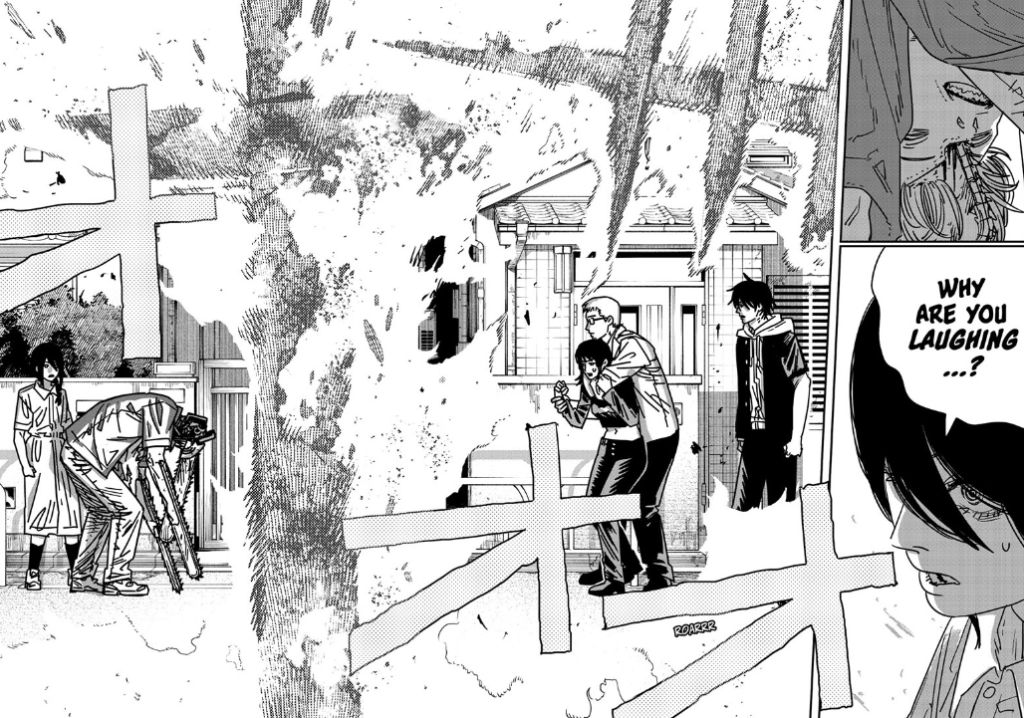
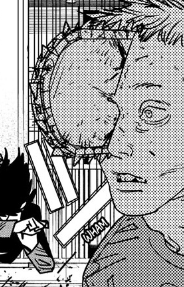
Denji became a Chainsaw Man zombie.
Exactly like Yoshida, Denji has begun simulating what he’s very actively lost as a real phenomenon. Denji no longer has dreams to show Pochita. He can no longer live as his personal vision of his shared identity with him. He’s lost his purpose and now just ‘wants to be’ Chainsaw Man. He isn’t Chainsaw Man anymore. He isn’t Denji, either. He’s just a zombie. A desperate performer of what no longer comes naturally, what was once an earnest, yet blind act of play.
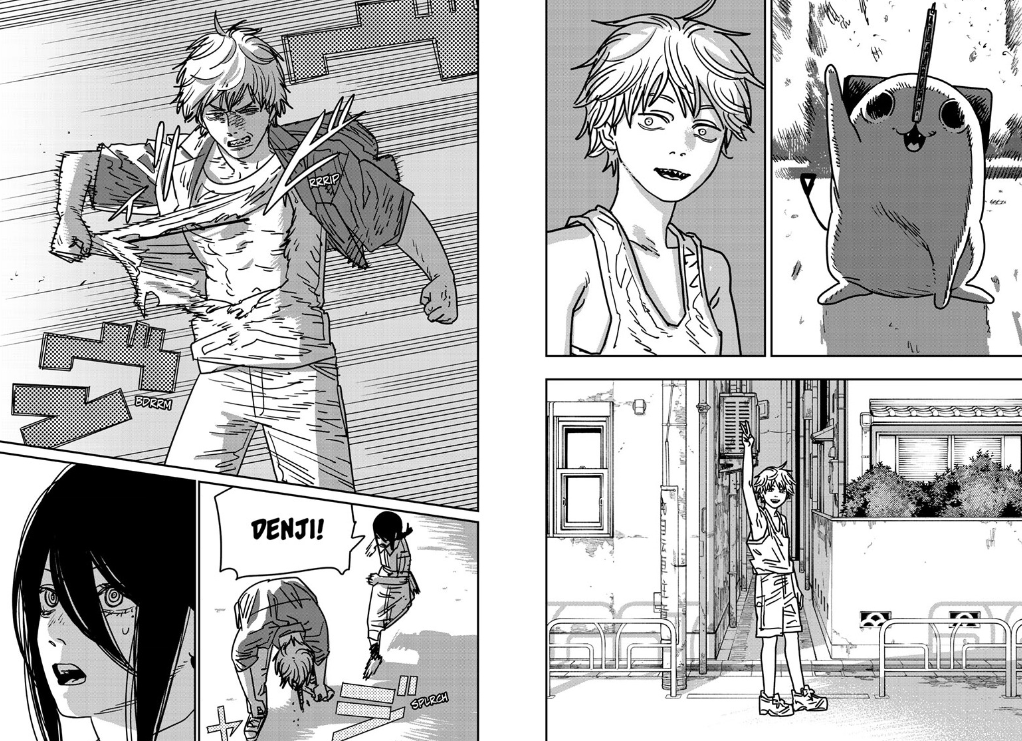
Pochita and Denji The Kid waving goodbye to the adult Denji who fucking loses it is a deliberate representation of this abandonment.
Denji knew he was losing Pochita, and without any self-control, this drove him into a rage to lose even more.
Denji saw his inner child peace out.
And in that moment, he ceased to be Denji at all.
Just a Chainsaw Man and Denji zombie before a burning cross of his own apartment. Just a worshipper of the fire that’s so slowly crept up over everyone, without fulfilling the interests of the actual Fire Devil on any meaningful level. Without engaging with his fire, with the whole responsibility of civilization. Justifying his own immediate pleasure as everything he ever built up was lost, exactly like Yoshida, and Barem, and everyone else, even disappointing Fumiko, who earnestly fought to protect Denji because, despite how Yoshida tried to use her as a weapon, she genuinely liked Denji, on some level.
There is our base nature, with devils, with children, with animals.
And within that, there are the contracts we make with ourselves, with the devils inside us, which admire our drive for justice – our contract with fire, the ultimate symbol of civilization itself.
Both of these aspects have been lost, abandoned.
And the only thing which saves us when both are gone – connections between human beings, the source of the divine – that, too, is something we’ll watch collapse even more.
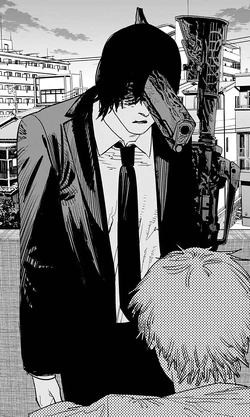
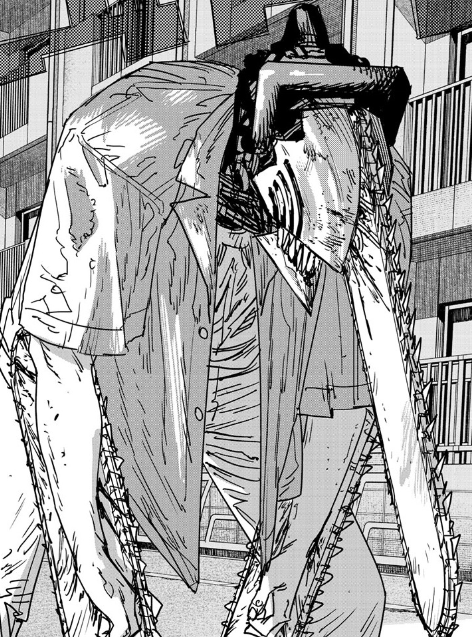
Makima won.
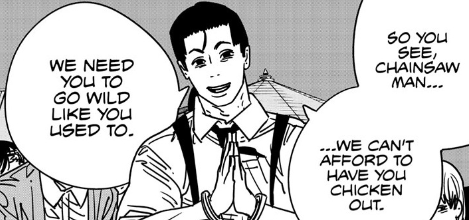
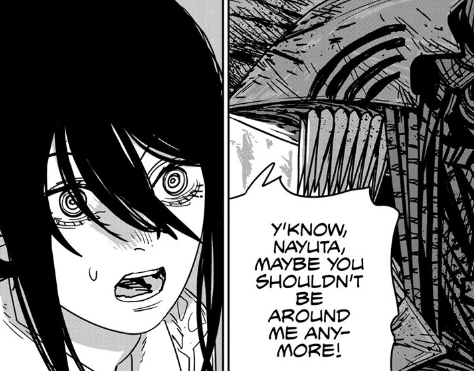
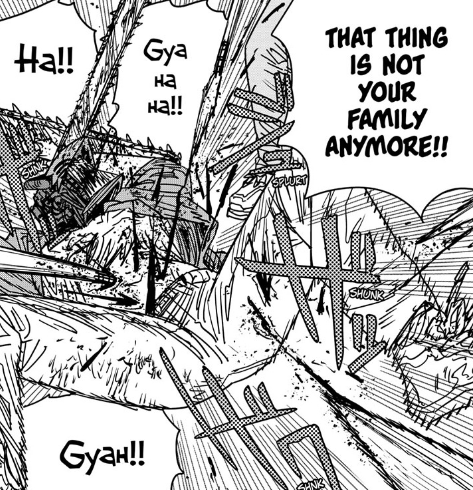
Every action he takes should be completely chaotic.
Again, the SA allegory rears its head. Nayuta is both the allegorical child of Makima and literally the new control devil. Fujimoto successfully portrayed her as being of the same essence of Makima – the (more innocently) manipulative tactics for love, the strict exercise of authority over those outside her love and the joy she finds in it. And in living with Denji, in admiring little things like Chinese food and pizza – in whatever love she found, she began to grow into someone better, despite her essence. Lil D fought her essence, and thus reinforced it. Nayuta had Denji.
And here’s Barem, who loves Ms. Makima, to tear the whole thing down.
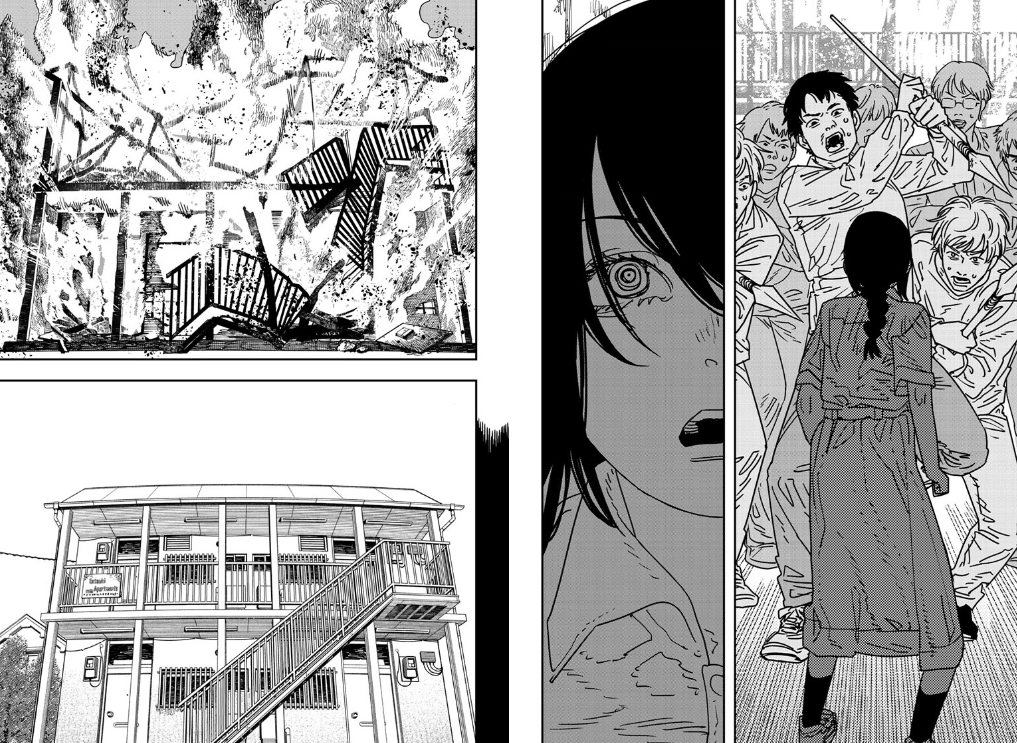
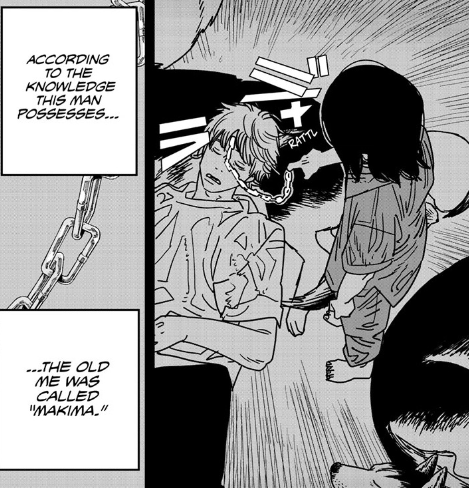
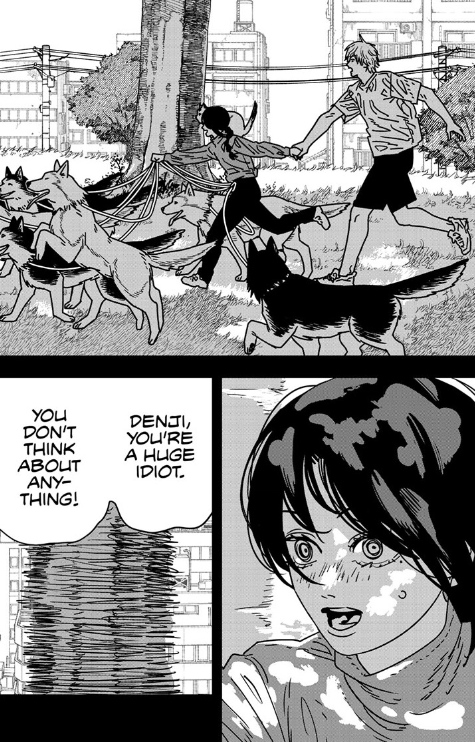
Perfection.
The biggest question which runs under this arc is why Barem and the Chainsaw Man Church and Yoshida and everyone trudged this along, or lit it up gleefully, or did any of the insane things that they did. And, somehow, Fujimoto stating it explicitly just… worked.
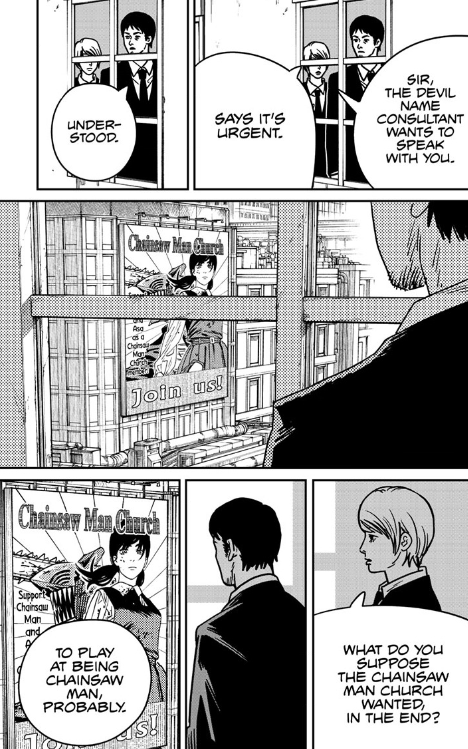
Why do people glorify war, without ever personally fighting in it? Why do people kill themselves for countries that don’t give a damn about them? Why do irresponsible teenagers fall in-line with whatever force while pretending to self-determination? Why do loners reject others while enforcing their inner idea of how they’re supposed to be? Why do abandoned teenagers go mad playing the savior punishing the bullies? Why do intelligent grown men give up living in reality to chase an absurd state-sanctioned fantasy that will ultimately kill and use them? Why do people destroy their lives and the lives of those around them with joy, confidence, insanity?
To play at being that hero.
Himeno was able to escape this. Aki so briefly did, too. But now, with everything taken from him, Denji’s been reduced to playing himself, as well.
I have no further analysis for the arc. The closest Chainsaw Man ever gets to a 10/10.
Back There Denjiman
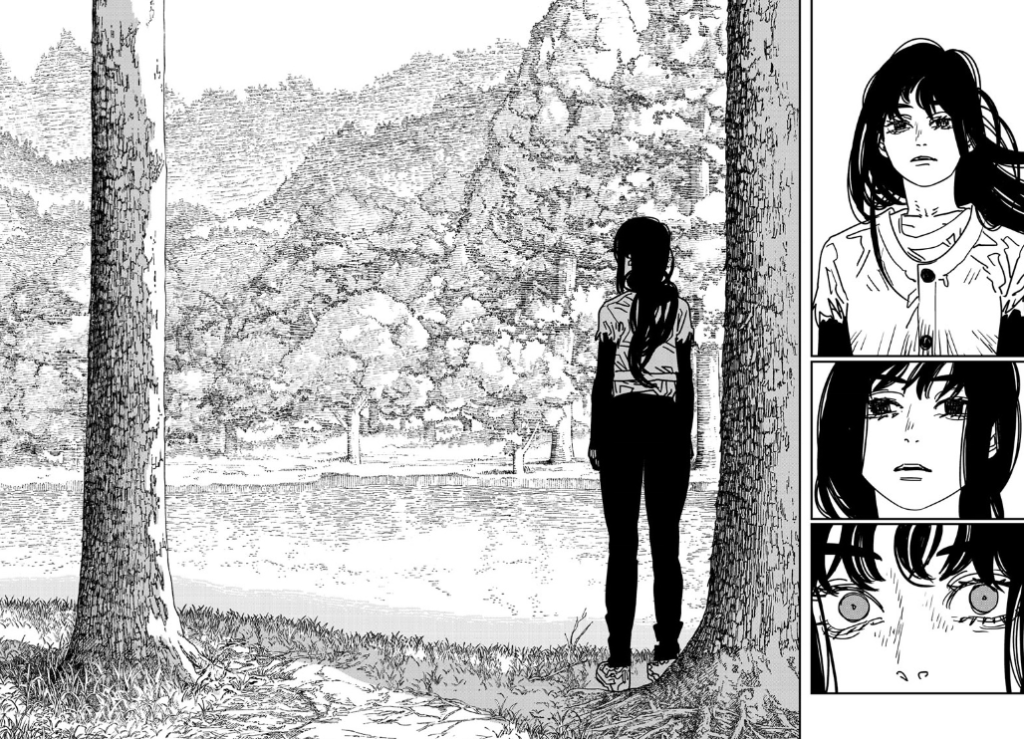
The devils Chainsaw Man eats have their concepts erased from existence. The Aging Devil Arc exists to explore the weight of this.
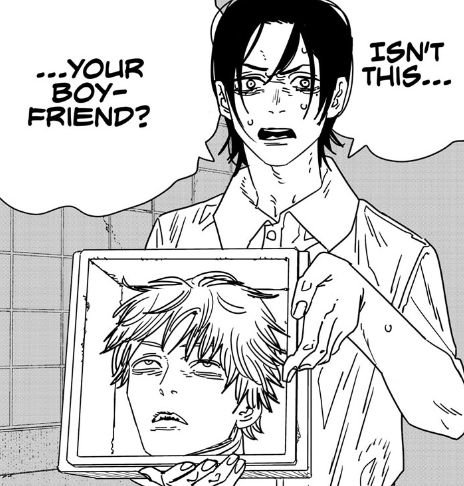
Kicking things off with a little bit of extra thematic emphasis, we see Denji literally reduced to an object of the state in the wake of his collapse.
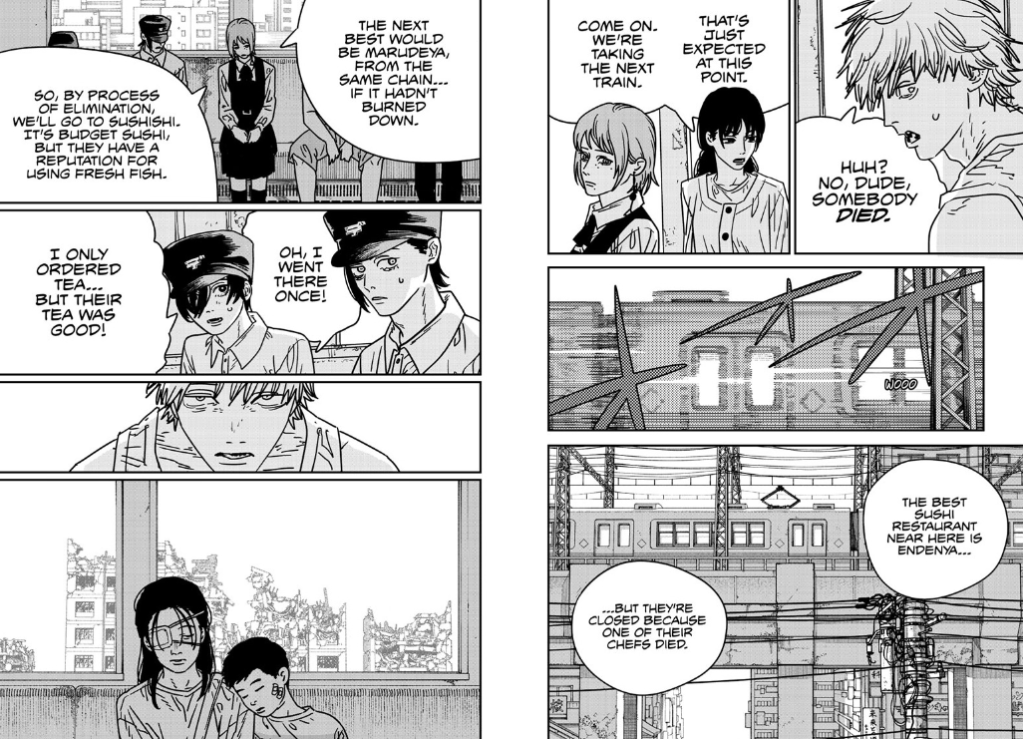
Denji awakes from his nightmare to find that all people are now valued as much as objects. Quite naturally, the situation has broken down badly enough for the bare minimum to be done regardless of the human cost, with no one baring their balls enough to actually do anything about it. There’s definitely a vague Christian element here with the resurrection, but I don’t care enough about this arc to examine it.
And Denji himself, with his last bits of real connection with Pochita dashed and the nightmare of Nayuta looming over his subconscious, falls further into the same – as his hypersexuality finally reaches a climax.
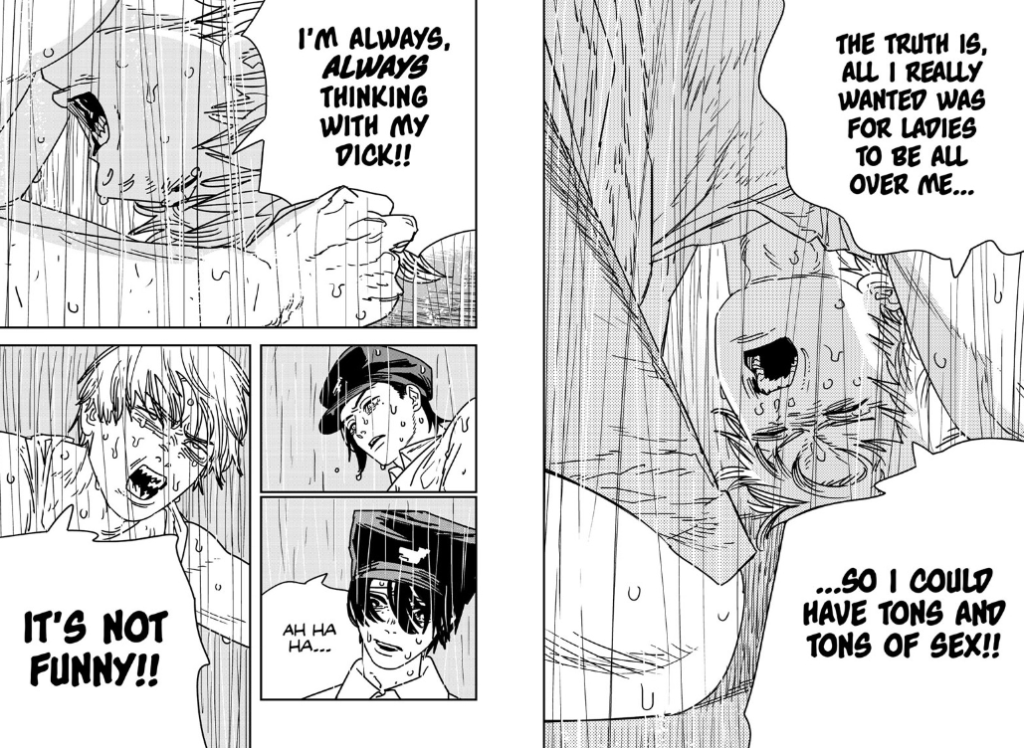
And then, well…
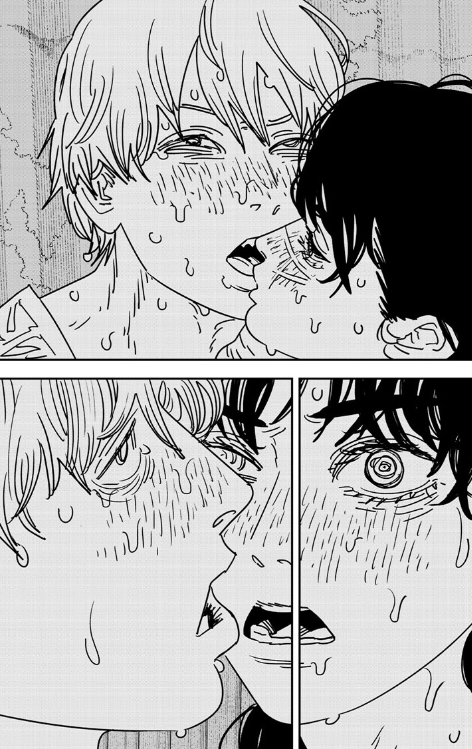
…Yoru simultaneously molests Denji and Asa. No sugarcoating it. This firmly takes her objectification factor from the manifestation of national principle to the imminent violation of consent and bodily autonomy in ways that set-up what’s to come with Asa’s past – but let’s not get ahead of ourselves.
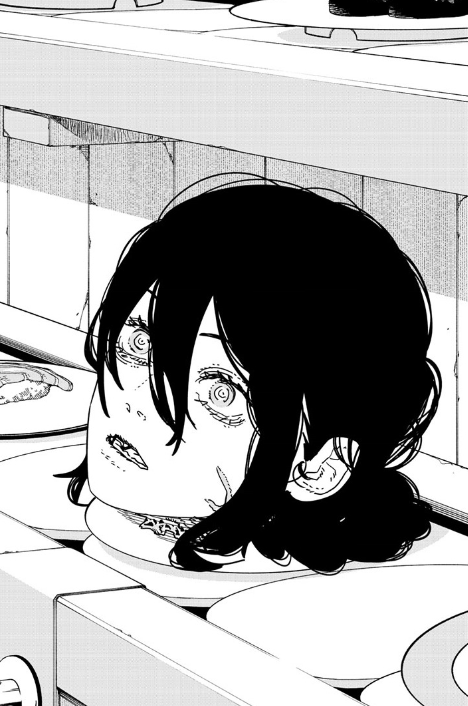
I want so badly to string together with joy what Fujimoto was clearly signaling thematically with this arc but I can’t, because Aging Devil marks the point where Fujimoto starts to shit the bed. The quality of the analysis will be dropping from here up to near the end of the War Devil Arc because this is Fujimoto at his absolute lowest, excepting Yoru’s scenes.
Nayuta is reduced from a devil to live with into mere food to consume; subsequently, Pochita is finally characterized as a pure horror with one of the best panels from the back half of Part Two.
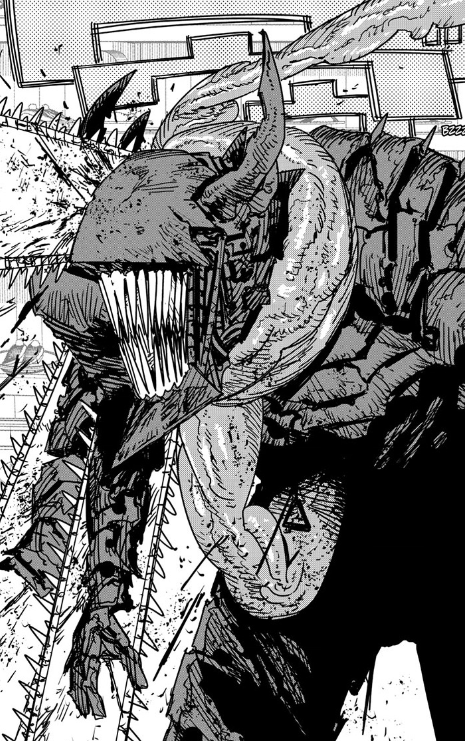
There was so much heroic fanfare around the black-bodied manifestation of Pochita, what most devils recognize as the one and only Chainsaw Man, Hero of Hell, that it never fully settled just how creepy this design actually is. With everything about it finally torn down, and the full context of consumption, dehumanization, and death all around, combined with the visual framing, and it finally becomes blindingly obvious: this is a rocky black mechanoid creature with no features other than a mouth. A death-machine of consumption with its intestines wrapped around its own neck.
A symbol of cyclical violence.
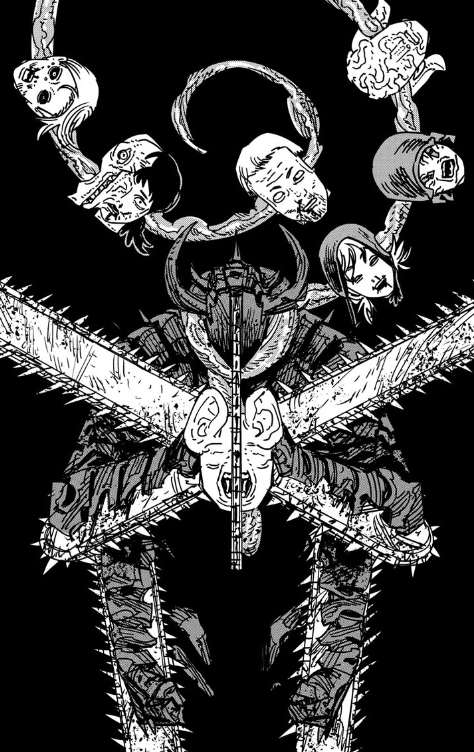
And we now watch him erase everything without care, up until we get the most harrowing imagery in the manga – when the big eater erases mouths themselves.
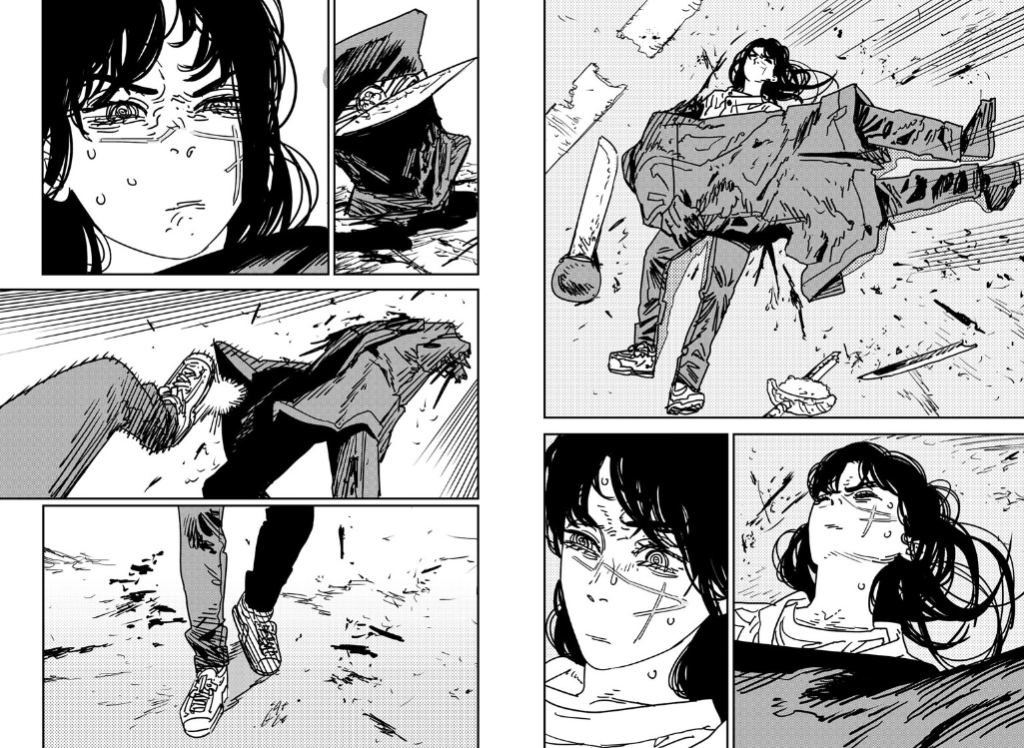
This moment is such excellent payoff and emphasis on Pochita as a potentially far more villanous figure precisely because the entirety of Part Two until now has been built on connections between people – most often reached through communication. Ears and mouths getting their dedicated emphasis over the rest to show how badly things have collapsed.
And, of course, it also works because a world of mouthless humans is just intuitively horrifying.
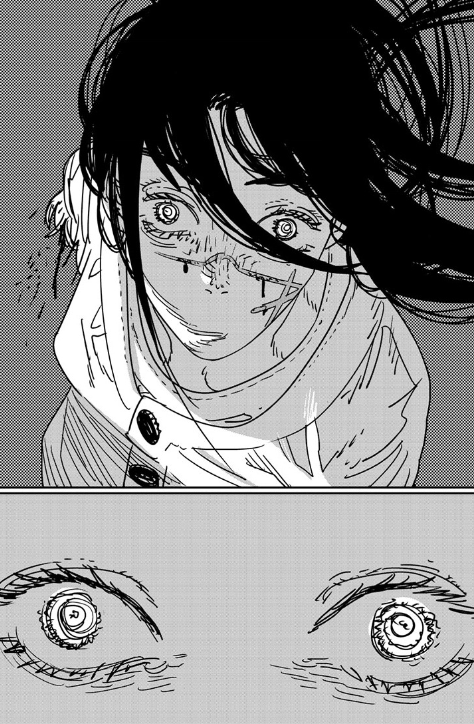
I must emphasize so strongly that the back half of Part Two is completely carried by Yoru, who I’ll be giving her due time with the final arc. But right here, right now, we’re getting some massive insights into this character and how she connects back to everything established about Chainsaw Man the concept.
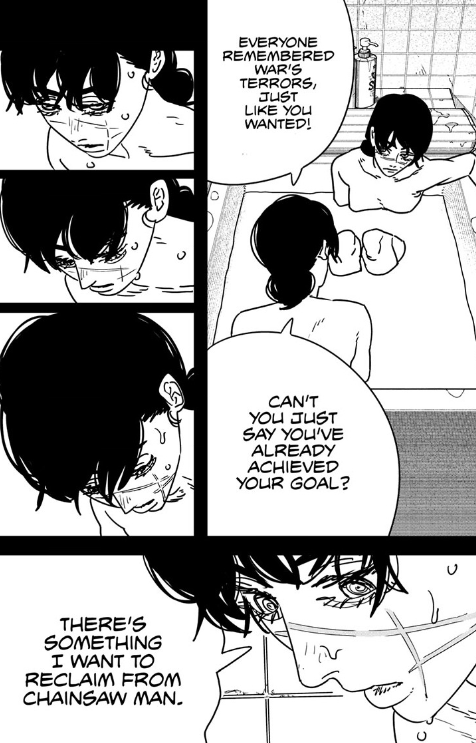
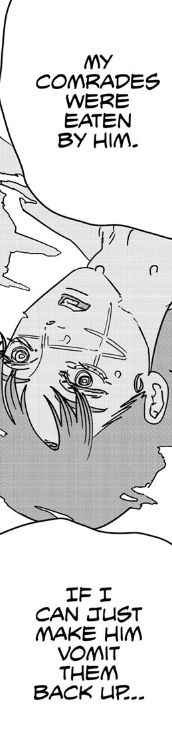
Through the entirety of Part Two, Yoru lives and dies by how she manages her own image – not for others, but, above all, to satisfy herself. She’s the logical endpoint to the system of devils as fear-feeders, taking note from Chainsaw Man the Hero to appropriate everything to her advantage. And at this moment, as she literally has to turn and look at her reflection to justify to herself what she’s about to do, it becomes clear just how performative her desire to prove herself against Chainsaw Man really is.
Yoru isn’t stupid enough for her genuine goal to be revenge. None of what she ever does with respect to Chainsaw Man is out of real desire, ambition, or intent. It’s purely to restore her horribly wounded ego.
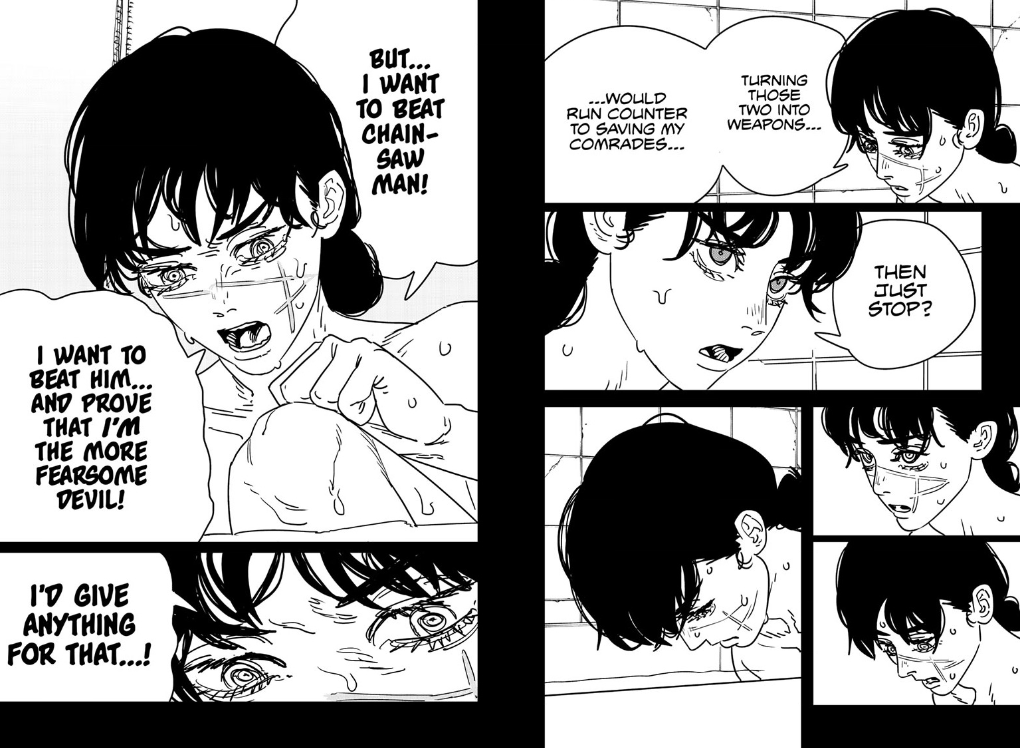
And so, with one of Chainsaw Man’s best panels, period, we see the mouthless, mentally-self-talking Yoru sacrifice her own children to restore the arms she lost to the same devil she’ll continue fighting for no real reason.
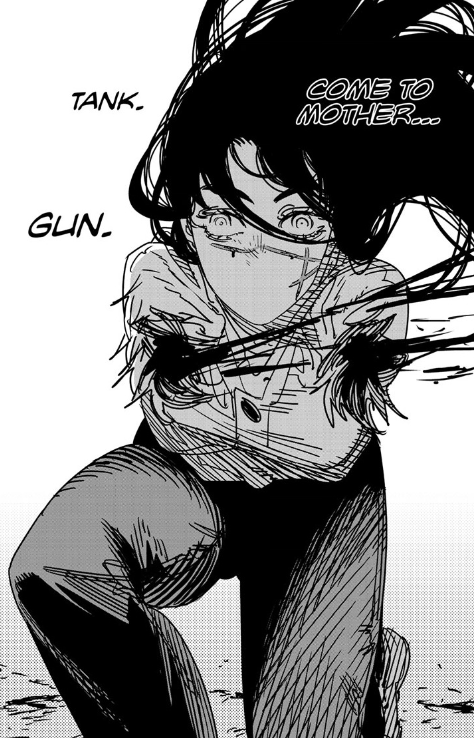
A very good representation of war, especially in its massively disfigured Post-WWI state.
And then, because the imagery above was still too subtle for Fujimoto, Yoru’s trigger finger cracks the visage of the Statue of Liberty to reveal a horrible monster with a sniper rifle.
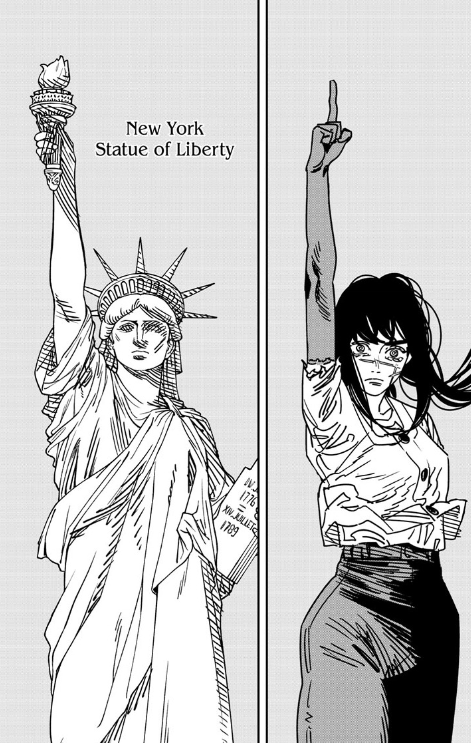
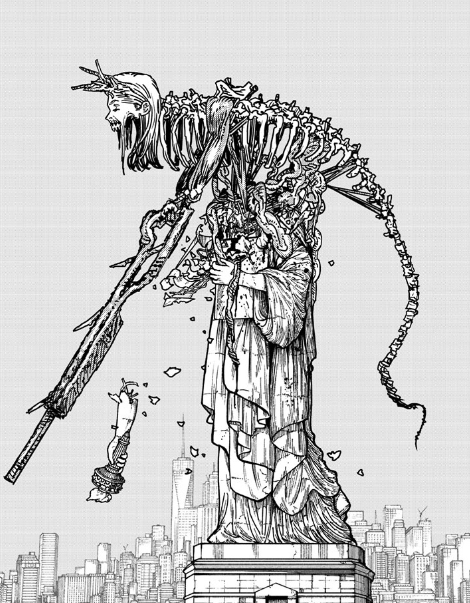
While it’s true that Fujimoto’s just thrown nearly all taste and intellect out the window at this point, this is still a great escalation of Chainsaw Man’s themes pertaining to image, manufacturing weapons out of people, and personal ego-projection. The visage of liberty as only a host for this thing, brought out when it’s time to destroy in order to protect Yoru’s fragile and baseless sense of personal glory – that’s a pay-off and a half to Bomb Girl, Control Devil, Chainsaw Man Church, and every moment we’ve had with Yoru until now, period.
Up until now, there wasn’t much more to Asa and Yoru’s dynamic than the very obvious subconscious-manifest angle.
And after Fujimoto convinced many of us of its truth long enough, and let Asa comfortably slip into her own bad habits…
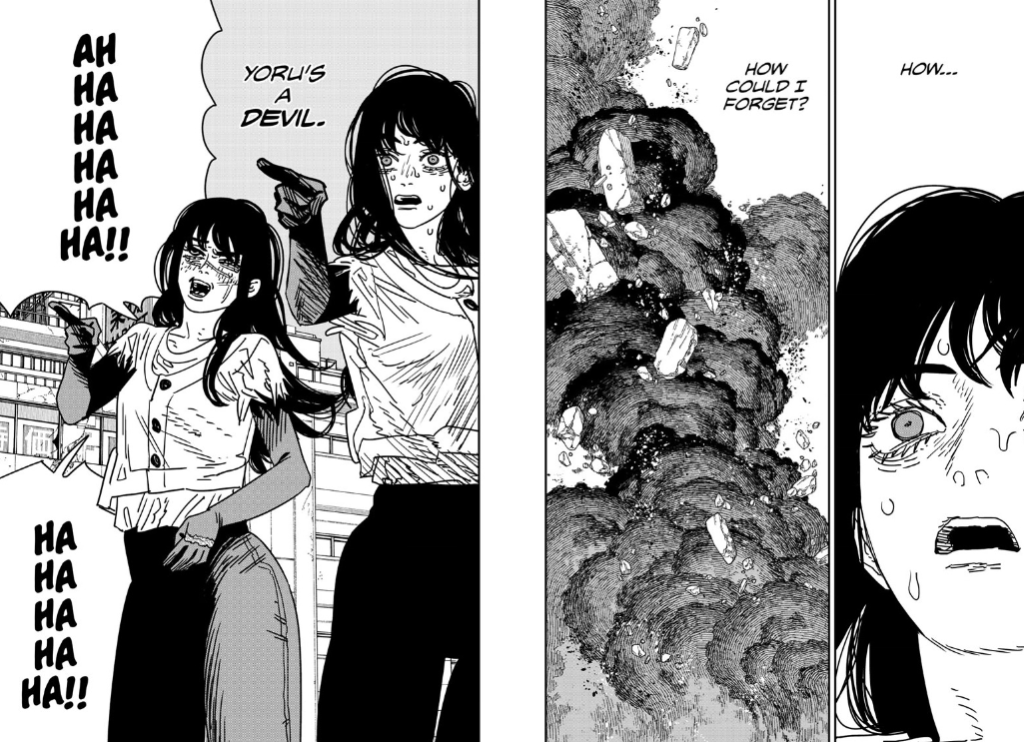
…the mask slips.
Yoru is not Asa’s subconscious at all. She isn’t her shadow.
She’s the incarnation of military might presenting herself as the key that will let Asa live out her subconscious desires for purpose, selfishness, recognition, and glory.
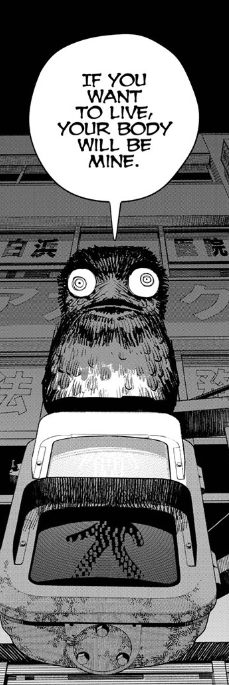
Exactly as modern militaries sell themselves to emotionally and hedonistically starved teenagers to make them into weapons.
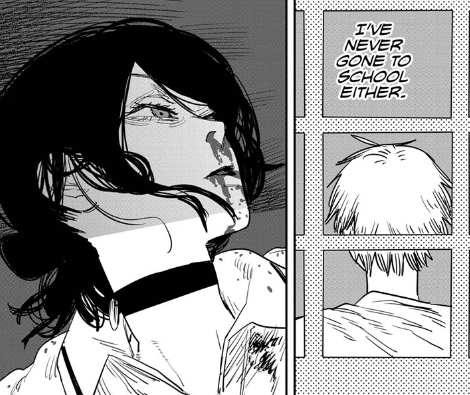
Exactly as a corrupt state tells its destitute it’ll give them what they want if they just become its property.
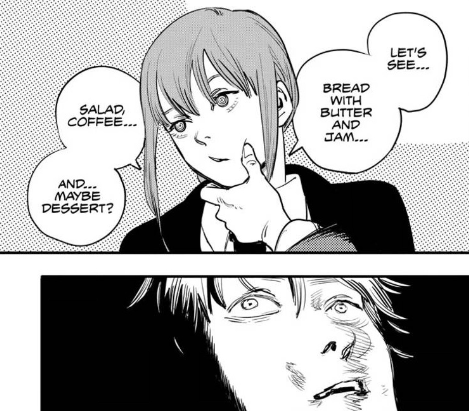
Yoru did not come from inside Asa. Neither did she initially make the contract out of some form of admiration, as Pochita did.
She wants to reclaim her former glory, so she made Asa surrender her body at her most emotionally desperate – right as she wished she’d lived a little more selfishly.
And after Asa began to have media attention dropped onto her, after she undid the same progress with Denji that Reze only dreamed of, after the both of them were reduced to husks – only then did the reality of her situation fully set in. Yoru is a devil.
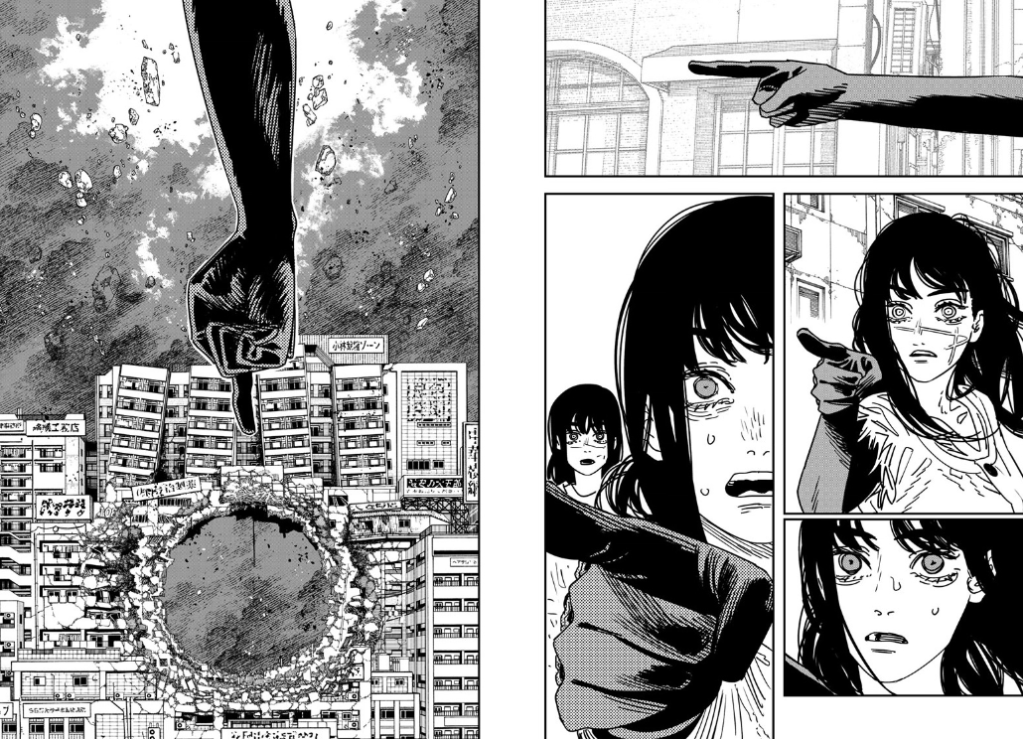
This moment and what follows is so good it damn near makes Aging Devil one of Chainsaw Man’s most memorable arcs despite what it turns into as a whole. Strong emphasis on almost. It’s still bottom three. It just happens that Fujimoto locks the fuck in when it’s time for Yoru to “shine.” While this moment is, ultimately, a base for some of the worst slander I could possibly give Chainsaw Man, it’s nonetheless very effective in its context and its own right. This shit works very, very well.
Just as Pochita’s presentation is made into that of a nightmare, so is Yoru’s – and presentation is all that she seems to have. Is this a structural thought-terminating cliche in the vein of Gon lost his humanity while Meruem gained his? Yeah, kind of. It’s still something to point out because it’s clearly tonally deliberate, and a lot of this arc is tone, for better or worse.
Let’s wrap up the good stuff.
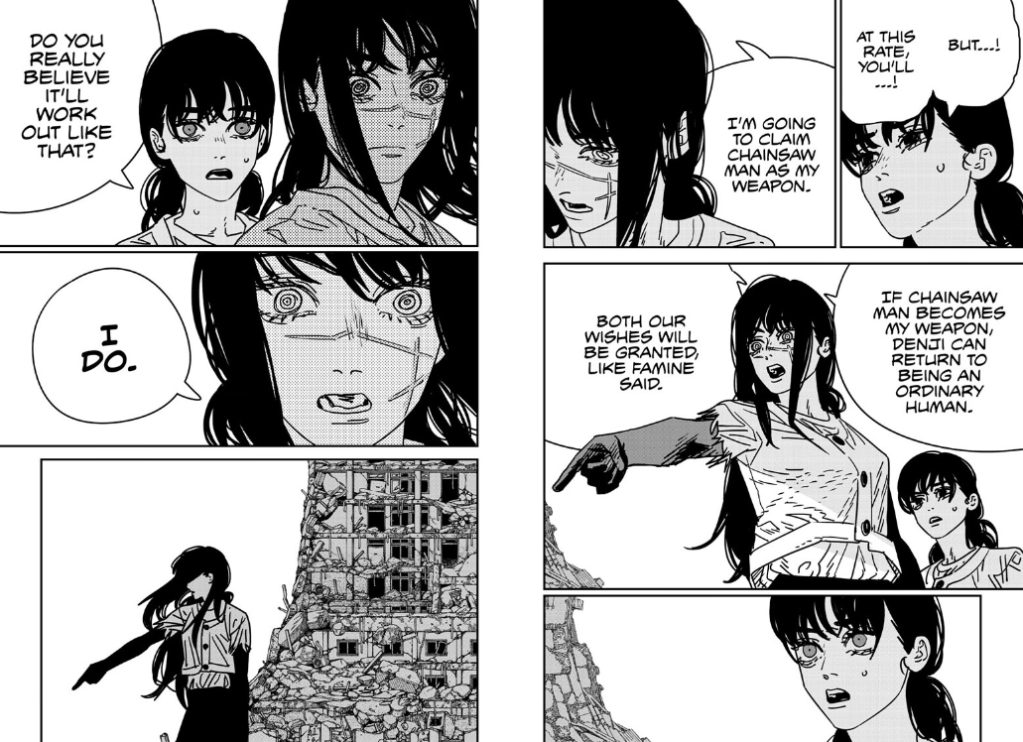
Yoru pretends Small Cock’s double-offer is in any way a good solution and, upon Asa’s confrontation, reaffirms it with vacant eyes. Not much to analyze – just a very good affirmation of Chainsaw Man’s core themes.
And, quickly, a characterization note.
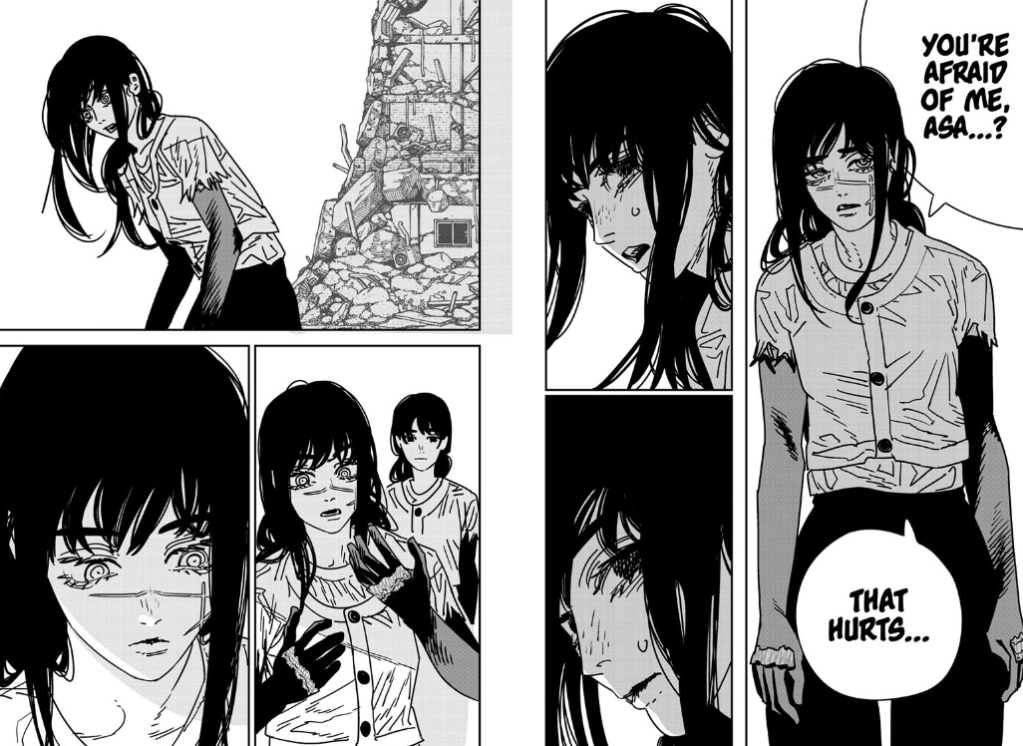
Yoru meant this, as her seriously shocked expression followed by the look of “oh, hold on,” implied even in the moment. Yoru connected to Asa’s fear and Asa connected to Yoru’s sadness.
Asa and Yoru’s situation works as a dark mirror to Aki’s character growth with Denji and Power. Yoru keeps waving these moments away as just their feelings interweaving…
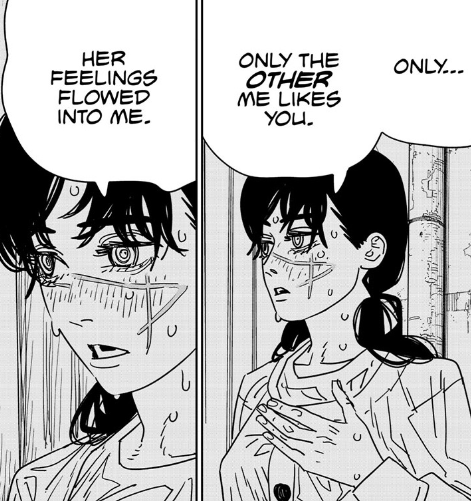
…but I find far more reason to trust the Aki-esque growth-through-experience. Firstly because the rest of Chainsaw Man is explicitly written this way (as with Denji and Pochita’s contract and Pochita’s backseating), and second because it’s what Yoru states herself in a moment where she isn’t flustered and wants to convey vital information to Asa.
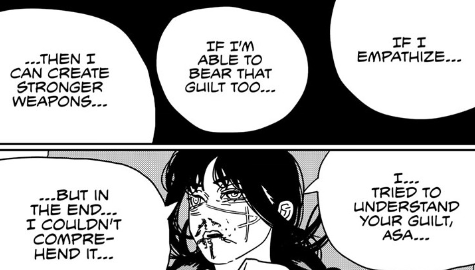
Note that Yoru, despite her extremely shallow exterior, has always been presented as knowing how to navigate people’s feelings quite well – admittedly teenagers’ feelings quite well. The phrasing here is very clear: Asa’s guilt is something Yoru isn’t directly feeling and it’s something she can’t comprehend. There’s wiggle-room on account of Yoru’s entire character pre-War Devil being performative (hence, she was still externalizing her own shared feelings, and Fujimoto really did just write her as Asa’s shadow outright) but her performance in the arc itself is something I choose to read the other way, though, again, it can be taken for performative exploration amid all the chaos of what she might really feel, behind all the bullshit. I think it’s a whole-hearted exploration, and I’ll get to it when I get to it.
For now: it’s time for some fun mid.
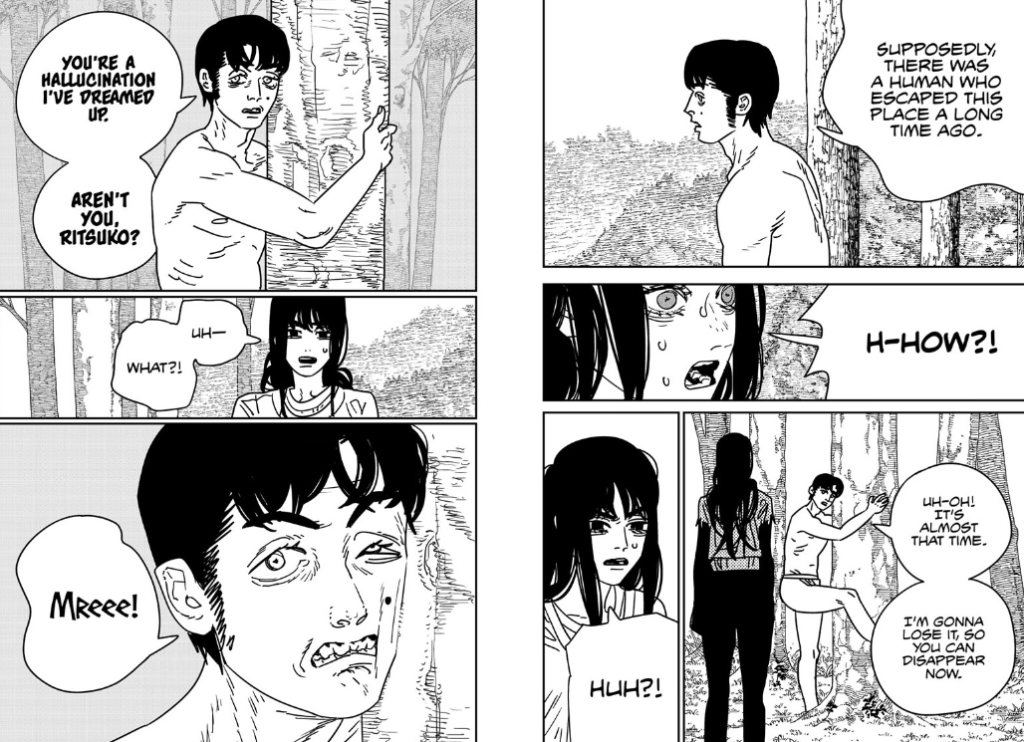
After emphasizing Yoru’s performativeness and impulse, we’re introduced to a world where complete dissolution of personal being is the only way out.
The background visuals here are very strong and completely sell the ego-break feeling that sufficiently many trees swaying quietly tend to give,
Amid some classic Asa nonsense, we get the last we’ll see of Yoru as a strong voice of reason amid the chaos…
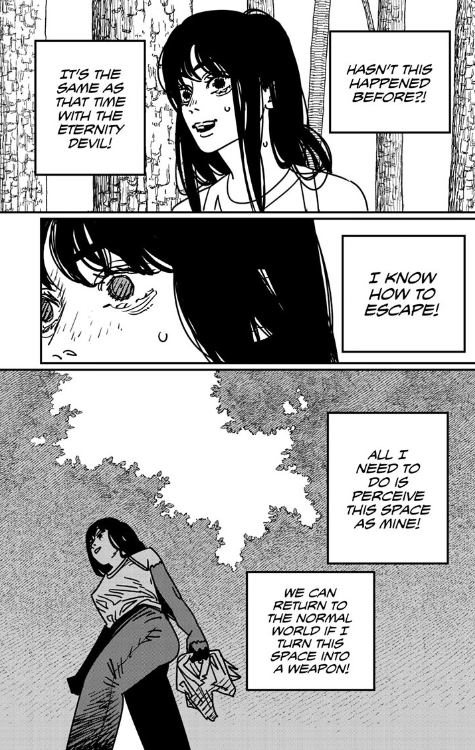
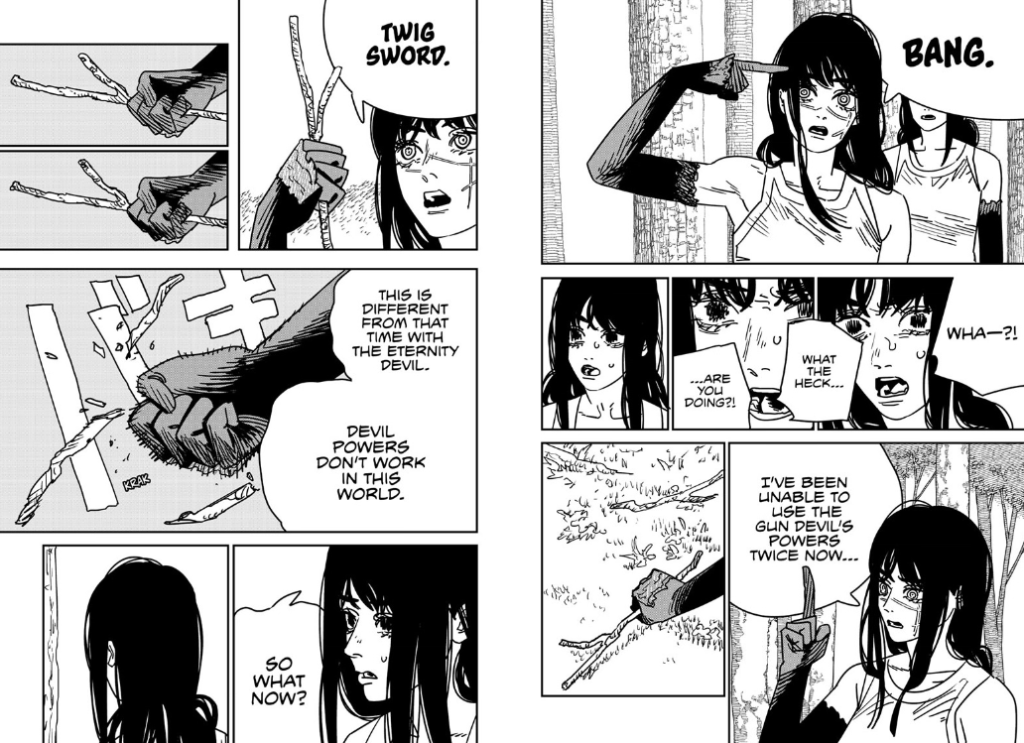
…which sells how much Asa is still banking on Yoru as the solution to her problems. Against the ways Fujimoto will sell on this front in the coming arc, it’s beautiful to see that neither of these characters are being flanderized. Yoru knows what she’s doing with the world around her and makes for an amazing source of strength when one is needed, she just refuses to engage with what she deeply desires. Asa is… Asa.
Both of them have changed very gradually and satisfyingly up to this point – Yoru engaging more deeply with Asa’s feelings after the initial wave of volatile I know what I’m doing! I could kill you any time for real I swear! fronts while Asa’s gone from too uptight to too comfortable without any plan to actually guide her yet. No one in this manga ever really gets better.
The backdrop of Aging’s world (and Denji having a meltdown in it) works to force Yoru’s true feelings to come out more strongly…
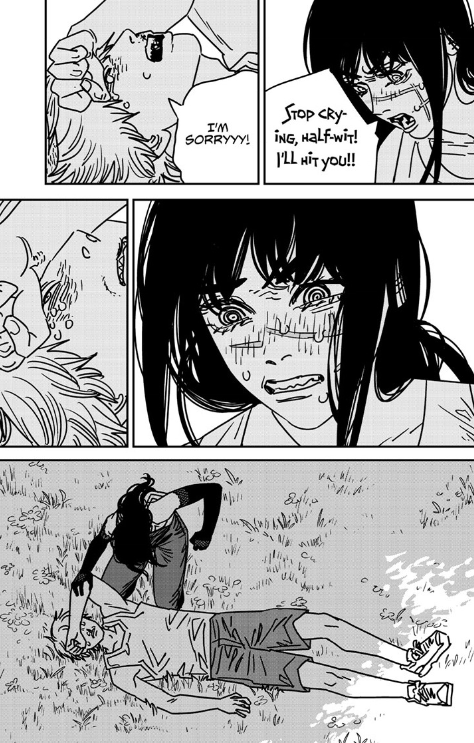
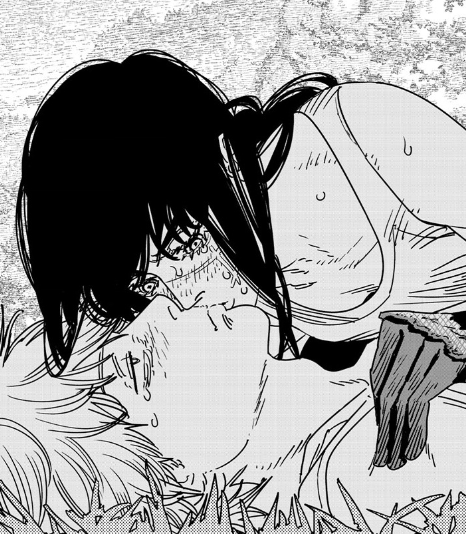
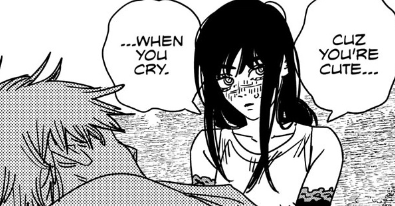
…which gets the ball rolling for a quick Yoru Bullshitting moment that feels like an actual propaganda commercial (I truly believe she’s trying to get the hang of this.)
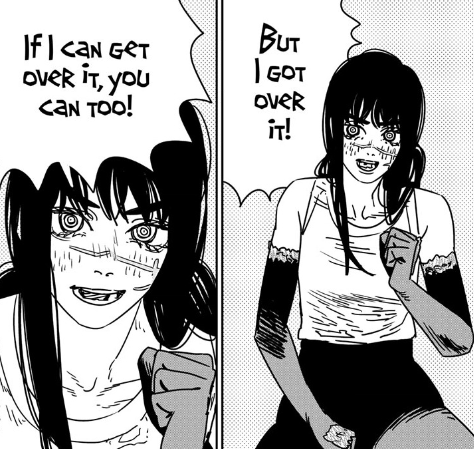
And it’s this which finally pushes Asa to reach out once again, with much more serious feelings.
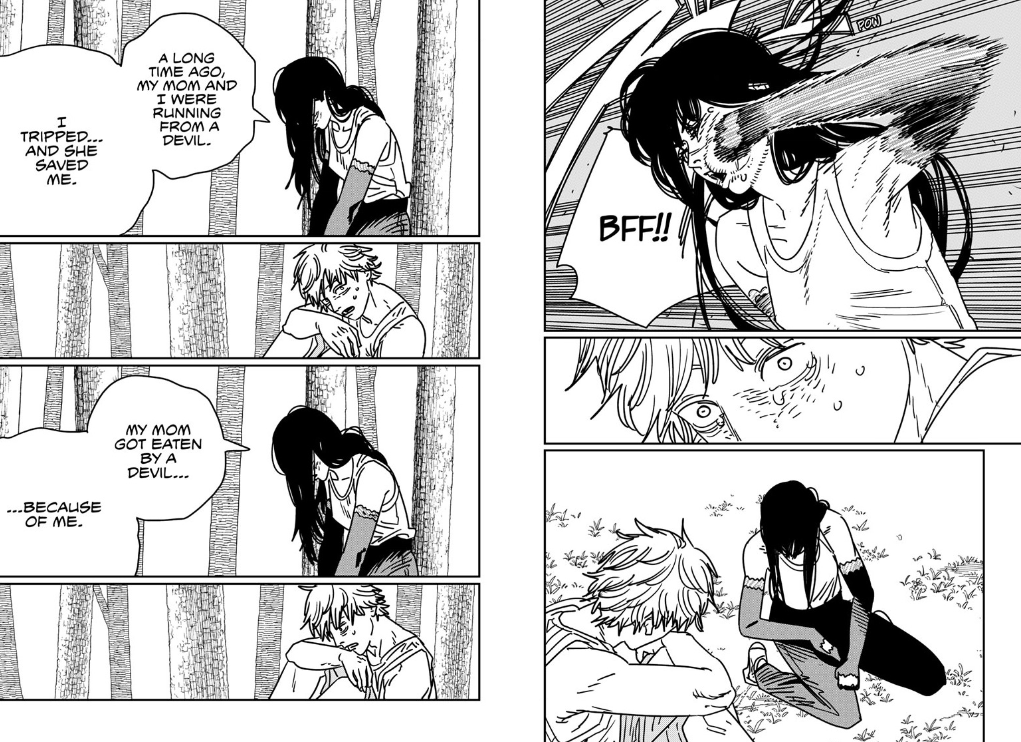
And so, in connecting with Asa, Denji vomits out snow and remembers, amid the endless consuming, sacrificing, and forgetting in the arc.
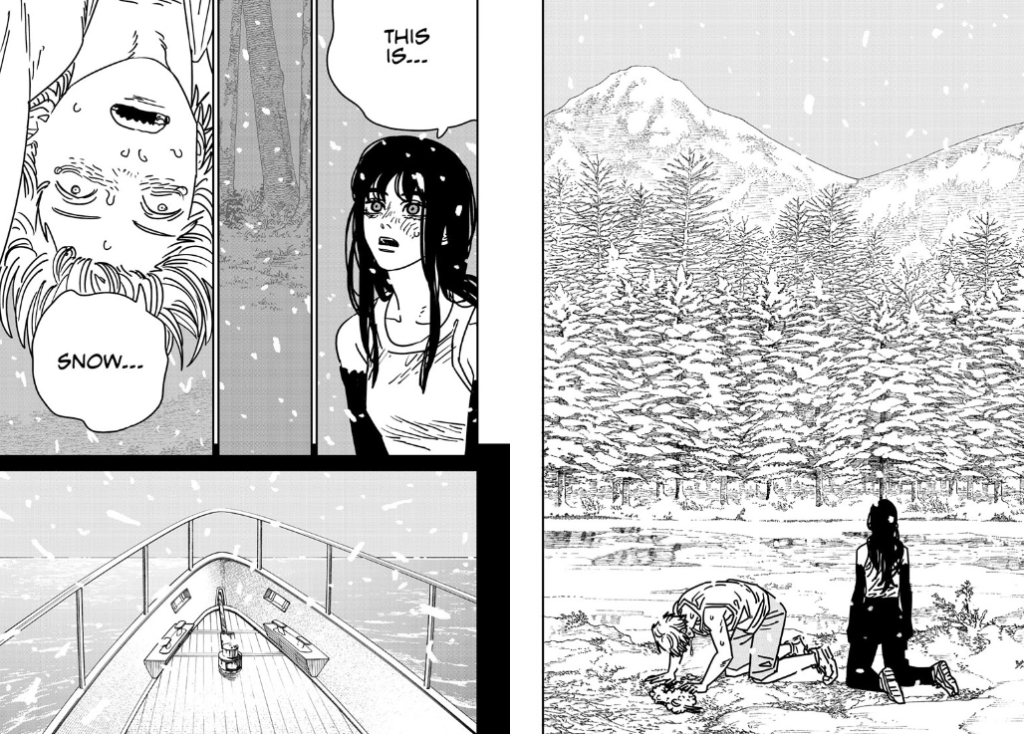
I do worry that this stage of the “analysis” is effectively a plot summary, so I’m going to switch over to the points that matter.
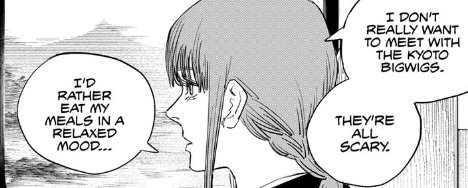
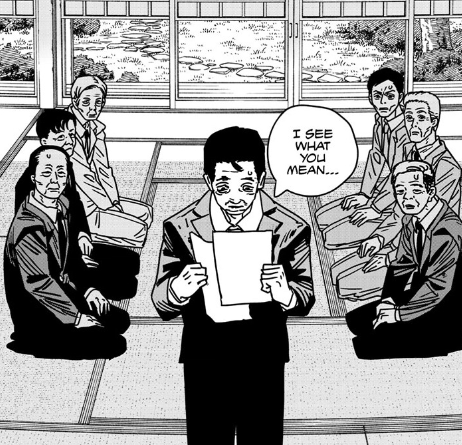
This is where we finally get to focus on the people who made Makima who she is – to foil the love Denji was raising Nayuta with.
Fujimoto… doesn’t really do shit with this.
I often see very idiotic comments about mangaka not writing their manga as if they were Wikipedia articles of themselves, but this is one of those cases were the mangaka did NOT do enough with what they had. The significance and underlying parallels are clear. The execution does not go nearly far enough. There’s plenty of human sacrifice, yes. Aging longs for any kind of sick new experience through the vicarity of human children, yes. Denji remembers his old life and thus regains it in direct contrast to all this child sacrifice shit, hence showing how to actually regain one’s life, yes. Denji’s a full-blown cannibal now in the context of the consumption motif, yes. None of this is remotely enough for the monumental narrative opportunity here. And I’m able to say this comfortably because, by the time Fujimoto was writing all this, he was exhausted by WSJ’s horrible working conditions and it showed everywhere.
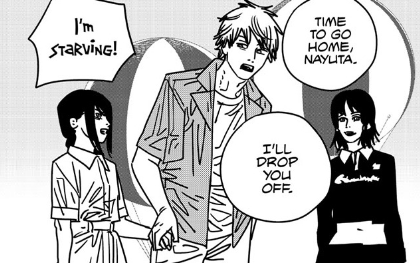
Do not take any of this as a critique of Fujimoto’s intention. This is a critique of Chainsaw Man as it turned out – and by this point, Fujimoto’s grip upon it is weakening. It genuinely hurts me to think about, because the foundations of these final two arcs given the execution of Justice and Aquarium could have been fantastic. With such a dream scenario, Part Two would have blown Part One so far away it wouldn’t even be relevant anymore. Unfortunately, that’s not what we got.
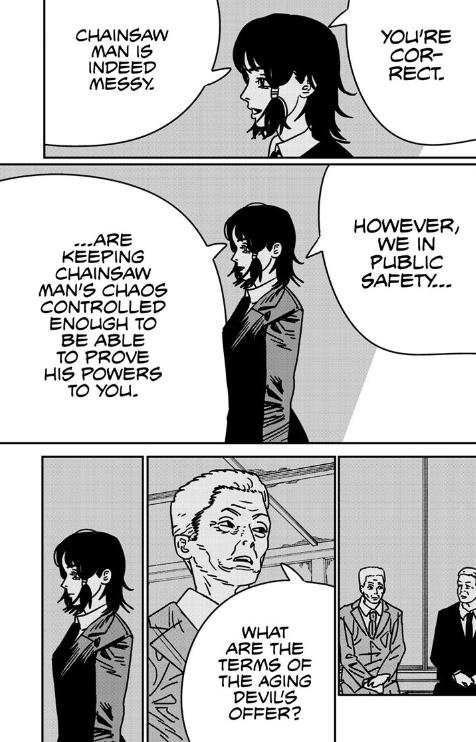
It was always implicitly clear, but it is good to have explicit confirmation on the Japanese government’s involvement, through Public Safety, with controlling devil chaos for its use. It gives the weight of Makima’s need for Chainsaw Man to be entirely anarchic. That’s escapism 101 and is perfect for the ultimate fangirl who’ll just live with her fascist hellscape regardless. Unfortunately, again, this was always implicitly clear. This isn’t any true addition of substance. The slight point is the notion of Chainsaw Man getting controlled by the government and Public Safety, the ultimate despair in the wake of Makima’s disappearance and, of course, Nayuta having just gone away. And, again, this didn’t really get to go anywhere.
Because of Chainsaw Man’s overwhelming emphasis on the artist’s relation with their work and the wider miseries of taking everything and everyone to confirm one’s ideology, I try so hard not to rag against any ‘wrong’ moves in this manga, and have worked tirelessly to get to the bottom of each thing I could. I genuinely grew as a person from this manga. I thank Fujimoto from the bottom of my heart for it.
The way this arc turned out is a bonafide tragedy.
Back to proper analysis.
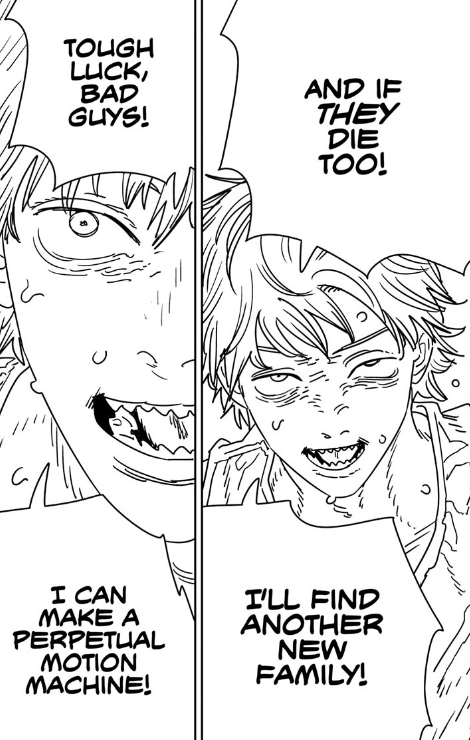
Denji’s raving about the perpetual motion machine again, and…
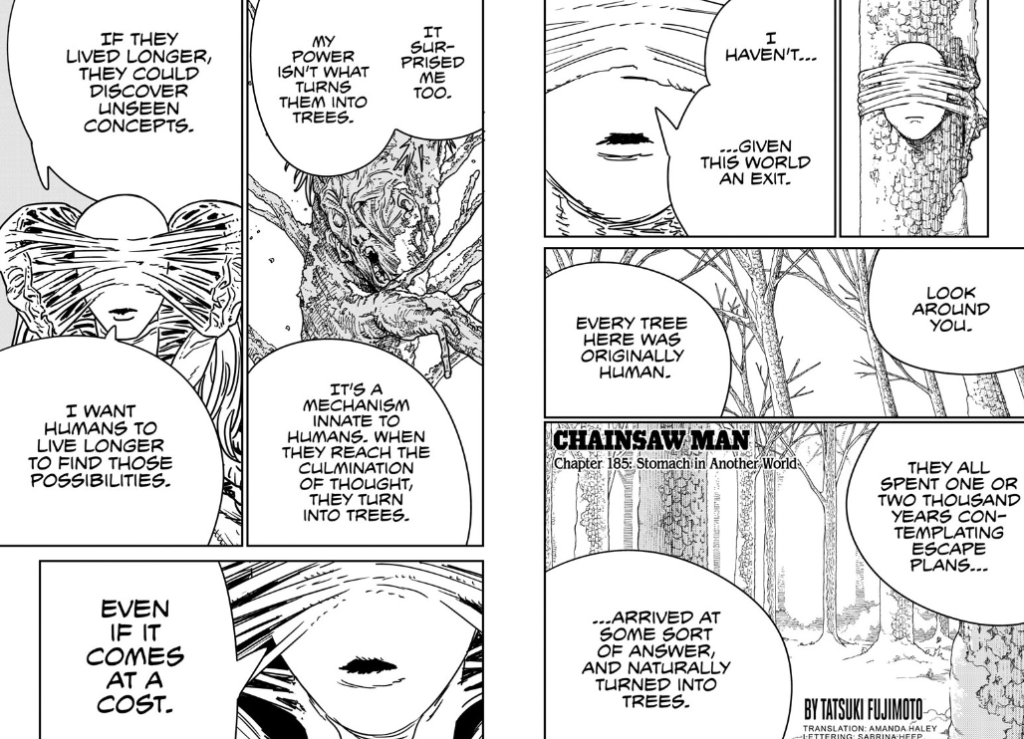
…there’s something going on with fire, trees, and chainsaws.
I’m not sure if it’s because I haven’t gone far enough or if it’s the Chainsaw Man Collapse Syndrome, but there’s something there with trees at the end of life, wood as the image of our discovering fire, fire as the symbol of transformation, the entirety of Fire Punch, chainsaws cutting down trees, Pochita’s erasure, tree-ism as an alternative to death, chainsaws originally being used to assist in birth. It’s a clusterfuck of symbols, and I don’t have a resolution for it. I’m raising it anyways, because holy shit, someone has to raise this. There’s also the possibility Fujimoto didn’t have such a density of related symbols on purpose, or a simple purpose like “yeah, let’s keep it around Wood.(???)” I’m still raising this.
Ultimately, the biggest point of this arc is sacrifice. I haven’t given it much focus because it’s so shallowly done we might as well be talking about the power of friendship.
Yes, Yoru sacrifices her children, the government wants to sacrifice ten-thousand children – human sacrifice is horrible, persists today in our societal structures, and Denji and Asa connecting against it all and remembering positive experiences against consumption, sacrifice, and killing is the underlying beat. This goes back to Yuko. Power of friendship. Deeply unserious arc.
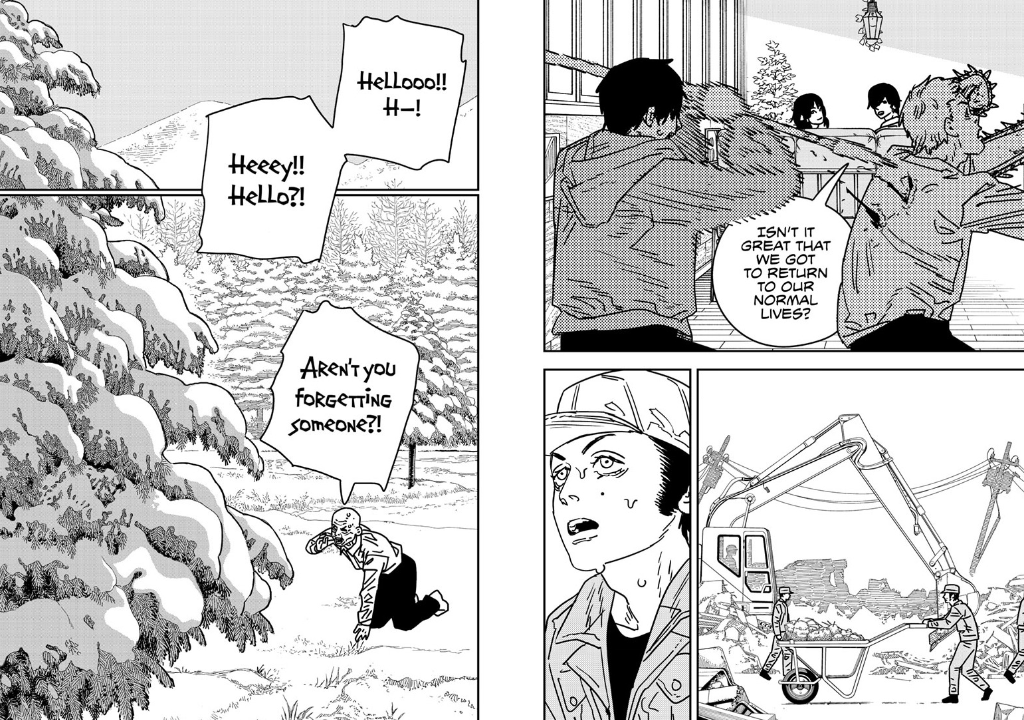
Yes, we see the horrors of our desensitized societies, Fujimoto.
My Beautiful Dark Twisted Fantasy: The Dream, the Nightmare, and the Devil’s Love
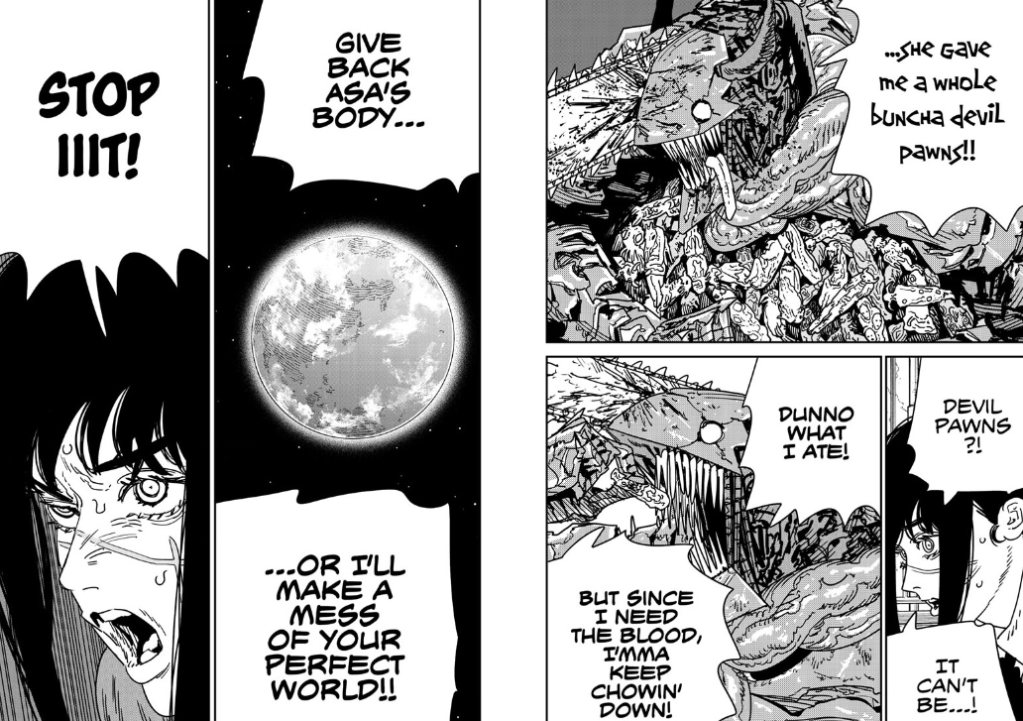
The War Devil Arc. The grand finale of Chainsaw Man in its entirety. I will be giving the final few chapters and ending their own closing section that segues into the review, but it’s time to cover the meat of this beautiful, horrible disaster.
Chainsaw Man is a story about reaching beyond the state’s images, always and forever; Part Two is, additionally, a story about reaching past addiction to take control of one’s real life. Denji suffers from the ultimate fame-will-make-me syndrome beyond a doubt, but it’s the literal consumerist angle that makes his gradual collapse over Part Two work. With the War Devil Arc, we finally see the end-all be-all of Fujimoto’s long battles with personal responsibility vs hedonism, dealing with misreads and lack of empathy from others for his work, the consequences of excessive fantasy and desensitization, and his visceral hatred for empire. It’s time for the grand poobah of Fujimotoisms, everyone.
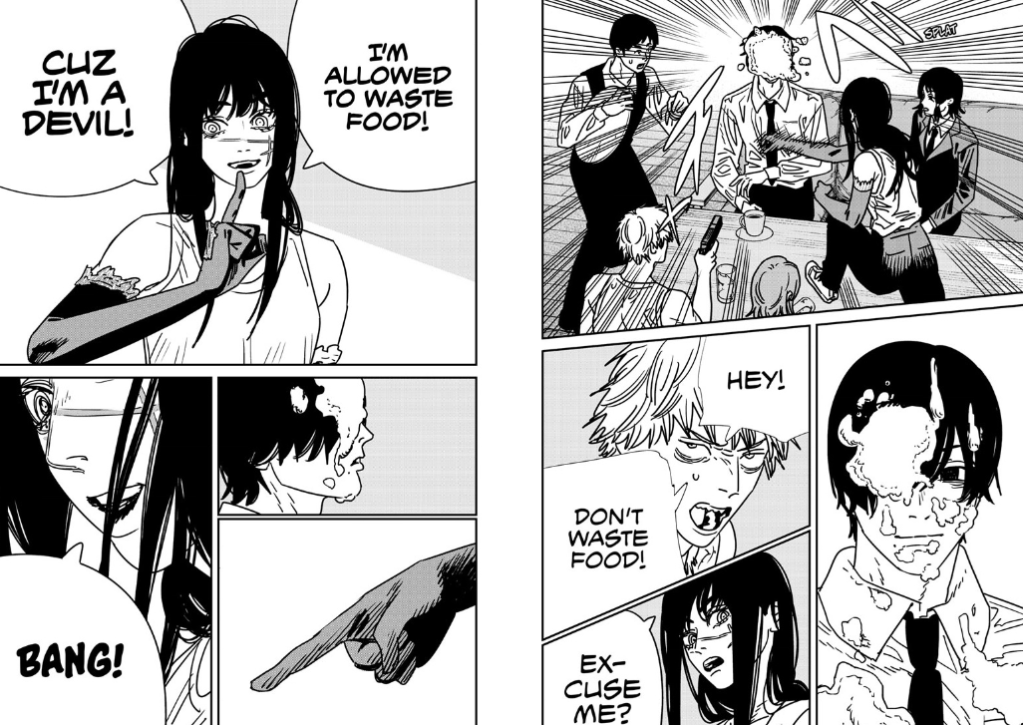
While the opening sequence of the arc is, for lack of a better term, horribly written, the dynamics at play still do the lifting. Yoru disregarding social contracts at the height of her power and Yoshida continuing to vaguely disassociate amid the wider collapse of society sets up the overall anarchy of the arc in addition to the explosive conclusion of the latter’s character. The dumb smile as long as he isn’t being immediately pointed at, combined with the end of the previous arc with his insistence on pretending this is normal makes it clear where this character will finally end: pure performance. It was always there with him, but we’re now crossing the threshold into a man doing nothing but the motions.
Denji isn’t dumb enough to engage with this, but he’s also too dumb to avoid getting dragged around on an even worse path by Yoru.
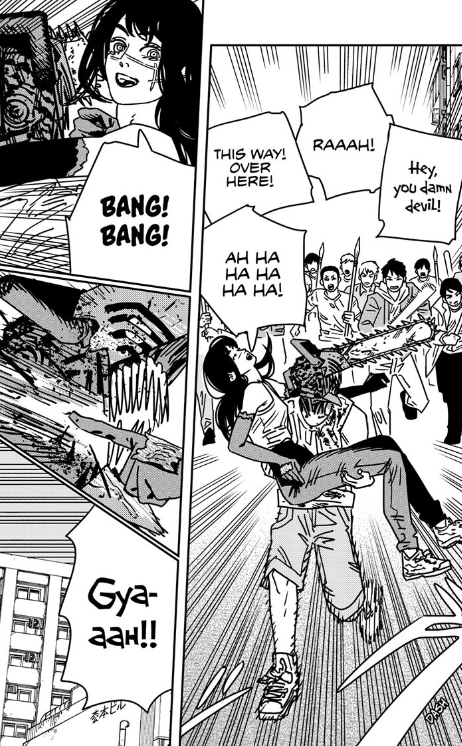
This marks the point where the consumption motif fully crystalizes as a metaphor for addiction. As much as it built up until now, it’s the contrast between Yoshida and Yoru that, theoretically, would have perfectly explained why addiction is so common in times of crisis while tying it to the same hysterical convulsions of violence Yoru directly embodies. If the options are pretending or powerlessness, it makes logical sense to get high on your own pain.
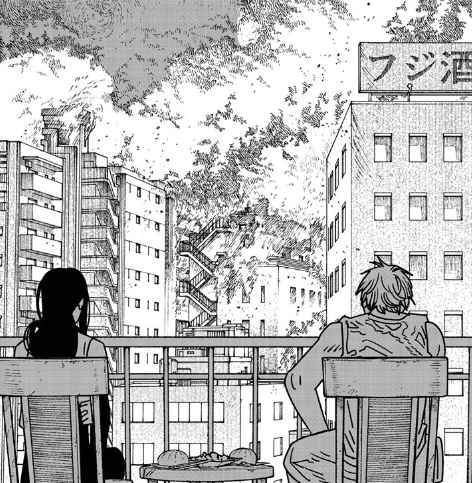
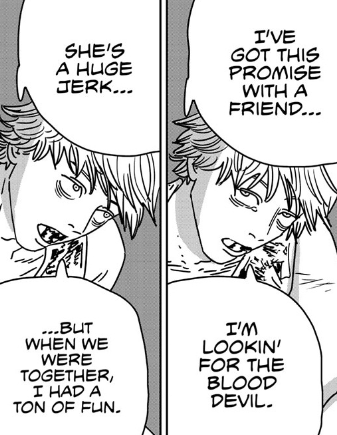
Burning cities and memories-as-obligations. Denji’s vomiting out devils in the Aging Devil Arc worked as a realization of escaping consumptive addiction, on top of tying remembrance to building positive relationships in the present – with Asa. It happened because, when Yoru tried to bullshit her way in, Asa punched her out and got real with Denji for a moment, from her heart.
But this time…
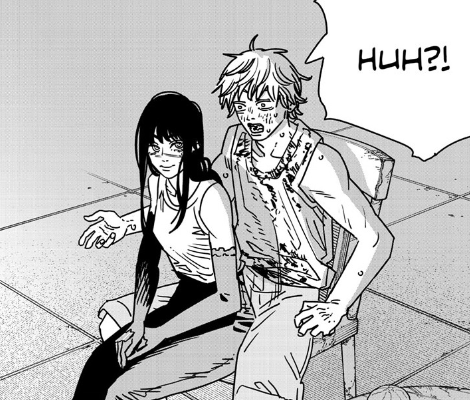
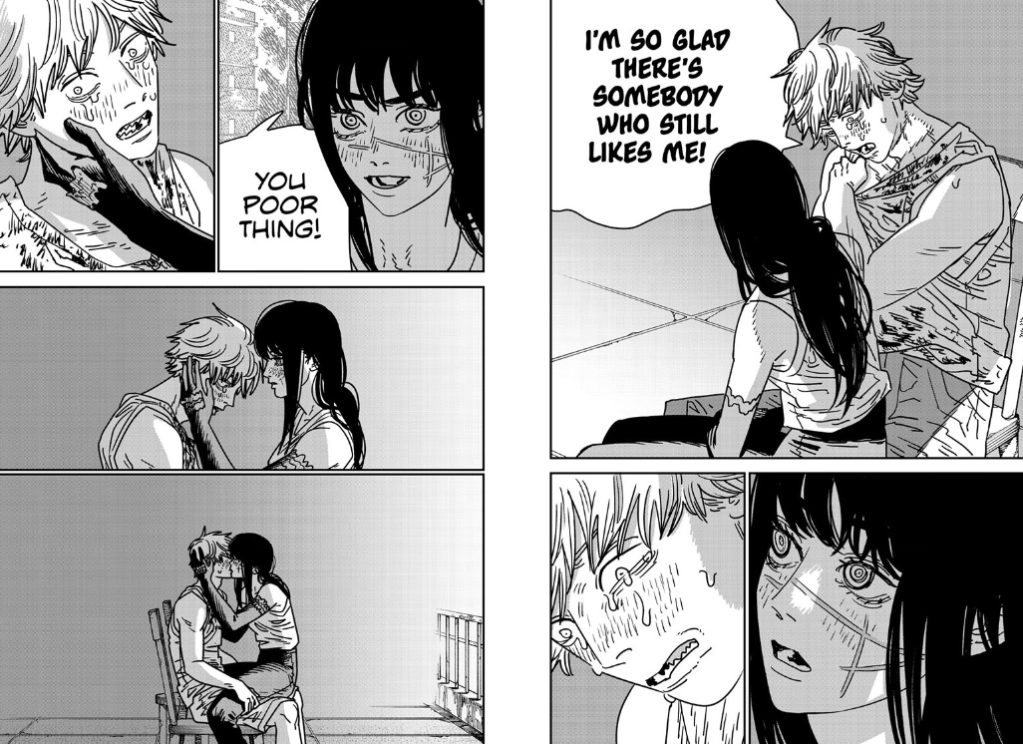
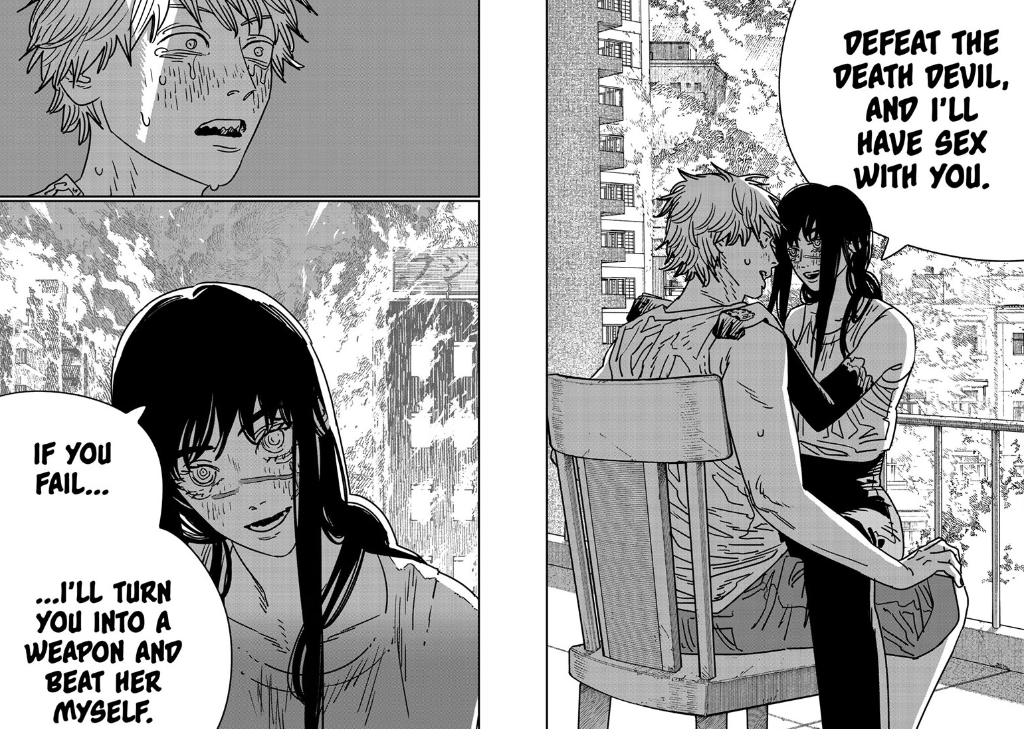
…the woman who molested Denji not too long ago continues the never-ending Groom Cycle the manga has going on, encourages his weakest and most miserable self from a place of personal gratification, and then directly threatens his life. Sex is being alive, death is the other option. As sexy as this sequence is, it’s miserable.
And extremely repetitive.
Then this happens.
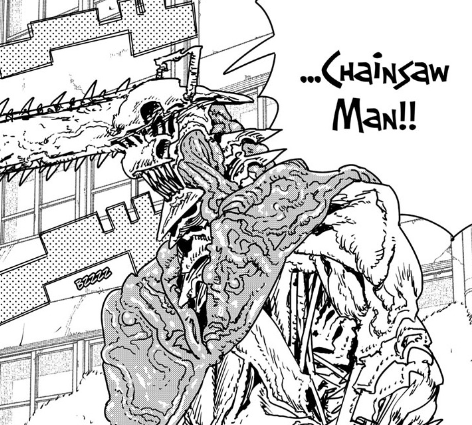
He’s the real protagonist. He’s the hero.
There are a minimum of two and a maximum of three different Fakesaw Mans.
Fakesaw Man Number One
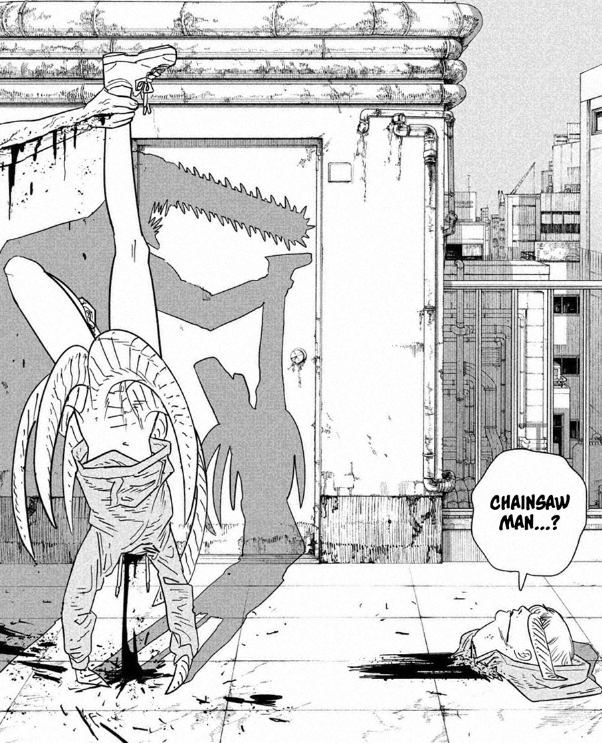
Fakesaw Man Number Two
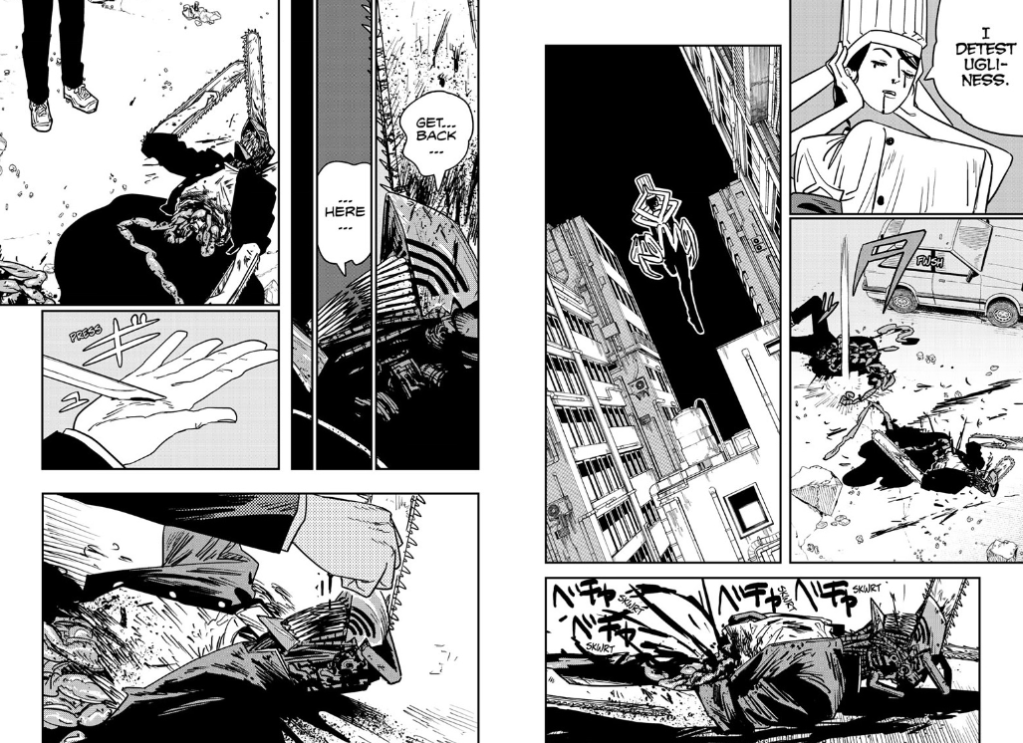
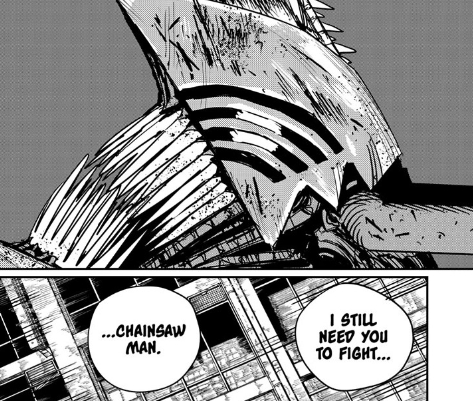
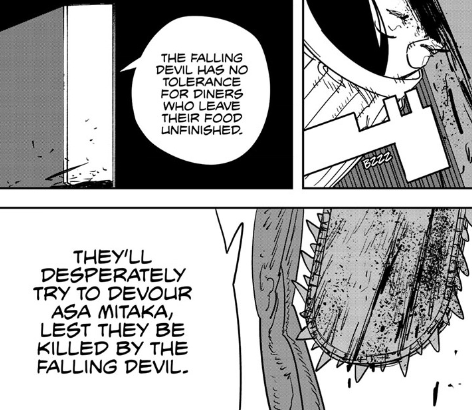
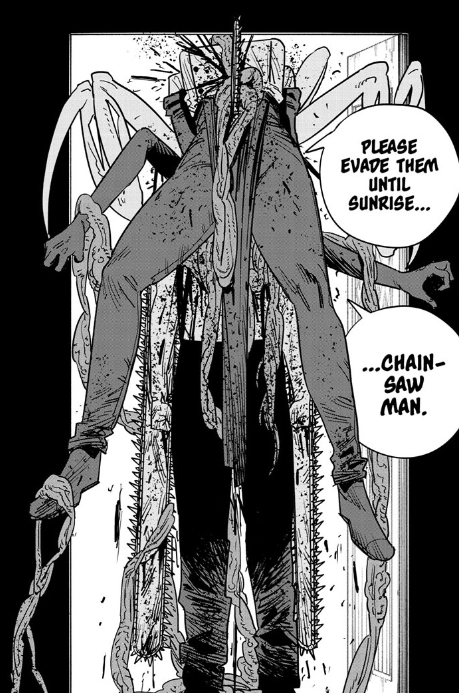
Fakesaw Man Number Three
The second is obviously someone else. Without question, they’re affiliated with Public Safety (on account of both his competence and his air of sensibility) and were likely the best protector of Chainsaw Man as a label we ever saw in the part (in direct contrast to both Yoshida and Lil D’s approaches in the same arc). The first is presented as a force of nature reproducing devilish anarchy while the third is presented as a zealous vigilante.
In any case: the Fire Devil is involved both ways, or the first Fakesaw is purely thematic. The first and last roll together well enough as a representation of the progressing nature of Chainsaw Man worship over the course of the part that it makes sense enough to me to treat them as one.
While Yuko wanted to be a hero like Chainsaw Man, this guy has a full-blown Napoleonic complex as a pay-off to the vicarious living and identitarian nightmares that defined the better part of Chainsaw Man’s back half. Lil bro thinks he Chainsaw Man. Straight up. It’s not a front for something else, as one might argue, no – he fully believes it. He’s like a fucked up and evil Yamato One Piece but much more insecure about it, needing to constantly project outward with I’m Chainsaw Man. I’m working with justice. This is justice.
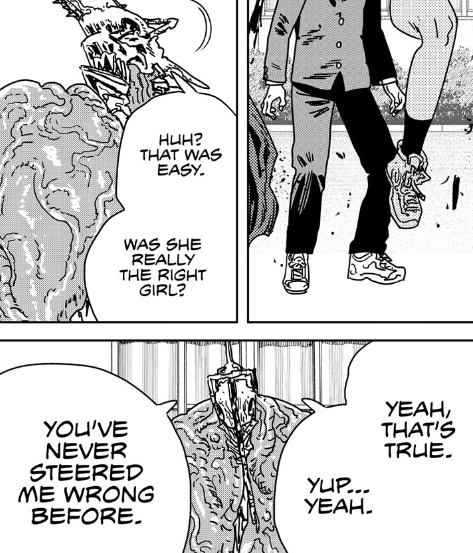
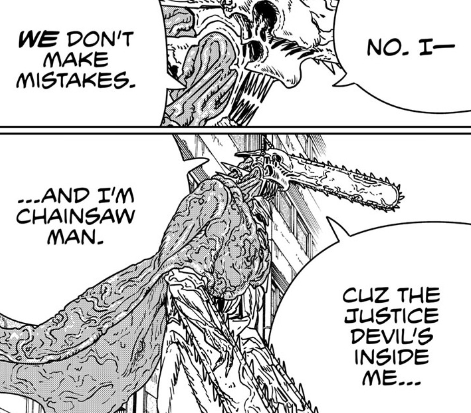
Given the light of the Fire Devil, he fused it with his own sense of self in addition to transforming himself into the image of Chainsaw Man, who he never met in his life. A realistic, disturbing pay-off to a lot of Part Two’s themes, and… completely unnecessary.
In theory, this guy segues perfectly into Denji’s final failures and the collapse of everything, but he offers so little new narrative, thematic, or character ground for the story that he winds up being little more than connective string. There’s just nothing to this dude that hasn’t been exhaustively conveyed in infinitely better ways for the past two-hundred chapters of manga.
What he does do, that I might bring this back into proper analysis mode, is segue the plot to the Fire Devil’s proper introduction.
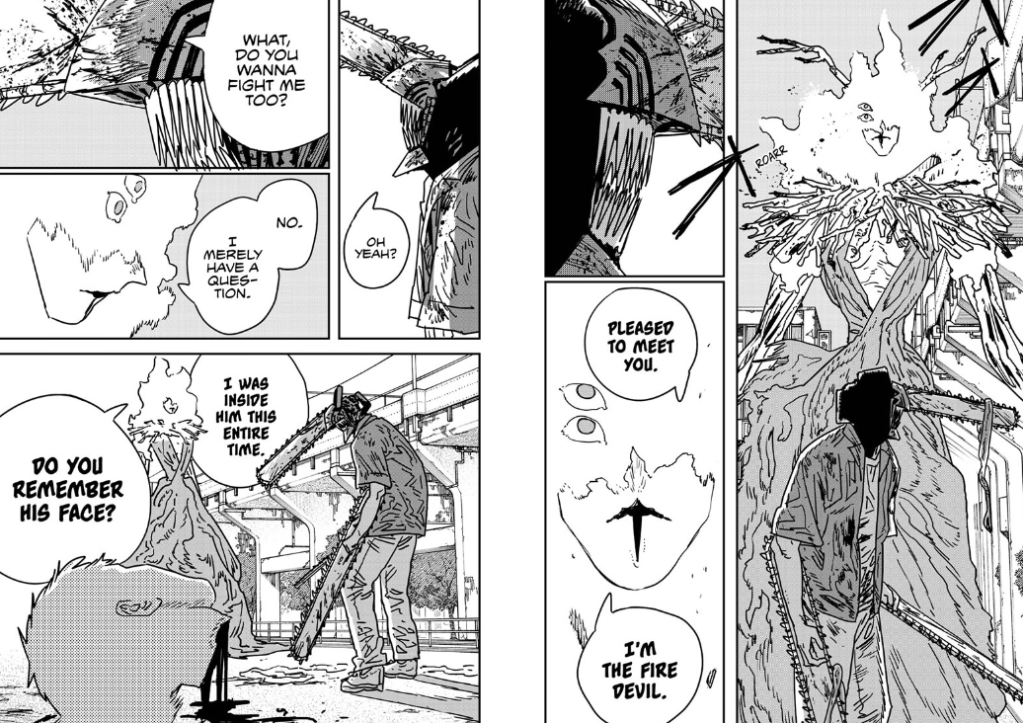
As I stated out of necessity before: the Fire Devil is an outside authority on Chainsaw Man, the final and ultimate pay-off for everything we’ve seen until now, because Pochita, the absolute king, won’t sully himself with outward expressions (a funny thing, on account of how much Fujimoto can’t stop spelling everything out in the surface text of Chainsaw Man, however much he’s conscious of and fights it, sometimes successfully.)
On account of its extreme significance for all of Chainsaw Man, here’s her monologue in its entirety.
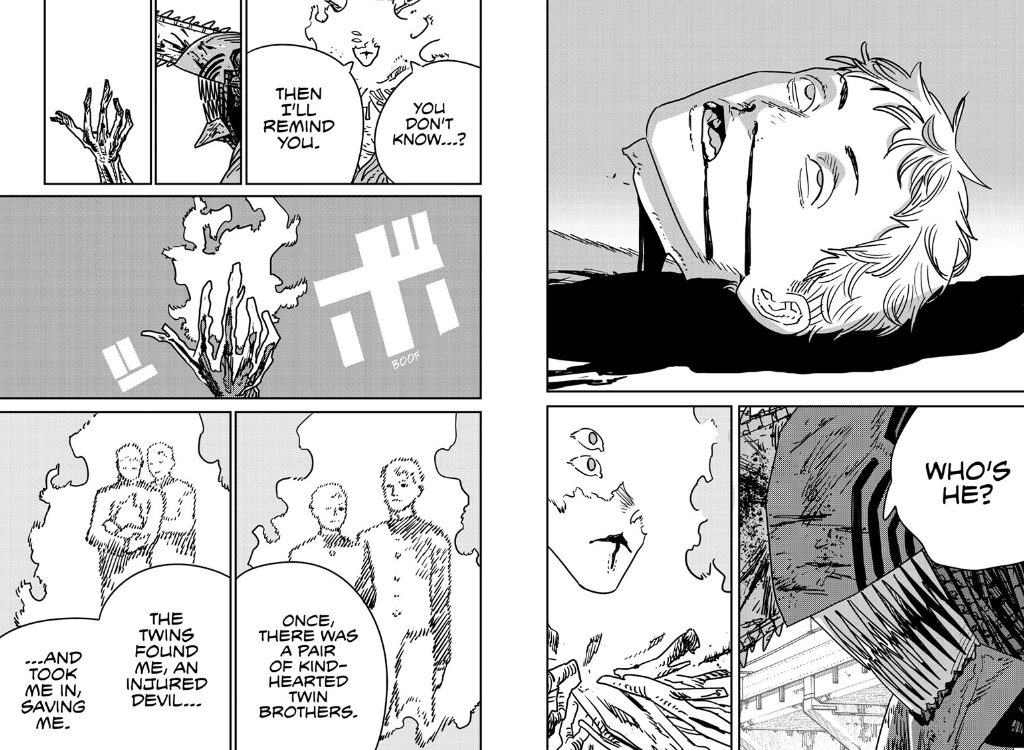
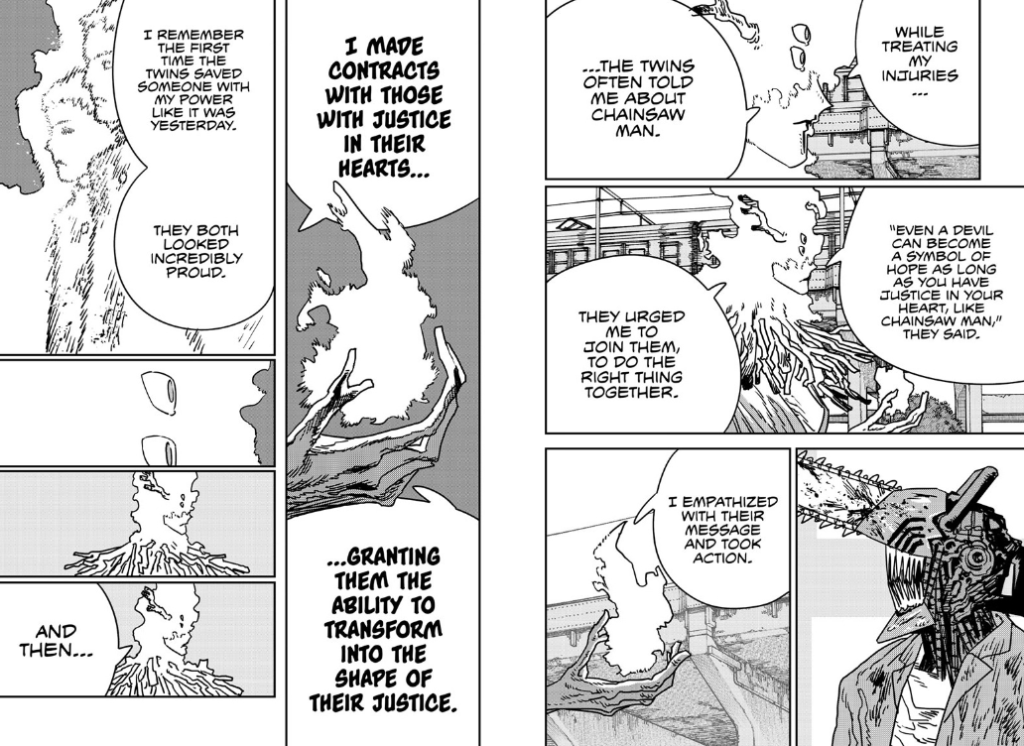
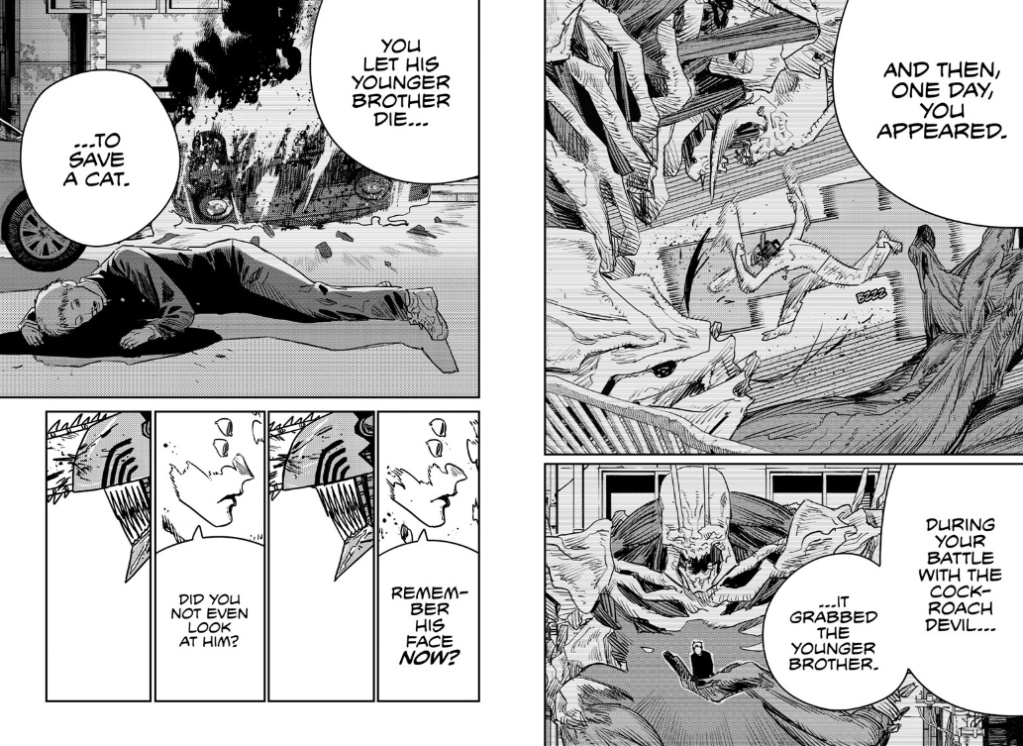
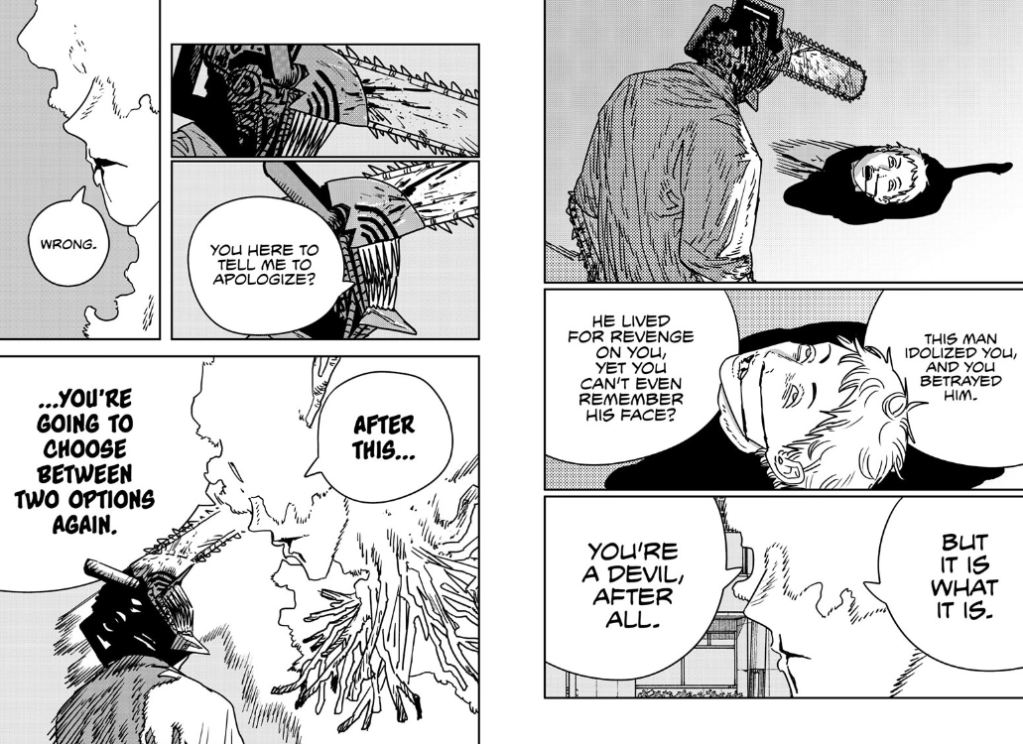
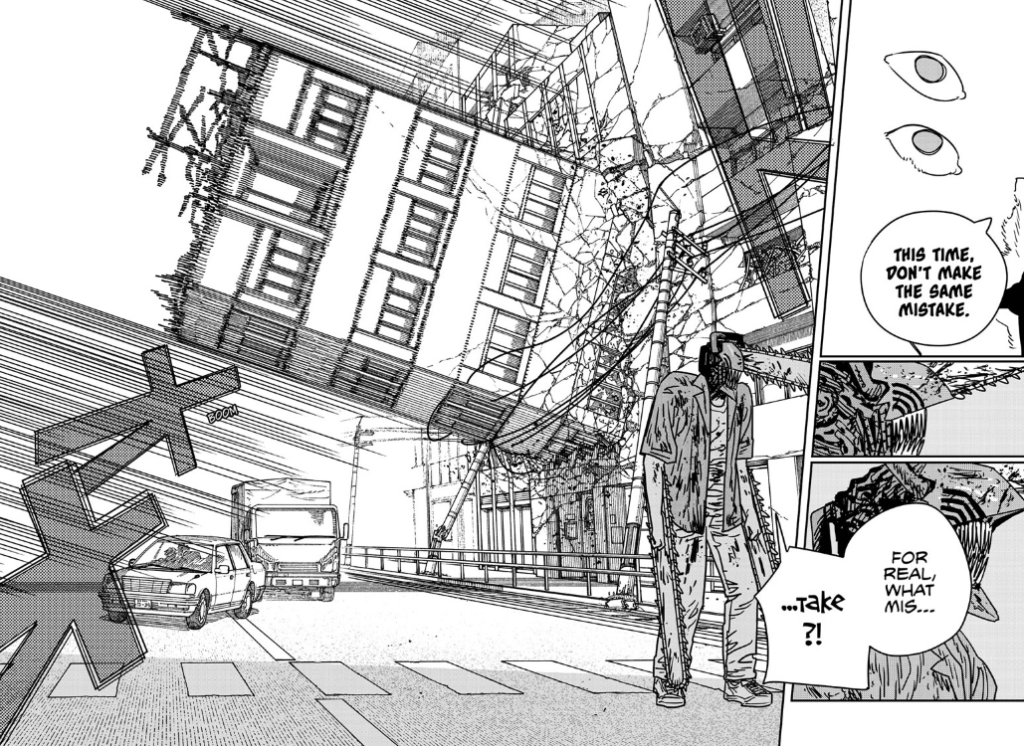
We’re once again bringing things to square one.
Denji talked passionately of his dreams of normalcy, and once went on to wish it for Pochita. Pochita loved hearing Denji do so, so he made a contract and brought him back to life with one condition: show me your dreams.
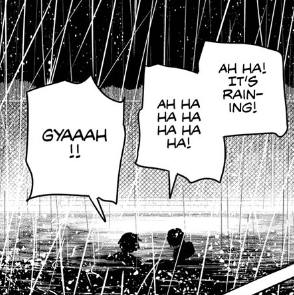
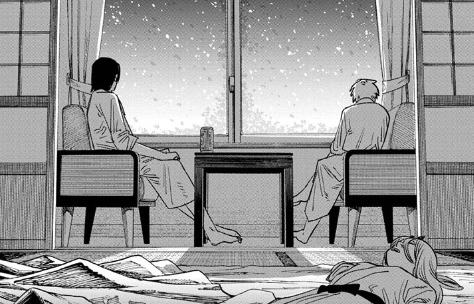
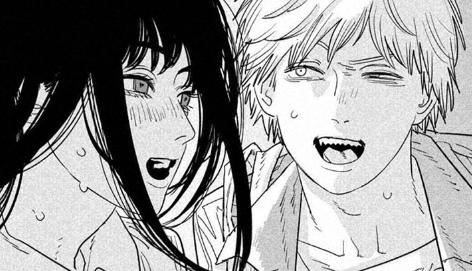
At what point did Denji drift so far away from it all and start showing Pochita his nightmares? Be patient with this side-note for a little longer, reader.
In my analysis of the Justice Devil Arc, I posited the beauty of reaching out to the devils and devil hybrids, the duty of care, the potentiality of unconditional love amid the great nightmare – and we saw this most explicitly back in one of Part One’s greatest moments.
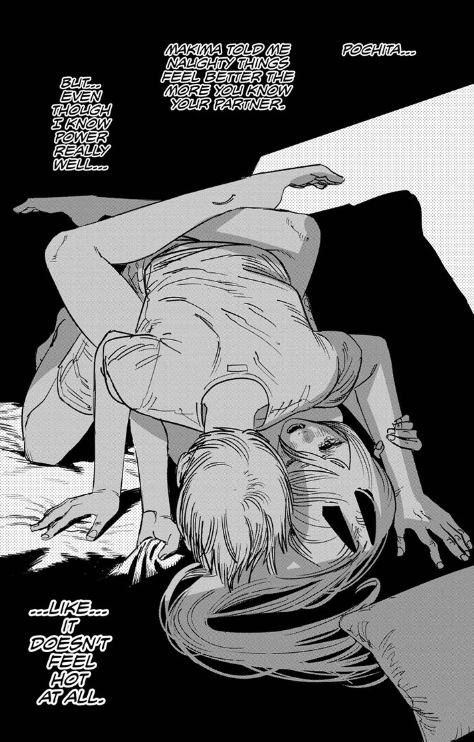
So much of Chainsaw Man is an exploration of the full depths of human connections, so much of it also shows how our treatment of others is often a mirror of our relation to ourselves.
So, Fire Devil made a contract with two boys who work as a direct stand-in for the kid we once knew – as they found her injured and took to her, and her eventual admiration of their hopes came out as a contract. That kid we still had, then, was a direct mirror to the Denji we fell for in chapter one. The original kid, for whom the entire next 230 chapters are his dream incarnate.
Now, we can see what the dilemma really was.
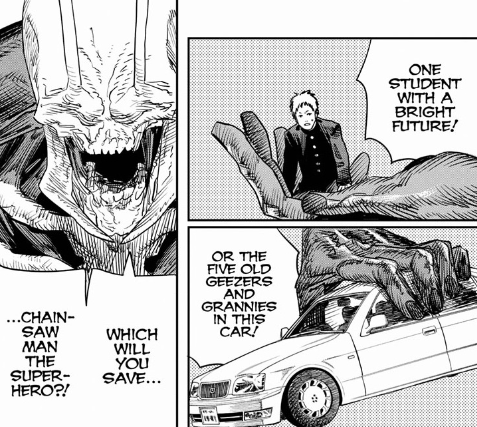
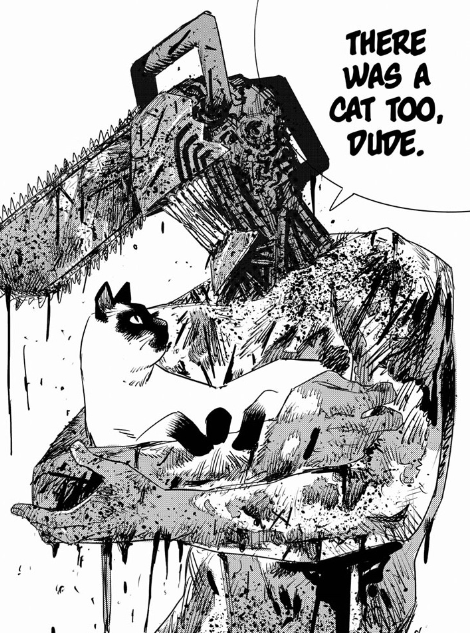
A student with a bright future – guess who, again? And on the other side, a bunch of old geezers – exactly as we saw just last arc, those societal forces who wish to control Chainsaw Man.
And Denji rejected both for what?
Comfort.
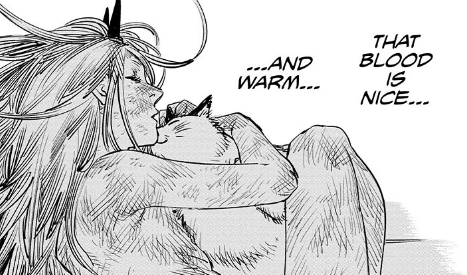
And he fell into a warmth and consumption cycle of devil intestines while copying Power’s perpetual motion machine.
And he went on to eat human intestines while screaming PERPETUAL MOTION MACHINE!, while Asa’s reaching out and making him remember his dreams.
He sacrificed his future, his dreams, his contract, all for the comfort he never got. A perpetual cycle of ritualistic consumption-as-blindness, a reduction of Pochita to a tool for fame – the horrors, thus, of Chainsaw Man as the one who erases the world, literally removes parts of the dream that is Chainsaw Man, the manga.
He fell right into Makima’s shoes – a love-hungry freak who’ll sacrifice the scope of reality itself – while Nayuta is beside him. A flesh-and-blood Control Devil reincarnate, and Pochita himself told Denji all he had to do to make her happy, to show her her dream.
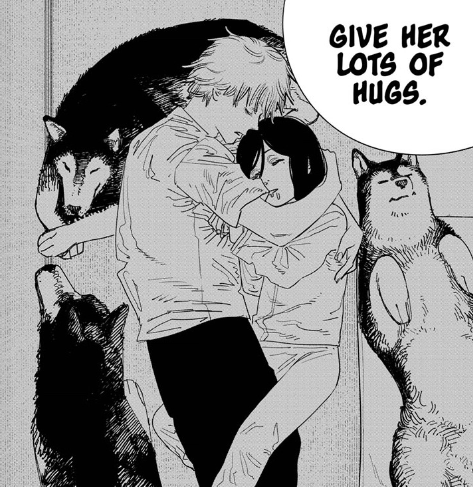
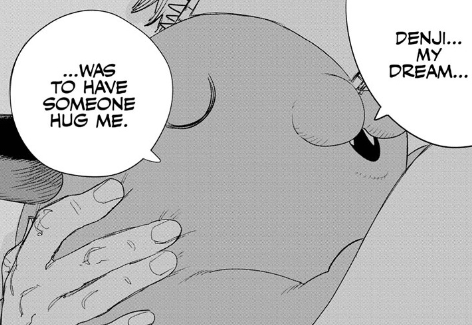
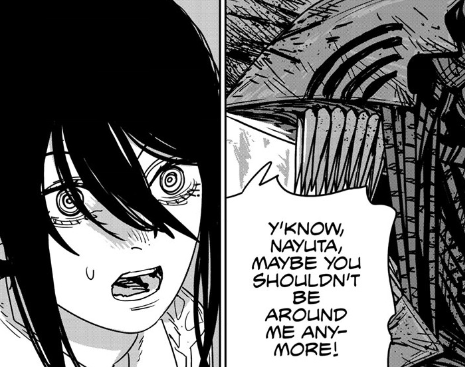
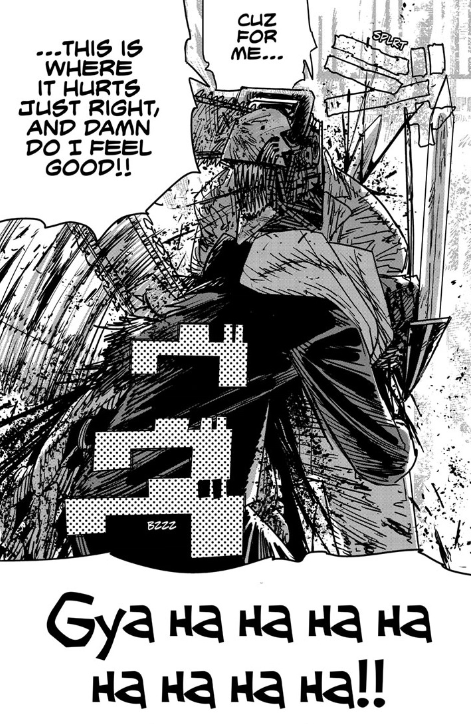
Nayuta, too, offered a mirror to his own soul through love, because that’s what connecting deeply to another does for us.
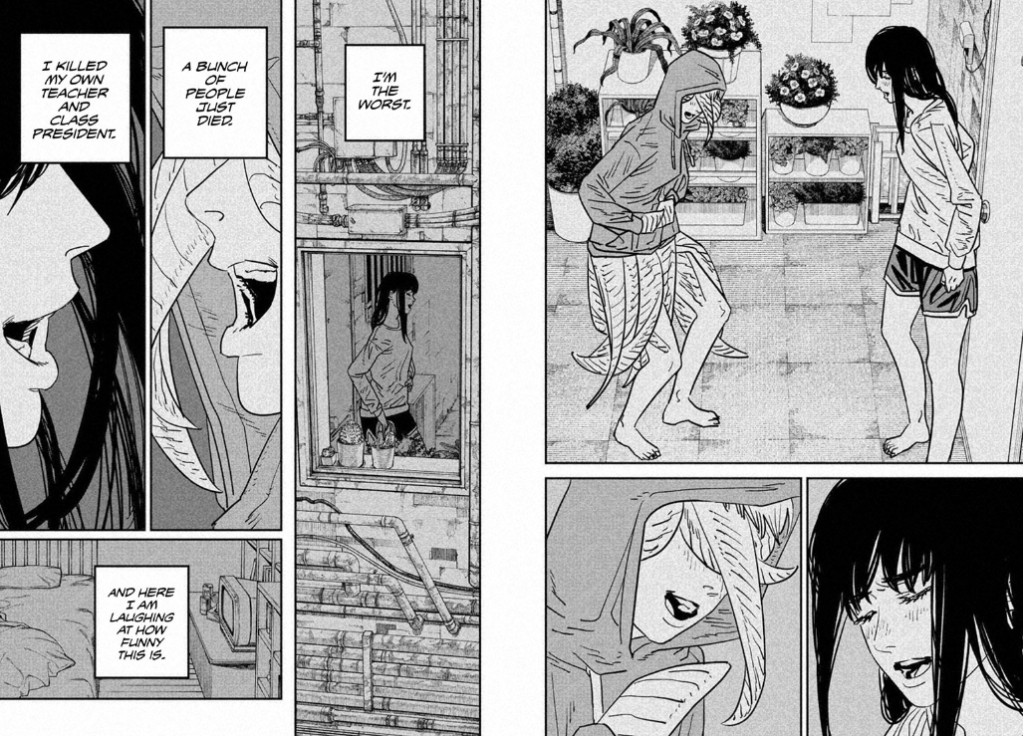
We can find happiness amid anything. We can find ourselves.
And Asa – oh, Asa, how is she doing?
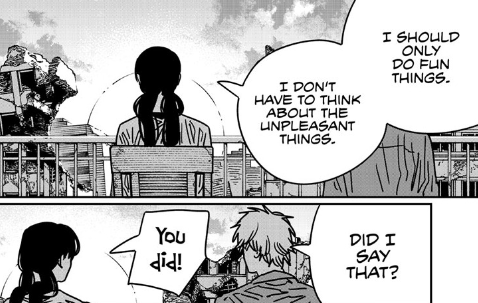
Escaping into herself with Denji’s permission because neither of them is trying anymore.
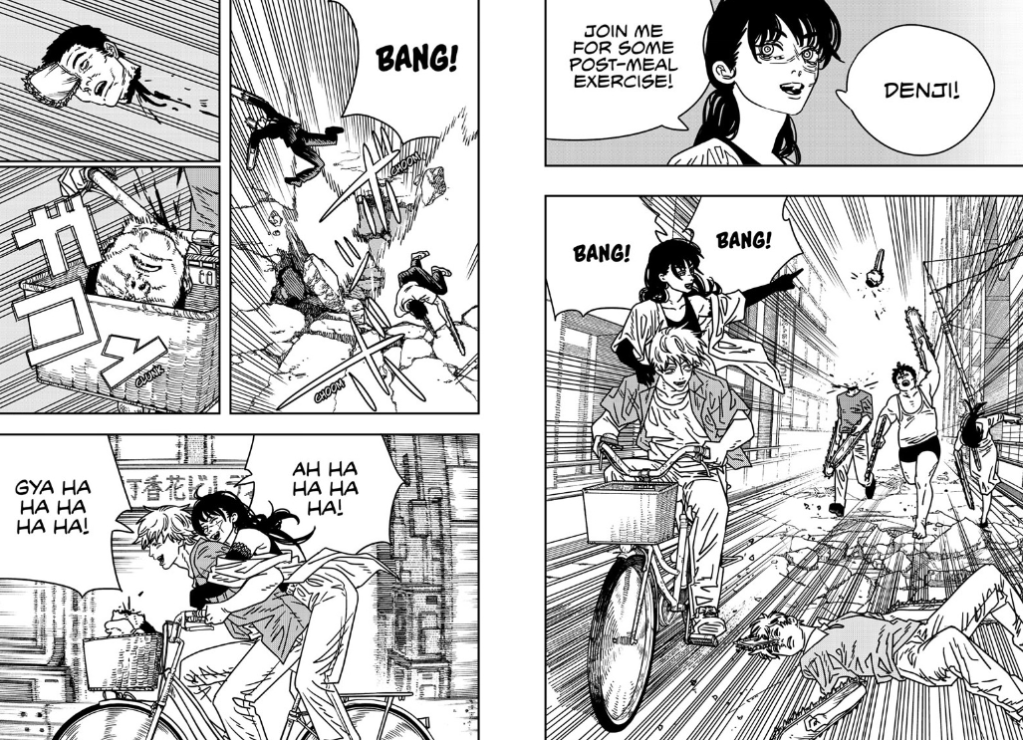
For a brief stretch of chapters, Asa and Yoru aren’t even presented as dichotomous anymore. They’re just… chill. They transition without warning. No one really cares anymore. Everyone gave up seriously fighting this just a single arc after Yoru bared herself unconditionally.
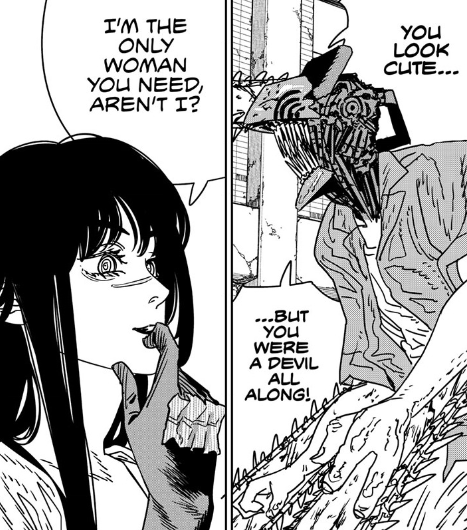
Denji let his old self die for comfort. It’s a beautiful inversion of Part One. After seeing all the beauty of what we’ve repressed in our flesh, all of the purer forms of love we’ve abstracted into ideological forms, and all the importance of comforting one another – we’re shown how trauma, addiction, and lack of self-control destroys you from the outside-in via worse and worse forms of ‘comfort.’
With this one crumb of context, everything clicks into one harmonious whole.
Theoretically.
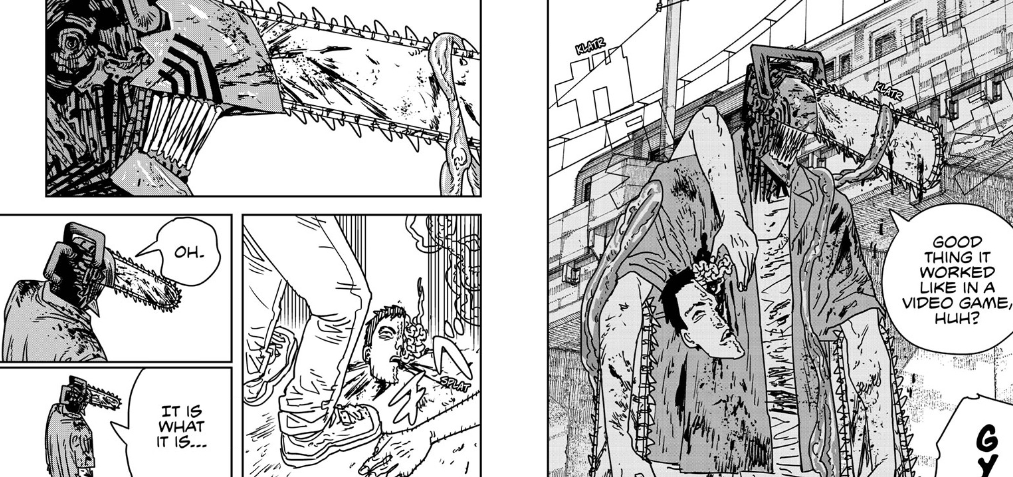
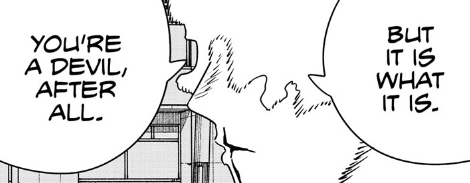
Ignoring that Fujimoto was so wrung dry at this point that the actual execution of this section of the narrative wound up fanfiction tier, and yes, the framework is fucking brilliant – and despite it all, the Fire Devil’s chapter is brilliant. It’s just that almost no one could process it because a lamb gyro in the middle of a septic tank doesn’t register as a lamb gyro.
And while the first of the twins died to his “choice,” the second was literally killed by his hand for the sake of executing a fake Chainsaw Man. Where the first twin is a reflection of Denji’s duty to himself by Pochita’s contract, the second is a reflection of his duty to other people.
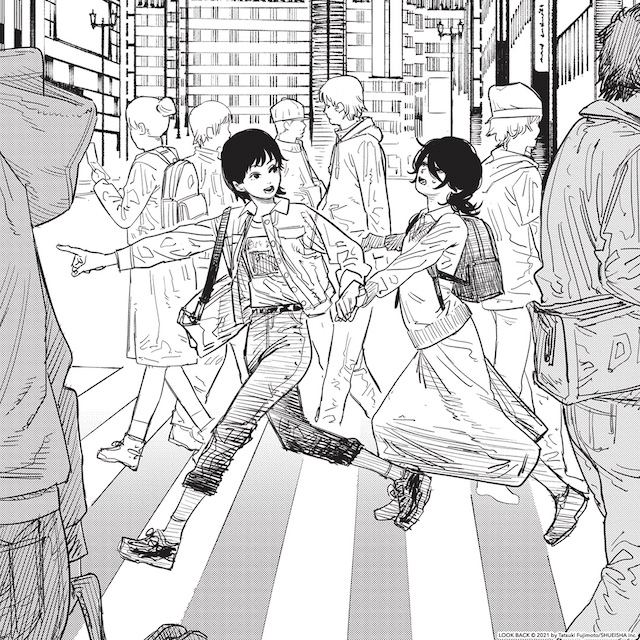
Yep! It’s Look Back again.
Denji fulfilling his contract meaningfully and showing Pochita his dreams is also tied to his further duty of offering something of meaning to others, just as much as others owe him fair interpretation. Yes, it’s Fujimoto’s meta reflections and critiques all the way down – but in ways still so generalizable to how we relate to fame, standards, and images in society as a whole. Going into one’s comfort is not enough, especially if you’re like Denji – traumatized, emotionally vulnerable, impulse-driven, insecure, and adverse to change. If you don’t want to be a devil, you need to actually work with your respective devil to get the whole thing under control.
So, with all that: what is Denji’s choice? After every choice ‘provided’ to him, after all of his rejections just to break down, what real choice can he make? What can one do of their own volition, their own humanity?
Fujimoto cuts straight to it.
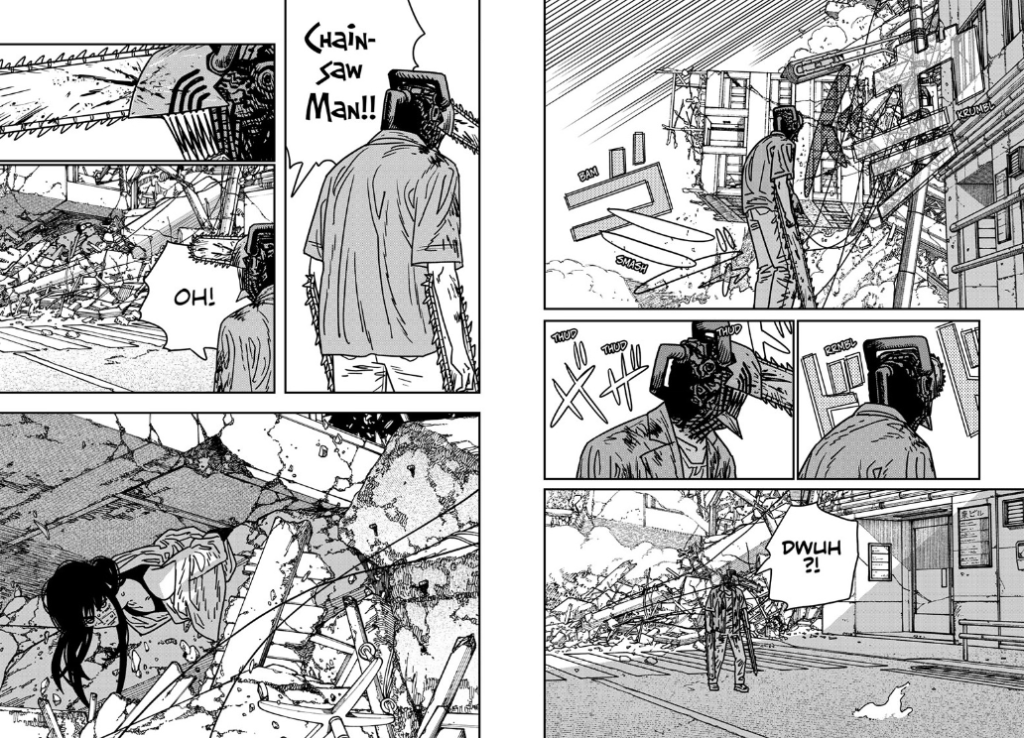
He can reach out to the person who wants to reach out to him, amid it all, and fulfill that duty.
And it’s not a coincidence that it’s the Falling Devil, the embodiment of collapsing into one’s inner nightmares and literally being mindlessly consumed by devils, that’s the one doing the destroying, here.
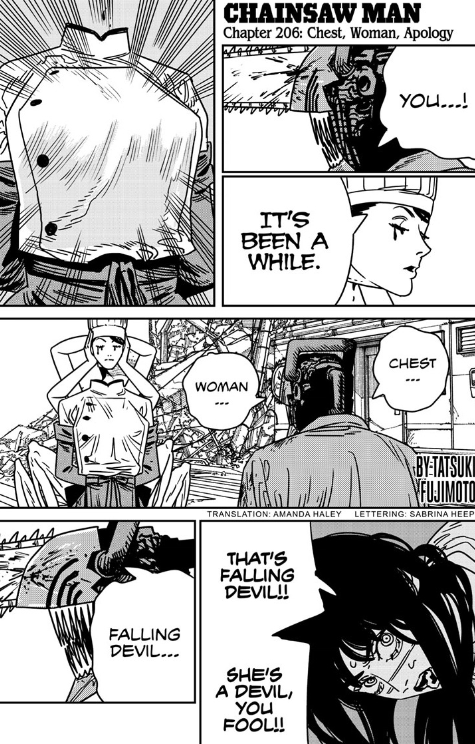
In the end, all of it comes back to Himeno and the Eternity Devil Arc, once again vindicated as a part of peak Part One. Choose connection. Don’t feed the devils. Connect even to the devils, if you can.
Because even the devi-
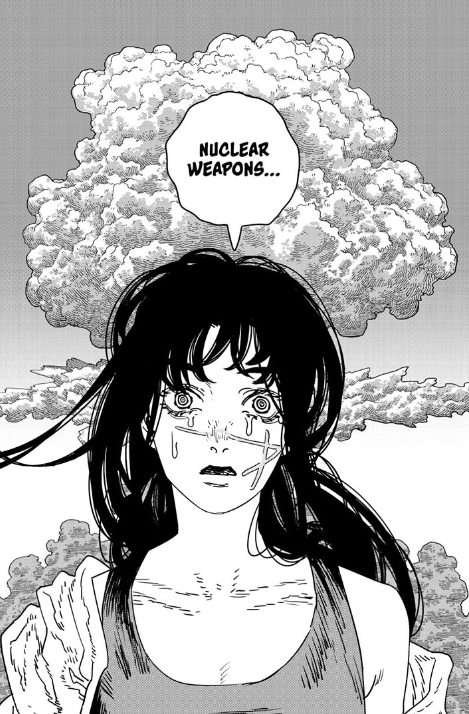
Well.
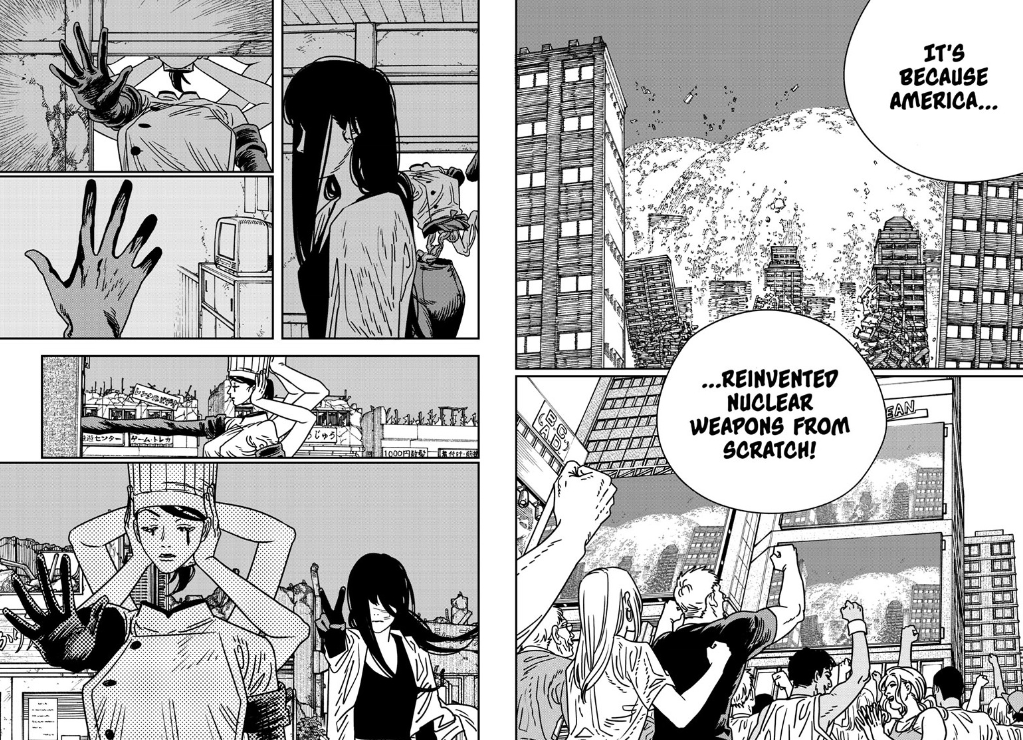
Peace signs have always been a psy-op in this manga.
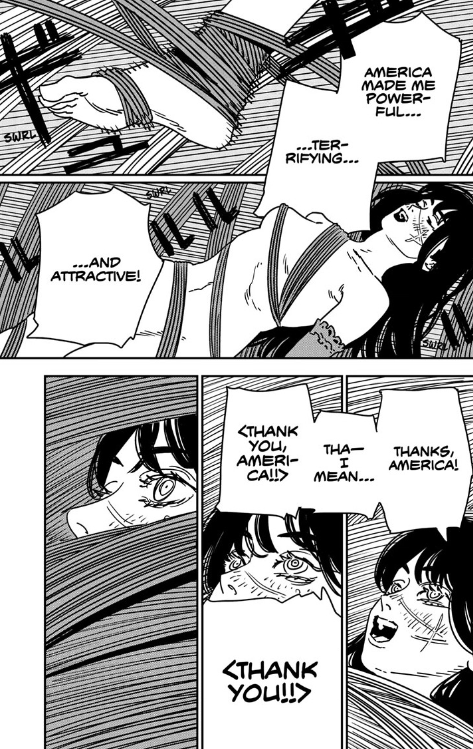
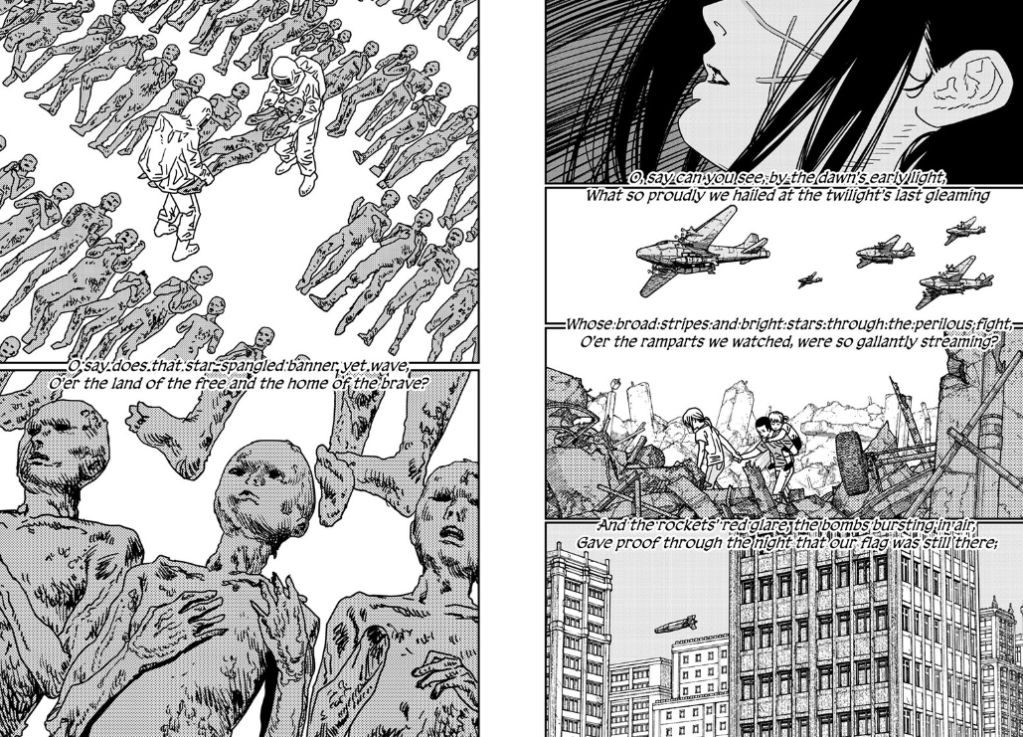
Comfort and vanity, Lil D and Yoru-in-the-flesh. The two big obstacles to humanity Fujimoto explores the most in Part Two. Denji’s and Asa’s tests.
So, will they finally pass, after all of the catastrophes we’ve seen until now?
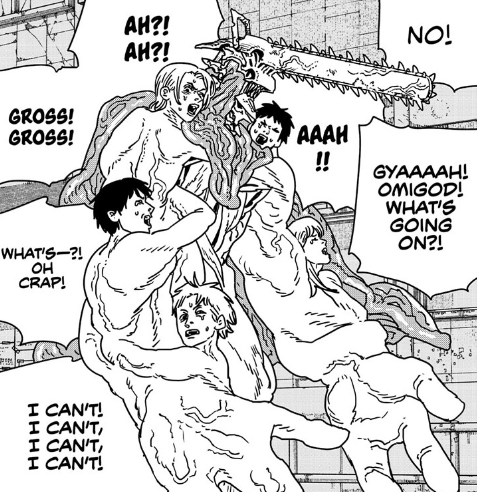
Final Fakesaw makes an armor of hostages and this is clearly bad and not Chainsaw Man’s thing. I couldn’t think of a way to fit this in naturally but pay attention to it because it’s kind of important for the final fight with Yoru.
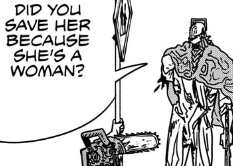
Crazily enough, he straight up morality-mogged Denji once.
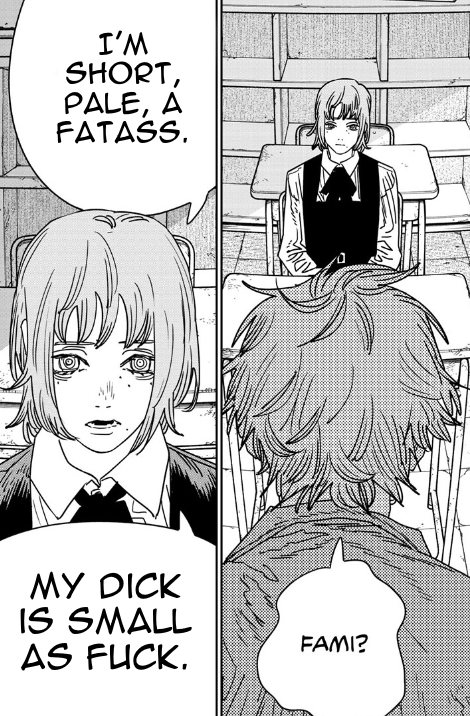
Into the endgame we go.
Death-chan gave Yoru the idea of separating Denji and Pochita, letting the latter be objectified after his act of faith to Denji…
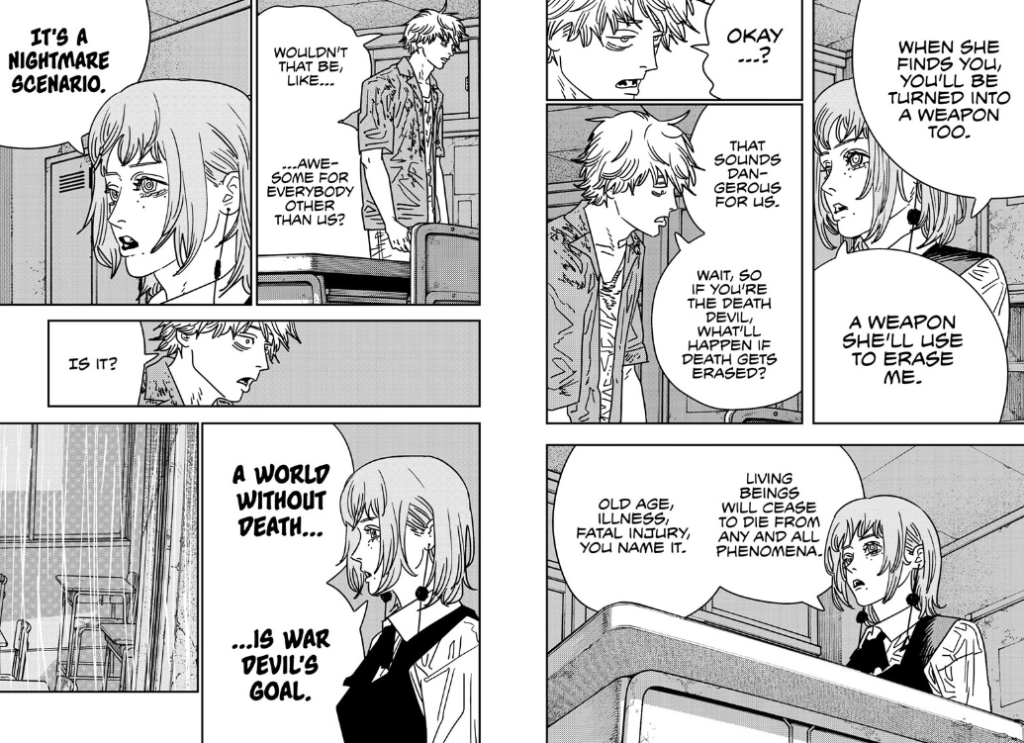
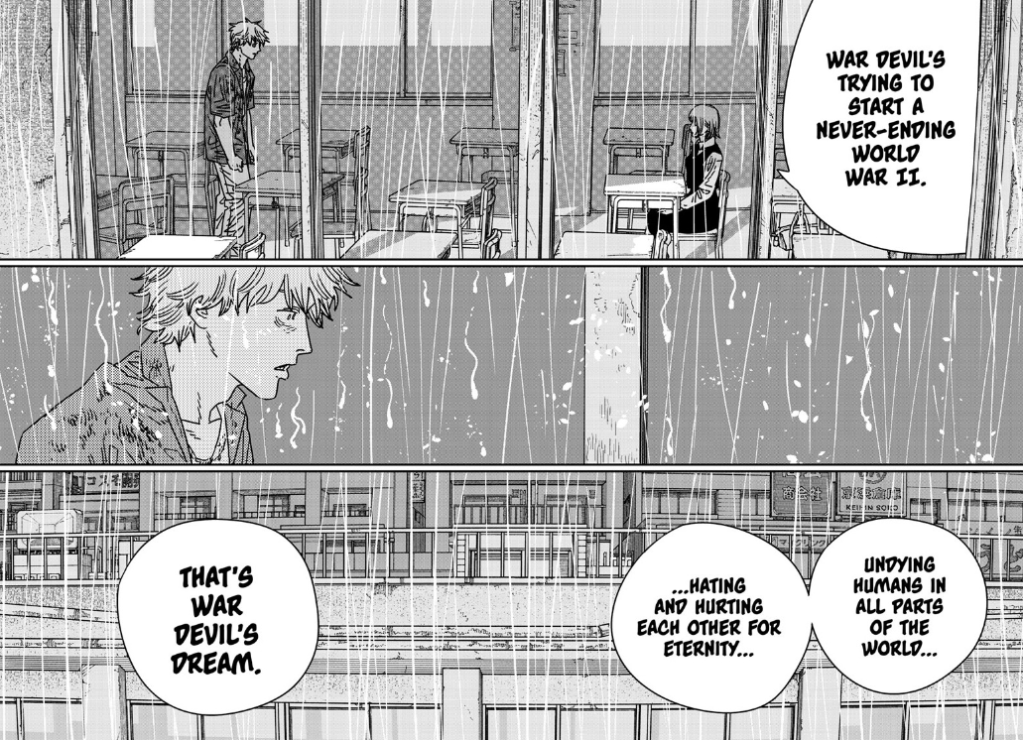
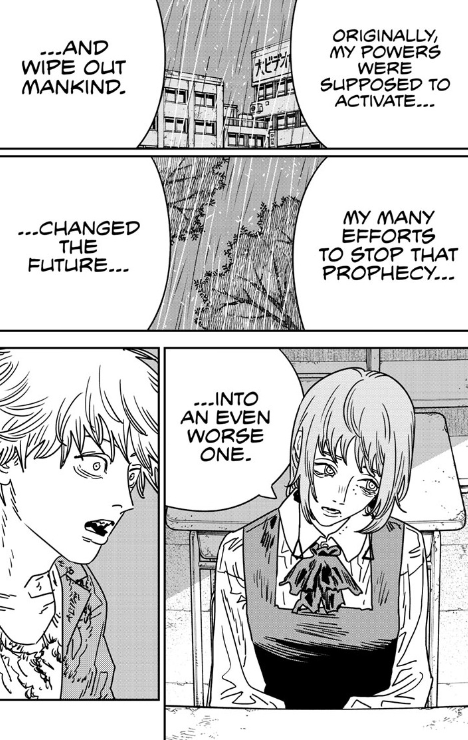
…and we finally get Denji confronting her, the mirror of his own death drive, as Yoru’s goal is concretized in direct consequence.
Humans hating and hurting each other for eternity. No ending. No room for any kind of connection or love. Pure violence for eternity to feed the end-all-be-all devil-of-devils. Yoru looping into her own ego and never reaching out to any hand. The endgame of what Fujimoto wrote from the start of Part One as the worst thing we can do in disconnecting from others for state-sanctioned fantasies.
Here’s the Lord of States, War herself. We’ve reached the absolute.
And it’s largely Lil D’s fault it ever got this bad, exactly as it’s Denji’s fault for not properly engaging his own opportunities to reach out to Asa despite her clear efforts before the disaster point. The urge to mindless eat, fuck, a spiral of intestines and never-ending forgettance cycle of addiction that drowns out the whole world around you…
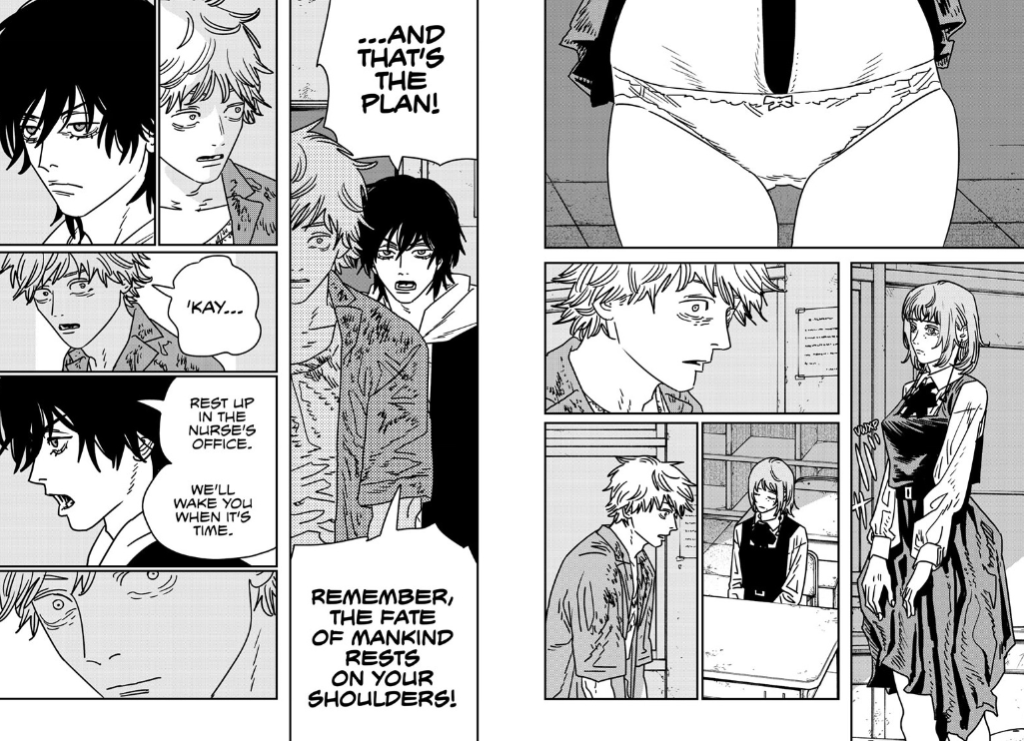
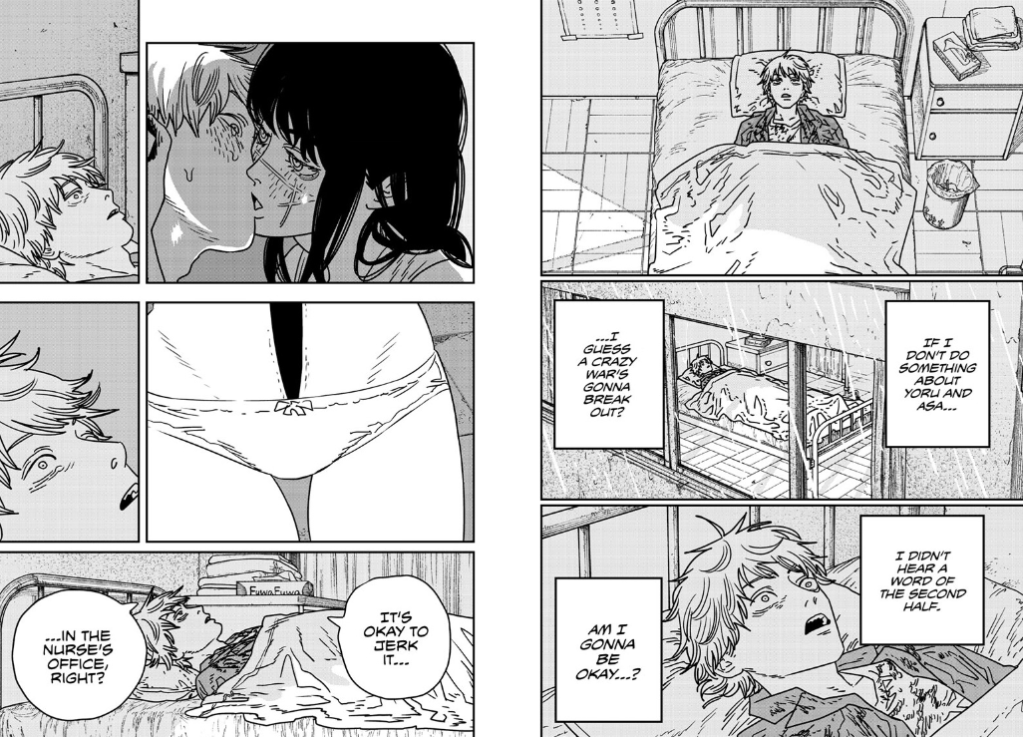
Before we move forward, it’s time at last for some deeper reflections on Lil D, Yoru, and what Part Two sells as a whole.
In Part One, Fujimoto played with devils to show what we owe to each other; in Part Two, Fujimoto played with our relationships to show what we owe to devils.
So, then, how should we be interpreting devils? Does inner child do it? That’s half of it.
We have enough perspectives at this point, primarily between Pochita and Fire, to put it into solid terms and concretize the opening chapter that started this whole thing.
Devils are not only inner children or ‘pure’ in that sense. They’re devoid of the weight of social contracts and everything we’d call worldly living. They’re the ones who create the terms of it, without intrinsically being beholden to it, themselves. They’re the divine Other we use to justify and guide everything we do in our waking lives, both the inner child and the higher authority we must listen to lest we lose ourselves.
Fujimoto can thus use devils as a means to explore the absolute foundations of our ways of being. Denji’s dreams and his need to show them (also, Fujimoto’s tight relation to his art as the realization of his soul), the brothers’ drive as true fans to aspire with their whole minds to higher standards of justice in this life, Aki’s fickle pretend-plays going back and forth between sacrificing himself for the sake of having an idea of his out-of-control future, for just some time, or parts of his flesh so he can command a fox, those beasts that need to be tamed because they took his family. Each devil and its contract is the embodiment of our fundamental modes of life. And those, like Aki, who never meaningfully understand and fulfill one proper contract, but instead jump between them, will be torn down as badly as the fool who walks into the belly of nature without respecting its laws.
This means that with the soon-to-be conclusion of Yoru’s character, we’ll fully understand Asa’s innermost depths – because she always has been, and always will, aspire to engage with the world around her and become a part of society and its long list of contracts in her own, conscious way, exactly as she should.
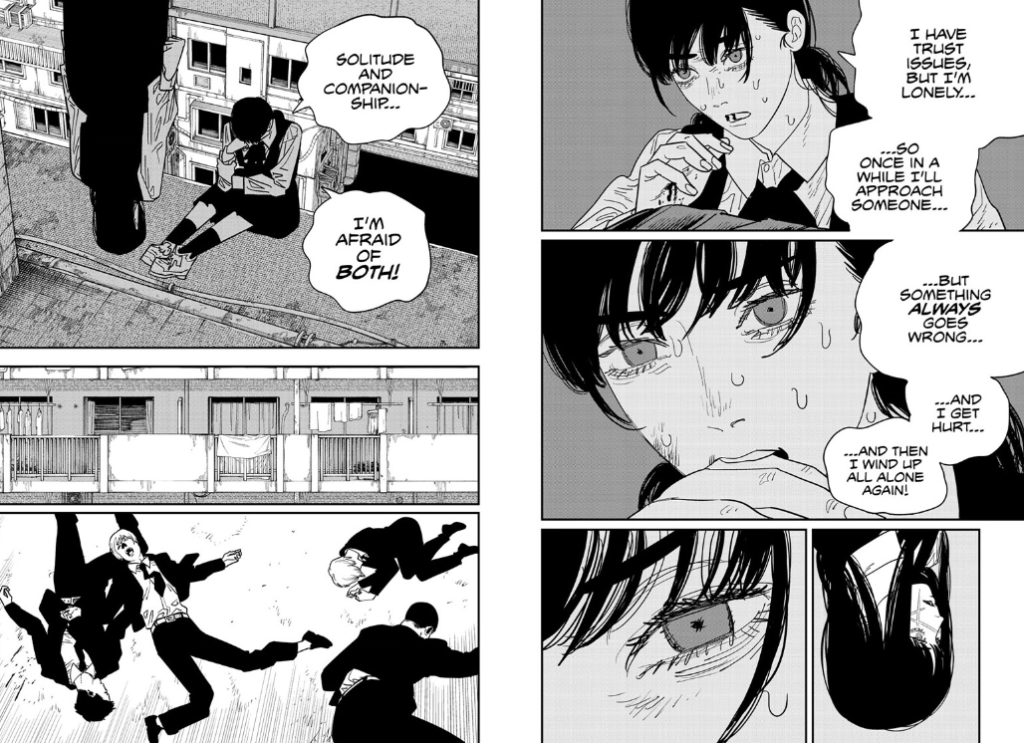
Contracts are the devil’s egos. And without reaching out to humans and being properly domesticated in-turn with them, they’ll just trip over themselves, too.
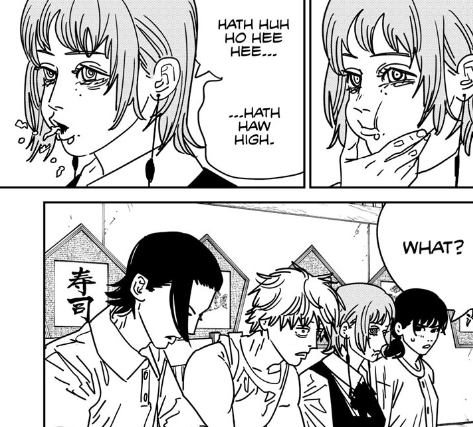
No one in Chainsaw Man is an apotheosis, including the devils. Lil D isn’t ontologically evil despite seeming to be the proper manifestation of death for everyone. She just has no idea what the fuck she’s doing, and everyone suffers for it. But she wants to. She loves humanity.
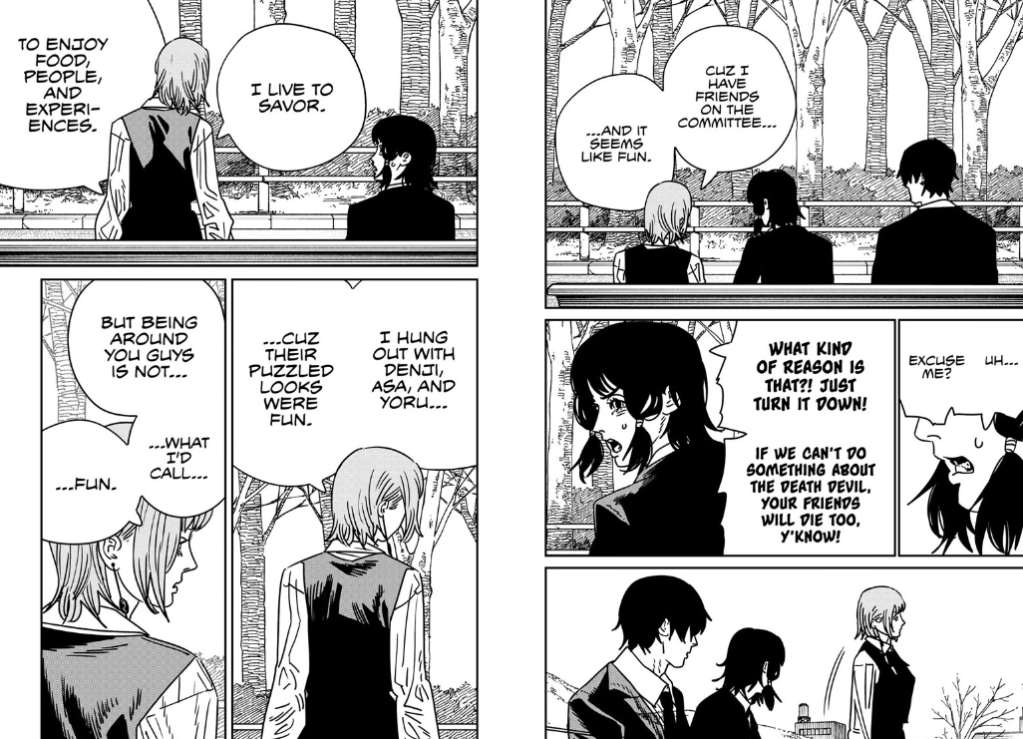
The truth is that, exactly as with Makima, Lil D has nothing but distaste for the professionals she’s surrounded with. When she’s working with the people who make her more like the Death Devil, she only makes the prophecy worse and she’s personally miserable. When she’s with her goofy friends messing around, she’s happy and not escalating the situation. Her more refined tastes, away from the honking-down and disrespect she stands for amid the main cast, are both her happiness and thus her way to avoid her destiny as the Death Devil. Exactly as Denji’s love meant a possibility for Nayuta, as Denji’s contract meant one for Pochita, as Asa working through her emotions and exercising better control could have meant for Yoru. It all comes down to the power of connections defeating the ego-loop-de-loop that fame, prophecy, and organized religions feast off of.
Even the devils need not be their names if they simply abstain from the nightmares and live among people. Then, they can just be… people.
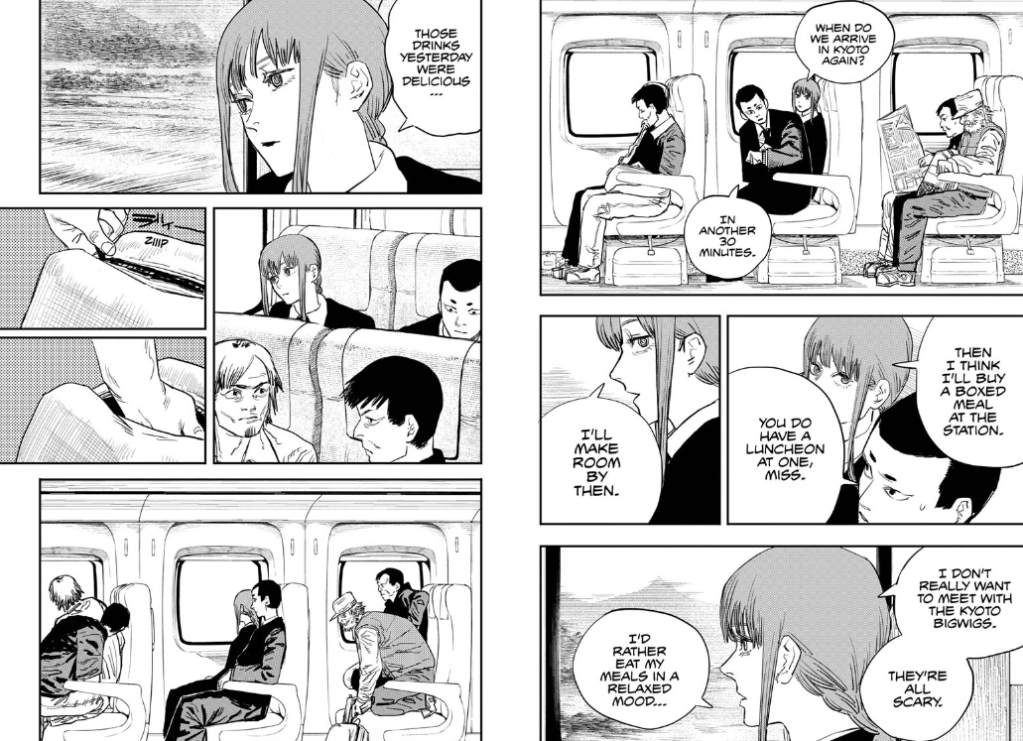
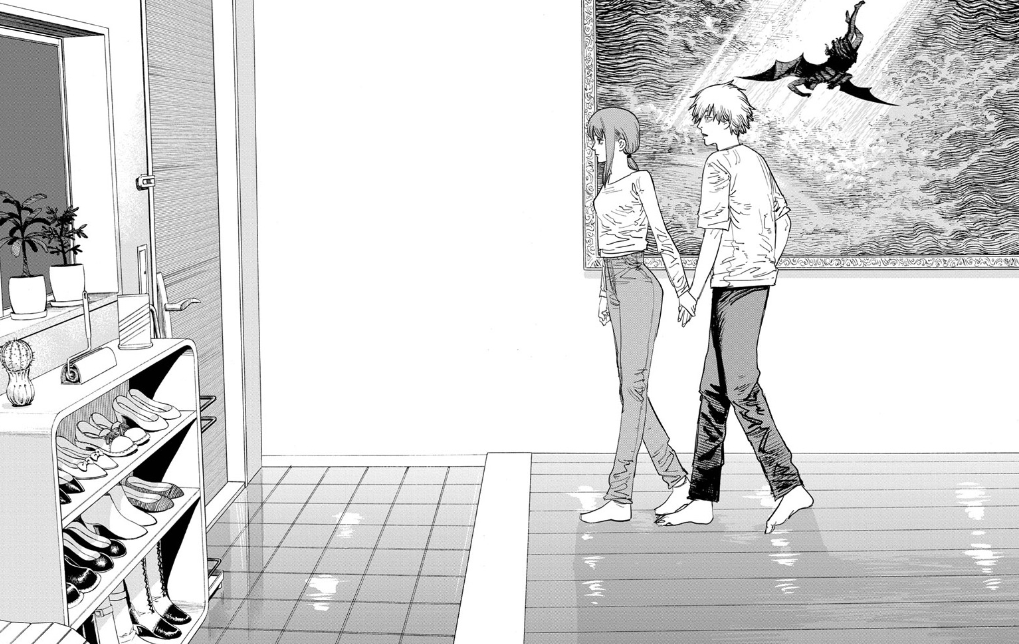
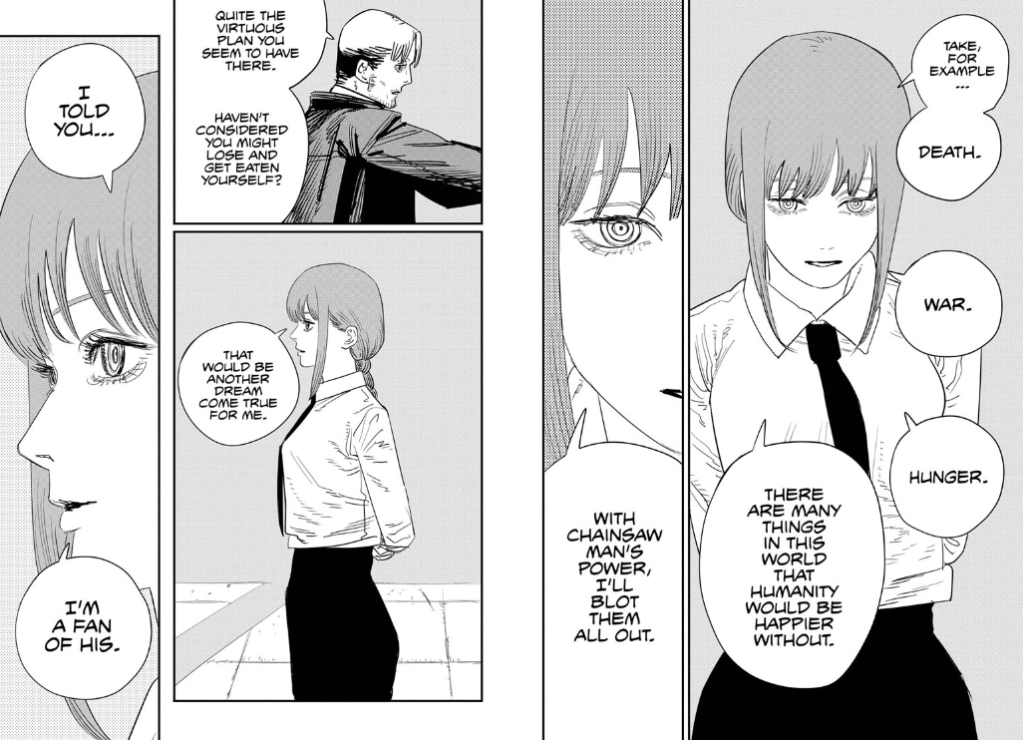
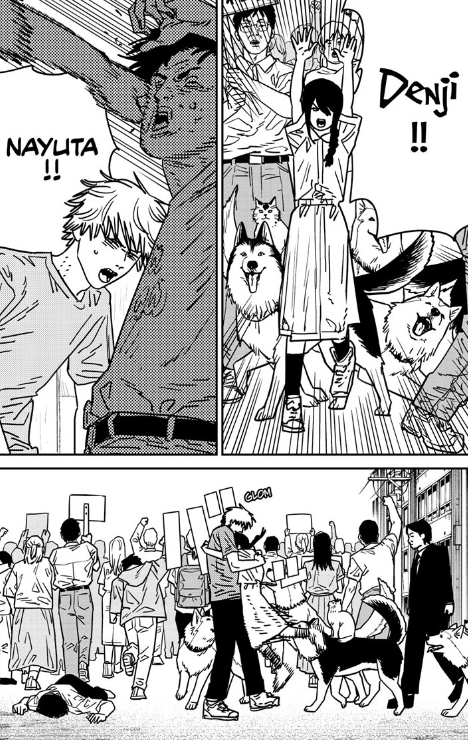
Lil D is the final, ultimate statement of this truth, which Fujimoto’s worked time and time again. She’s literally the Death Devil. But, if she doesn’t fight it, and empower all these horrible things out of a double-sided death drive, but just lets go and returns to the ground floor and opens herself up – she can truly savor life without devouring it.
The problem with Denji’s Chainsaw Man addiction isn’t that he’s relating to Pochita at all. It’s that he’s a disconnected addict reducing Pochita to, well, a weapon, again – a weapon to claim the love of women. Denji fucked up, Yoshida made it worse, Asa tried but she’s autistic, Yuko is dead, being a teenager in Japan is horrible. That’s Part Two in a nutshell.
The stakes are definitive for the final test. Denji will have two choices, one last time. Will he make the correct choice? Will Lil D’s endless death spiral of punching her own reflection end? Will Pochita be truly involved in all this once again for a better world? Will Yoshida stop being like that?
Before answering all of them (except Lil D, because Denji doesn’t know what the fuck her new plan is to begin with) in quick order, we’ll made the final digression of this long, long analysis: it’s time to talk about the GOAT of Chainsaw Man.
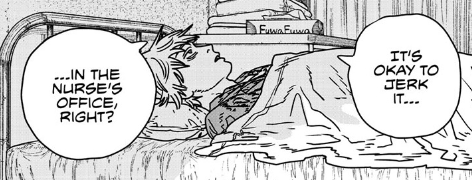
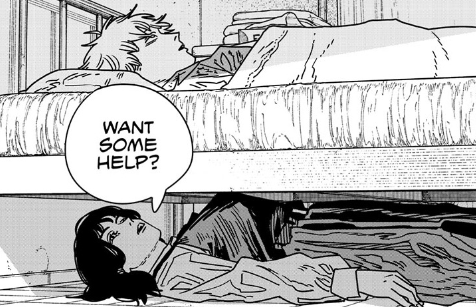
Enter and become: Fumiko Mifune.

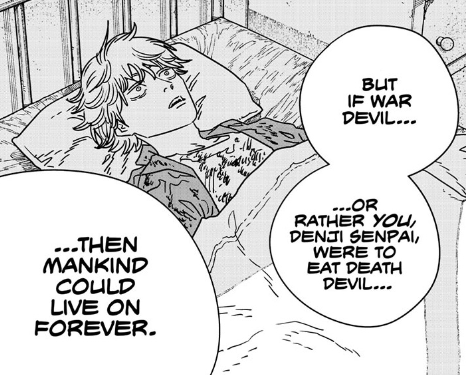
The Biblical horsemen of the apocalypse are Conquest, Famine, War, and Death. But today, Conquest has often been traded for Pestilence – disease. And right here, we see the girl who happens to fit into that role.
Amid all the addiction and all the bullshit, Fumiko openly chooses to be the living embodiment of entropy and nihilist fatalism, decrying literally everything, reducing Lil D to her devil name against her efforts to connect with humanity, and setting up the ultimate doomsday scenario.
Some readers missed it, but if you did the math on the two panels above, you might have realized that a deathless world is, for Fumiko, the equivalent of an all-you-can-eat buffet. The scenario where there’s no death for humans and she can reproduce herself through sex – now only the pleasurable act, with no death in counter to it for a pragmatic purpose – is a scenario where all of humanity could be swarmed by Fumiko Grey Goo. And, were she willing to engage in elaborate forms of bestiality, we could have still gotten to see an infinite Fumiko Tree Colony. Kind of like Fire Punch if you really think about it.
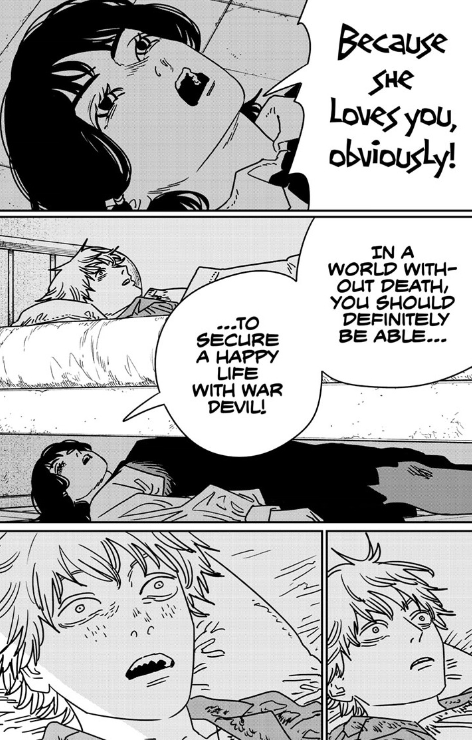
She’s ultimately here to encourage absolute abandonment, push Denji into his addictions and unhealthy habits, and otherwise spread the most extreme, doubled-down death drive of debasement and fucking-as-cloning. Because, yes, making a contract with the STD devil at age fourteen can irreversibly break a human brain. She’s the worst possible mirror of Denji’s own trauma, and she’s the one to call herself a Denji-senpai fan. Love her.
Now, enough debasement. It’s time for pure performative goodness.
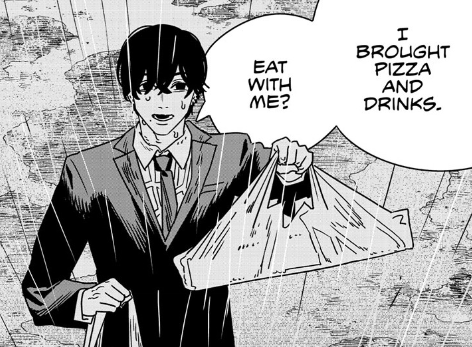
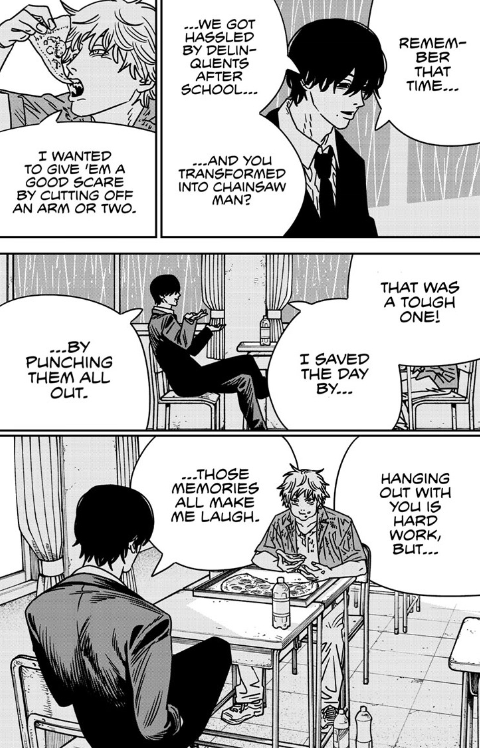
Yoshida recalling “memories” that refer to absolutely nothing true or authentic is one of the funniest and saddest gags in Chainsaw Man’s run, and serves as a direct foil to the remembrance of snow and love Denji worked through in Aging. This is pure simulacrum done towards violent ends, as Yoshida had always been the tool of. It’s just that now’s the final pay-off for this absurd “friendship” between a boy who has no idea what’s going on anymore and a walking parody of the modern teenage condition ready to blow himself up.
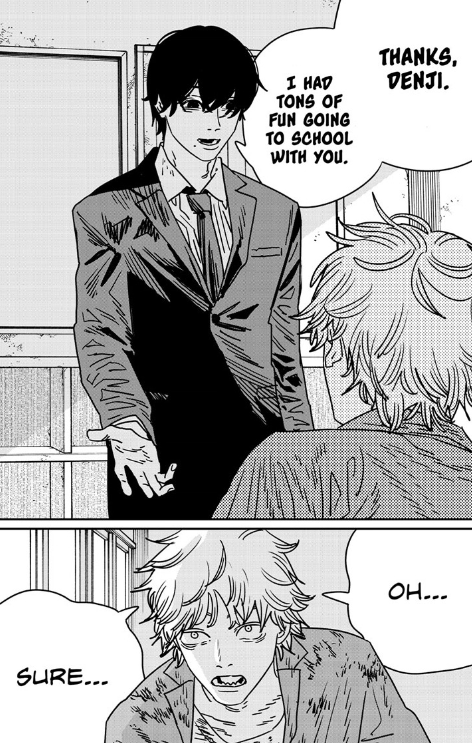
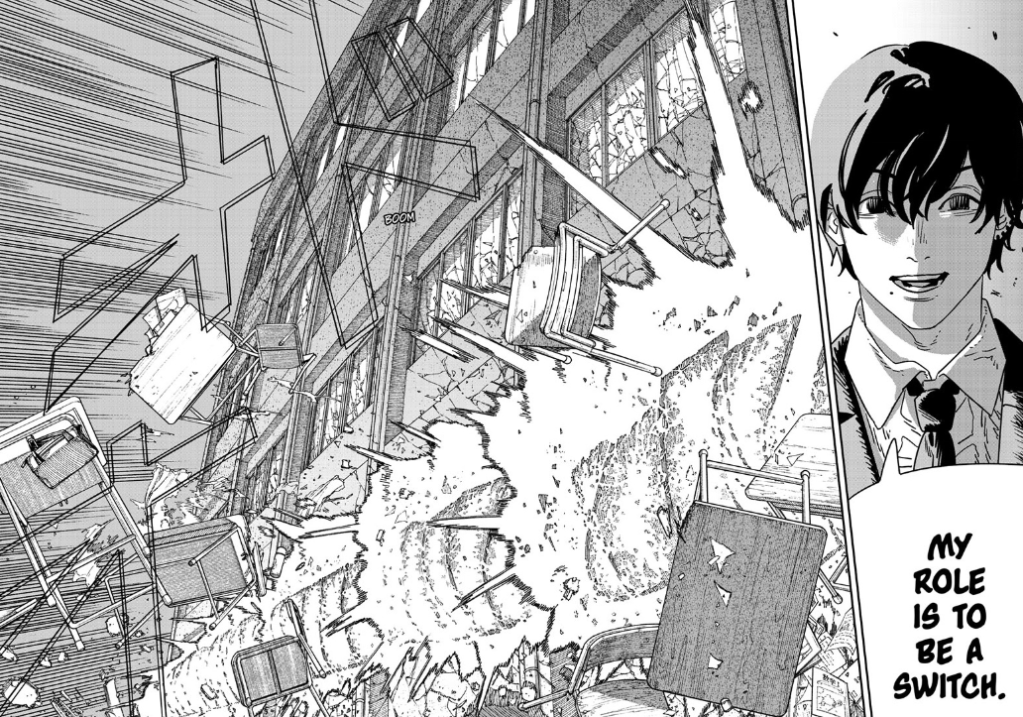
Rest in Peace, Yoshida. You were a fucking weirdo.
If Denji reflects modern feelings of enburdenment and Asa reflects modern alienation and projection of insecurity, Yoshida reflects modern giving the fuck up and violently disassociating while boomers swing you around like a knife.
And when all that’s left is the fire and Denji’s forced to come to his senses without the theater left to go on anymore, Fujimoto makes sure you feel the harrowing rot that many of us have gotten so, so numb to.
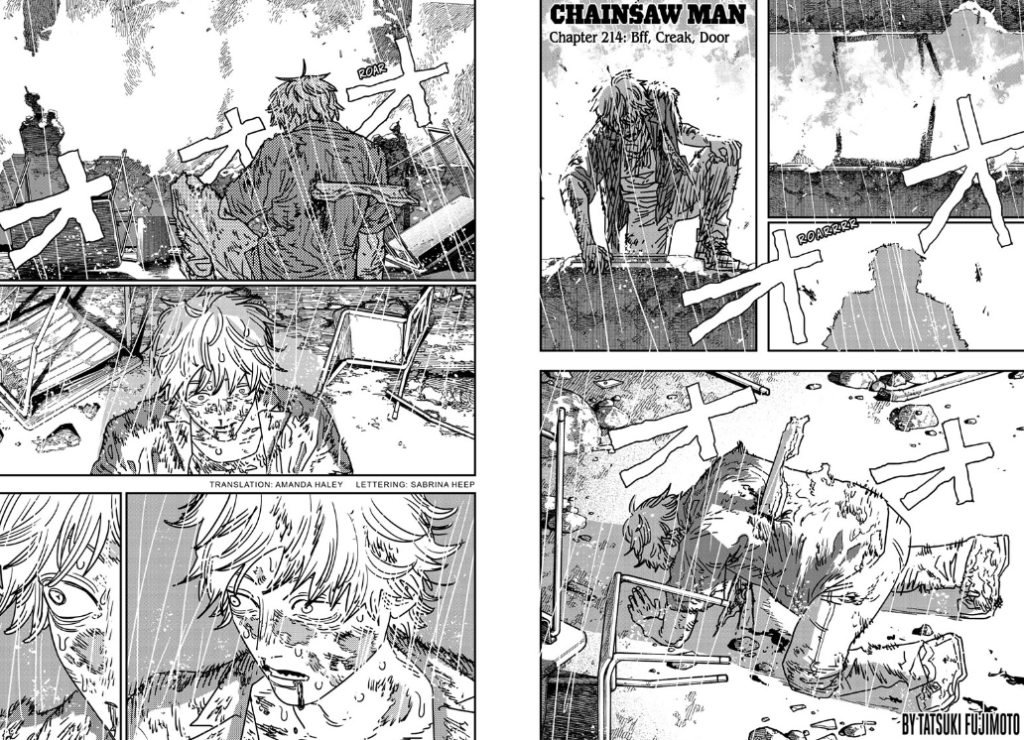
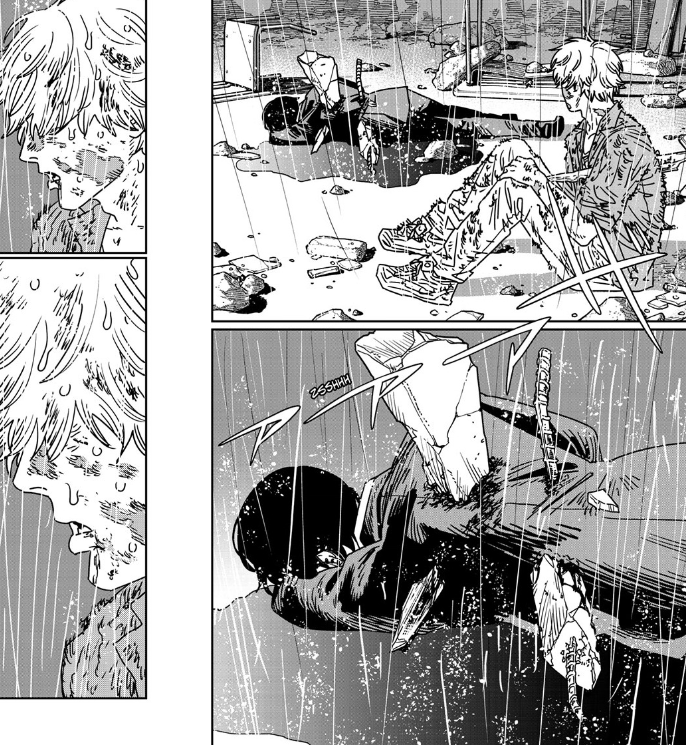
If you’re familiar with Quake, you’ll notice the similar first-person-perspective with Barem’s flamethrower here. That’s because his life is like a videogame. Not even a joke. Pure simulacrum over death. Nothing matters. Let’s all keep sacrificing ourselves forever.
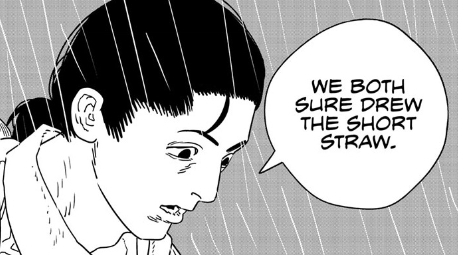
Just one more sacrifice, dude. Just ONE more sacrifice and everything will work out. Just a LITTLE more human sacrifice to the idols and I SWEAR all the self-destruction and devaluation of human life will prevent Y2K or woke or the illuminati or whatever we’re doing today. Just ONE more sacrifice bro
And with that, we reach the endgame.
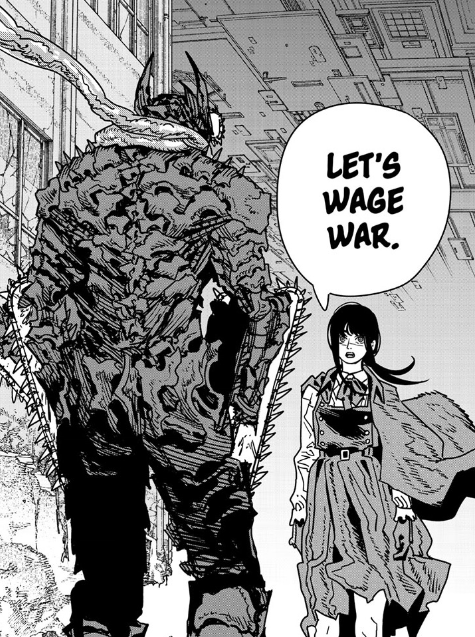
It’s time to redeem the reputation of Yoru, myself, from the real-world slander of Chainsaw Man fans and haters alike. The warm, hard truth is as follows: Yoru is the greatest character Fujimoto ever wrote.
Yes, I mean it exactly. She’s not just better than Makima, than Aki, Denji, Asa. She’s better written than Togata Fire Punch, and I do NOT play about Togata Fire Punch.
Ready?
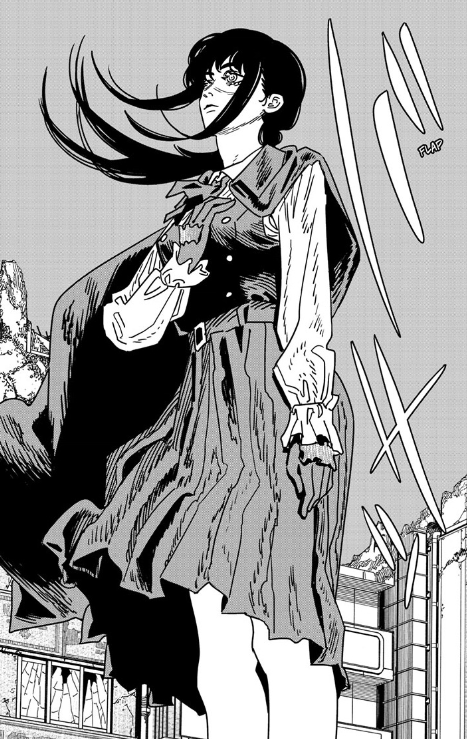
The video comparison with Barem is very exacting, and, in a bitter piece of irony, it’s clear Yoru herself is fully engrossed in the gamification of war – that is, her own being is currently the base for the gamification of reality.
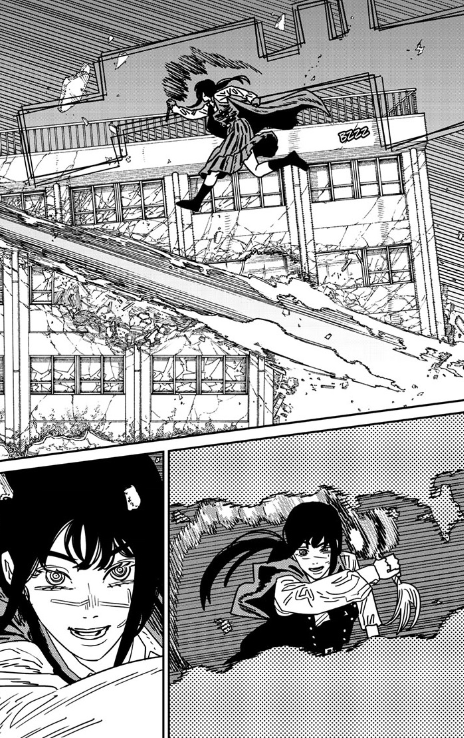
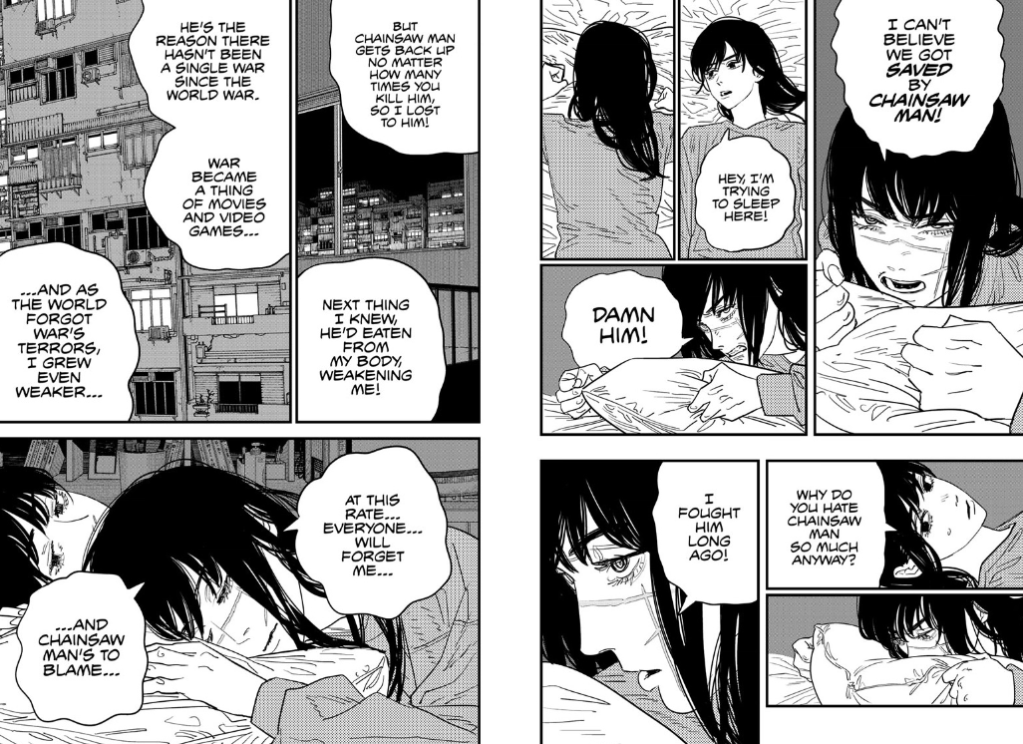
Yoru, again, is completely and utterly reactionary, and is doomed to always be so. If her devil name is reduced to simulations in games and movies, she’ll build herself out right from it by treating life as games and movies – to have fun, play, abide by internal rules of how it’s supposed to work without reference to other people, and glorify herself with cinematic quotes and poses, even presenting herself like a Shonen protagonist.
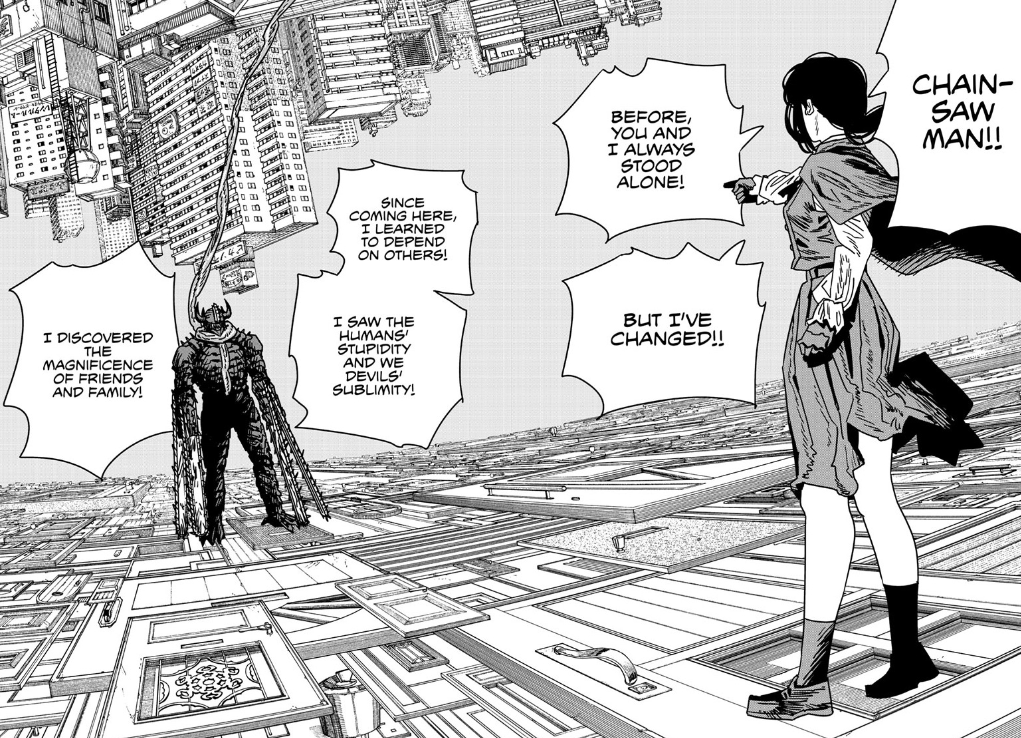
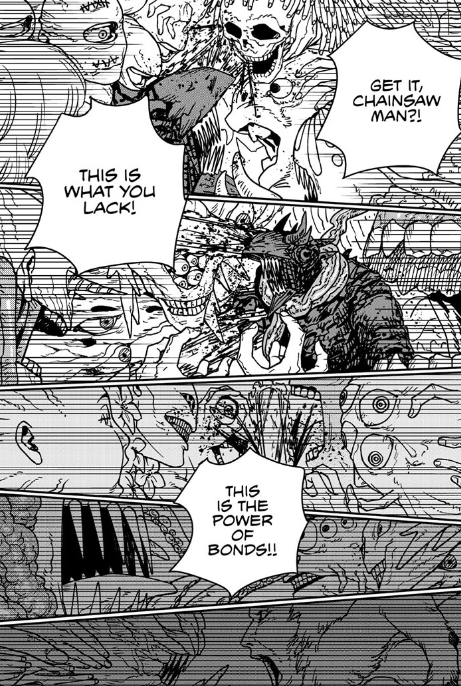
War cannot create. It can only draw out, appropriate, trade, and simulate. Tribal warfare as we understand it through contemporary anthropology and sociology appears to be a matter of semi-regulated attacks (in accordance with laws of honor and survival) between ruling tribesmen used to seize and/or trade women and children. War, as it evolved through Feudal Europe, became the subject matter of honorable service of lordly causes, worldly and Divine, spreading territorial extents, religious ideas, and internally attained standards of civility. As contemporary capitalism and older mercantilism evolved through regions such as the Netherlands and a number of industrial revolutions, war became less focused on human or social exchange or enforcement and more, than ever before, on either raw resource acquisition or the production of greater trade networks. Under Soviet communism, war was organized along lines of ideology and targeted the citizens of neighboring countries with the intention of using said ideology to sublimate them into Soviet material and ideological standards of living and production. In modern warfare, the act of killing is simulated, gameified, abstracted through bureaucracy and entertainment industries, with virtual training and the firing of missiles through screens becoming increasingly blurred and the act of killing getting reduced more and more to the pressing of buttons, hence the sociological term Nintendo War in reference to the Gulf War.
Always, always, war utilizes or funds, to seize or trade. Under no circumstances does it create. War will always be reactionary and materialist by its very nature. Thus, Yoru has no coherent intention. There is only the desire to make everything of her own devil name, and, in her real, bodily engagement toward it, she’ll adopt the nature of the times.
She’s really, really having fun with this – and in doing so, she justifies the suffering of Asa and Denji beside her.
You might be starting to get what Yoru’s all about, now, but the analysis will continue.
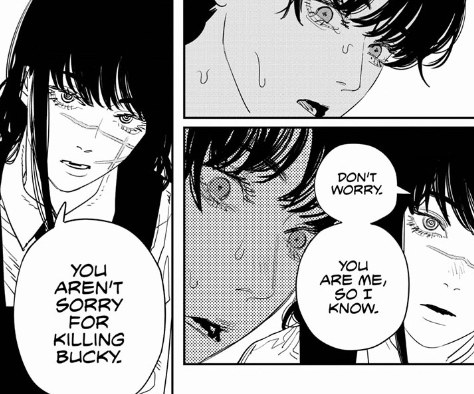
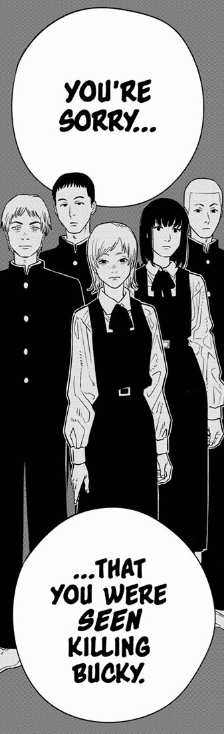
Yoru loves projecting. Her very surface-level emotions, through which she weaponizes bonds and turns Asa and Denji to her advantage, are all she was ever able to use to read Asa. Hence, she sees the surface of Asa’s character – her fear of humiliation – and fails to see her moralistic and sentimental core, despite literally sharing her body.
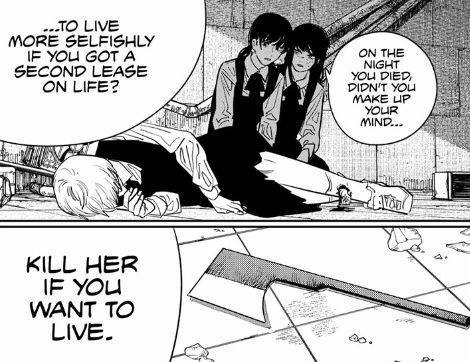
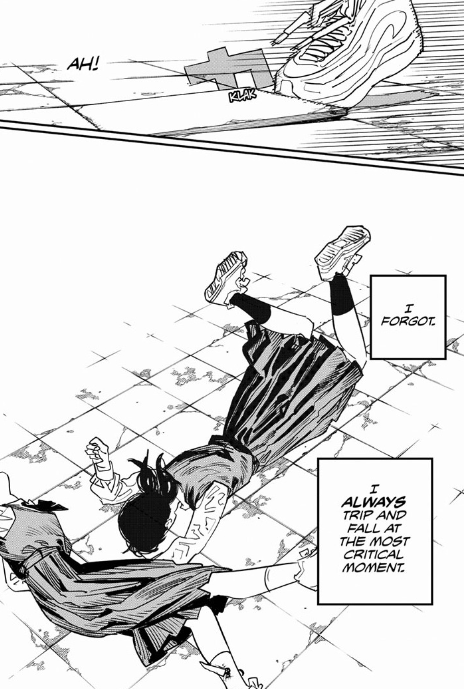
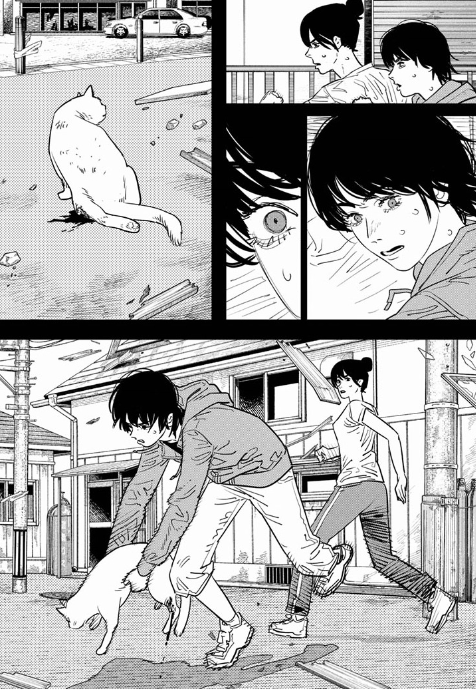
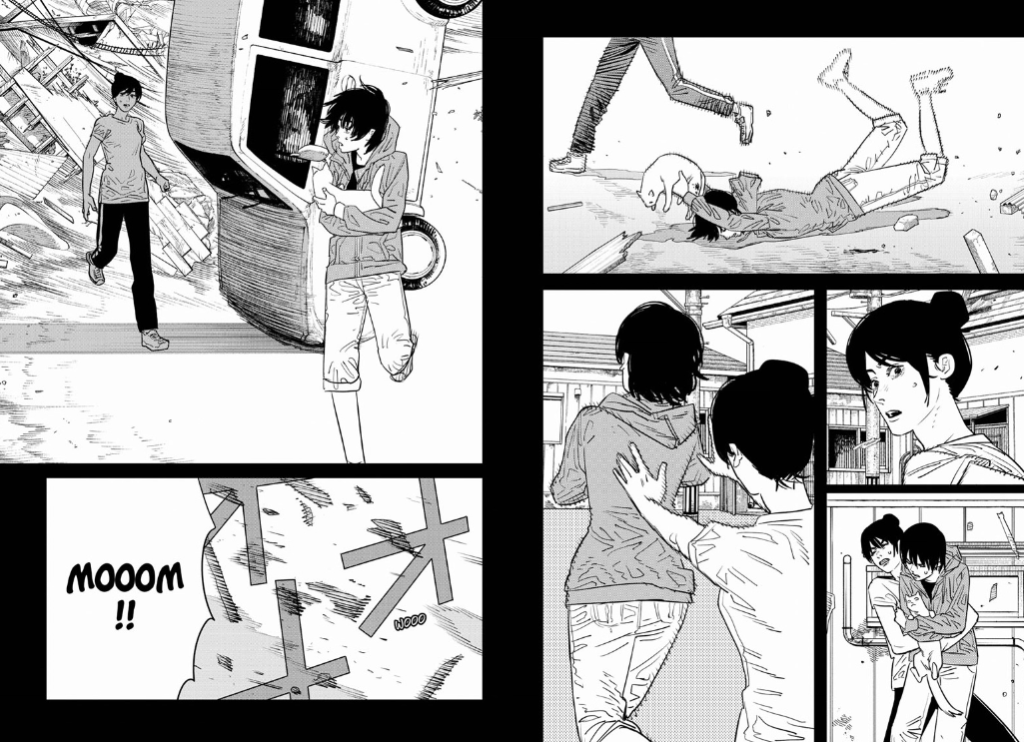
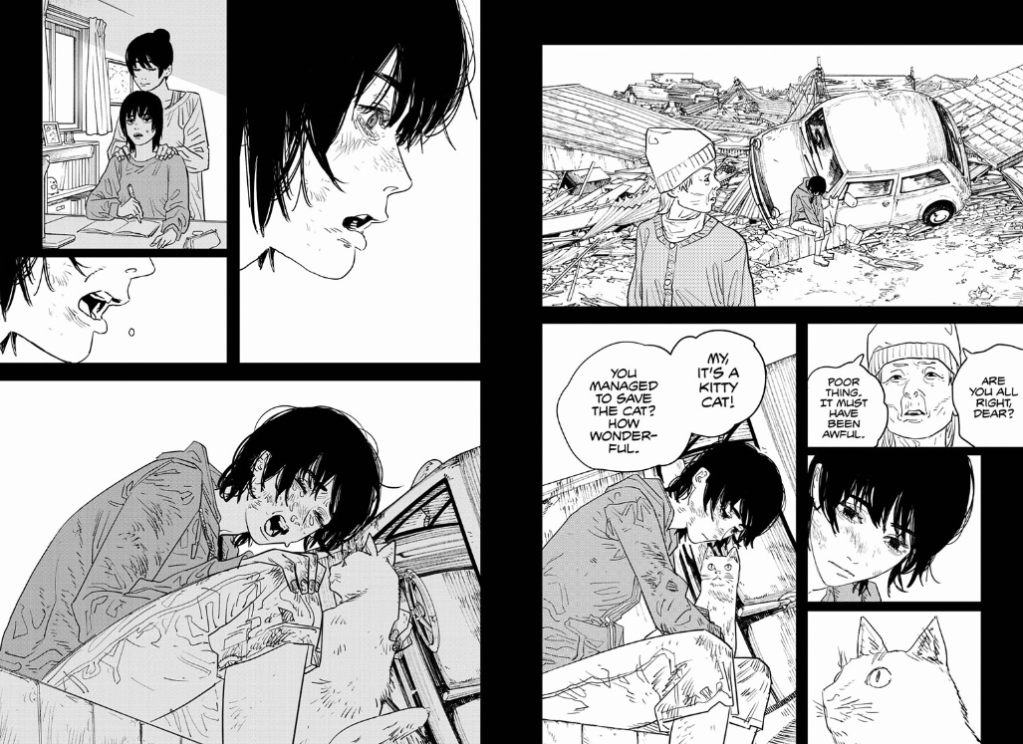
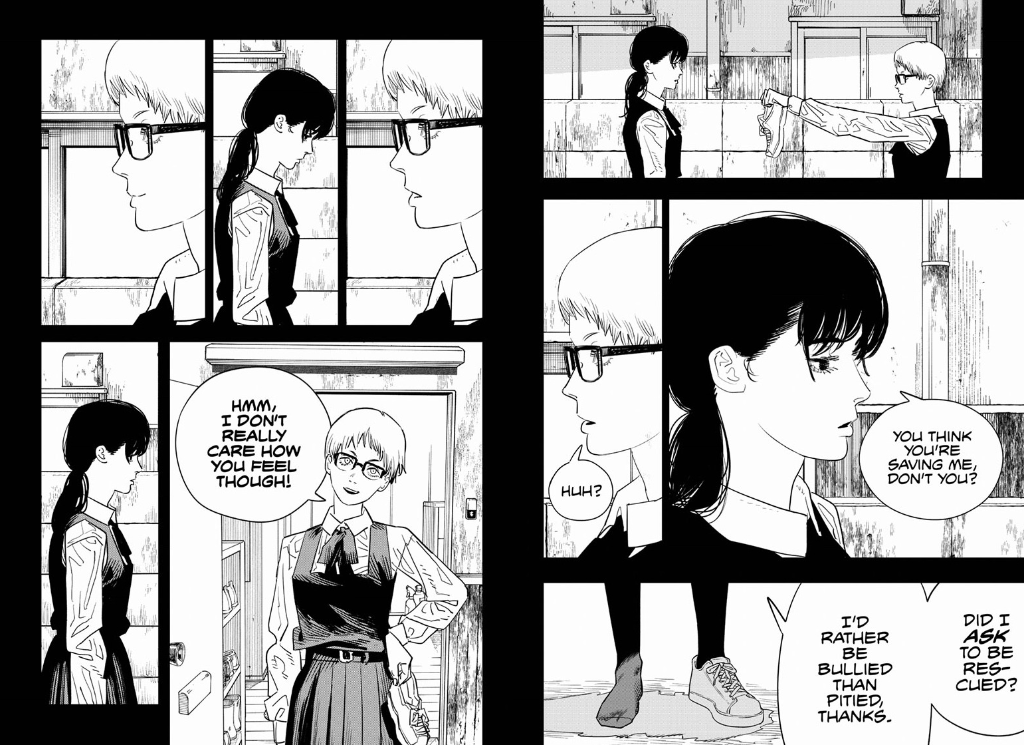
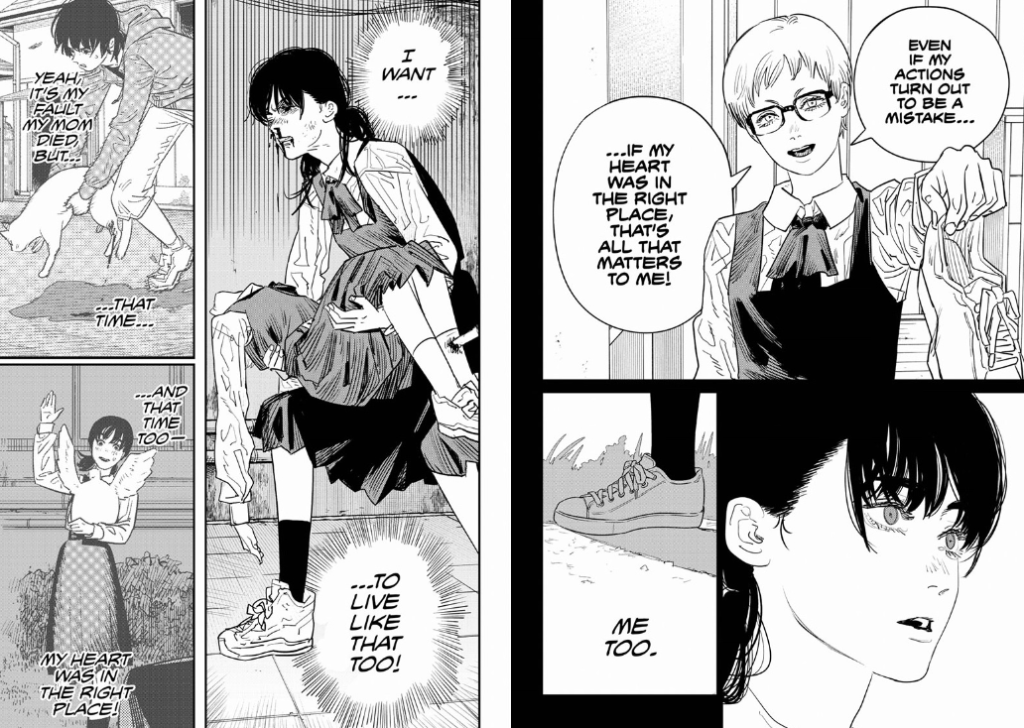
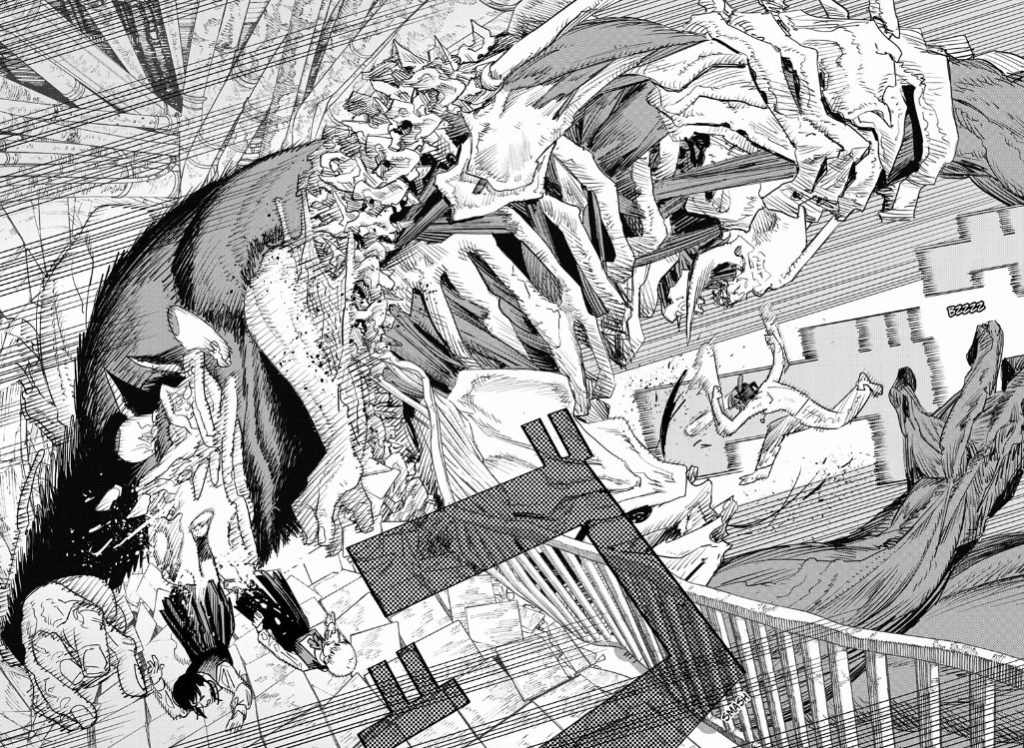
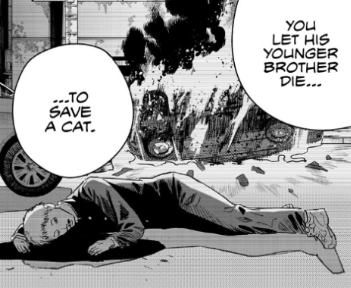
If your heart is in the right place, you’ve begun to live well. If you never learn responsibility, you will never grow out of childhood.
Exactly as the Fire Devil said…
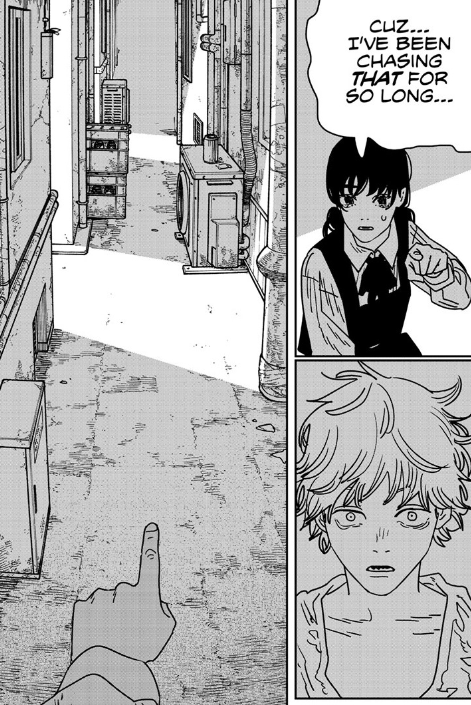
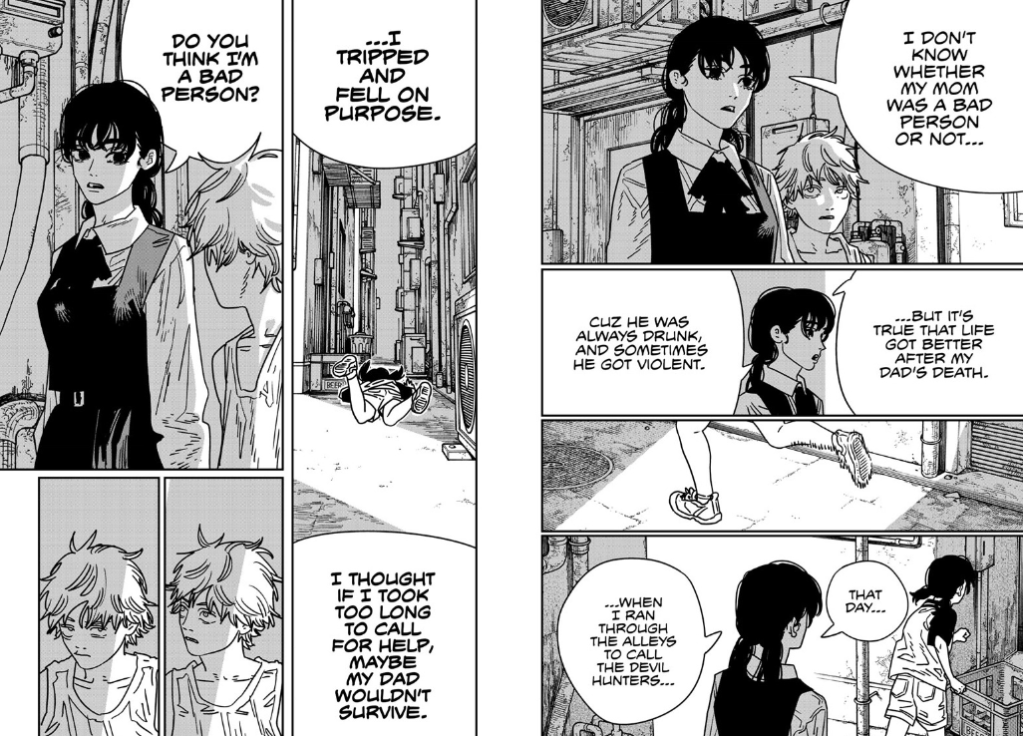
…one day, sooner or later, you will have to make the right choice. You will have to take responsibility. You will have to reach out to another human being.
Back then, Asa tripped and fell on purpose. Back then, she fucked her life over a cat, but kept her heart in the right place… for some time.
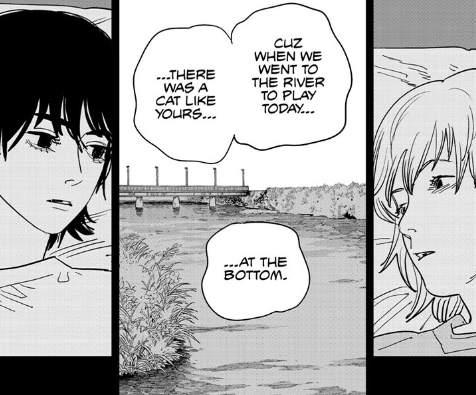
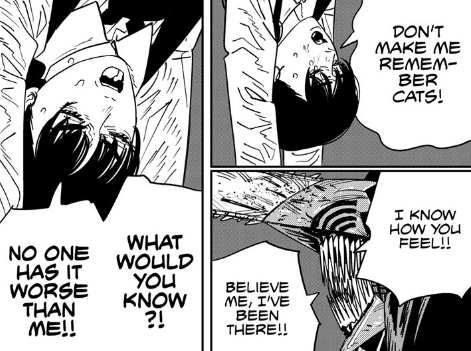
You can keep running. You can keep tripping. But don’t let it become such a habit you fail the relationships that finally prop themselves amid this Hell.
Asa did do good with this at first. But by now, everyone’s regressed into their worst habits, again.
Eventually, you have to stop baring your personal cross your whole life and join the rest of humanity. It is your duty. And this time, don’t make the wrong choice.
So, we have pure numbness, we have addiction, and we have reaching out. You can spiral forever like Asa often fell into, you can destroy your brain like Denji often does, or you can connect with each other and even heal devils.
But I’ve gone over the surreal subdivision of reaching out that Chainsaw Man has developed, primarily in the Justice Devil Arc.
Let’s see that spread one last time, now.
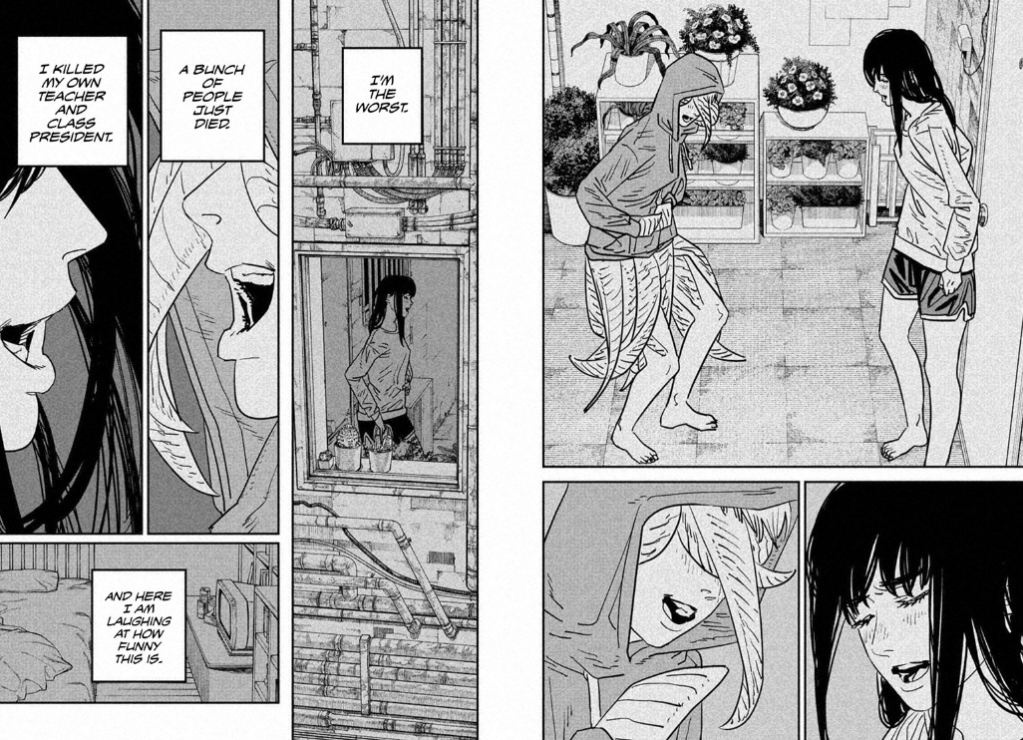
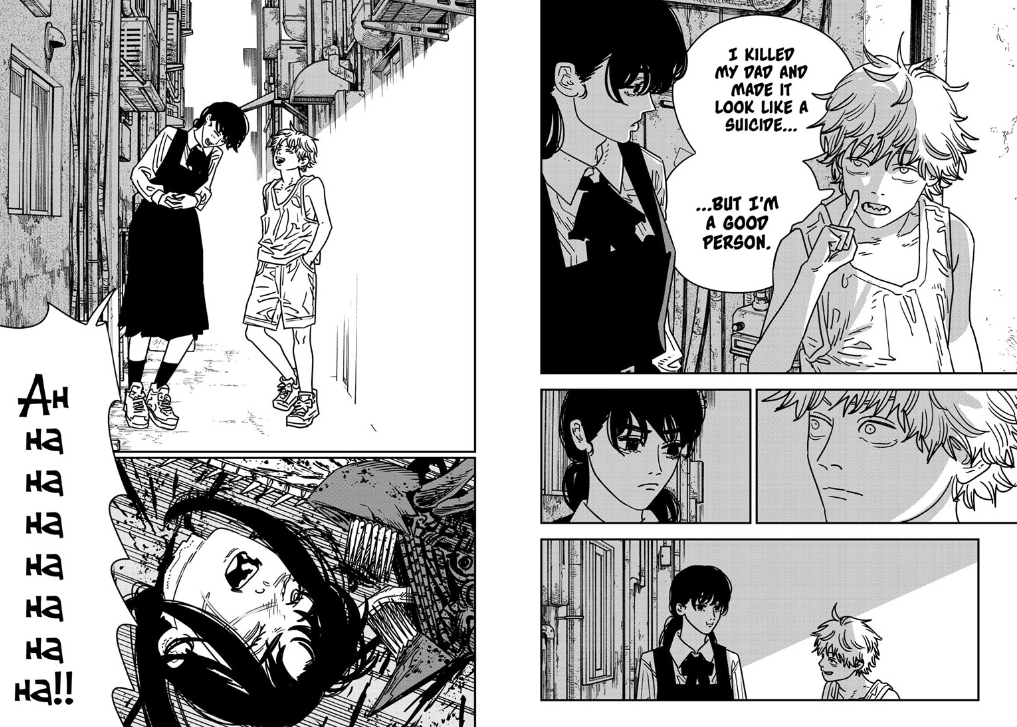
The essence of Yoru’s character is love. Love in Hell.
Turns out, Yoru’s the best but crappiest kind of love. One that can only bring Heaven when everyone’s in Hell.
Yes, Yoru’s the closest Chainsaw Man ever comes to an outright apotheosis: it’s because her feelings are so tied to her name and image that this works while still retaining her raw existence as a solid human person. The glory of Yoru is the surrealist joy that Chainsaw Man had been building from all the way back when Power was introduced.
And unlike Power who has other strong emotions she can’t process, or an Aki who denies his reality and loses all possible control as the Gun Fiend, or Asa herself, who attaches to fame and recongition and society while decrying it, or even, of course, Denji himself, who uses Chainsaw Man as a means to an end and thus loses his real connection to Pochita – unlike all everyone who suffered through this manga with their inner and outer contradictions, Yoru completely understands what she’s doing. It’s her intention. It’s her purest intention and she loves it.
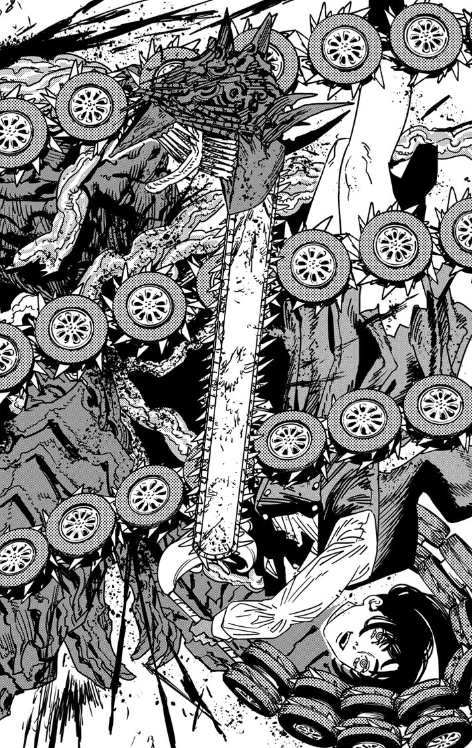
The ability to find Heaven when you’re in Hell. The glorification of the consumption-violence-addiction death spiral. Devils are not the bases of concepts. Humanity reinvented nuclear weapons from scratch. Devils respond to the passions and vices of humans.
And she loves their vices, which make her beautiful.
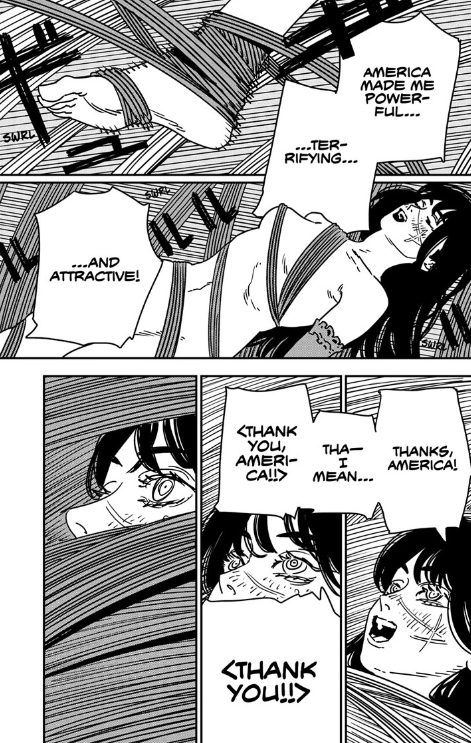
And, as we’ll soon see… she did so much of this in response to Asa’s feelings. Processing bonds to weaponize them, and weaponized bonds as her beauty. Yoru’s the absolute of the emotional arc of devils, which ran as the undercurrent of the whole manga.
But against her grand idolatrous convulsions of ecstasy…
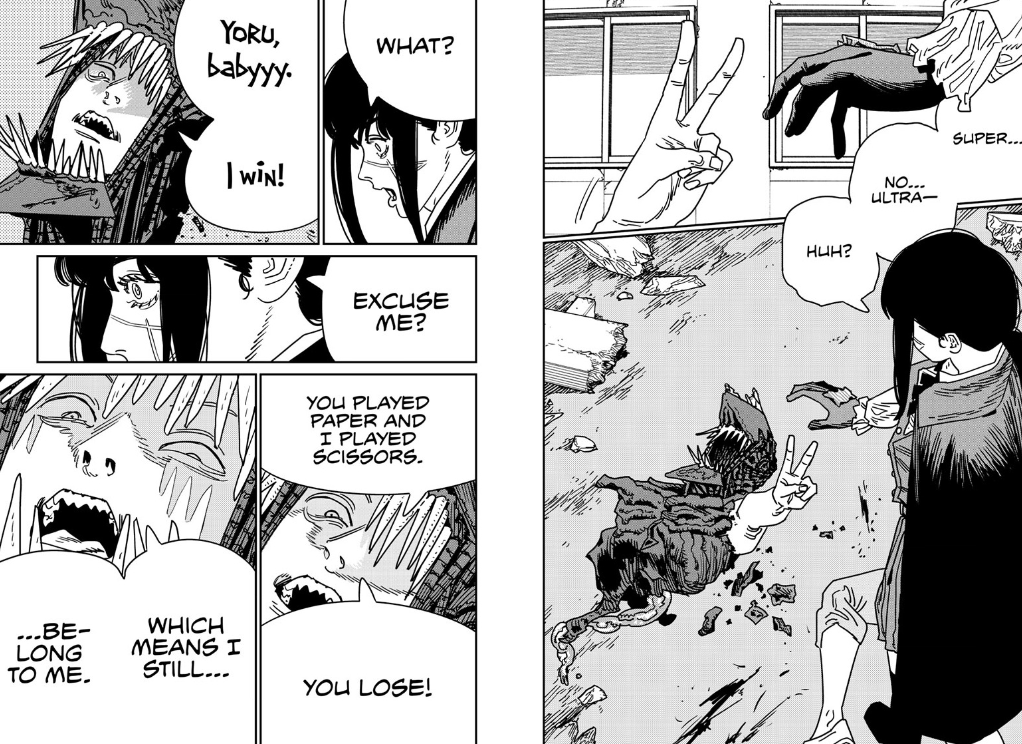
…Denji tells Yoru to go fuck herself.
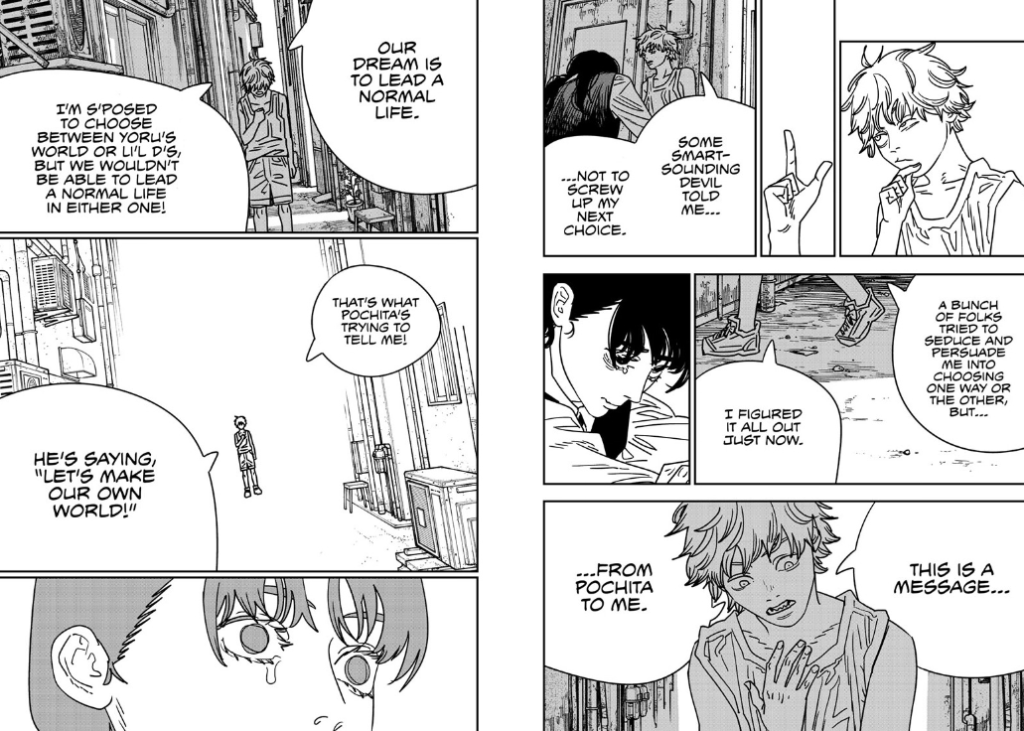
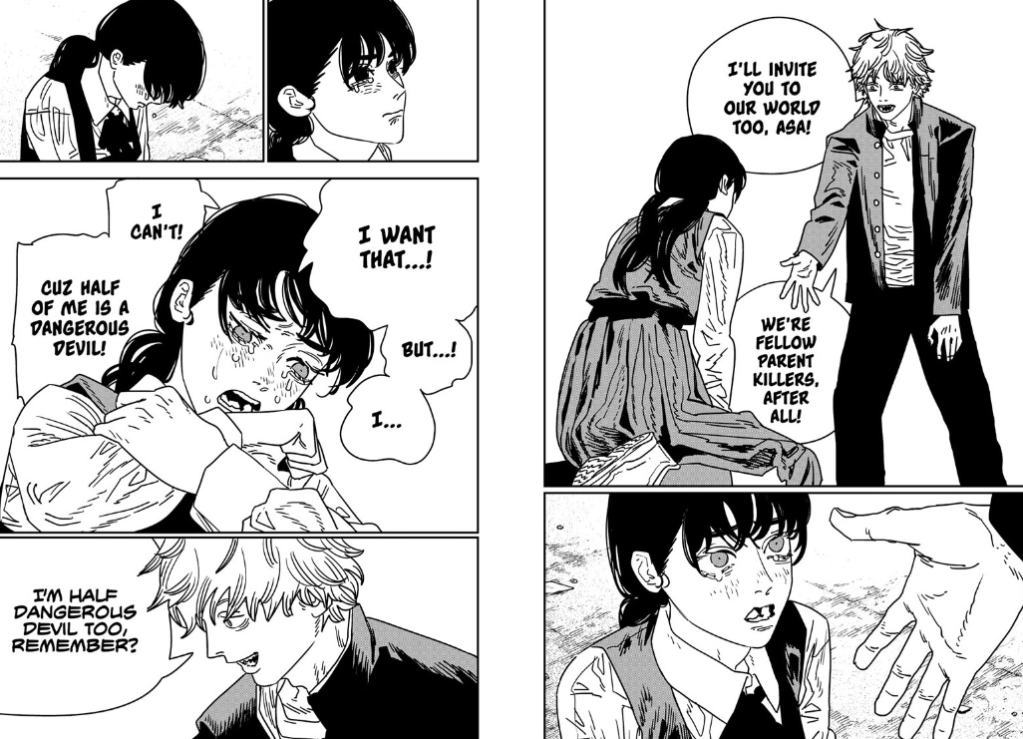
Denji makes the one and only real choice and reaches out at last.
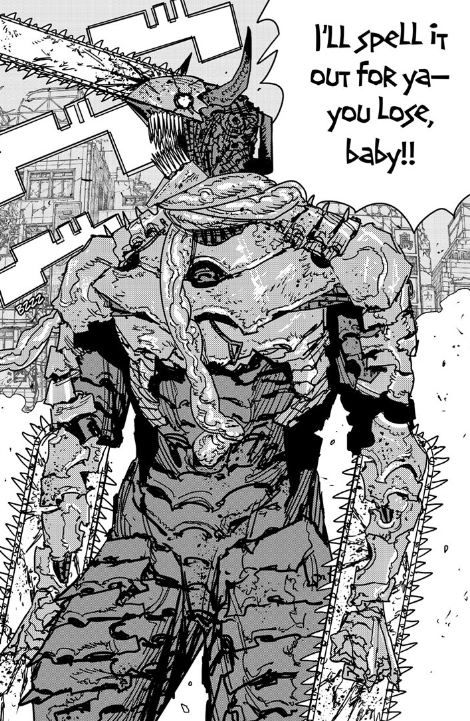
Denji fulfills Pochita’s contract completely and becomes one with him at last.
Denji is Chainsaw Man.
Denji is Denji again.
Denji gets his devil under control.
Denji reclaims body and role from Yoru and all the other bullshit we ever saw in this manga from devil hybrids to Makima to Yoshida.
Denji completely self-actualizes.
Denji fucking WINS.
And now, having reached the pinnacle of his character at the end of the long road of despair, Denji…
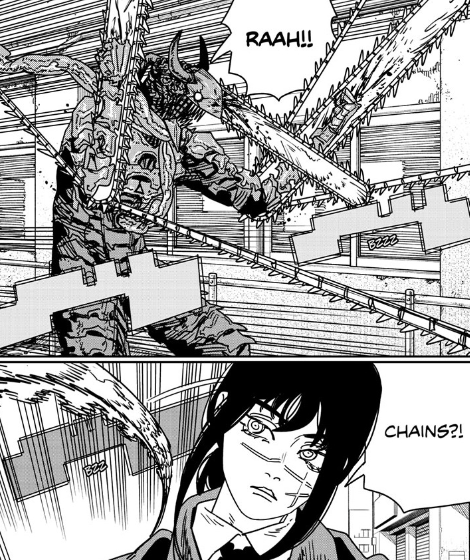
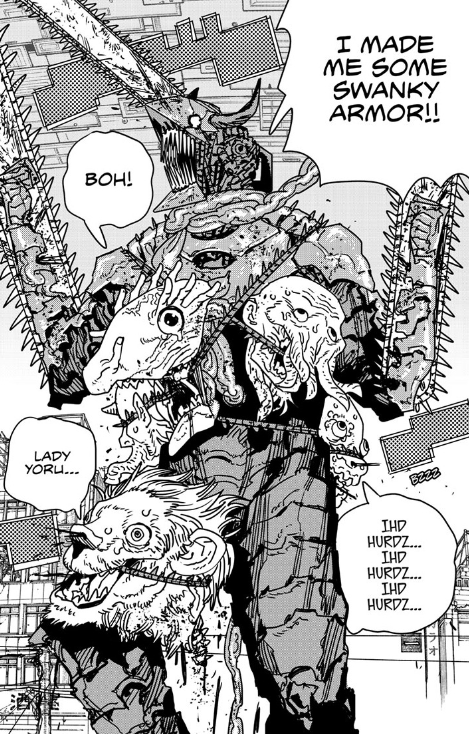
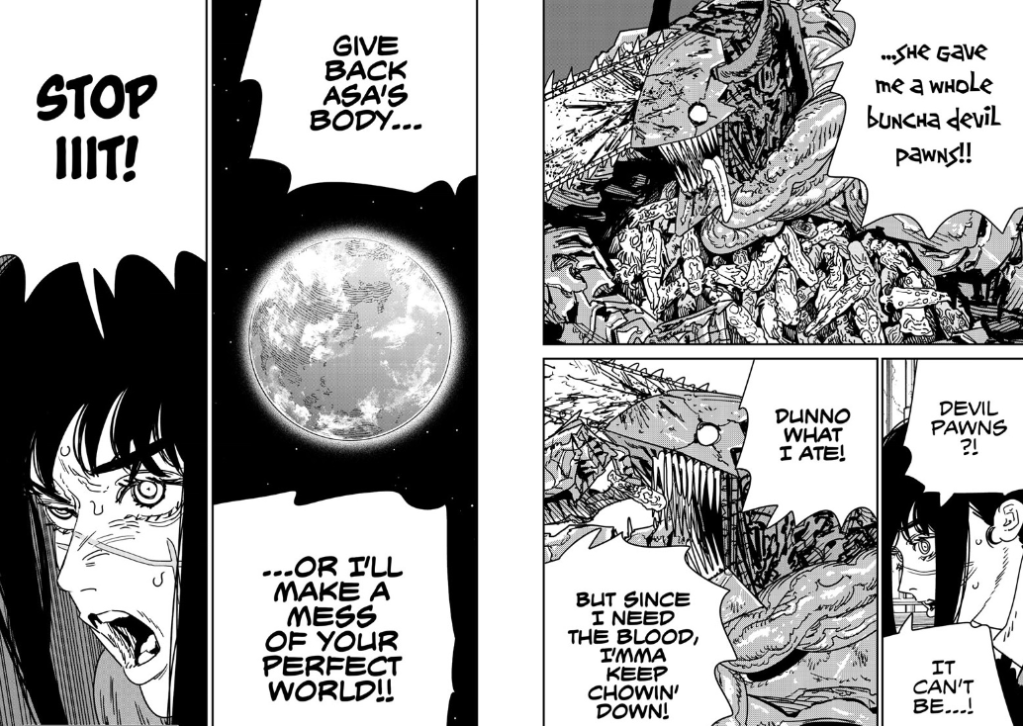
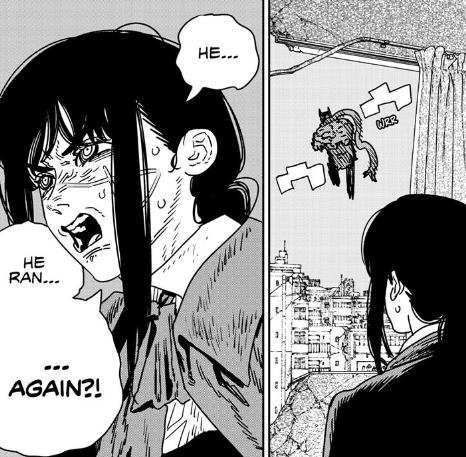
…gives the fuck up and makes the worst performance a Shonen protagonist has ever had – using chains and threatening to erase reality for one person exactly like Makima, making a hostage shield exactly like Fakesaw Man, and running away repeatedly, making Yoru of all fucking people become the more honorable fighter in addition to the better outcome for all of reality with her literal torment nexus.
Jesus Fucking Christ.
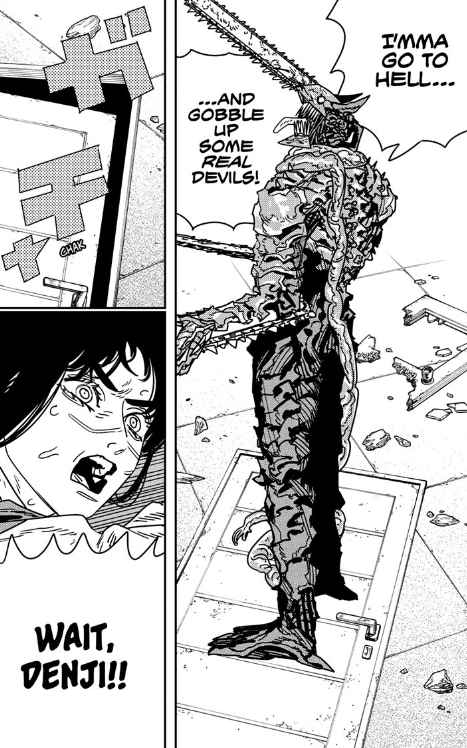
The framing of the final round is clear overall: Denji (Man) functions as the adult playing along with Yoru’s childish fun to eventually make her realize how dumb it is and get Asa out that way. A good plan in the abstract, with a beautiful piece of character development in the fact that he finally uses his memories effectively for some emotional intelligence and pattern recognition that let him reach Yoru’s dumbed-down heart.
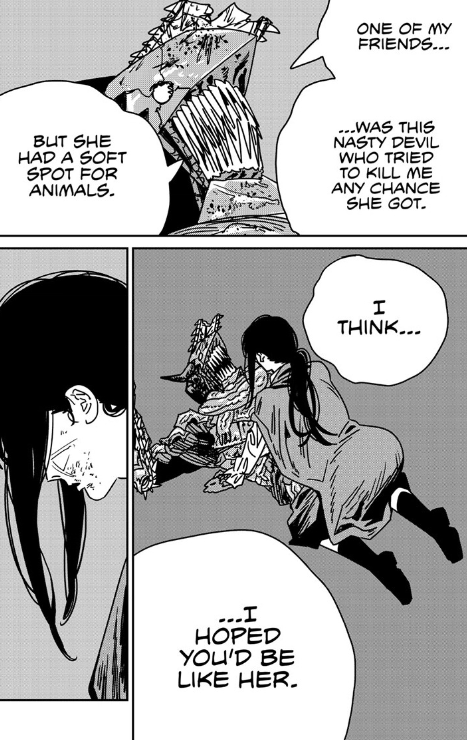
But the problem is this is literally all Denji had when using the REALITY SHREDDER 3000 to take all of creation hostage for the power of love. The power of love is beautiful! Solipsistic priorization of it over all of reality is fucking horrible.
This, then, can be the one ocassion we appreciate Chainsaw Man being a work of fiction, despite the fact that Fujimoto actively avoided this for the entire manga.
The easy out is that devils are those divine forms we contract with in the social and societal spheres. Then, what Denji does here is taken as nothing more than the disregard of all images, period, to bring out the heart of this strongest one. Which is incoherent, because that’s devil names. Makima equated the two because her entire existence is name-making for love. Denji is genuinely destroying everything by the aid of the role played by Lil D.
All it would have taken were a few unlucky Gacha pulls, and everyone would be worms for eternity.
Denji became one with Pochita at last, and that one was a complete parody of the contract.
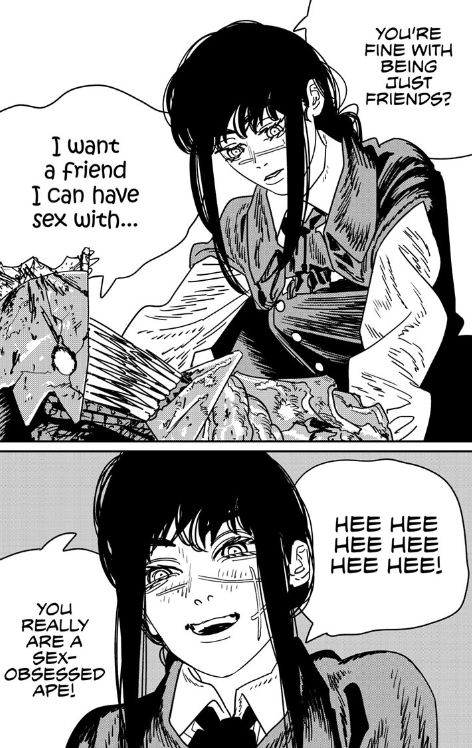
After all, Denji had sex at the back of his mind with his wish. And with Yoru’s acknowledgment…
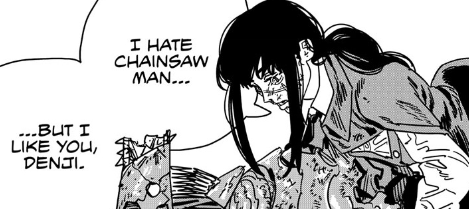
…Denji Man is reduced to what it says on the tin: Denji Man, not Chainsaw Man. Self-actualization itself corrupted and a form of escape. The worst possible ending with the face of the best.
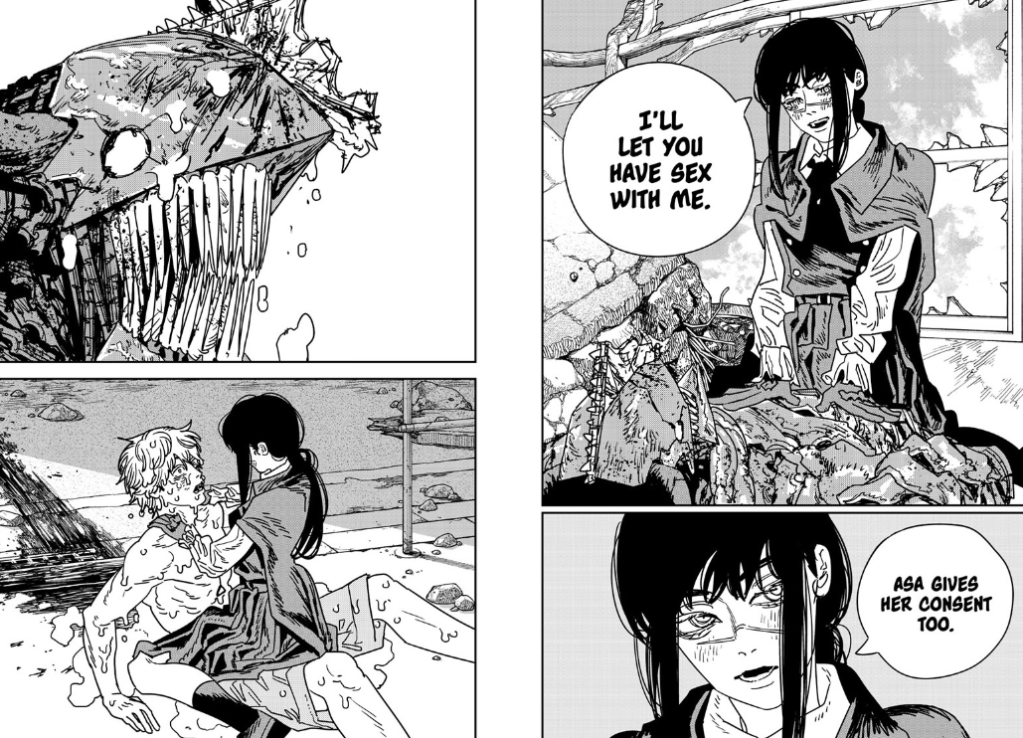
Asa is forgotten as an actual result because Denji fucking failed, despite the fact that his intentions were, at least briefly, perfect. She’s reduced to a footnote who can’t state her own consent. And the visage melts for Denji to holler for Hitler pussy as the world collapses beneath unloving and unloved animals of endless consumption.
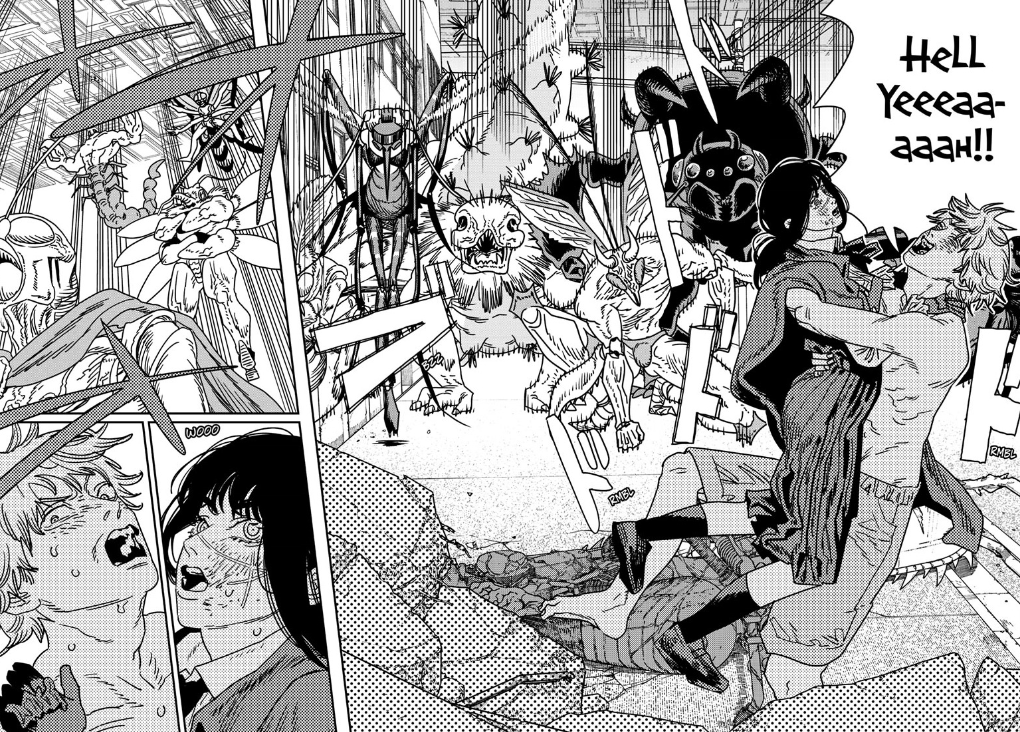
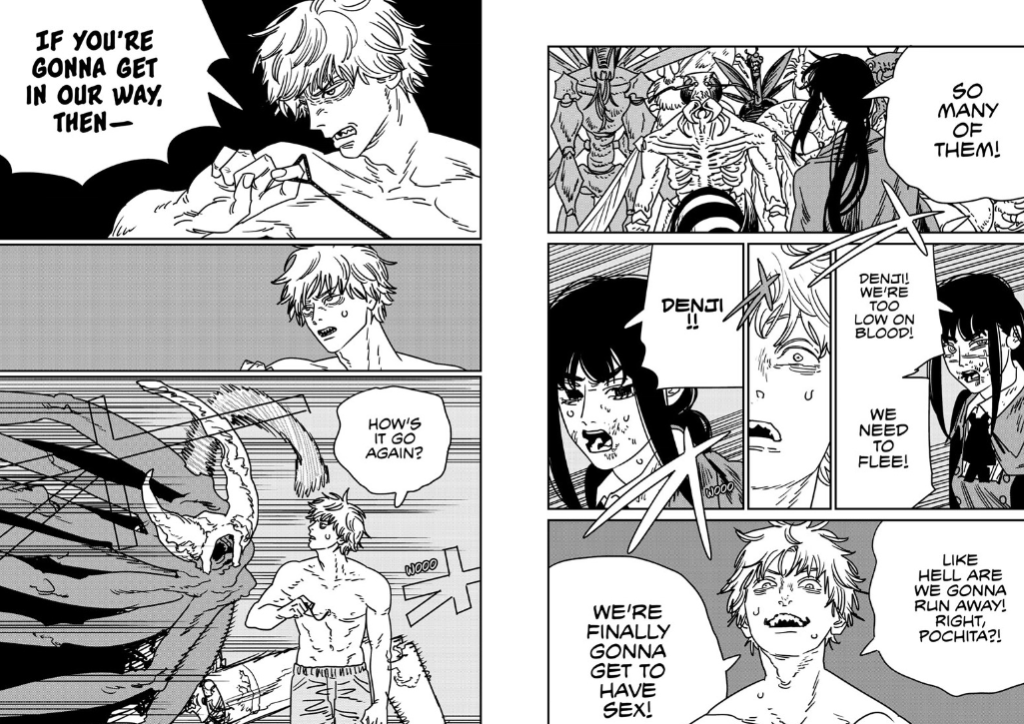
Asa and Yoru’s mutual warning is meaningless as Denji justifies anything to be reduced to pure sex-death drive, becomes a total parody of himself worse than Makima that can’t even finish the quote any more with Lil D gone (by Pochita’s mouth!), and the Silksong Devil ends the nightmare in the worst of all possible ways.
The Horrors.
Before we move to the end, it’s time to say goodbye to Fujimoto’s greatest ever.
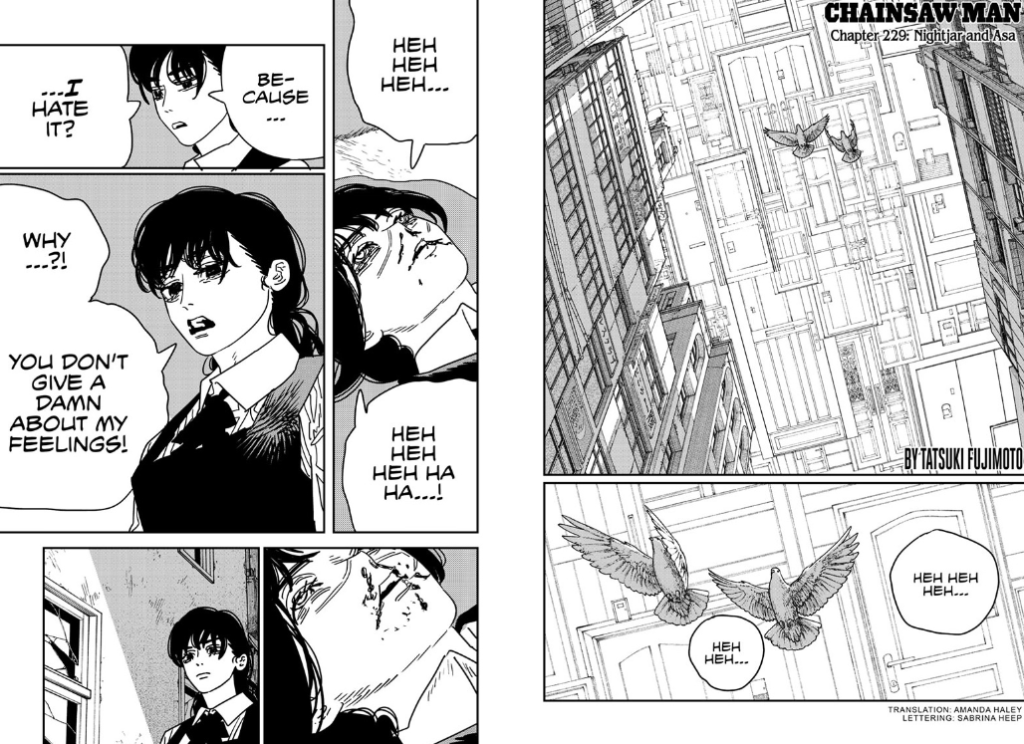
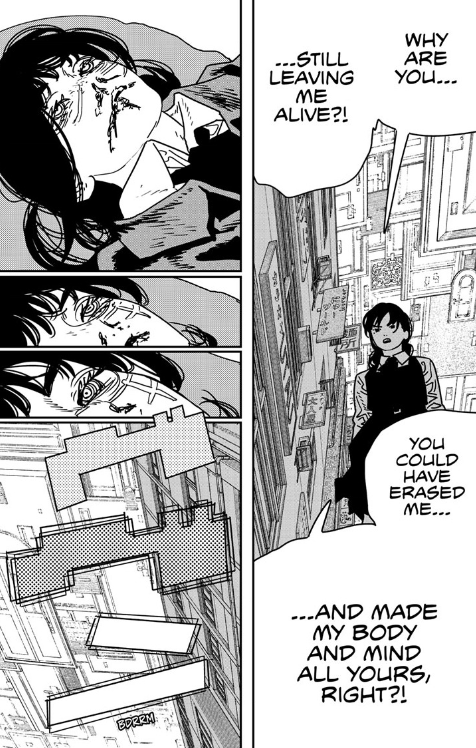
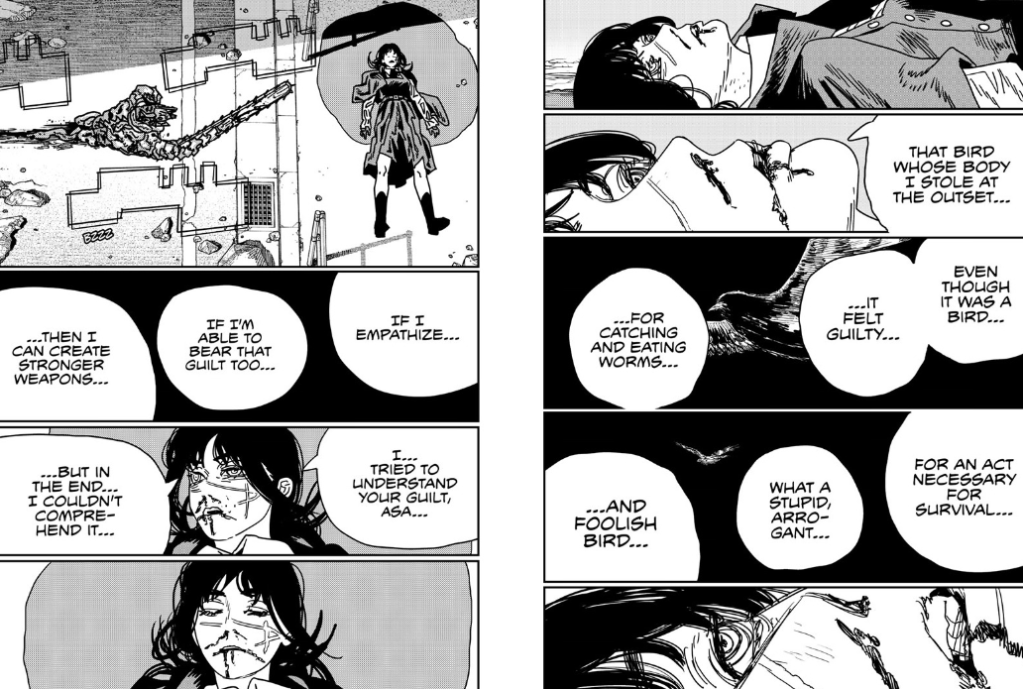
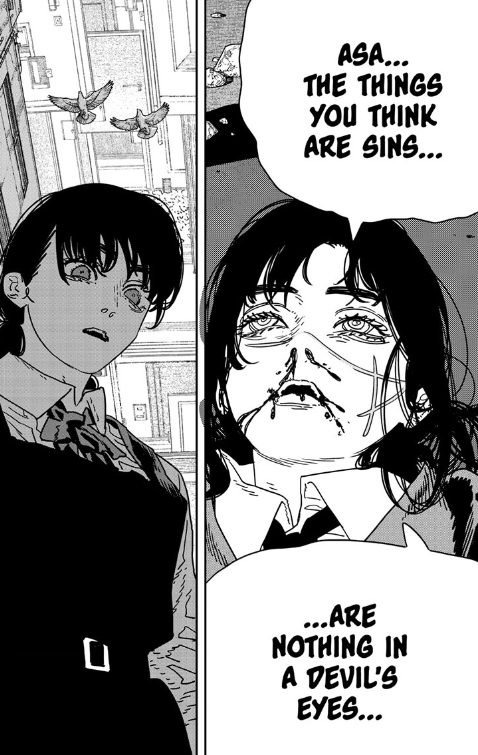
This horrid Love and War wasn’t Asa’s shadow, but she always chased it. Every abstaining, fearful, hypocritical act of withdrawl she ever engaged fueled the confused and horrid desires of Yoru. None other than the worst of us as the justifier for war, embodied as a force which reacts to us, measures what it can see of our hearts, and uses the bonds. Asa did not take enough responsibility for Yoru, and when she so briefly did, Denji couldn’t properly return the damn favor. And so Yoru got nuclear weapons back and we got here.
Yoru came to rule, and yet, in the process of trying to understand, she merely danced around in confusion.
This scene is meaningless for Asa, because this truth of hers was established in her introduction; it’s Yoru’s scene. It’s the confirmation that everything she ever did was, as the greatest, final devil, a plea to comprehend the humanity she’s produced by yet cut-off from – exactly as Denji used Chainsaw Man while losing contact with Pochita, and in turn, humanity.
Yoru wanted to make humanity enhance her image and vice versa; and above all, she truly wanted to understand her host.
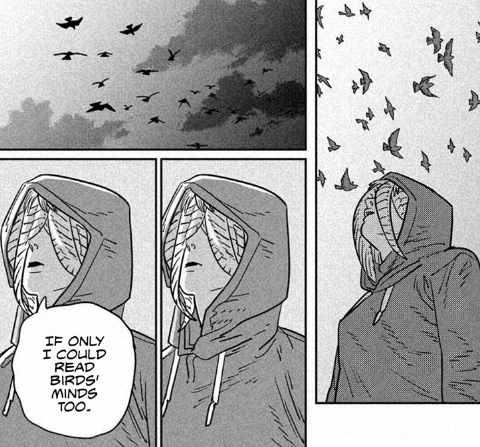
But the things Asa thinks are sins are meaningless in a devil’s eyes. She gave up on the world, failed to truly escape her past, all over unfounded fears as Yoru found the beauty in the chaos- the same beauty of redemption seen in different flavors with Aki and more wholesomely with Yuko. Asa failed to reach the implications of her own nature. Her hypocrisy with the world and society is literally embodied in her setting a contract, yet failing to fulfill it. A rule-enforcer who can’t live in the terms; an attacker who can’t avoid empowering the target. A failed contract. Alienation and irresponsibility.
Asa failed Yoru as Denji failed Pochita. As Denji cycled into his own trauma and ultimately used their moment of becoming one just to become the next Makima. This was Fujimoto’s limit with this journey. In failing to truly live with one’s humanity and one’s devilish nature, Denji and Asa both ultimately lost it all in their own ways. If those birds could simply live happily, without all the baggage of shame and fear built only on pattern recognition… and now, it’s all gone.
The dream is over. It’s time to wake up.
Thank You, Chainsaw Man.
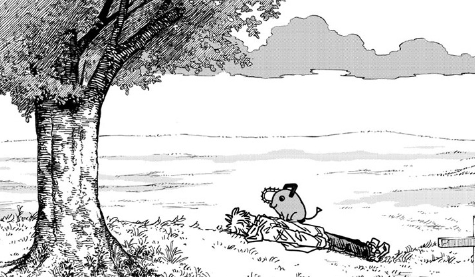
When I was reading Chainsaw Man week-to-week, I’d always had serious frustrations with it. When I was reading the back-half of Part Two week-to-week, I was in fucking agony. I hated it.
What astounds me is that the ending, which single-handedly redeemed the entire part and put all of Chainsaw Man together for me, was the most hated moment of all for nearly the entire community.
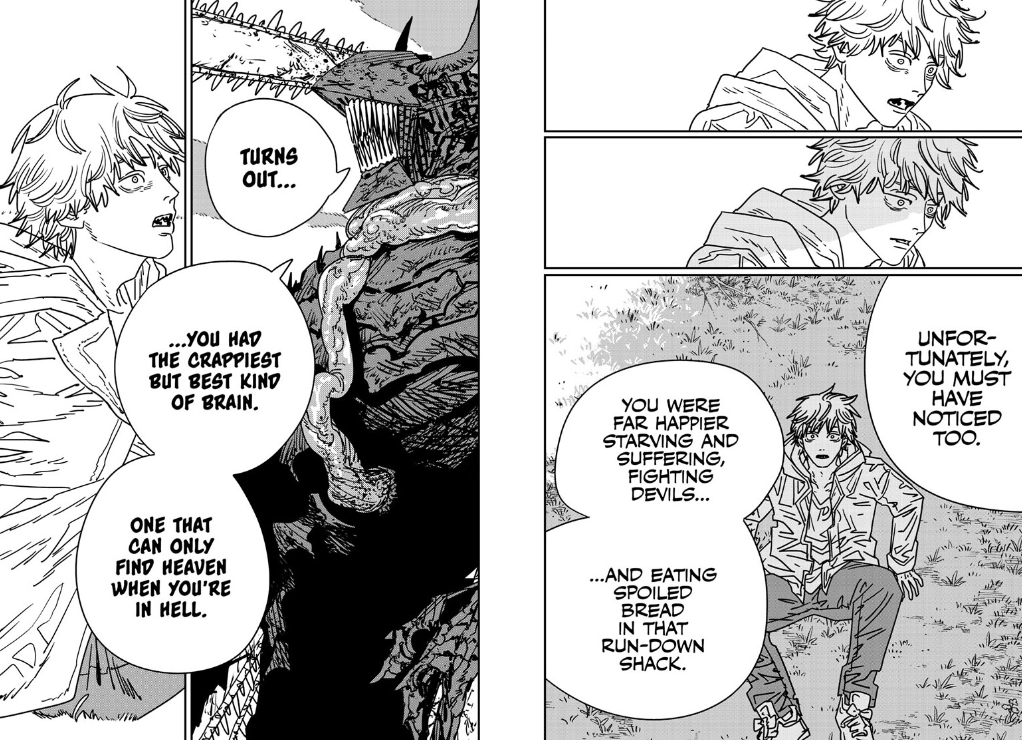
All the fame and all the glory and all the standards which Denji could never have lived up to after the things he went through, and all the surreal joys of day-to-day life even among devils and confused anarchy… it was in those moments of hearts opening up amid the terrors that Denji found his moments of happiness.
And now, it’s time to evaluate what everything meant.
Fujimoto, Chainsaw Man, Publishing, Perception, Debt, Youth, and One’s Own Terms
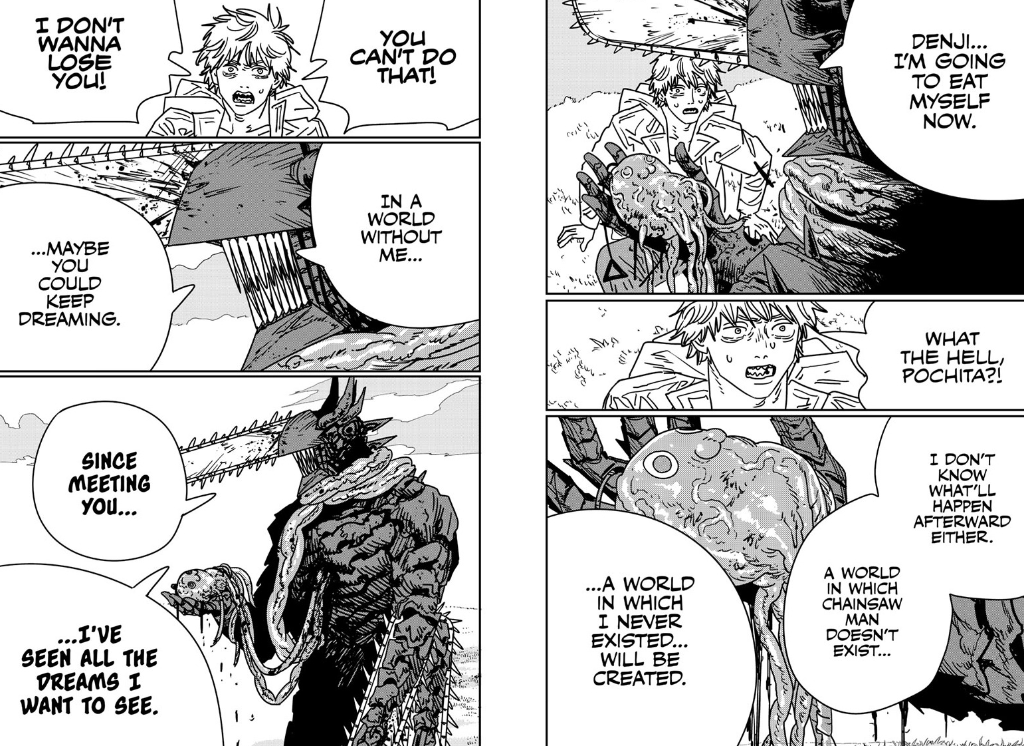
After every perspective and every critique and every weird admirer, after every bit of condescension from Yoshida and wresting for control and correctness from Makima and every personal piece of trauma Denji was held back by, Fujimoto ended Chainsaw Man on his own terms. Denji reclaimed Chainsaw Man, and Pochita ended himself by his own will, after everyone tried to use him for every conceivable purpose, and hugged the kid who just a dozen chapters ago finally grew up inside.
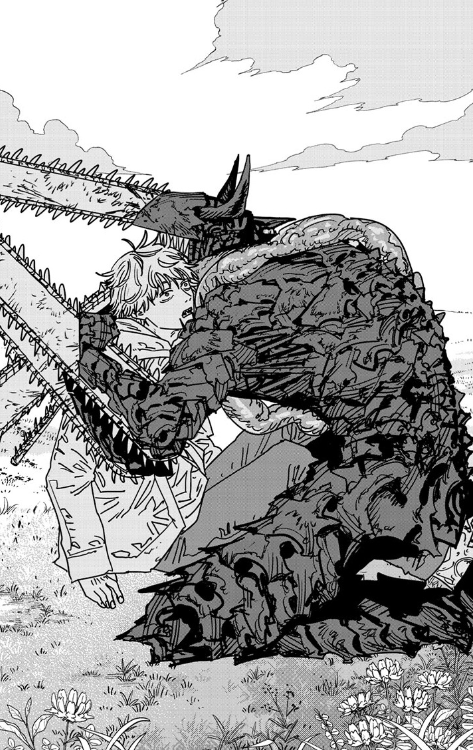
Denji could only find Heaven when he was in Hell. Denji, alone, could let the Hellish Pochita get his loving hug.
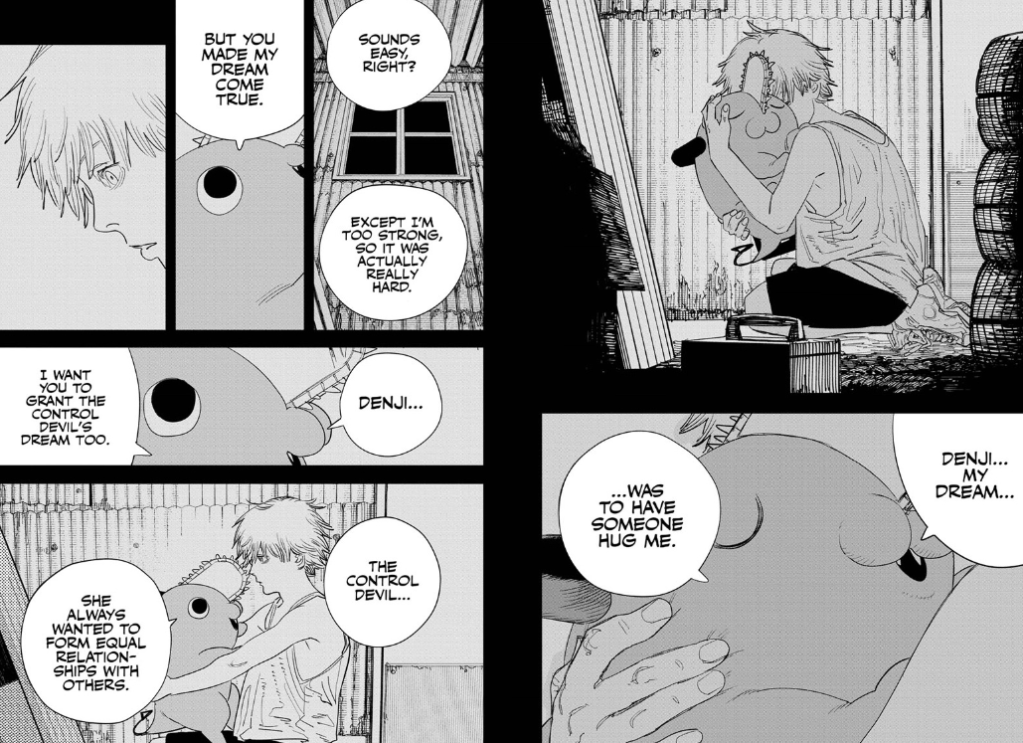
Fujimoto wrote this work from beginning to end and managed to have a fucking blast doing it. He managed to articulate so well some of the most beautiful relationships in contemporary Shonen. He managed to weave in excellent sociological analysis and put to the page so many of the nightmares upon the shoulders of our futures today. He fucking did that, even after tumbling and falling near the end from the grind, and he found his soul reflected back to him in Chainsaw Man. He worked through his addictive, submissive, and fantastical problems and made them into art while doing so. He hugged and loved his own devil and touched so many people who read this.
In the end, it comes down to reclamation. Against Yoru, who makes everyone and everything belong to her, against Makima, who had the strictest ideas of what is right and blocked out all things and people who did no fit regardless of their deeper characters and feelings, against the entire nightmare of the Chainsaw Man Church. For Power, who was property of Public Safety. For Aki, who accepted lying to himself for a shallow peace and became the weapon of international power games. For Yoshida and Fumiko, reduced to parodies of themselves who spread their misery just to justify their horrible standings and not go completely mad. For Asa, who could never just live as a human being, who made a monster of her unconscious free to be weaponized by War, reducing herself to a tool out of fear, building a wall around herself from hypocrisy and anxiety and lies. For Makima, who could never understand love off of Public Safety’s long-term grooming of her into a useful asset. For Yoru, who never understood any of these people. For Yoru, who flailed about in fascist ecstasy and brought it all down with her.
For Denji, who was happiest before all of this weighed upon him. For Denji, who was burdened with his father’s debt and a never-ending string of debts from then on. For Denji and the millions of other kids used as sacrifices for old men in power. Reclaimed, and ended between the kid and the dog.
No amount of bullshit in the worst of Chainsaw Man will ever make this anything but the greatest ending this manga could have possibly had, just for this aspect alone.
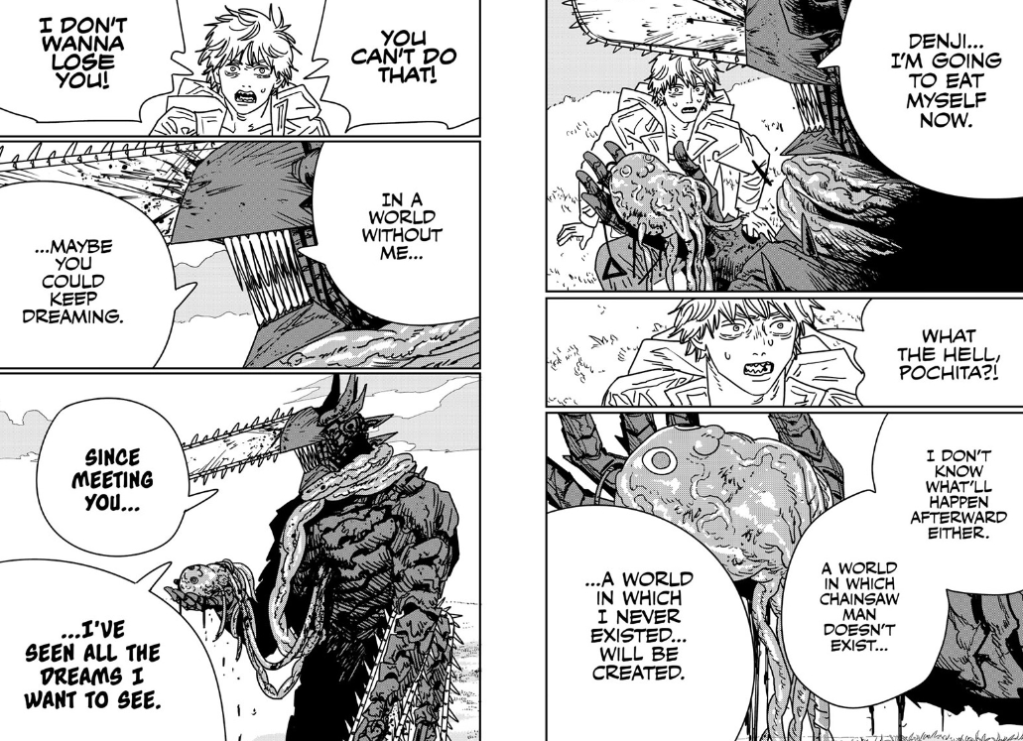
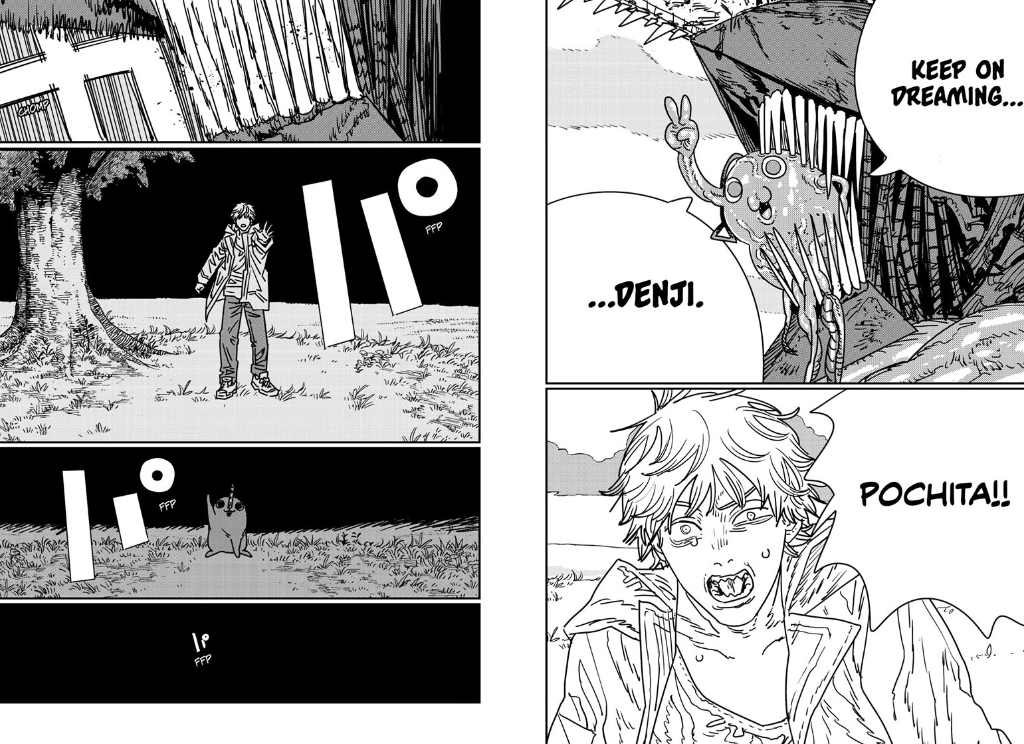
In the Chainsaw Man Church Arc, when Denji lost all of this love, promise, and dreaming completely in the lowest point of his life, we saw his child self and Pochita wave goodbye to the real him.
Finally, despite the pressures which forced them here, despite Denji’s desperate, addictive inability to let go, Pochita can truly wave goodbye of his own will – his own choice.
Denji found Pochita again, against all the world, and even though he fucked things up irreversibly – as Fujimoto himself so struggled – all he could see in Chainsaw Man seemed to be love.
Pochita’s very existence was a contradiction.
He was a horrifying thing that, under all the baggage of material existence, wanted a hug. He was a blind consuming-machine who erased things from reality. Chainsaw Man, truly, as any work of art, runs the risk of being an act of forgetting, an act of running too deep into symbols and possibilities as to live in them as an ends.
But, alternatively, one can end it on their own terms after all the dreams they had to see are done with.
Thank you, Fujimoto, for ending Chainsaw Man on your own terms despite everything.
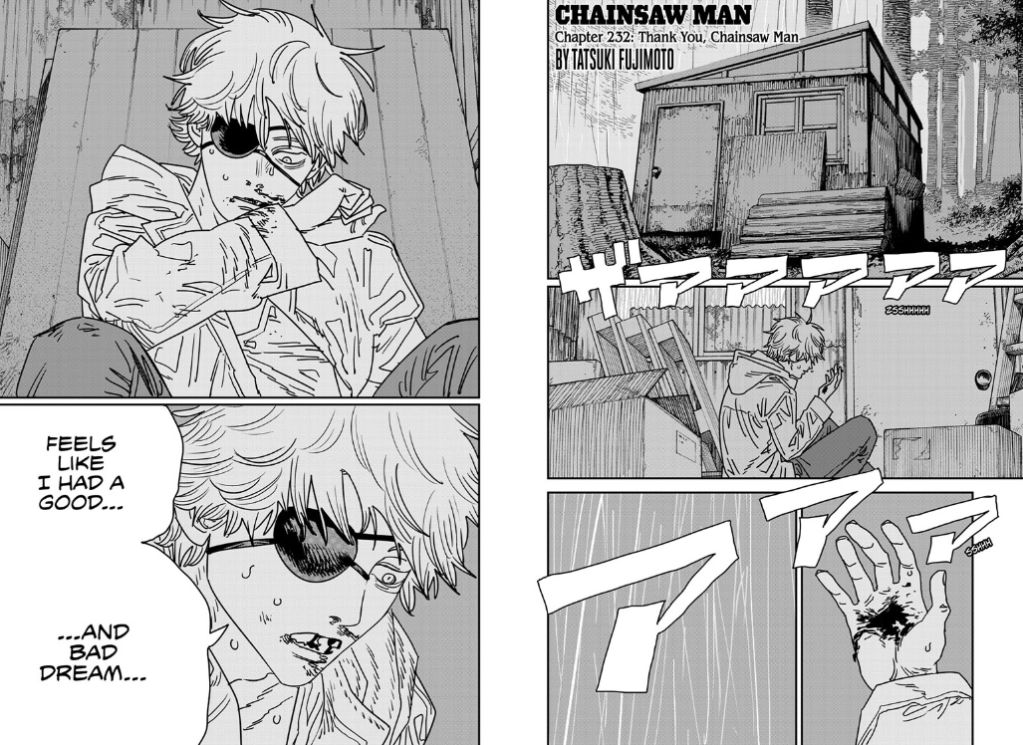
The dream angle that everything hinges on has been HORRIBLY misread by everyone I’ve ever talked to or had recommended to me online against my will. It’s either a plot-headed, this was all just a dream?, or a complete refusal to engage with this hinge at all.
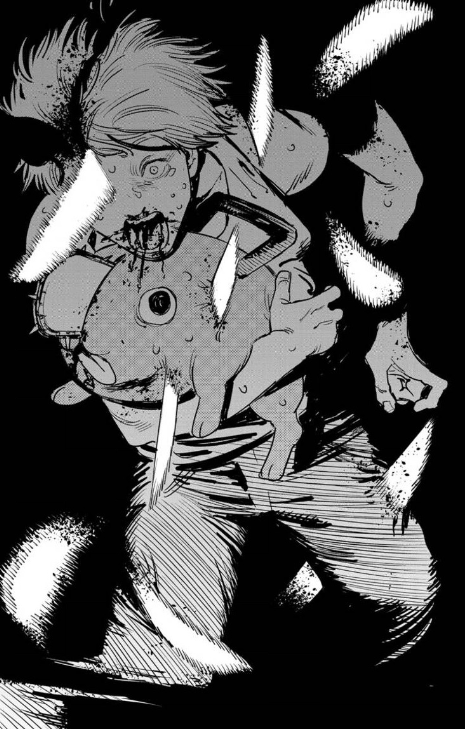
Worldly reality dictated that this bum kid dies here.
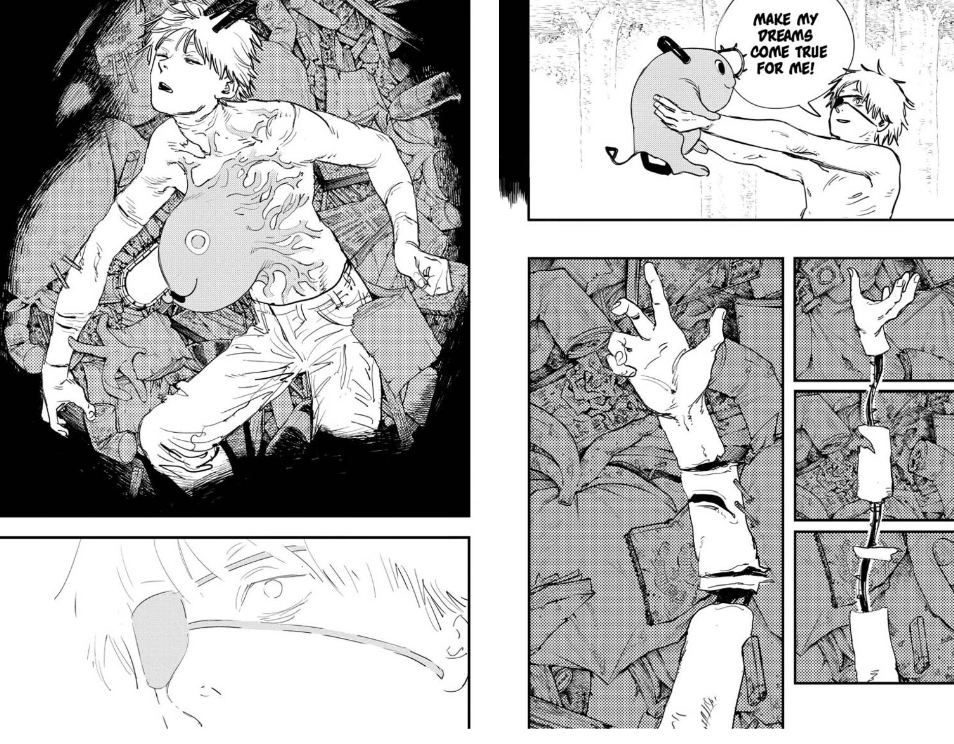
But with Chainsaw Man, we get this inflection point, with the reborn, dream-living Denji on the left panel above, and the old Denji, the one whose dreams are being shown through Chainsaw Man, as a faded-away ghost in the panel below. It’s a direct visual representation of the whole things backbone. A dream, a life free from bad things in the sense that it can find Heavenly beauty in Hell – as Denji’s brain had always worked. Fujimoto showed us an entire mind. Denji’s mind.
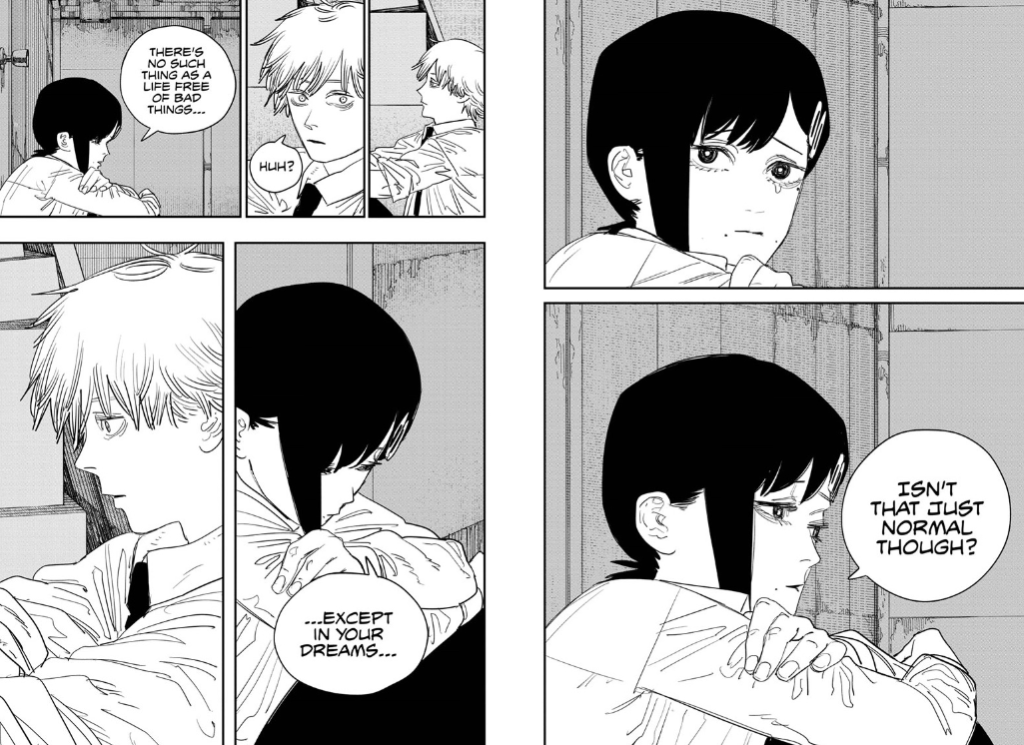
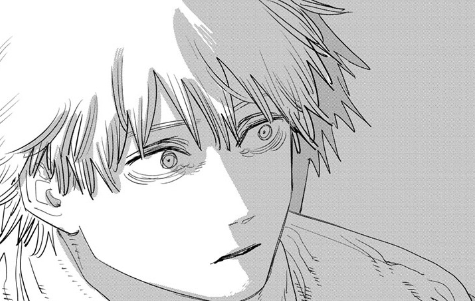
Denji found fantasy and dreams of everything-toast while working as an effective slave for the mafia. With the dreams realized, we saw what all of that looks like. The transformative power of art, which can take those repressed longings and transform them into narrative form. And, along the way, he lost the plot. He stopped being Chainsaw Man and started wanting to be Chainsaw Man. The awareness broke the dream that was this wild ride – the manifest dreams of a fucked-up boy through devilish miracle.
We can use art to express our dreams. These can be taken, misinterpreted, abused by the world around us. Many great directors will come close to fist fights with their producers and editors over even some seemingly small alterations.
But Chainsaw Man ended on its terms even while the whole world – and Fujimoto’s working conditions – were falling apart. Denji went to shit, we saw all that could happen with it, we saw Yoru and Yuko and Aki and the surreal liberation Fujimoto finds in Hell, amid the miserable and downtrodden, perhaps with their hearts more open for it. And with everything done, he says goodbye on his own terms, and, as the old him goes kicking and screaming at the loss of Pochita… we get a Denji cleansed of everything we ever saw, but – but – with every single experience we ever saw him live in his other life granting an almost infinite meaning to the smallest of details.
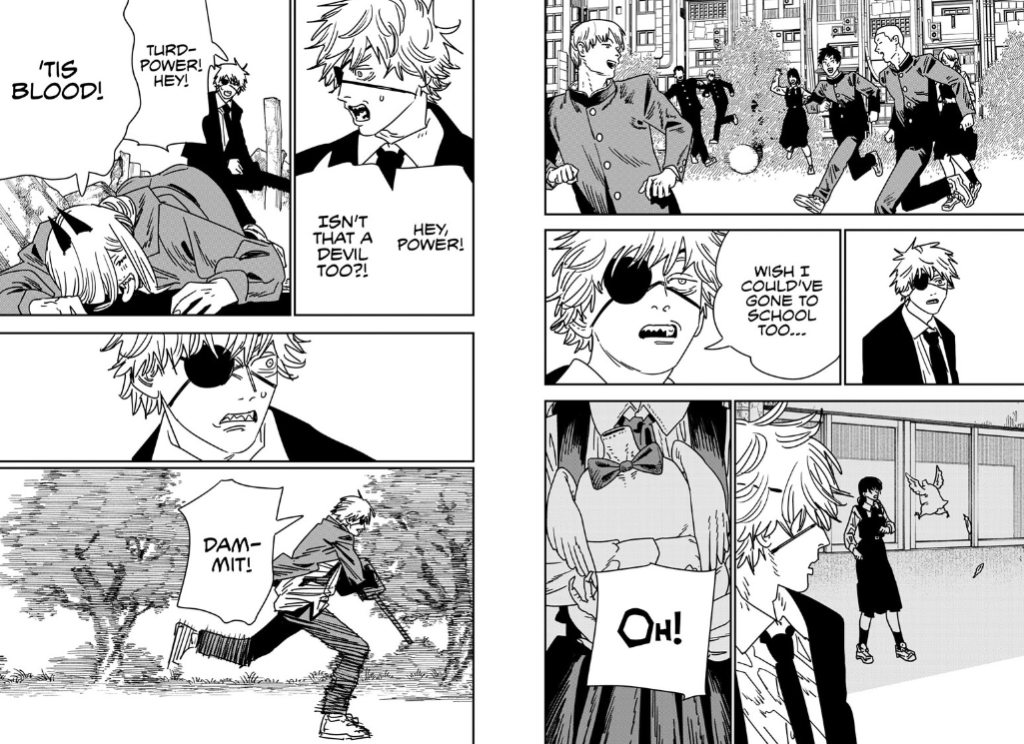
This is my Denji.
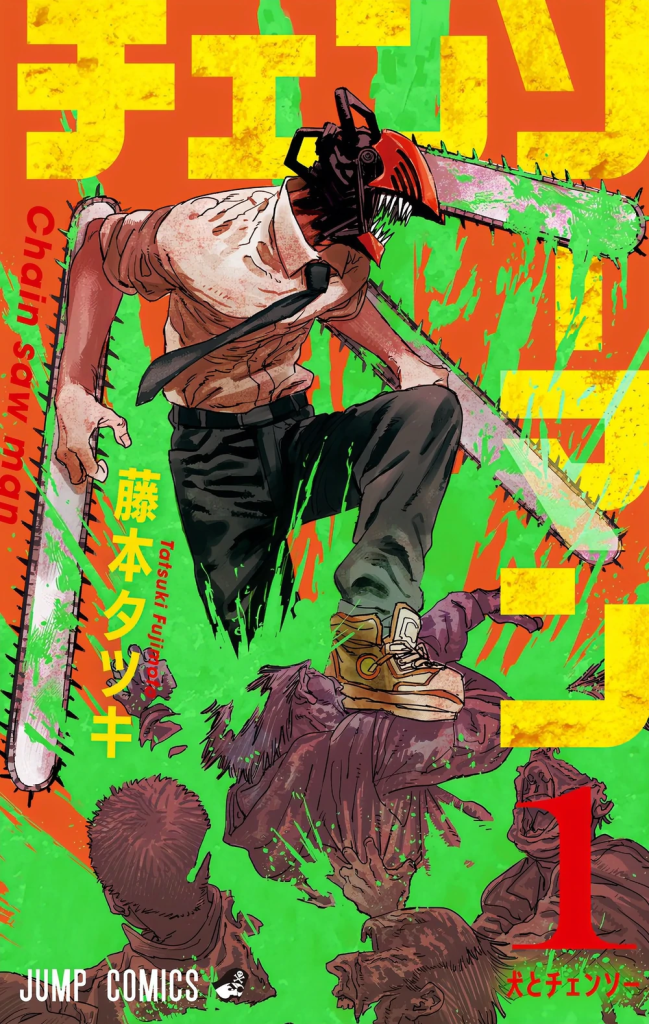
Not quite the Denji who bombastically flew out from a sea of green blood.
Definitely not the traumatized victim of Makima, who handed him everything without real choice and made him far less of himself – visualized with the green background melting through into his outfit. The Denji we followed in Part Two.
The Denji who, with the other’s final choice amid total collapse, woke up again at the other end of Chainsaw Man, re-born by the chainsaw (originally, a tool to assist birth), popping out from the city as his own man with hunger in his eye. Beyond the spectacular cycle and strong in his own shoes. That’s my Denji.
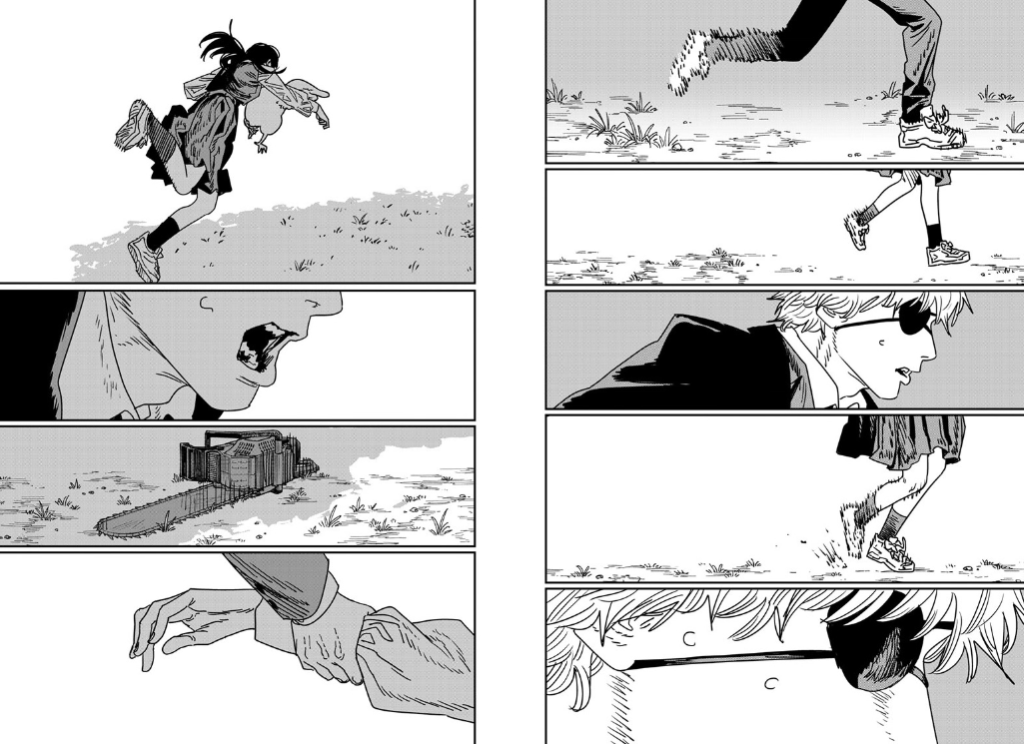
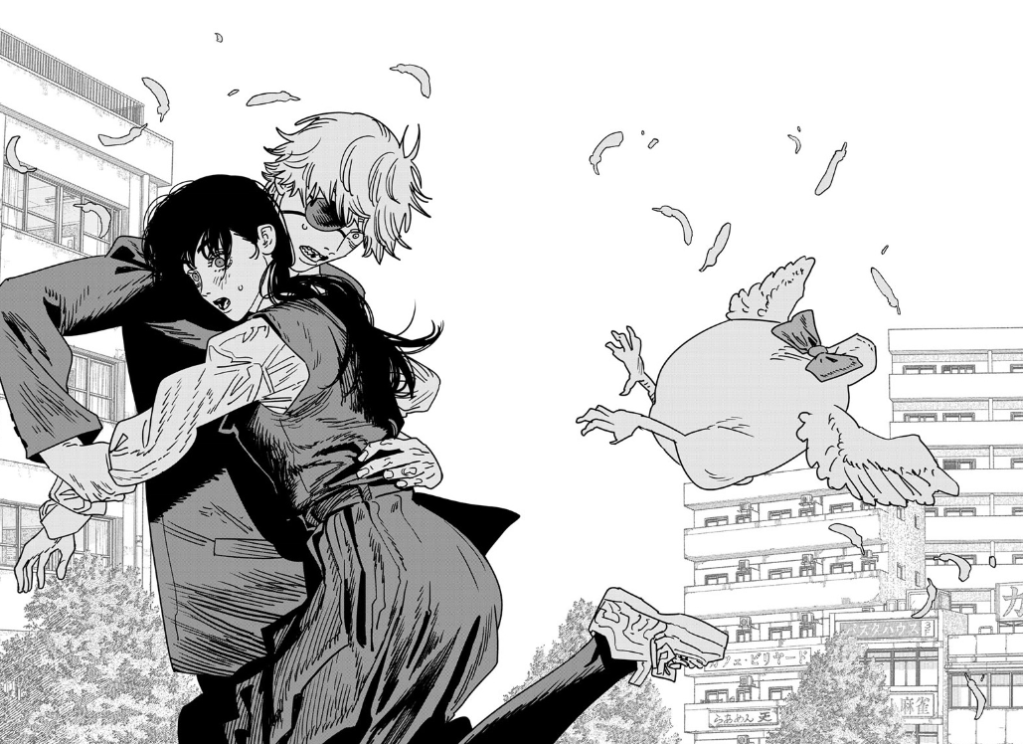
The Denji who lets go of the chainsaw to save Asa Mitaka. The Asa who, having been reached out to in this potentially horrible moment, has been lifted out from despair and given another window to her growth into the world, one more time. By having taught us everything, Fujimoto showed us beyond all doubt just how much weight lies in these little deeds. That, alone, is a shining star of the transformative power of art.
But, really, all of this comes back to the essential contradiction of Pochita in this world.
To return to the Spider-Verse comparison for anyone who saw the films (and my condolences to those who haven’t, they’re masterpieces): the contradiction of keeping the continuity of Spider-Men functioning at the cost of Spider-Man’s essence, in letting Uncle Ben die for “canon,” is the perfect comparison. Ever since Makima fucked things up, Denji used Pochita more and more as a crutch. With the endless chase of Pochita and the weight and burden of his reputation among all devils – thus, the ultimate reputation, symbol, and image – the whole world slipped away from exactly that love for dreams that Pochita chose to go on for. Pochita is what would (or will) happen if Miguel came to his senses and said fuck the spider-society if it’s this corporate bullshit. He sacrificed his own existence in contentment after seeing all the dreams he wanted to see and made a world without Chainsaw Man.
Because Chainsaw Man, like the Fire Devil, loved people’s dreams. As Yoru loved and writhed over the wall of devils not being able to fully understand. And as it meant the dreams would go on, it was Pochita’s will to have a world without him: the completely selfless act amid a cast of endless addiction, comfort, and self-preservation. Super Jesus.
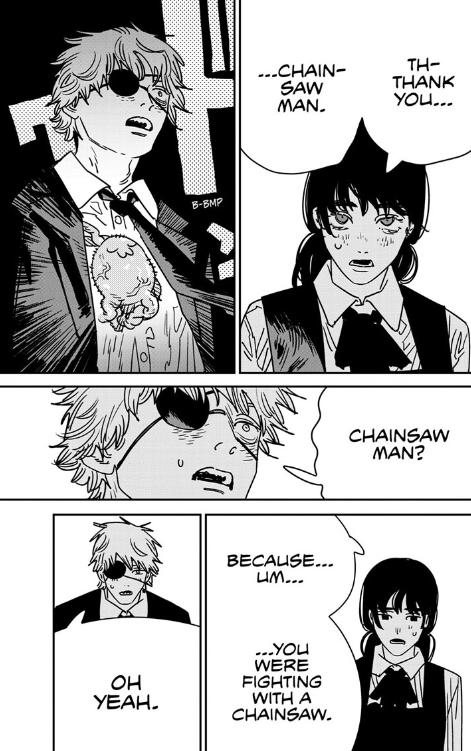
I’m going to ignore this page now and really appreciate just how phenomenal of a character Pochita wound up being, how refined Chainsaw Man’s essence wound up being when all the bullshit in-between was left behind. Denji must keep on dreaming. Fujimoto will keep on dreaming, whatever is next. And we, too, must keep on dreaming.
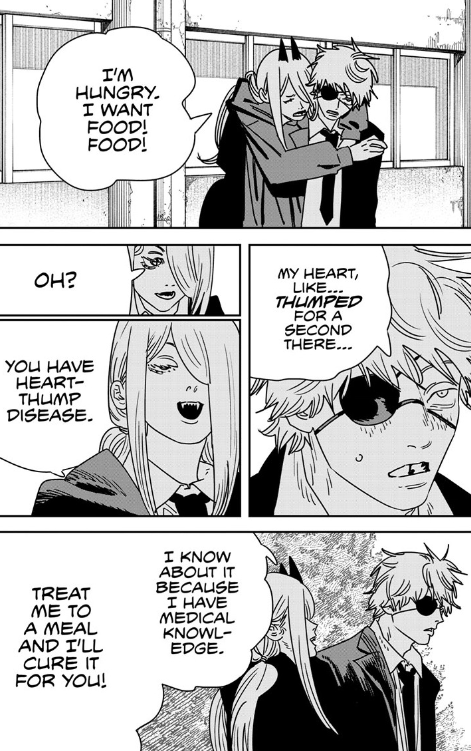
Power always took things as they came, so childishly. And that is the frame through which Fujimoto shines this new, greatest, internally free Denji. Denji was always shaped unmistakably by his experiences, by his bonds, by his memories. And with a whole world of his dream undone, its implication still so briefly rings out in his heart, and the full meaning of his actions shines to us only because of all we saw for the 229 chapters in between 1 and 231+232. This is the kind of wisdom and understanding with which this new Denji experiences his life. And that is one of the finest pieces of artistic elucidation of a whole person’s subjective world I’ve seen in a good few years of manga.
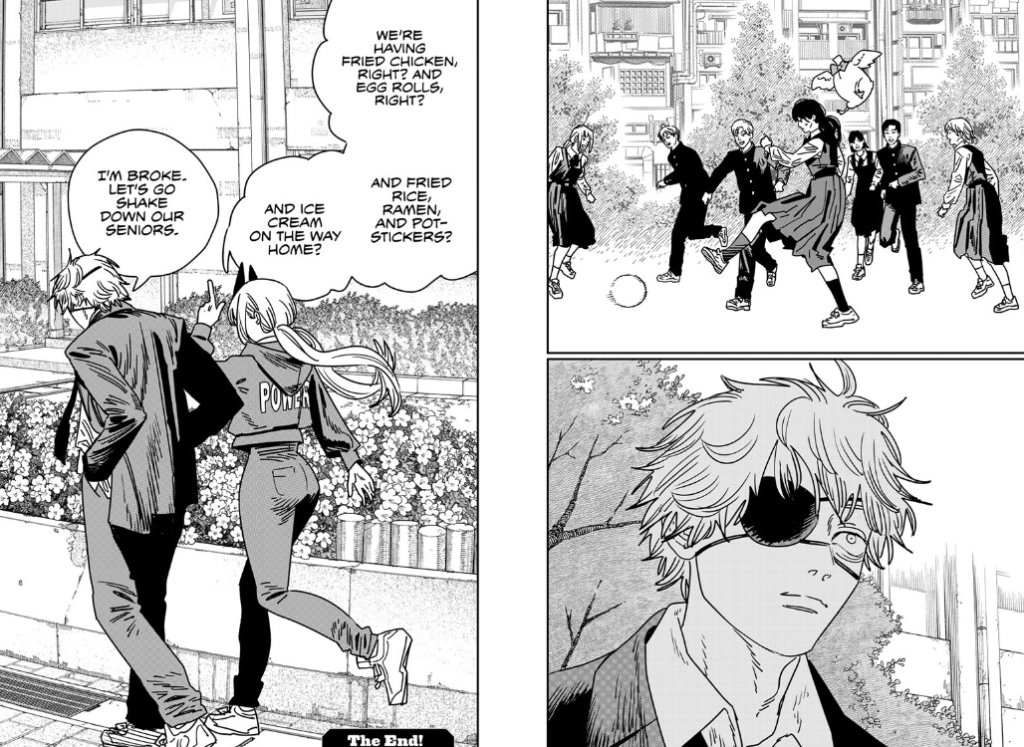
With maturity and understanding, with the slight but powerful heart-thumping of his other life beside him, with a grown man’s self-assured look of absolute contentment upon the woman he otherwise fell down all possible stairs with. This is my Denji. And he’ll keep his head high and dream on no matter what happens from now on.
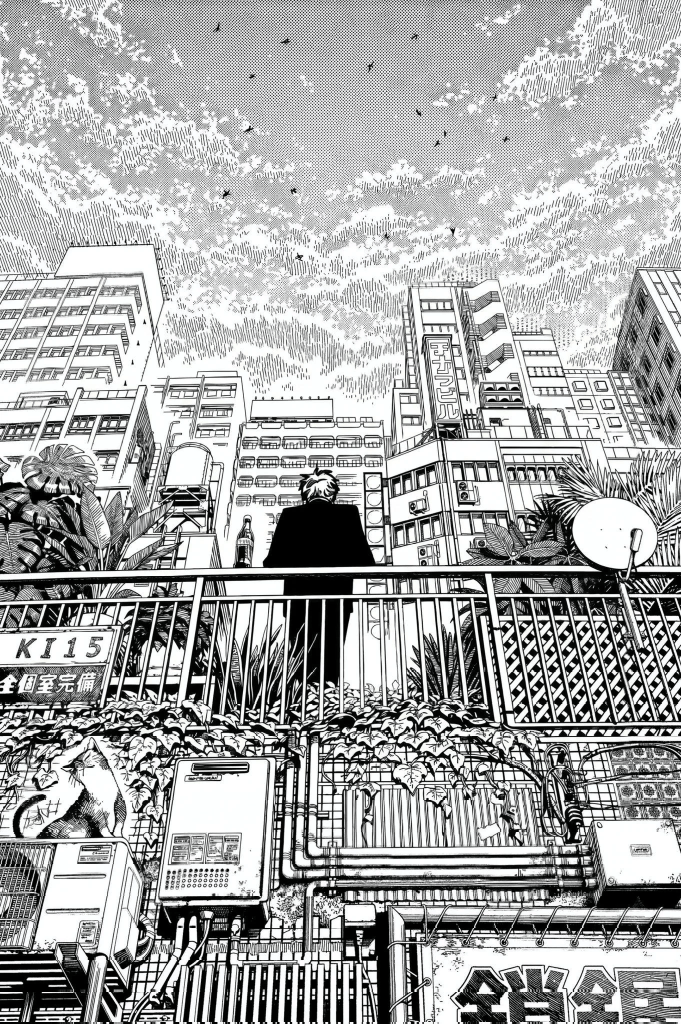
Thank you, Fujimoto.
END OF THE ANALYSIS
THE REVIEW
The Good
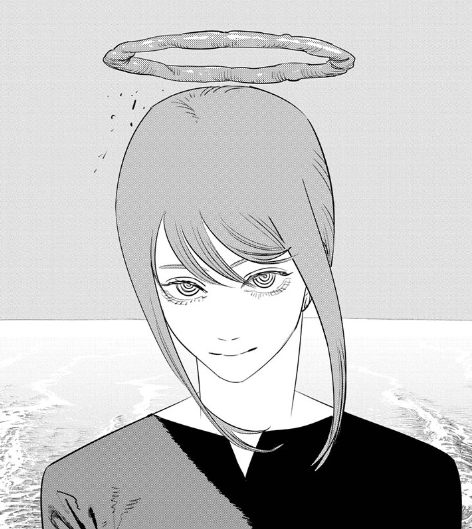
1. Fujimoto’s Open-Eyed Understanding
1a. A Deep and Consistent Human Condition
When it comes to why Chainsaw Man is such a phenomenon, there are two primary reasons I spot. The first, which will be covered here in point one, is that it’s an incredibly effective character work above literally anything else and millions of people around the world resonate extremely strongly with its cast and the scenarios they live through.
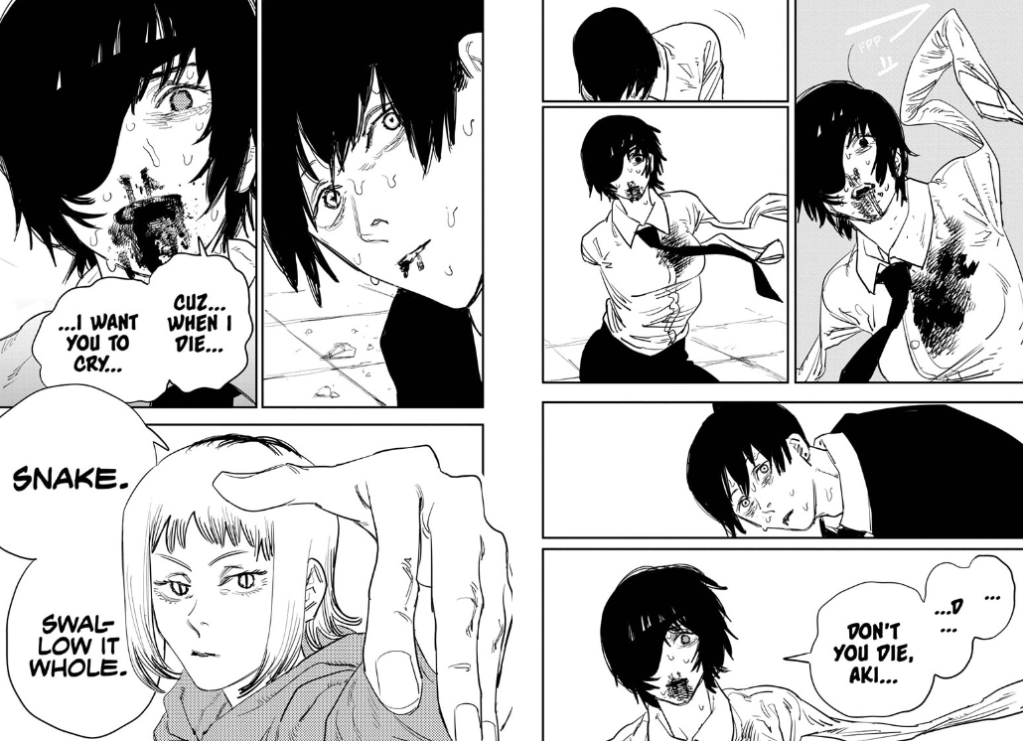
The base of this, and why Chainsaw Man at its highest moments goes beyond mere relatability into immense personal impact, even with characters fans relate to the least, is that Fujimoto utilizes an excellent amount of personal life experience which he’s worked through as honestly as possible to squeeze out universal frameworks of human conditions, which give each and every one of his characters a palpably real emotional weight, even with mere panels of screentime.
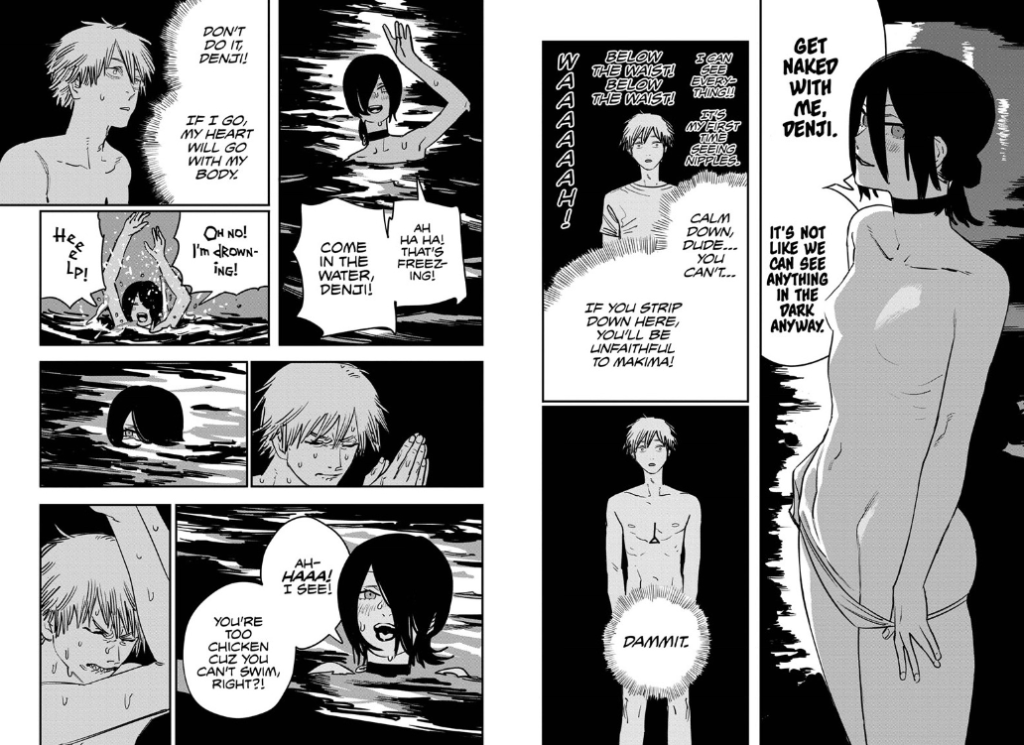
Rejection of the body in daily life, profound yearning for emotional freedom, how this freedom is developed in tightly written human relationships that show universal archetypes of our development – first experiences of love and sensuality, the deepening of one’s (found) family through heavy burdens of life slowly coming on – the intrinsic need for warmth and how it’s projected outward by so many in power to tighten their heart as much as possible amid the brutal grind of corporate life. We can go on for a while, but Fujimoto sets the bases and develops them throughout it all, so that each successive character arc has a little more weight behind it.
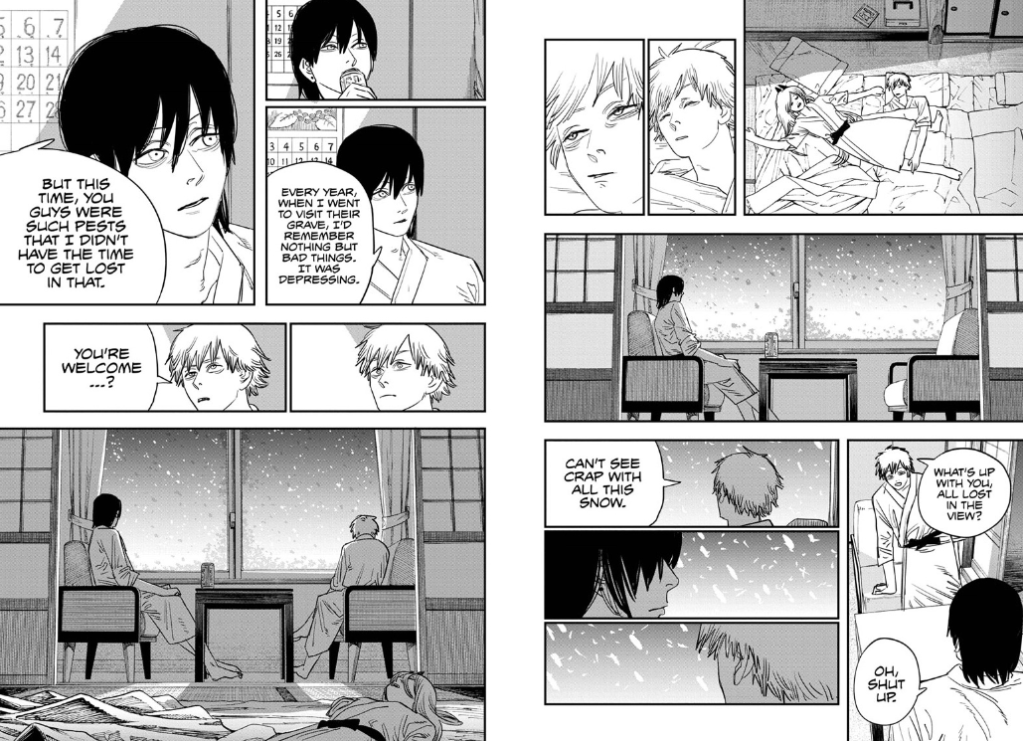
1b. The Characters: Fully Realized People
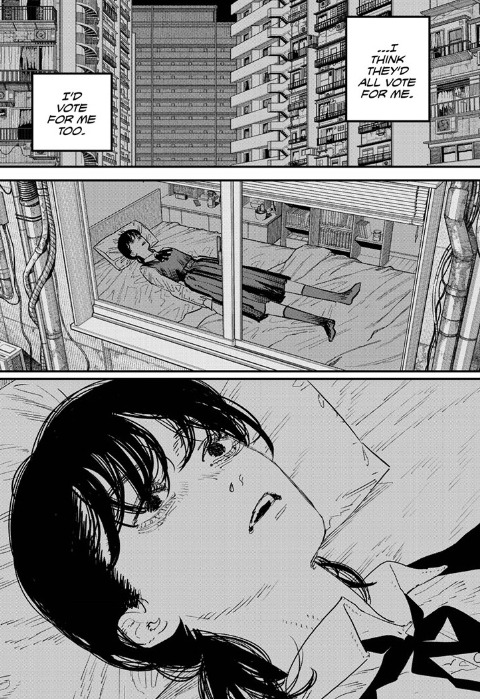
Just about every single character in Chainsaw Man is a complete tapestry of personality. This isn’t merely on the structural level, with every note of characterization, motivation, etc being hit. These fuckers feel ensouled.
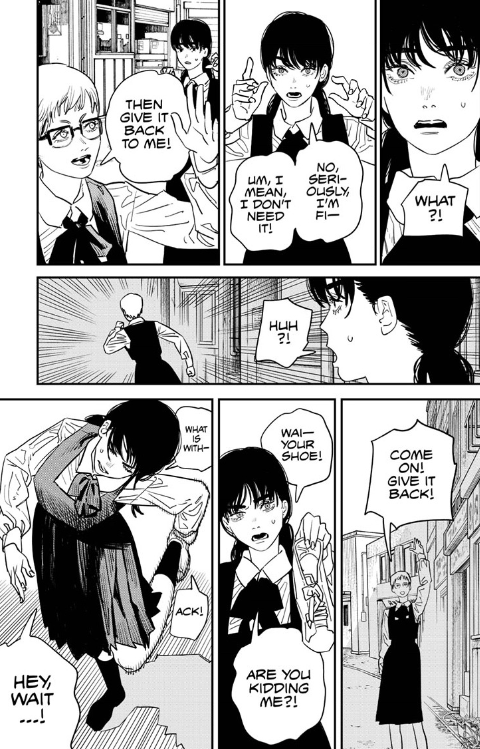
Words of dialogue, inner thoughts, the actions they take, the things they choose, the interactions between them, the expressions – God, the expressions!
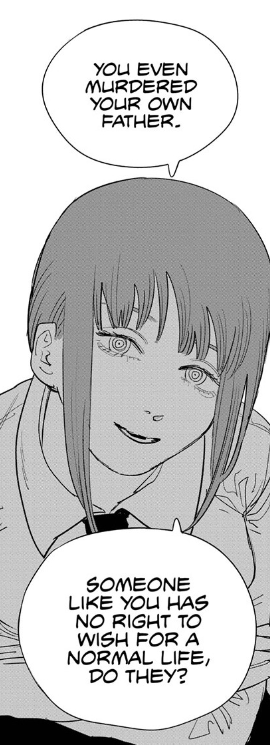
Look at this expression. The gleeful bearing of enforced truths upon a social outcast with that psychotically dead look in her eyes, the vague smile and condescending sneer of it all – all of it is so palatably real. Almost all of the expressions in Chainsaw Man, especially before the Great Art Crash of Midway Through Part Two, sell the emotions completely.
And the realism and weight of the interactions?
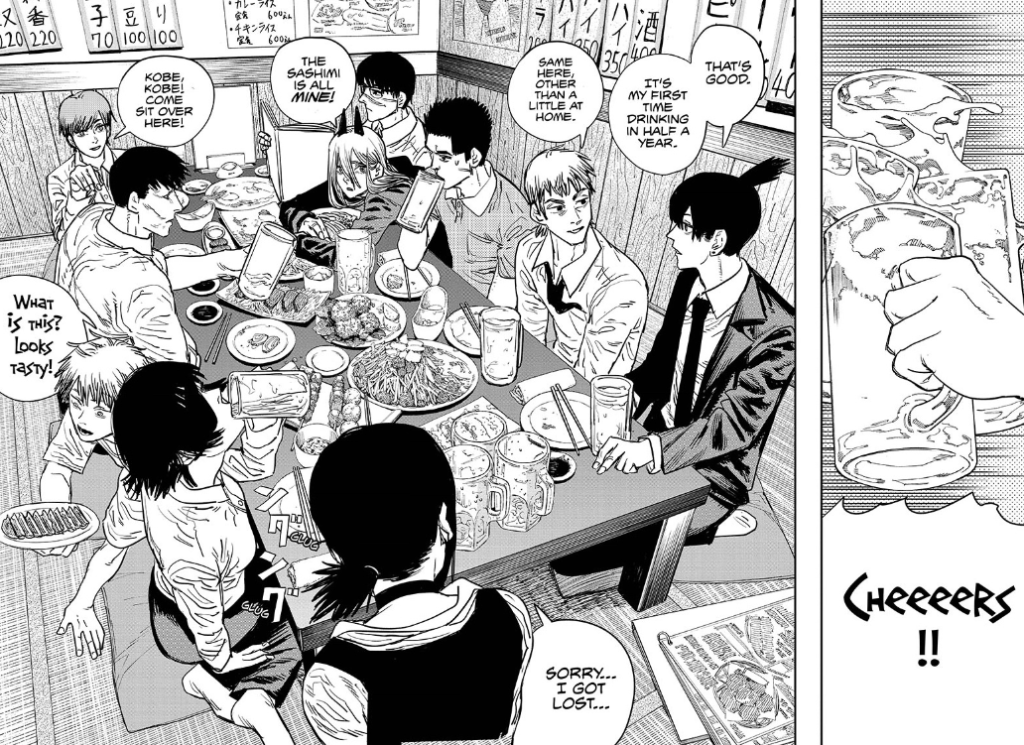
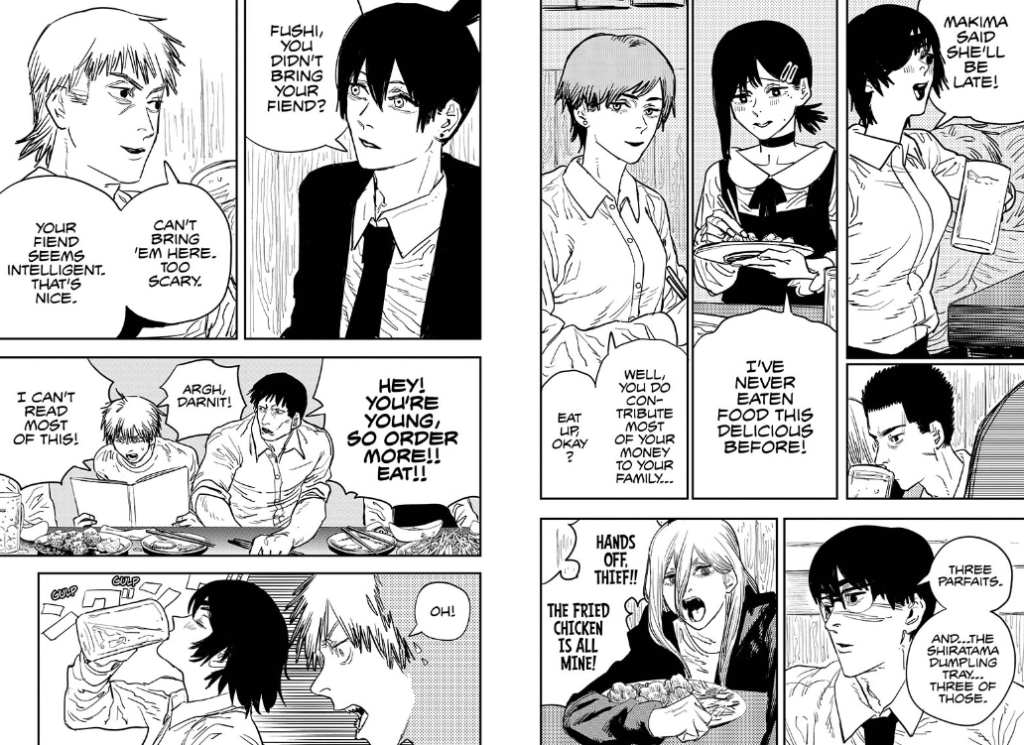
Each and every character here, most of whom aren’t even proper characters in the narrative, is a fully realized person and part of the dynamic. The dialogues they’re having with each other, their postures and expressions, the active involvement with the scene of the restaurant in all the appropriate ways, and the fact of the full dynamism of the scene of ten different people all at once is a feat of craft that could hardly ever be praised enough.
Then, there’s extremely well-timed, painfully real, hilarious dialogues like this, complete with the right reactions.
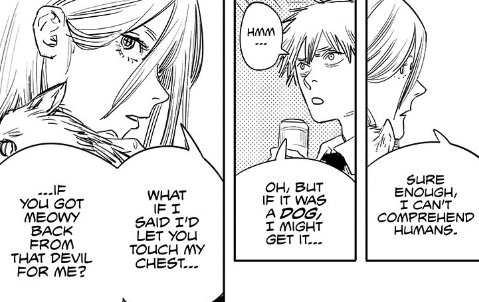
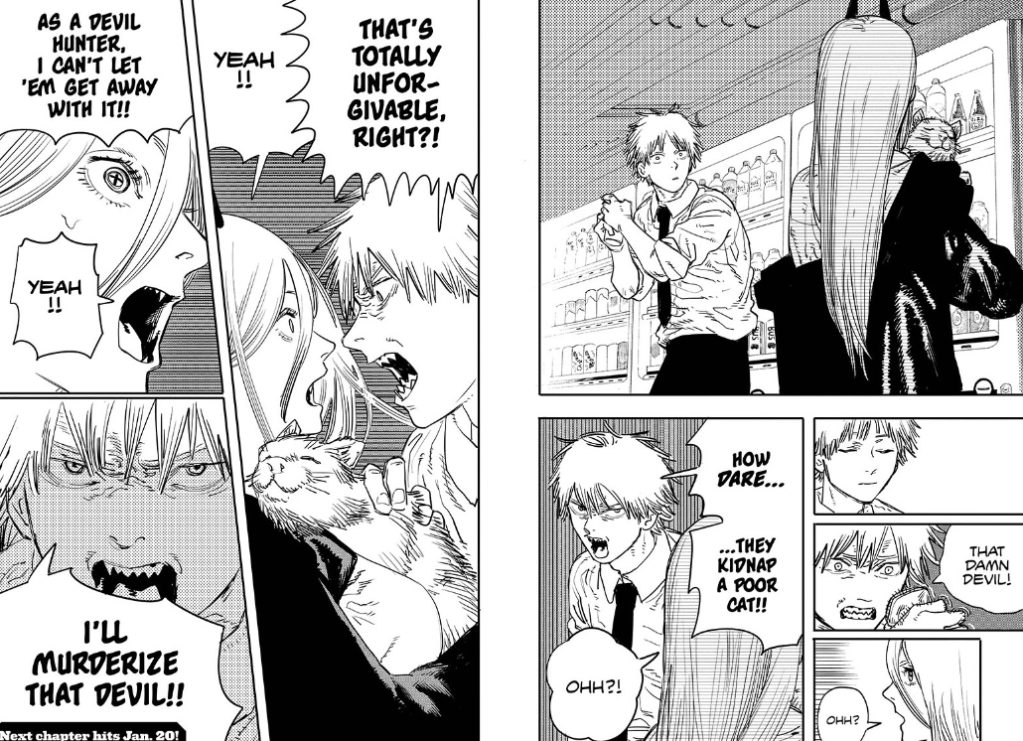
This works so well because the interiority is also completely clear. Power’s childish scheming and Denji’s processing and going along with it because, as we’ll forever see, he’ll do whatever the fuck it takes to touch some boobs and otherwise acquire his material needs. He’s a sobering realist in that way.
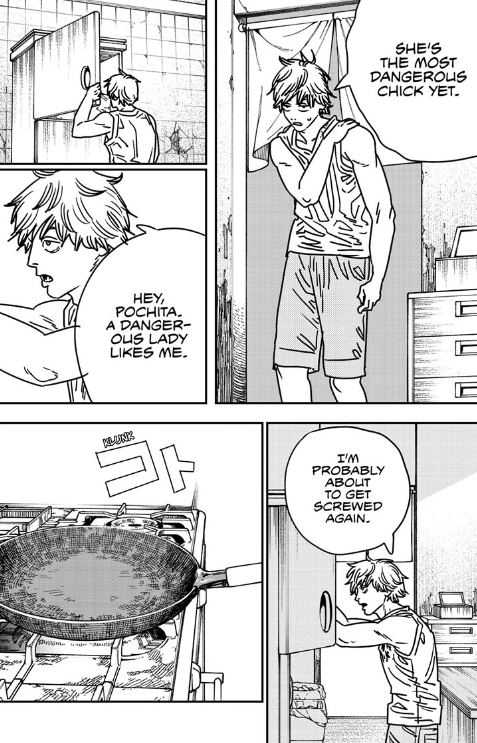
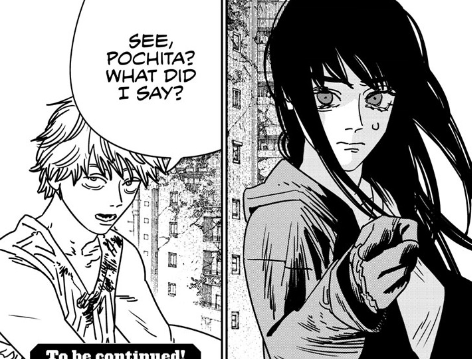
But it’s in taking the examination much further that I find myself coming across the real excellence of how Fujimoto writes characters in this manga and how it goes beyond these surface-level treats: first, that Fujimoto sees the causal links of behavior, role, and symbol.
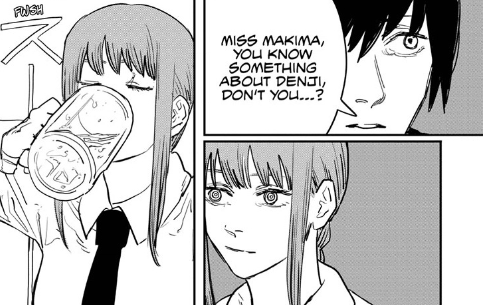
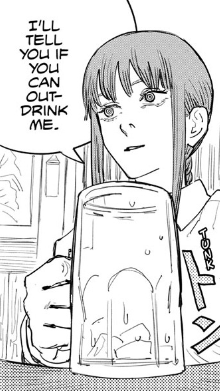
Everyone who dismisses Makima’s “mask” loses too much essential characterization. Look at this smug, bougie, valedictorian sorority bitch. You can visualize her in one of those blonde-cult videos from an Ivy League school making fun of poor people. The cocky, condescending playfulness that runs along with the social current in acceptable ways to then destroy people who make her feel gross. This is the Control Devil. This is the woman who gets the kind of position and power she has and the entrenched world-view around it. The entire link, from birth to death and from role to temperament, is fucking perfect. This is a character whose writing is complete.
Going even further, we get to Fujimoto not even stopping with worldly cause-and-effect; he can channel these peoples’ immortal souls independent of the lived experiences that roughen out their edges.
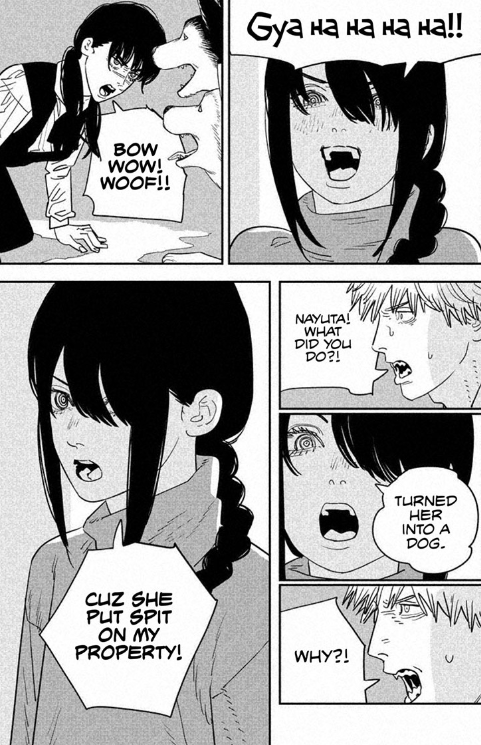
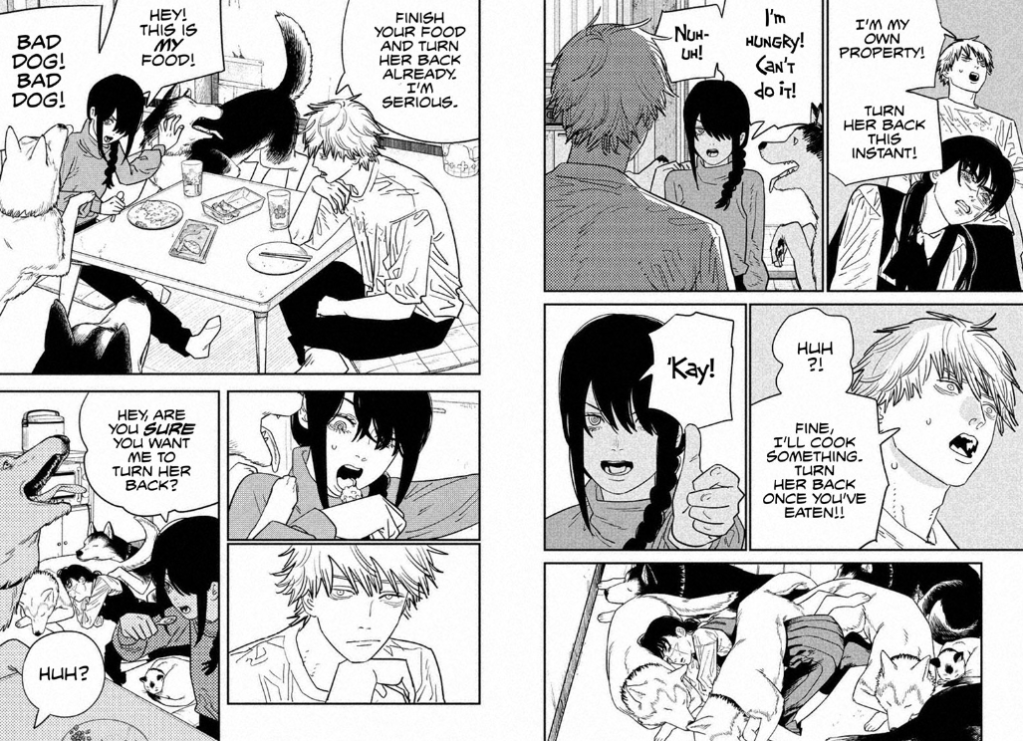
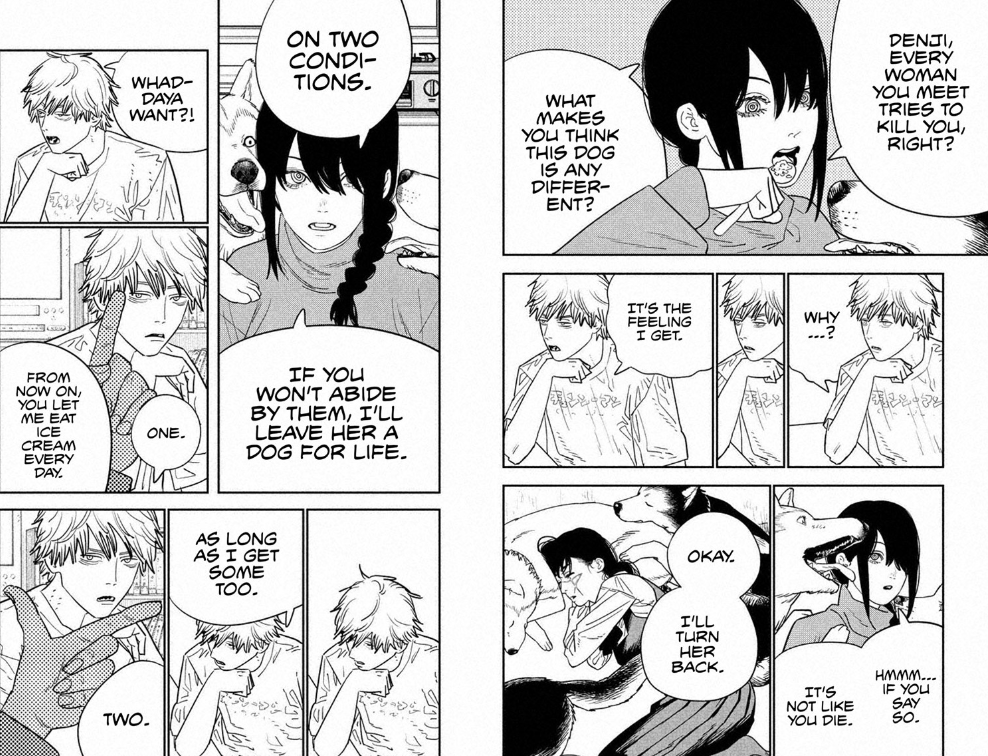
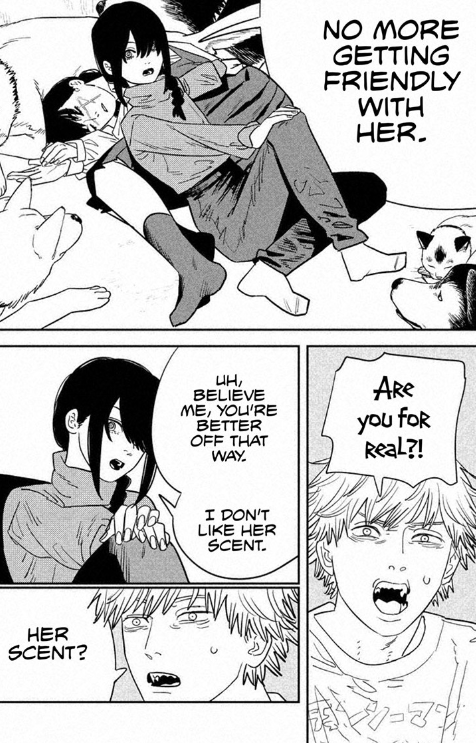
Nayuta is of the same soul as Makima. A different upbringing, and we see her at a much earlier point in her life, and it’s immediately obvious. The particular ways she navigates power, her satisfaction in securing dynamics and love, how she spots and enforces her dislikes in the environment with bad scents – it’s all from the same essential character. The learned differences – her brash self-expression, bratty demeanor with its openly scornful longing for arbitrary advantages – pop out all the more for it. If we looked at this with a Buddhist framework, we’d know that Nayuta could discover Makima as a previous life with a solid continuum of experiences accumulating over each other from the previous life into this one. That’s how precisely Fujimoto weaves these characters’ essences. It’s astounding, and it makes all of the emotional beats, interpersonal dynamics, and thematic statements sing even harder – in addition to further emphasizing nature vs nurture, that yearning for personal freedom at the spiritual level which we often lose in waking and working life and all its distractions, and so on and so on. Unbelievable.
This cast is so easy to attach to, to relate to, to feel for, and to understand no matter who or where they are. Personally, I resonated so much with Makima it helped to genuinely change me in some ways, and I found Yuko and Yoru prime “literally me” targets as well. Denji, Aki, Asa, Barem – I connect to something in the ways of each of them, I find myself feeling Aki more deeply every day I have to deal with straight bullshit dealt by life. They’re all too real and moving.
2. Playing Basketball with the Collective Unconscious
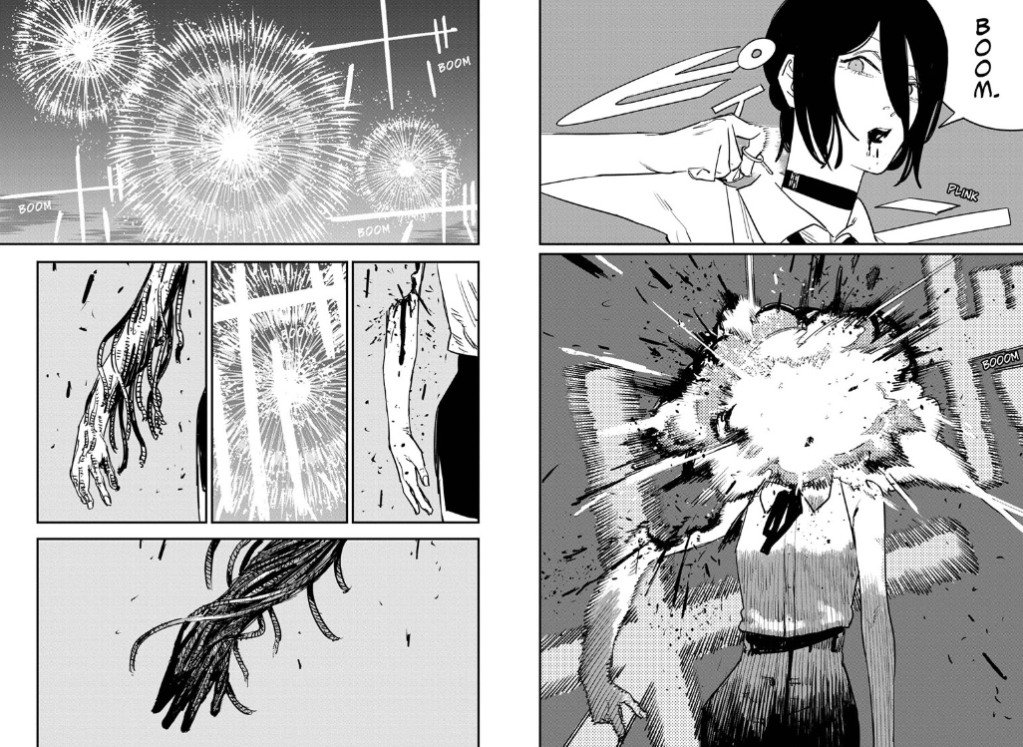
The other, second reason Chainsaw Man is so primed for popular appeal – mainly in its first part – is how well Fujimoto puts solid images to driving archetypes and overarching ideas and themes of contemporary humanity and our current historical condition in general.
Reze, the self-destructing runaway bombshell with a buried heart who’s a spy from a foreign nation. Makima, the sadistic muse who gives and takes away from the artist and the man at her whim and weaves the social fabric. Aki, the self-sacrificing victim of life’s biggest difficulties who picks up a cross he doesn’t believe in to sustain himself. Each of these characters reaches the universal, the implicit, the images and ideas and themes at the back of popular culture, human expression, and the tides of the times. This isn’t something I personally care for, but it’s an incredible pointer for any artist who wants to achieve great success. On the surface, have good fun; beneath it, the foundations are the things lurking at the back of so many of our heads, so that we intuitively grasp, connect to, and feel their fullest weight. Combined with all the excellent character work in general, and Fujimoto wrote the precise formula for how to make characters that’ll grab readers by the throat.
What’s even more impressive, however, is the ways in which Fujimoto deconstructs these archetypes and powerful singularities of idea through his overwhelming empathy to get to their worldly bases. The idea of Makima is the fullest realization of his lifelong inner tendencies which took form the day that bicycle was thrown down before him – and rather than leaving it at that, he examines the social currents and societal standards that created the constrictive archetype she embodies on a collective scale.
The detached control of old men, the push for talented women to be perfect, the removal of love from her hands – Fujimoto doesn’t accept archetypes, he spots them and then takes them apart. In Part Two, he even begins spotting a lot of the newly formed ones to really connect to modern woes in particular.
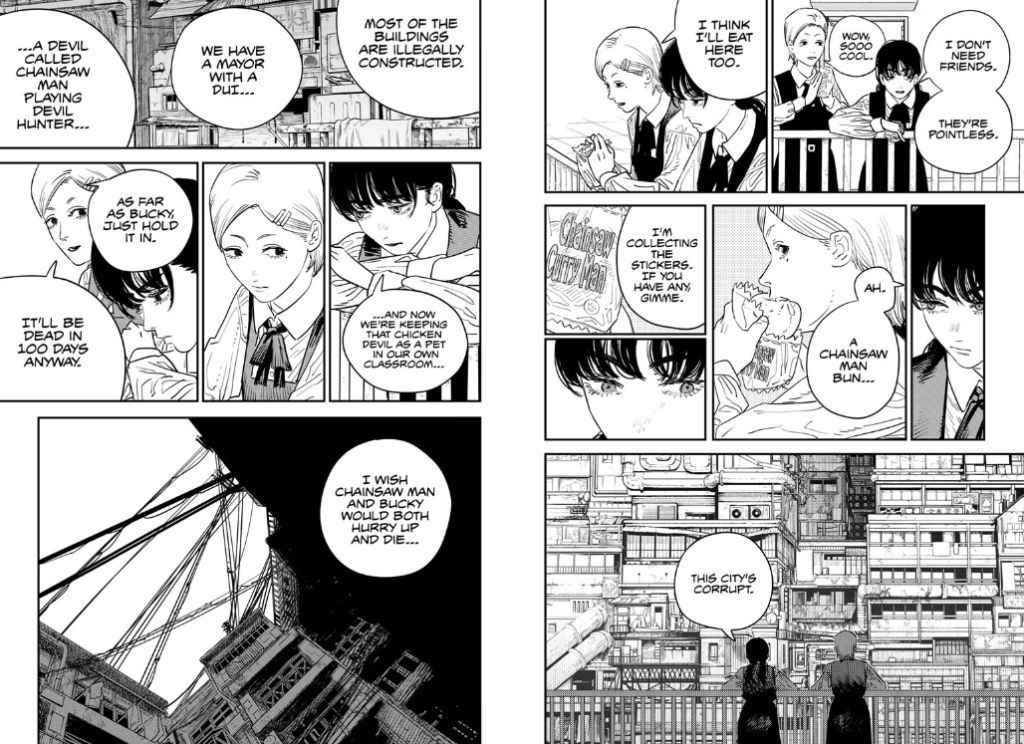
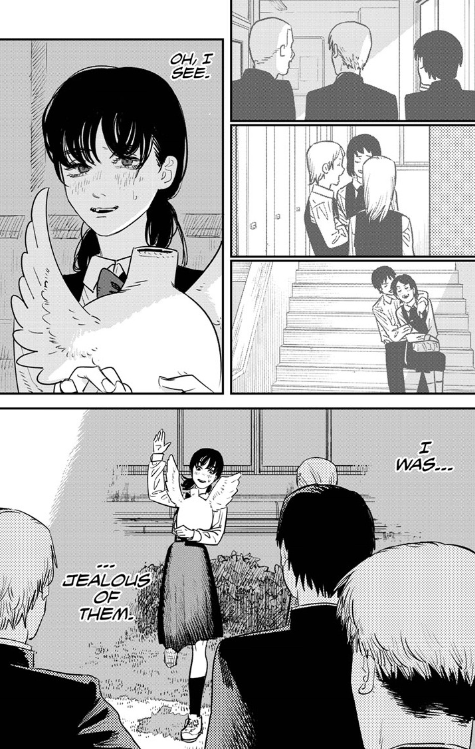
The awkward, self-fulfilling social reject who projects their jealousy outward is an absolute classic, but Fujimoto bounces this historically common type of person against modern media and consumerist culture, while also using modern standards and understanding of mental health, to produce a character who feels fundamentally new, if not in pop culture on the surface level, then in the extent to which he explores her fully. A bit of a Cyrano? No, not really! I can’t think of a non-reductive comparison for Asa Mitaka.
In addition, there’s the kinds of people Fujimoto sells simply because he’s a bold enough motherfucker to write the likes of Denji and Yoru the way he does, when trying that in 1400s Europe would have had you burned at the stake. He’s real for that, and it’s something many people crave from art today.
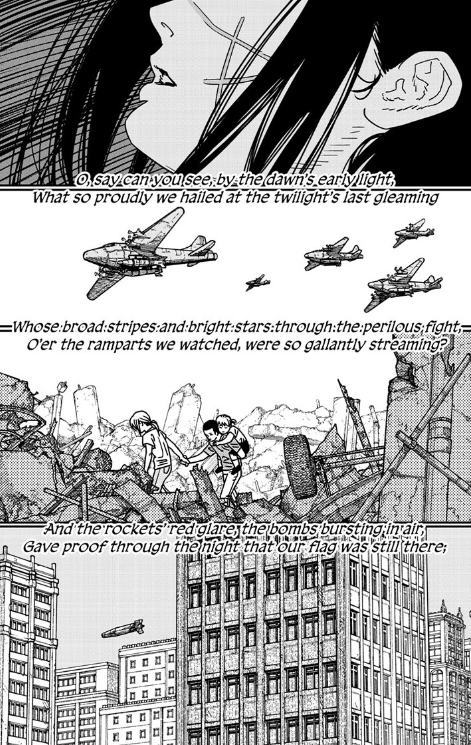
3. Mastery of Symbolic Craft
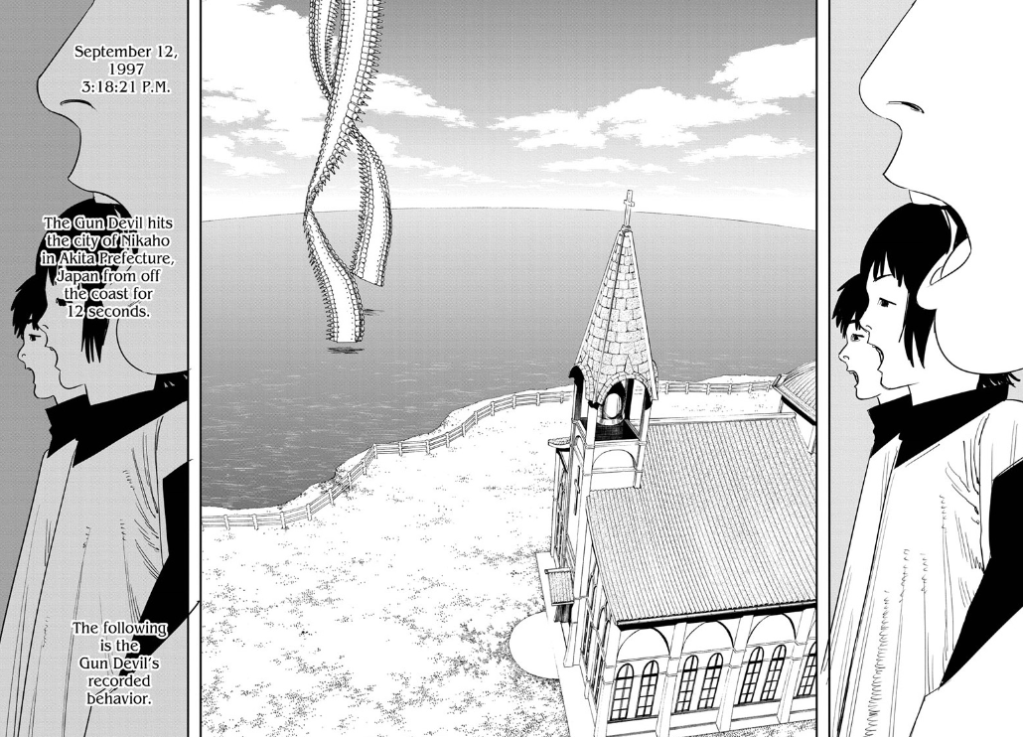
Fujimoto knows how to put elements and symbols together like few of his contemporaries do.
With the double spread above, Fujimoto already performs a very cool trick: he repeats the same panel with grayscale and the beginning of the rampage’s description. For the attentive reader, this sells a half-cinematic half-documentary-esque transition of the active scene into a horrific fixed past and thus builds perfect anticipation for the next spread.
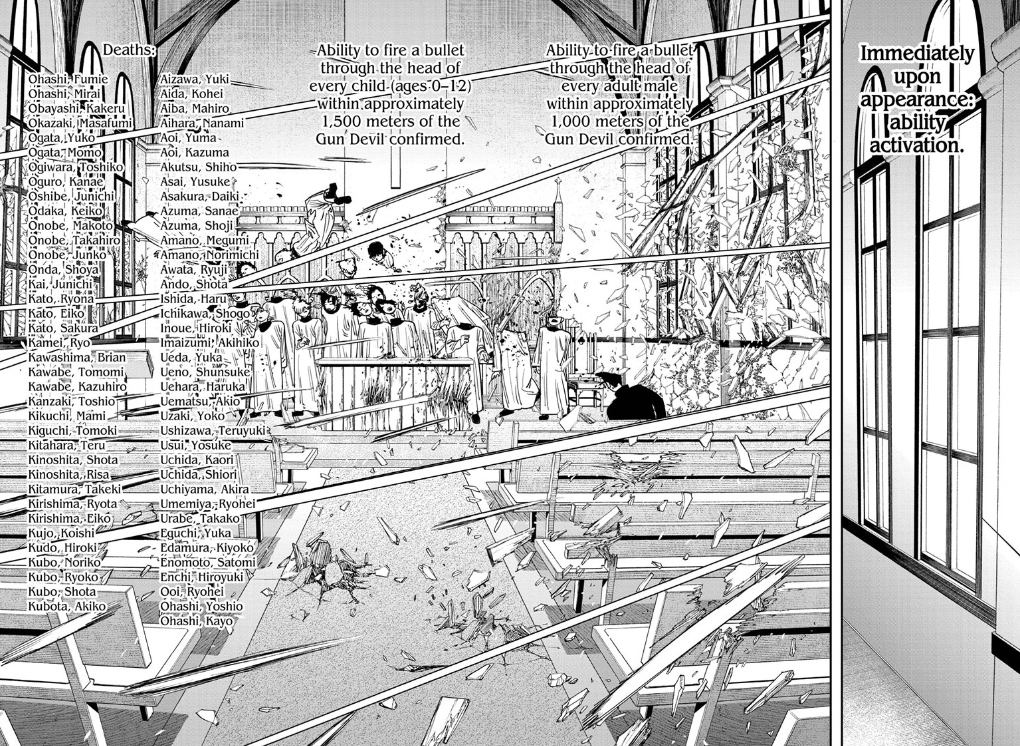
Returning partially to the point of archetypes: Chainsaw Man has an incredibly strong internal, thematic logic to many of its scenarios that thus makes the wider world tick. The Gun Devil, like any devil, becomes stronger the more its subject or self is feared; the terror of mass shootings, like any terror, spreads itself out the more prime victims it has to spread itself, as with Aki. In the Gun Devil having a wider range for children, who build more terror and trauma, Fujimoto has excelled in properly anthropomorphizing gun violence and practically written his own sort of Godzilla with its own symbolic weight as just one entity in a much wider narrative.
Moreover, Fujimoto’s art itself is exceptionally evocative and emotionally alive, something boosted by his great scene construction.
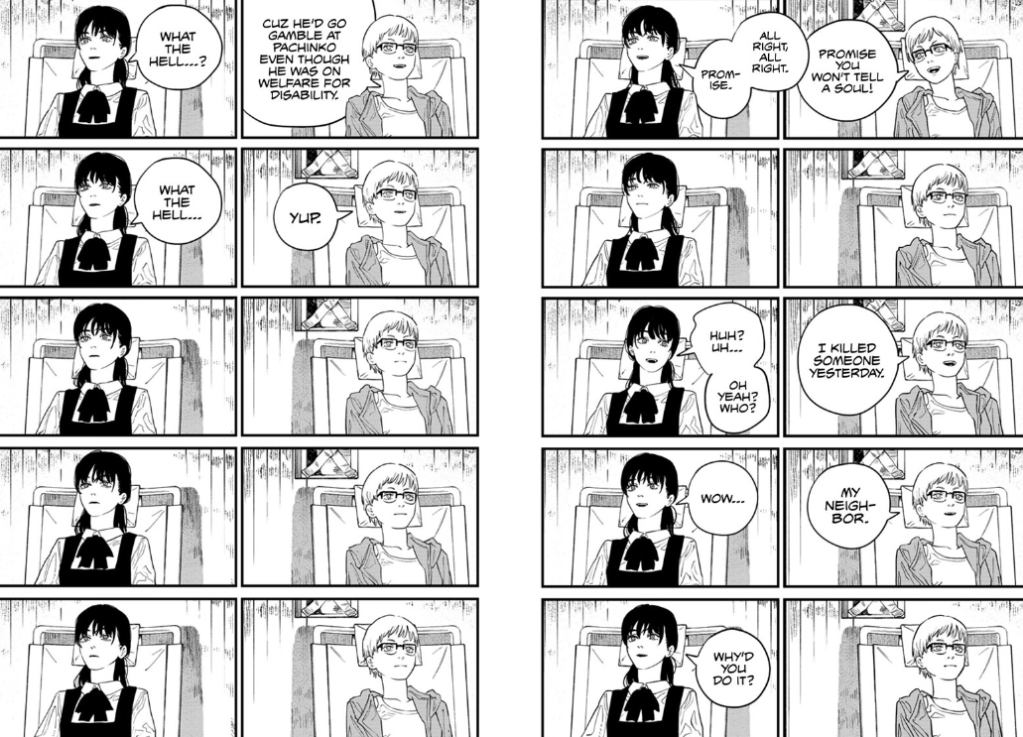
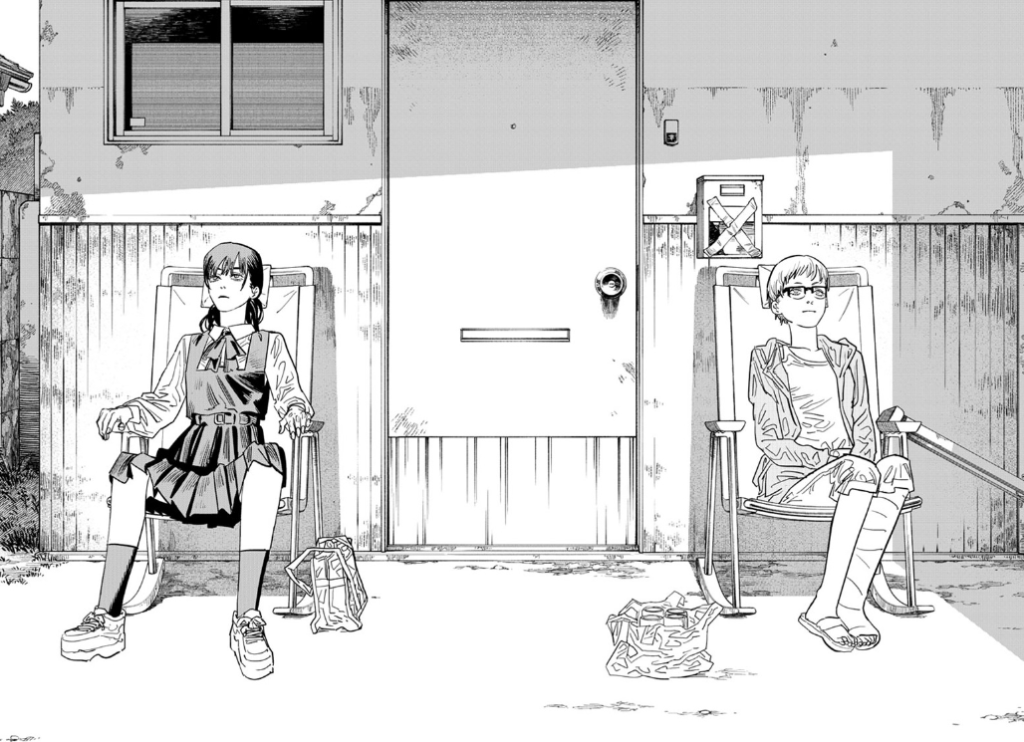
The natural flow of realistic dialogue once again works wonders, but the use of panel repetition to visualize Asa’s slow processing of reality before the starkly lit, zoomed out, dead scene of the two in their own worlds amid it all is perfection. Asa’s open pose, broken-open face and Yuko’s polite, inward pose with her dead-eyed smile perfectly sell the scene, before even getting to the background and lighting. This is excellent use of craft without being Did he just cut the page? Meta Hype Moments and Aura (a distinction I want to make because Chainsaw Man has horrific amounts of this and I’m going to ignore it for now.)
This mastery of craft goes beyond the visual expression of scenes into the abstract construction of scenes-in-sequence, as I touched on when discussing the ball-kicking-game in the Katana Man Arc analysis – in addition to denser symbolism, as I touched on with Pochita and kid Denji giving the man his goodbyes in Chainsaw Man Church.
4. Long-Term Narrative Focus
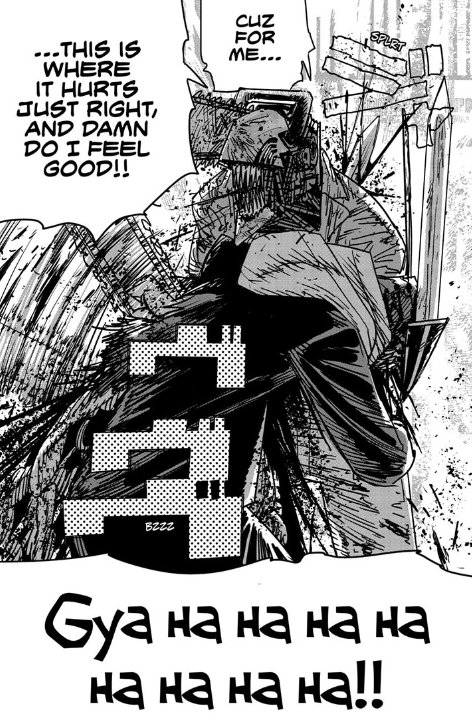
Once again: Fujimoto weaves long-term narratives like he’s one of the Moirai weaving human history. I’ve talked enough about this in the analysis that I want to focus on one aspect in particular: the fact that in Chainsaw Man, rather than too much foreshadowing as we’d usually think about it, he engages in a lot of just… doing things that we can’t process the full implications of in the moment. The two scenes above are a perfect example.
So much of Part Two is just doing a deep dive into the full range of consequences of everything that was done in Part One, and so much of it forces out from many readers a larger awareness of the kinds of things we tend to not really give enough focus. This is, also, a source of one of Chainsaw Man’s big flaws – repetition – but it’s more of a strength than it is a flaw, hence it gets to go here. For crying out loud – the Eternity Devil Arc practically contains the entire manga within in to the point that it’d be fair to slander Fujimoto for writing anything after it.
But it’s that elucidation and testing of its characters’ limits that helped make the story as powerful, poignant, and informative as it is – going back to the undercurrent of nearly all of this praise, Fujimoto’s empathy.
With it, I also must draw attention to an extremely understated quality that makes Chainsaw Man work, against all its bold-faced screaming: Fujimoto’s humility.
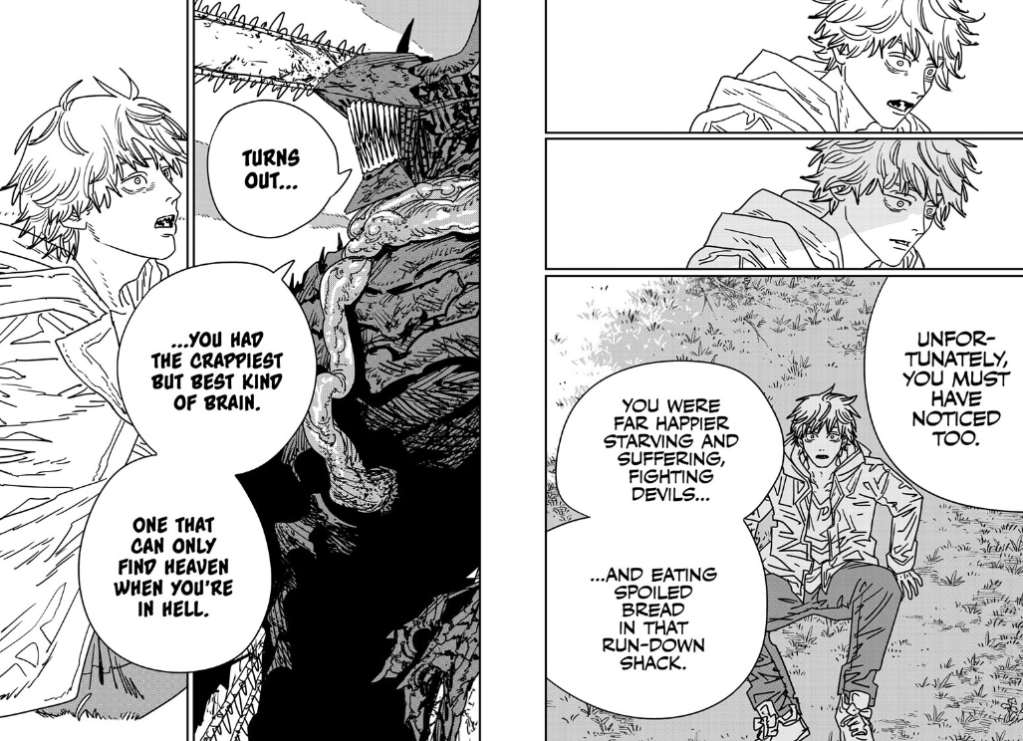
One could very well read the ending of Chainsaw Man as Fujimoto openly stating, “I’m not entirely built for this.” It sounds goofy, but it ties back to the exact open-minded, open-eyed perception and lack of belief that makes Chainsaw Man’s characters, its conflicts, and its narrative so universally and essentially poignant. Fujimoto is not one of many mangaka who doesn’t know when to call it quits and who’ll jerk off his own ego to high Heavens. He is sensitive to criticism, yes, and… he ultimately works with it. The entire Fire Devil plot thread is an excellent showing of the fact that Fujimoto turned his issues with people’s criticisms into a more meaningful, mutual reminder of duty. All of the critiques of fandom, industry, and collective religion in Chainsaw Man Church show Fujimoto pairs personal humility with reader respect. He avoids essential embellishment of anything as much as he can, and his story sings for it.
This self-understanding, however, will also lead us straight into my first and biggest critique of Chainsaw Man and Fujimoto’s works thus far as a whole.
The Bad
1. Fujimoto’s Lack of Intention or Genuine Creativity
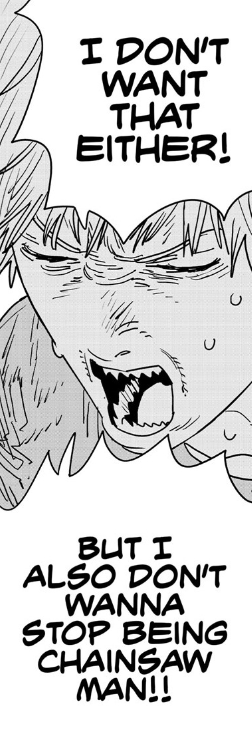
Chainsaw Man is largely Fujimoto’s journey of self-critique and self-exploration, as with many of his works, and he makes a phenomenal conclusion on the majority of them. In doing so, he also creates some transcendent statements on art and reality.
Unfortunately, this self-critique also works because the things he’s critiquing are active problems that had shown themselves for not just the near-entirety of Chainsaw Man, but his entire career up to this point.
Before progressing further, I want to qualify that I didn’t write this analysis and review as a big-time Chainsaw Man fan working to redeem my favorite manga. I didn’t write it for entirely neutral reasons, either.
Ever since I first caught up on Chainsaw Man, I was confused on a lot of people giving it way too much praise for what it is. As Part Two went along, I alternated between this and confusion on people giving it too much slander against what it’s doing right. With the ending, I’ve begun seeing takes so bad, I knew I’d have to step in and put some genuine critical work in before we reach catastrophic bad take mass. What I want to do with this essay is create a substantial analysis of Chainsaw Man for what it is in its entirety, that might also serve as a basis for (better) future discourse, and a lot of that involves tearing down what I see as excessive praise from a smaller frame-of-reference.
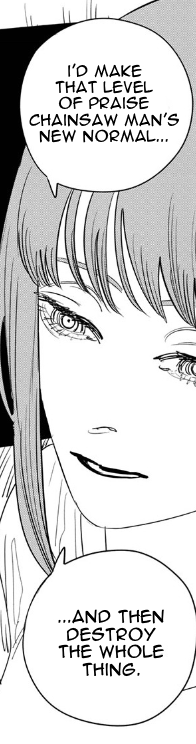
So let’s get to the big issue: Fujimoto has no true intention when he writes. He’s a master of craft, as I’ve established, and this mastery has led to inspiration for many, many newer mangaka. He’s got a fantastic grasp of human character and societal archetypes, and this is why Part One in particular was so widely beloved. He blueprints the ultimate narrative so effectively.
Have you noticed that every big piece of praise I’ve given so far only ever described surface-level, element-based, and observant characteristics, rather than deep, spiritually profound, or inventive characteristics?
It took me a long, long time to find a concrete name for Chainsaw Man’s severe limitations as a work of art, but when I came to lack of intention, I finally knew how to communicate it.
Chainsaw Man does not, ever, show itself as Fujimoto’s soul put-to-page, outside of the final ~twenty or so chapters. It comes across, rather, as Fujimoto’s masterful arrangement of elements according to a creative drive that’s largely based in observation and re-arrangement, not conception and insight.
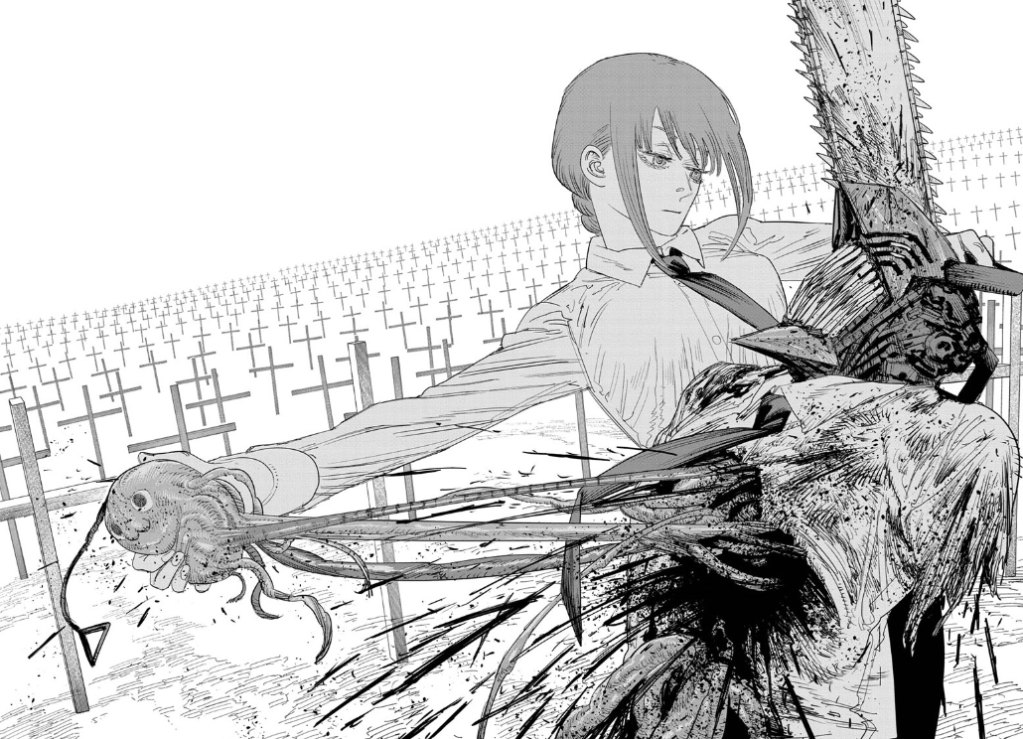
This is my favorite double spread in the series. Can you, my reader, tell me how Fujimoto’s intention and soul come through the page, without reducing it entirely to technical and symbolic terms?
Here’s one of my favorite double spreads from Jujutsu Kaisen.
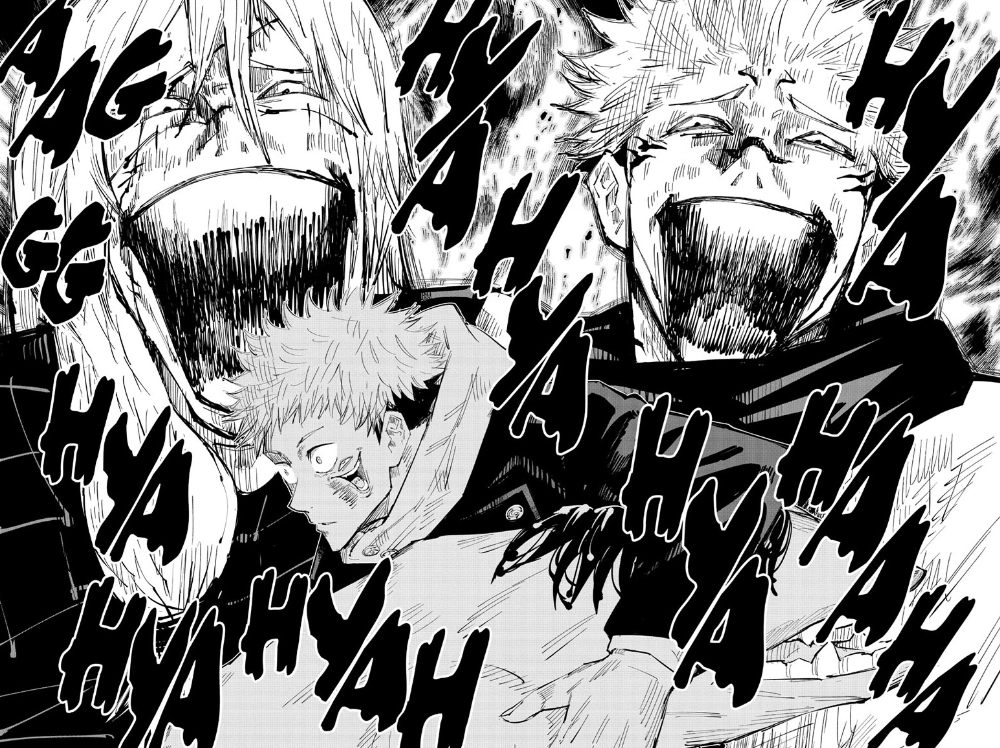
Is it possible for you to even break this spread into merely technical or symbolic terms? No, it isn’t. This is what it looks like when an artist pours their soul through their art, when technical skill is the weapon of the intent rather than the intent the lead performer of the technical arrangement. This is completely ensouled. This is brilliant. This is Art with a capital A.
Nothing Fujimoto has yet created is Art with a capital A.
This is, in a lot of ways, Chainsaw Man’s great strength. This symbolic construction means that raw meaning is moreso in the accumulated intuitions and experiences of its readers – it’s a true mirror-of-the-perceiver work of art, and I’m sure I even gave too much of myself away in some details of my analysis, as objective as I worked to be. Chainsaw Man gives you what you give it; but this also means it (outside of the main undercurrent with Yoru and the majestic ending) doesn’t invent any new concepts or push phenomenological ground, as the greatest Art does. It merely elucidates what we have and know, see but repress in our unconscious thoughts and feelings.
This idea cannot be communicated solely by description, so I’ll be using a cinematic example to explain my perspective on Chainsaw Man’s ultimate shallowness: Federico Fellini’s 8 1/2 (which, I will state, does not uncover profound reader repressions like Chainsaw Man does, so don’t take it too harshly.)
This film is the work of a director and a cinematographer both of whose technical skills are so immense that combined, the film looks, to this day, more modern than the majority of films now coming out – and it was released in 1963.
The tiniest photon in this film is placed precisely so that the film almost ceases to feel as a film and becomes much more like a raw rendition of reality, save for the color. It wouldn’t be pretentious to call it objectivity as a form – it’s that precise.
And that is the worst form to convey narrative through film you could ever find.
In the same way that 8 1/2 is built upon an extraordinary mastery of craft that distracts from subject-oriented creative vision, Chainsaw Man’s is arranged in such a matter that Fujimoto’s creative vision just… isn’t there at all for nearly its entire run. It’s jarring, because we do get glimpses. The page of Denji being cut up in Chapter one (the best illustration in Chainsaw Man, period, after the whole thing came and went), that brief moment during Makima’s rant where you could see the literal child’s face delivering the authoritarian tantrum – Fujimoto can reach this level of expression! We saw him do it! I believe he might very well do it more from now on, if he continues with art and gains a much stronger grip upon his work (which, I believe, is the direct implication of the ending – I’m very hopeful!)
But up until its ending, Chainsaw Man is a (pleasantly, meaningfully) childlike reflection of reality and humanity as we fundamentally understand it, not a push forward on anything unprecedented. A reclamation, truly.
And, in fact, this understanding is the master key to Fujimoto’s entire career until now: he’s been grappling with his inability to personally invest himself in his art, in his inability to secure what he wants, and to do things entirely as the expression of his own desire.
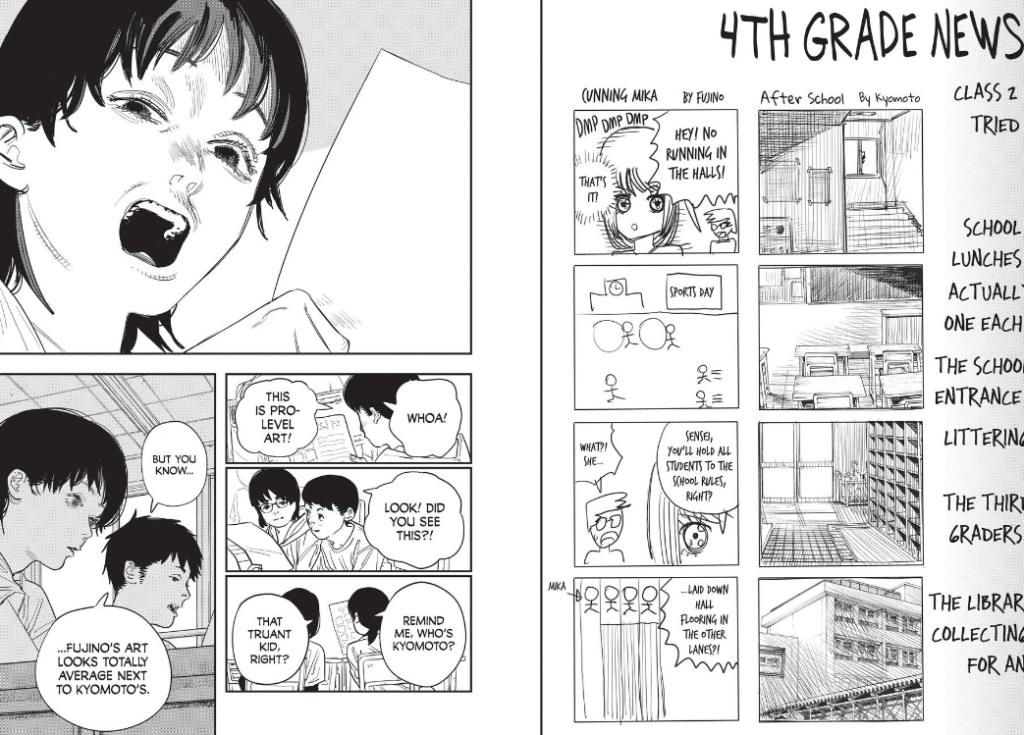
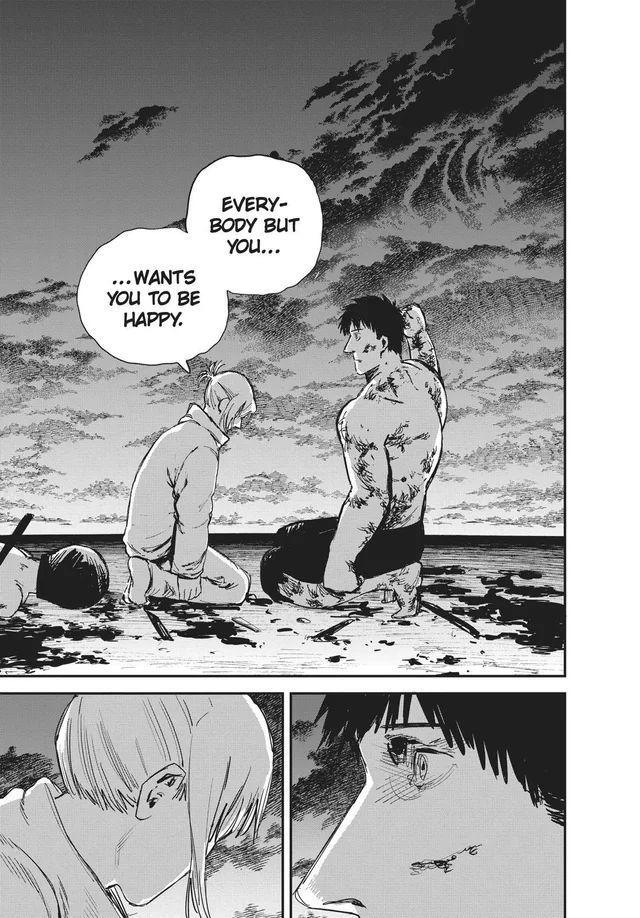
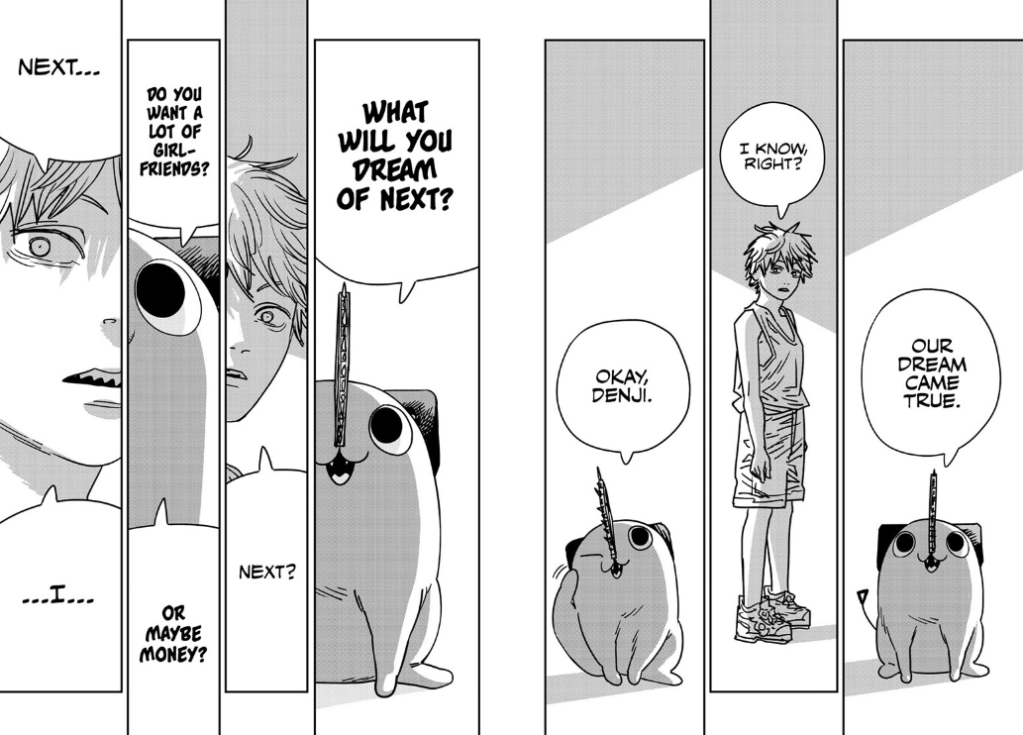
Fujimoto has been an observer, a competitor, a defender, an Apologist, an impressionist. He has not yet been a conceiver, a visionary, an attacker, a demander, an expressionist. He gets so objective with the analysis of desire as an observer that he loses that essential subjective drive that enables deep art and the pushing of reality into new forms.
And nothing shows this lack of personal intention and its very clear consequences better than the fact that so much of Chainsaw Man is just…
2. Hype Moments and Aura
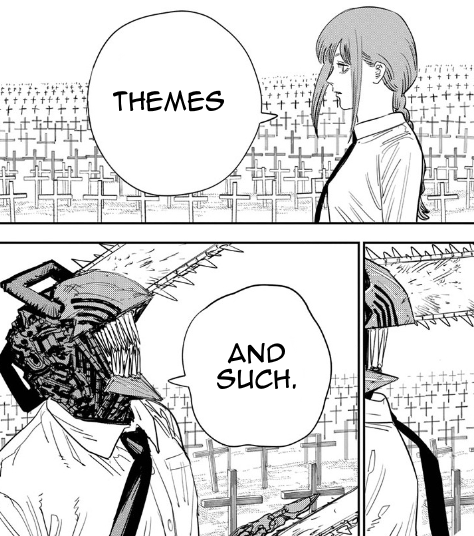
I’ve read Chainsaw Man three times now, and each time, between all the highly effective and beautiful scenes that give insight into what Fujimoto truly intends to convey, I’m brought down by the weight of massive stretches of chapters that are nothing but Hype Moments and Aura serving as connective tissue for the actual story. The fights, for one, are completely meaningless outside of Gun Fiend Aki, Yoru 1, and Yoru 2 – excluding those, you could throw the fights out and lose literally nothing.
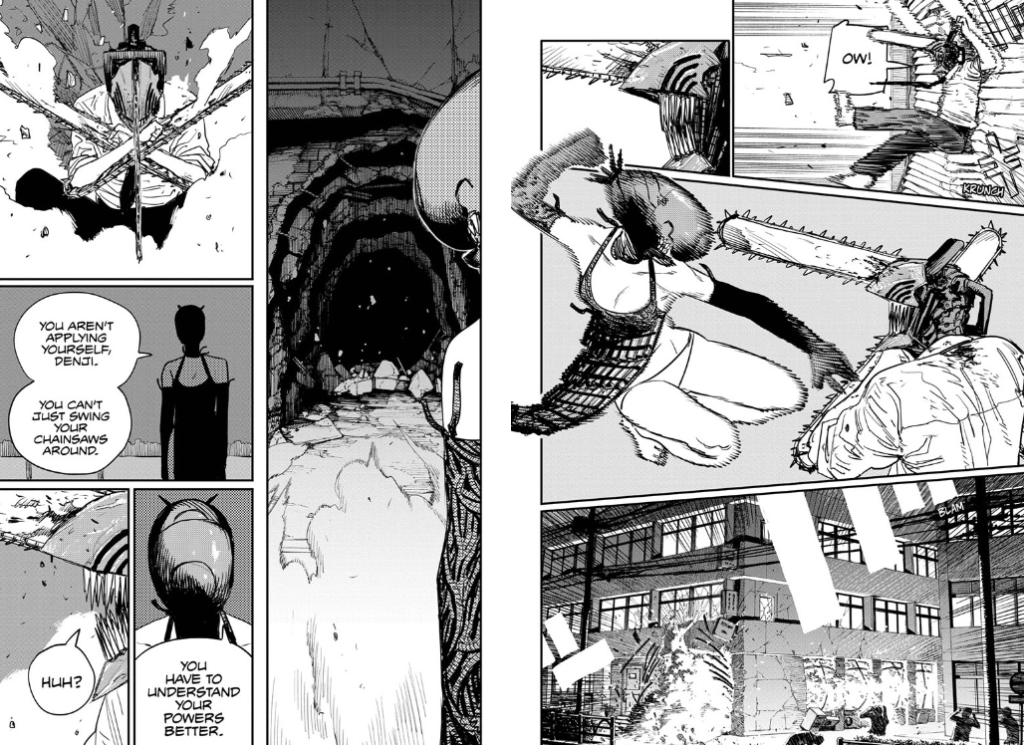
I love a good manga or anime fight despite potential overemphasis on literal action or solipsistic elucidation of strategies or rules that don’t mean anything on the basis of something through the fight being meaningful. The characters’ thematic cores being embodied in their expression, fighting style, and moves so that the trading-of-blows directly informs the narrative, as with a Morioh Gang vs Kira or a Luffy vs Kaido? THAT’S the good shit! And, on the furthest extreme, you’ll come to Jujutsu Kaisen, which uses it system so damn effectively that most of the rules and lectures actually function as the thematic statements, character insight, and as full-blown metaphysical tapestry showing the binding rules of this reality as it means something – whether with regard to cyclical trauma, or to the shallowness of public perception, or to whatever else Gege conveyed through the fine details of Cursed Energy as a worldly law. Chainsaw Man does not do this outside of the three fights I highlighted – with the snowball fight, with Yoru’s gaming-of-reality, with Pochita’s erasure being worked into a fight beside Aging. For the entire rest of the manga, it’s just fireworks, with the meaning on the other sides.
This doesn’t end with the big fight scenes.
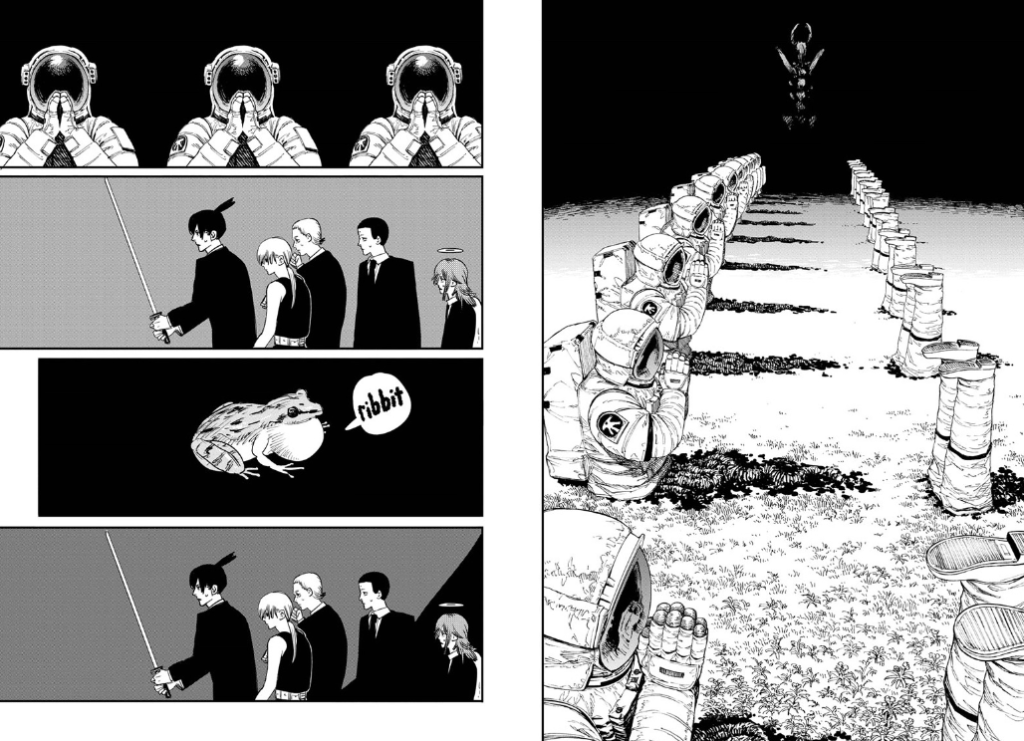
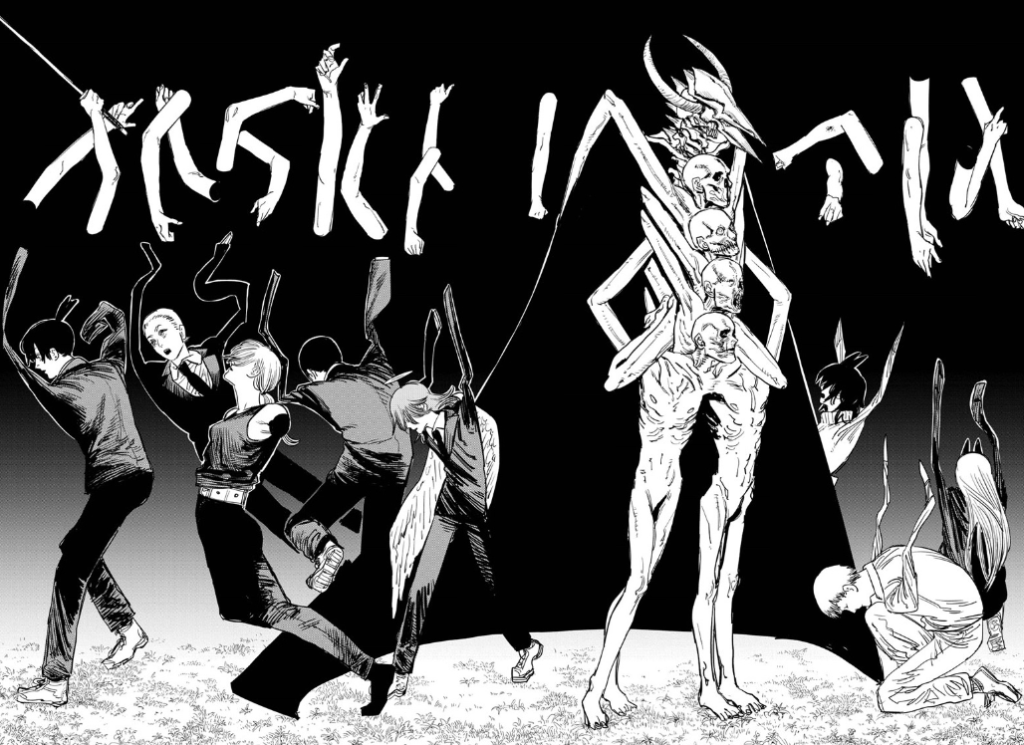
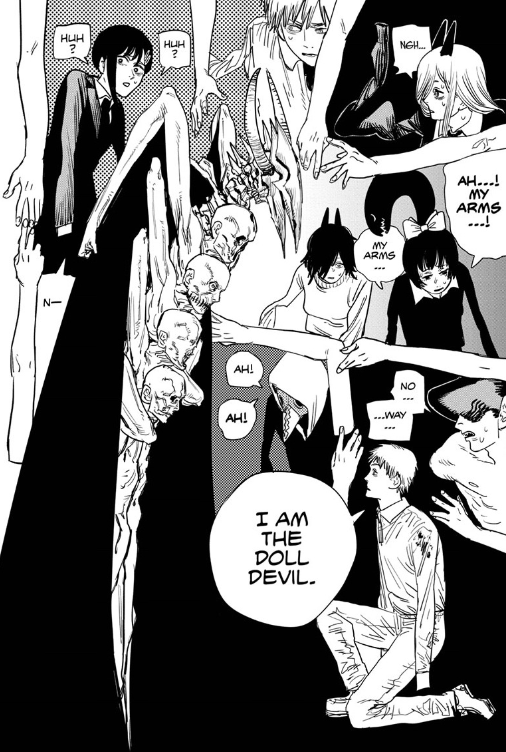
The International Assassins Arc is a good one to highlight in my strikes against Chainsaw Man, because it’s without a doubt the worst arc in the series while being among the most highly praised for its emotional intensity and bombardment of ideas, fleshed-out characters, and a tightly woven plot.
But intensity and immersion without purpose isn’t Art. It’s pornography.
A huge chunk of Chainsaw Man is pornography. And, weirdly enough, it’s not the stuff people decry as “gooner medias.” It’s most of the parts of the manga that the average reader remembers most fondly.
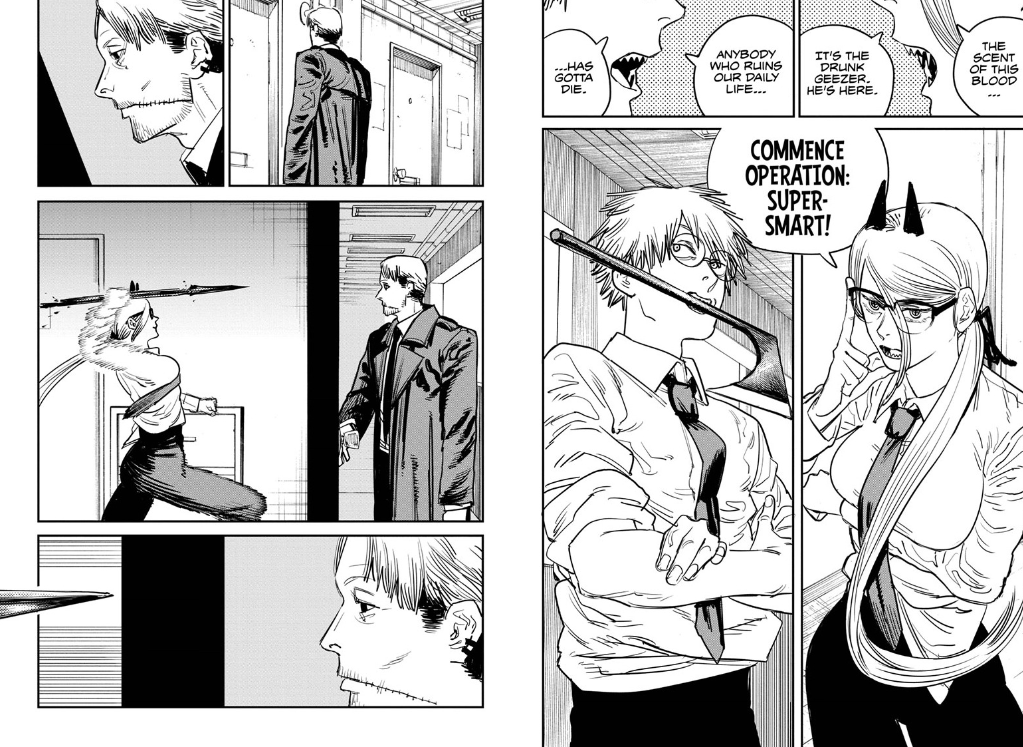
“Human connection” without a purposeful conclusion is self-glorification. Fujimoto often writes truly grand relationships and characterization, but ultimately, the only characters who truly inform much higher ideas throughout their entire execution are Aki, Makima, and Yoru. That’s it. Denji is tied with Yoru as the best character, but he had 232 chapters to do it with. Power is great by the end, but for the most part, her role as entertainment is her entire purpose leading up to the stuff that really matters. This is, of course, the other side of Fujimoto’s synthesis of deeply true human life stories – but it’s also, ultimately, a form of escapism. Large parts of Chainsaw Man fall under the wide, wide umbrella of art that’s life-affirming because the artist is, in-fact, working through their difficulties with affirming life. This is escapism. This is mere entertainment. This is a contradiction exactly as embodied by Pochita and his cyclical consumption.
A major issue with the popular usage of the term Hype Moments and Aura, funny and unserious as it really is, is that the more genuine issues people try to convey with it isn’t actually about mere spectacle rather than meaning. It’s about bombastic spectacle rather than humanistic spectacle, which is apparently good.
The reality is that there’s no non-aesthetic difference between action for the sake of it and deeper emotions for the sake of it. And, while Chainsaw Man has some fantastic through-lines as with its tackling of addiction, of our relation to images and fame, of the nature of empire’s evils on a spiritual level, it also does a whole lot that’s just there for the sake of stirring the heart and nothing else.
Chainsaw Man is not that much deeper than its contemporaries. It just puts more of its depth up-front.
Speaking of.
3. Lack of Respect for the Audience
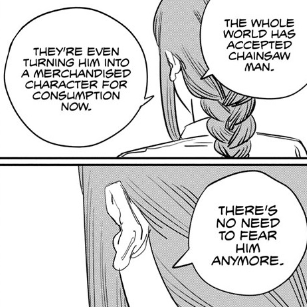
Too much is said out loud in Chainsaw Man.
Part Two makes massive steps in the right direction, but the better part of it and ALL of Part One is completely devoid of reader respect. Themes and character theses are stated directly through dialogue and monologue. The narrative, at times, gets so on-the-sleeve it comes across as insulting toward reader intelligence.
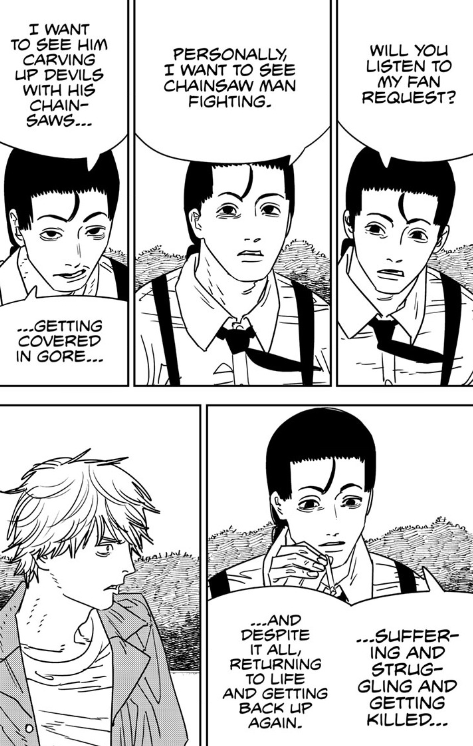
I love Barem for what he is, but in moments like this he ceases to be a character and becomes something out of a soyjak vs. chad image. This happens too often in Chainsaw Man – and that’s a consequence of its realism! This kind of dialogue and monologue is painfully, annoying real – but fiction as a direct reproduction of reality is extremely dangerous. Fiction is something to convey meaning and, optimally, should crystalize meaning through its very form. Chainsaw Man often reaches a point where it almost functions as a reality unto itself, and is far less of a work of art for it.
Being stuck on one note of critique is dangerous, because that which you point yourself to is that which you make the limit of your world. An author who speaks to the expressed beliefs of lower denominators is reducing themselves to that level of depth. Speak to fools, and you are a fool.
But this, like the previous two points, is amended more and more as Part Two, specifically, goes on. Chainsaw Man becomes subtle and artistic as it goes, however slowly and painfully.
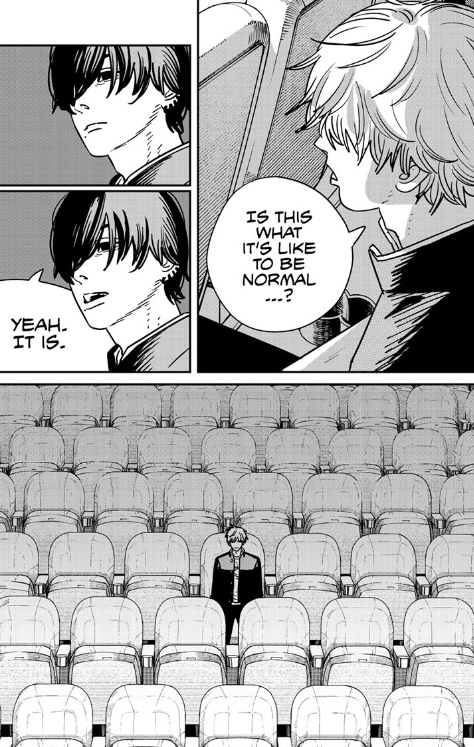
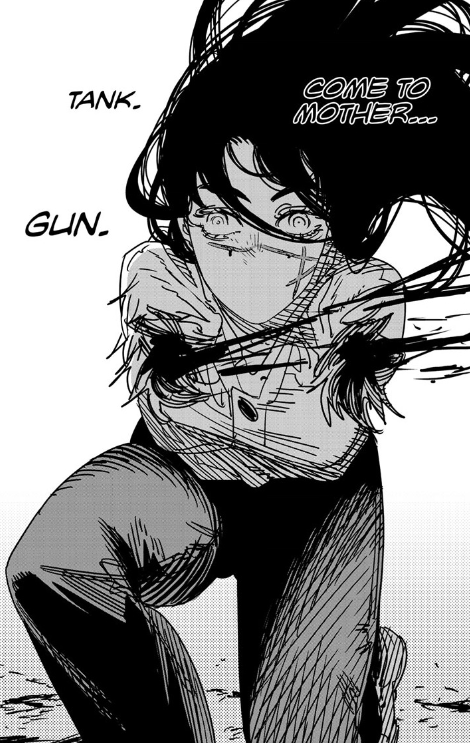
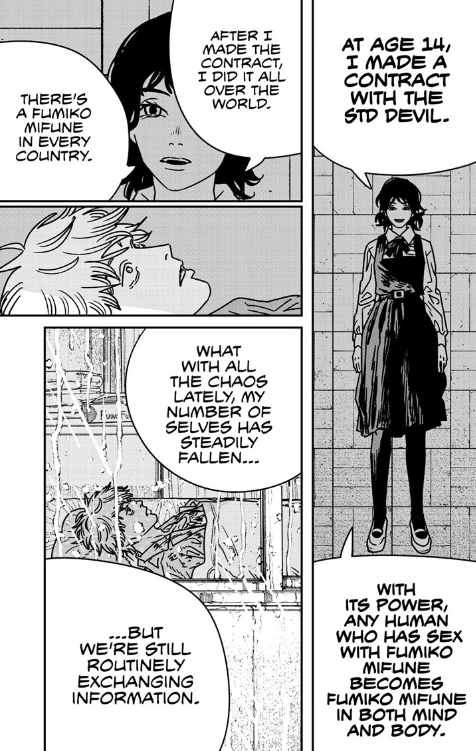
The foundations of Part Two are, without any question for me, much better than those of Part One. Part One is the kind of work that lives and dies with its popular appeal, and Part Two’s reduced popularity is thus a consequence of it. Surely, I love Part Two more than Part One overall, considering it breaks down all three of these major issues quite nicely?
Well…
4. The Weekly Grind and its Consequences
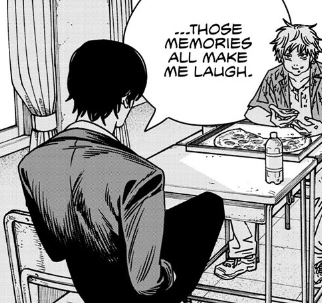
We’re moving past issues in author intent into issues with the final result that depend on author working conditions.
Part Two fucking collapses as it goes, not merely in its art but in its content, its focus, its dialogue – you name it.
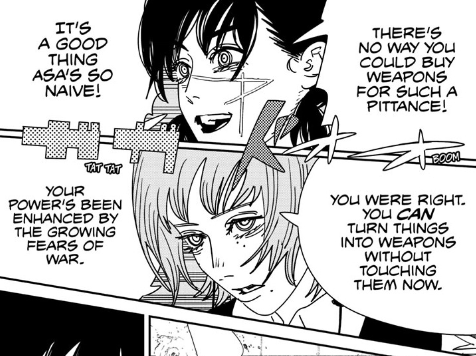
Its MCU dialogue.
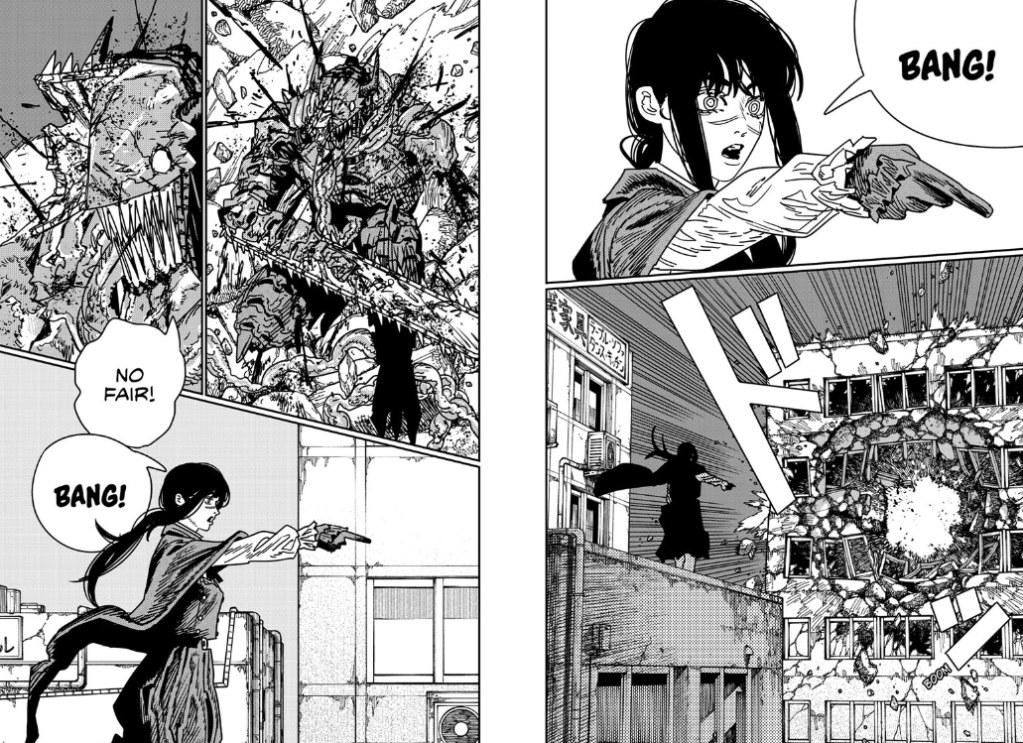
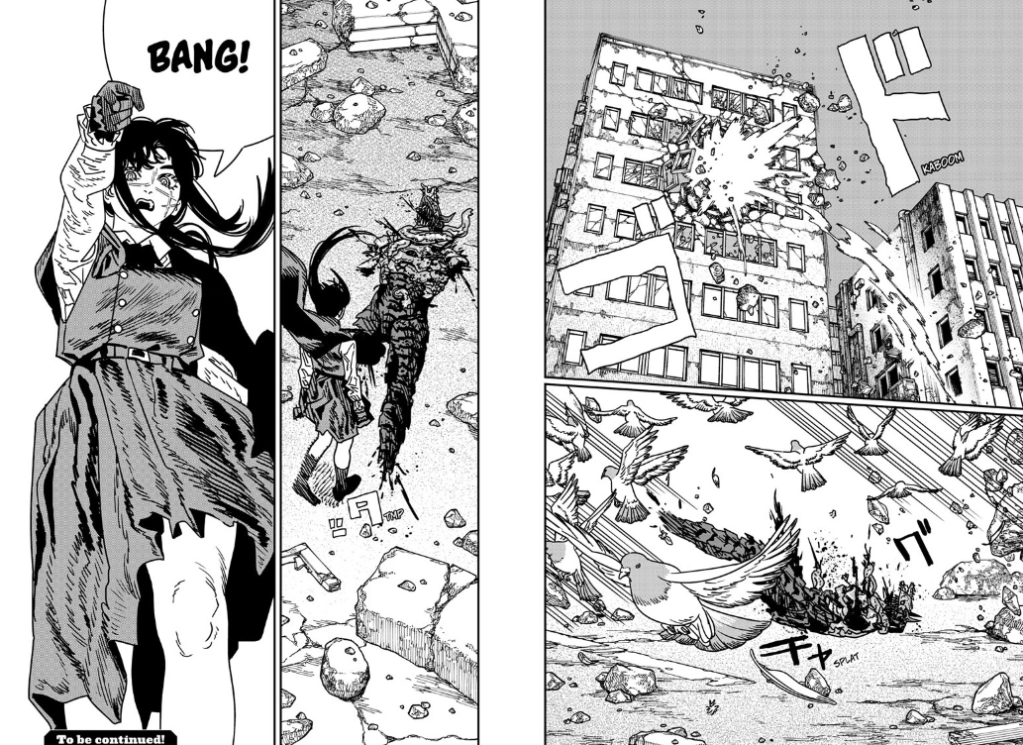
Its going-through-the-motions.
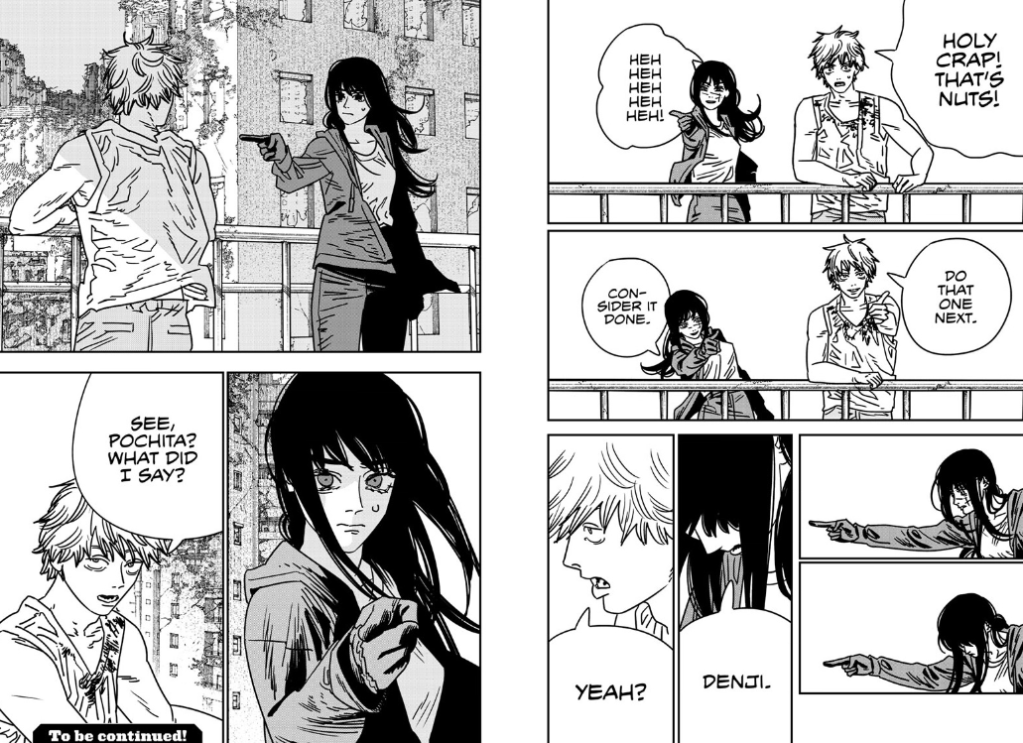
Its flanderization, loss of character and dialogue control, loss of narrative and tonal flow.
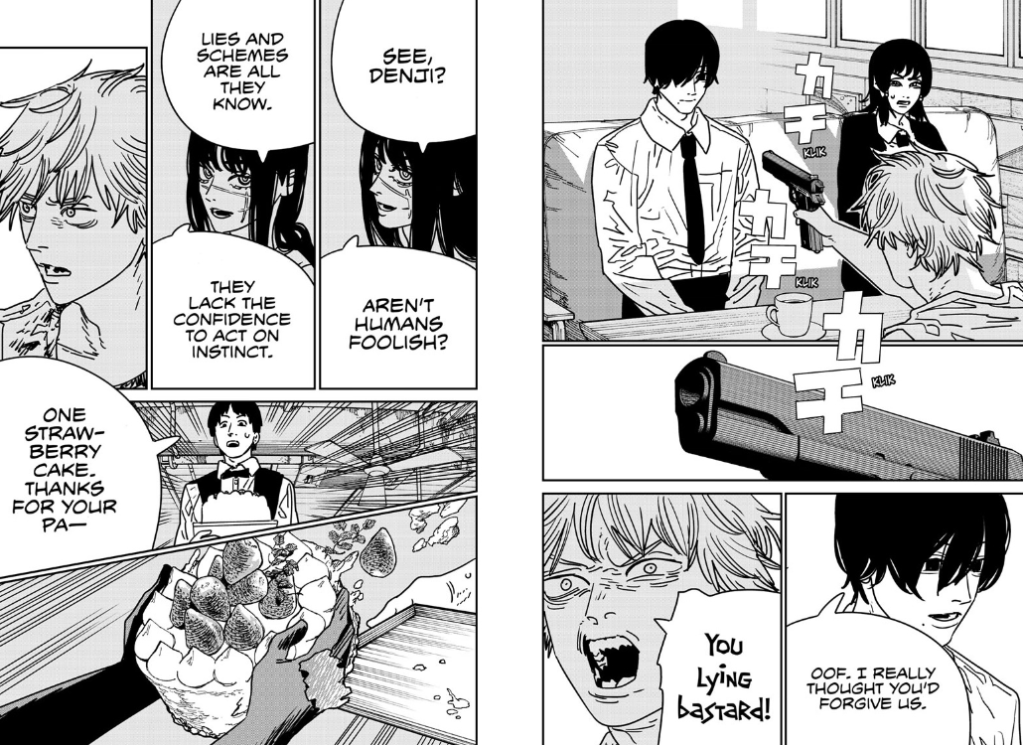
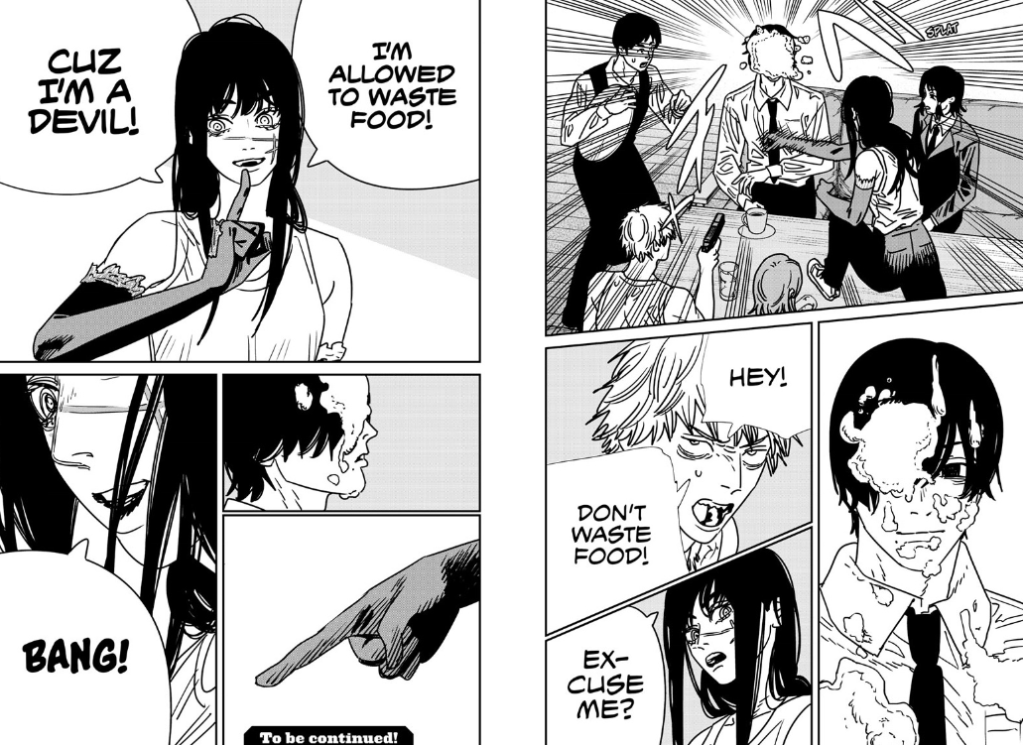
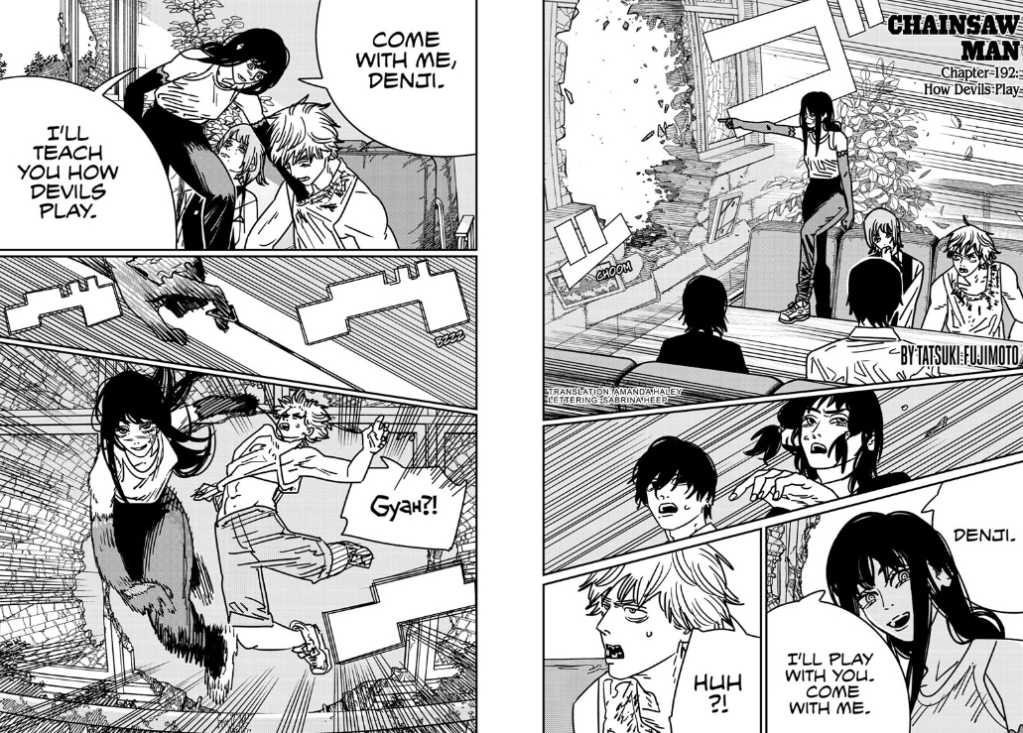
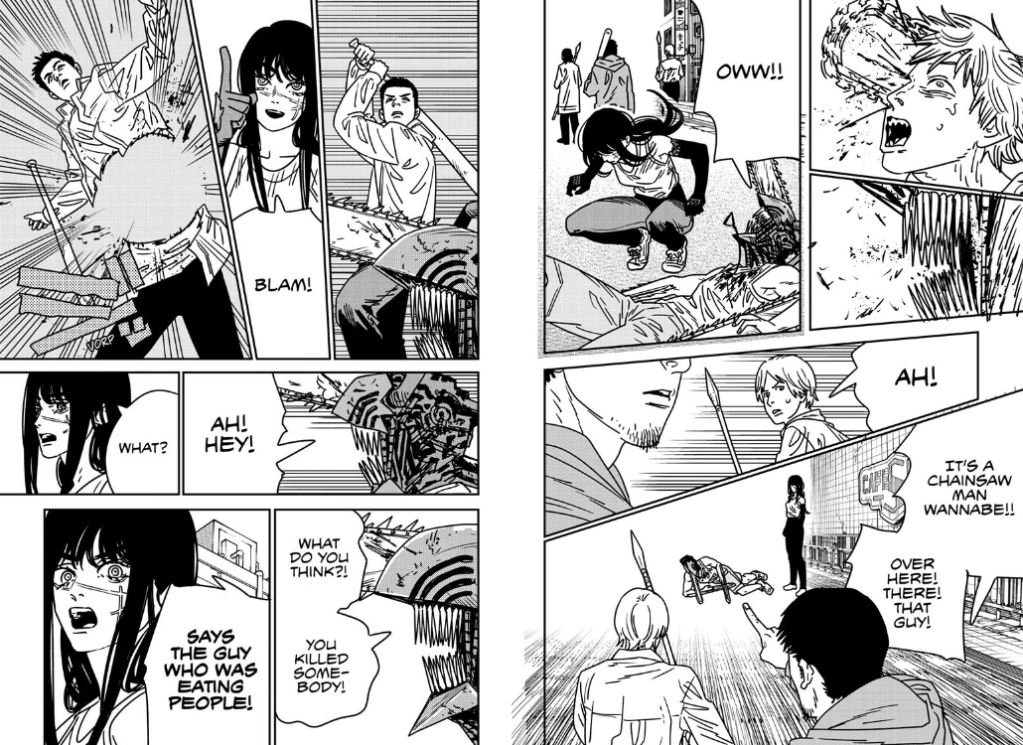
And the times where the manga completely collapses into soulless stream-of-consciousness nonsense.
This is the flaw that hurts me, because it’s a genuine loss of potential.
Part Two, with even just the quality of most of Part One (which, however, did also visibly start collapsing in the Control Devil Arc), would have been astounding. It would have blown Part One out of the water and been by far Fujimoto’s greatest work. The War Devil Arc, in particular, has literally everything that would have made it by far my favorite Chainsaw Man arc, a potential 10/10, a potential all-time great Shonen arc. None of this truly came to be, even with the terminal lucidity of the first half of Denji vs. Yoru 2 – and the ghost is clearly visible.
Most of Chainsaw Man‘s big flaws were truly being addressed in War Devil. It had everything going for it, and, because the grind was too much, we got a subpar execution for what was supposed to have been the peak of Fujimoto’s entire career paying off the 232 chapter run of his biggest work thus far.
It’s a tragedy.
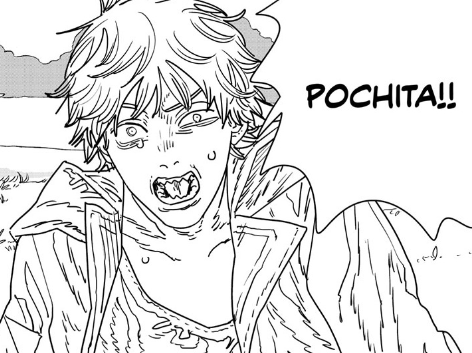
Closing
Holy shit, it’s done!
This review has been exhaustive and at this point, I have nothing of substance left to say.
I like Chainsaw Man. At times, I love Chainsaw Man. I think it’s horribly overrated and, at the exact same time, horribly underrated. With how controversial the ending was, I also had that to address – in fact, that was my main drive to write this. Overall, I’m pretty happy with how this thing turned out!
If you enjoyed this essay (and I worry for the sanity of someone who reads a 32,000 word essay they aren’t enjoying) and would like to see regular write-ups on popular culture, personal reads, and whatever else strikes my fancy, you can keep up with my Twitter at @renasvmmers and buy me a coffee at https://ko-fi.com/renasummersblog
Thank you for reading!
Here’s the Funny Fantano Numbers:

 renasummersblog
Leave a comment